What is AI TRiSM?
Artificial Intelligence Trust, Risk, and Security Management (AI TRiSM) is a framework introduced by Gartner. Its aim is to keep AI systems trustworthy, reliable, secure, and compliant. It monitors and enforces controls in AI systems while AI runs supporting operational governance instead of periodic oversight.
Gartner estimates that more than 80% of enterprises will have used generative AI APIs or deployed generative AI applications by 2026. Implementing AI TRiSM controls is essential, especially for organizations that use agentic AI or embed AI across their apps, SaaS platforms, and business workflows.
However, many organizations still manage AI risk through policies, employee training, and limited AI rollouts alone These measures can guide employees on how to use AI, but they don’t control what an AI system does while it is running. AI TRiSM adds technical controls that monitor AI behavior and enforce rules in real time.
The problem AI TRiSM solves: why fragmented governance fails
Before TRiSM, many organizations handled AI trust, AI risk, and AI security as separate silos. Teams used different tools, frameworks, and glossaries. The result was blind spots that audits never caught.
For example, an AI model could pass a fairness review and still leak customer data in production, or it could pass a security audit but violate a company policy. Shadow AI—unauthorized AI tools that teams use—stays invisible until a security incident happens.
Fragmented governance is a growing vulnerability According to Gartner’s research organizations with mature data governance see 52% fewer compliance incidents
The idea behind AI TRiSM is that trust, risk, and security are connected You can't verify fairness without monitoring the data that flows into AI models. AI TRiSM brings all 3 together into one operational loop that runs alongside your AI—from design and training through deployment and live operation.
Why Gartner considers AI TRiSM as strategic
According to Gartner, traditional governance based on policies and periodic audits, “establishes intent, but does not ensure AI systems behave as expected in real time.”
This gap has become more difficult to manage as generative AI and large language models (LLMs) spread across business applications. These systems can expand an organization’s attack surface, introduce risks such as prompt injection and sensitive data exposure, and give attackers new ways to manipulate AI-powered workflows.
Gartner’s experts argue that enterprises need technical controls that can enforce governance policies while AI systems are running. AI TRiSM is that foundation—the technical layer that makes governance work through areas such as model monitoring, data protection, access management, and security testing.
Governance requirements have also become more formal. The EU AI Act introduces legal obligations for certain AI systems, and NIST’s AI Risk Management Framework (RMF) outlines how enterprise AI should be governed. These new obligations are pushing companies to treat AI governance as an ongoing operational and security responsibility.
How the AI TRiSM framework works: 4 layers of governance
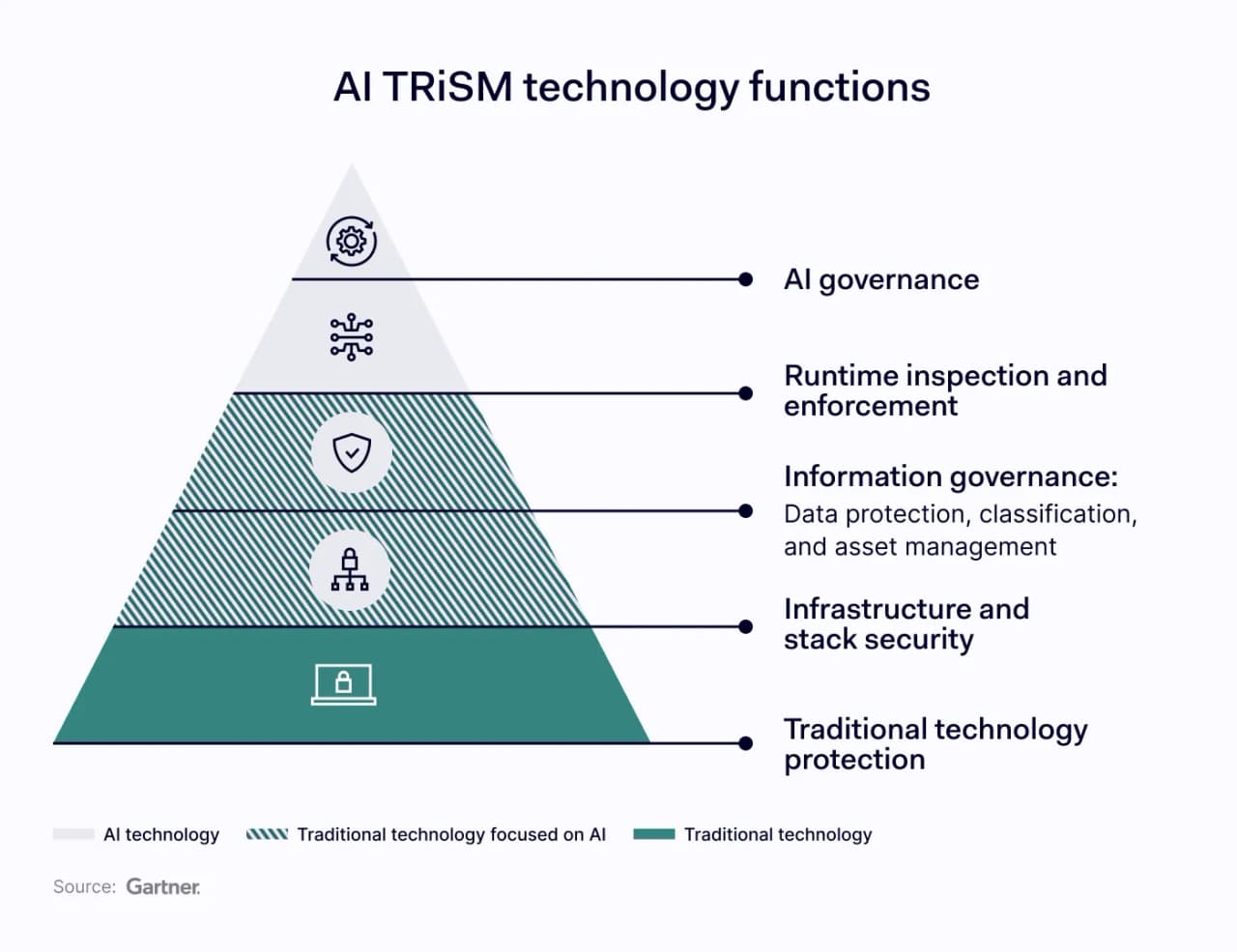
TRiSM organizes AI controls into 4 interconnected layers:
1. AI governance
This top layer provides overarching processes, standards, and guardrails that help keep AI systems and models safe and ethical.
AI governance starts with AI asset discovery and inventory. Organizations should create a centralized catalog of every AI asset, including embedded AI in SaaS tools, custom RAG implementations, and autonomous agents. This inventory should also cover shadow AI.
AI governance processes handle:
- Pre-deployment approvals for models
- Risk classification and validation
- Audit readiness
2. Runtime inspection and enforcement
This layer screens live AI interactions That covers inputs flowing into models, outputs coming out, and the actions agents are taking. The system checks all of it in real time against your governance policies.
If someone tries a prompt injection attack or if a model is about to leak sensitive data, the system can block the action, fix it automatically, or escalate to humans for immediate response.
3. Information governance
This layer is about controlling what data an AI system can ingest and produce Information governance includes:
- Classifying which data is sensitive
- Tracking where training data and fine-tuning data come from
- Controlling what data flows into prompts and retrieval-augmented generation (RAG) contexts
- Restricting what AI systems can learn during training and what they can reveal in their outputs
4. Infrastructure and stack security
The foundation layer covers the technical environment AI runs on: models, APIs, pipelines, cloud services, and endpoints.Controls here include secure model operations (ModelOps), defense against adversarial attacks, identity and access management for both human users and non-human agent identities, and ongoing evaluation of performance, reliability, and security both before and after AI deployment.
Why this matters now: the real risks
As more employees use AI tools and companies connect AI to sensitive data and business systems, AI security risks become harder to control.
Shadow AI
Employees tend to use AI tools without official IT approval, and it’s happening at scale. Research cited by Forbes found that 49% of workers use AI in ways their employers don’t approve of. Among those workers, 63% consider it acceptable to use AI without IT oversight when no approved option is available This makes shadow AI difficult for security teams to track.
Organizations may not even know which AI tools employees use, what company data they share with them, or how that data is handled. And this creates massive blind spots.
Data leakage
A single prompt that includes customer records, source code, credentials, or proprietary business logic can expose sensitive information through an unmanaged generative AI tool. Depending on what data is shared and how the service stores or uses it, this AI data leakage can lead to a security incident or a breach.
Data leaks in machine learning are harder to detect than traditional breaches. Standard security tools may have limited visibility into how information is processed, retained, or reused by AI systems.
Prompt injection and adversarial attacks
Prompt injection uses attacker-controlled instructions to make an AI model ignore or reinterpret its intended rules. It can happen directly through a prompt or indirectly through content the model reads, such as an email, document, webpage, or image.
The risk is higher when AI can access company files, tools, or code. Attackers may use prompt injection to expose sensitive data, change a model’s behavior, or interfere with automated workflows.
In adversarial attacks, threat actors make subtle changes to text, images, or files to manipulate AI systems and affect their behavior.
Compliance pressure
Organizations are now accountable for how their AI systems behave Regulations such as the EU AI Act are pushing organizations to document, explain, and provide evidence for AI-assisted decisions that affect employees, company partners, and business outcomes. Organizations need to show that AI systems are monitored and that people remain responsible for material decisions.
Agentic AI vulnerabilities
AI agents can act with little human oversight, which creates security threats, such as stolen credentials, misconfigured permissions, and vulnerable dependencies.
Other AI agent security risks are memory and data poisoning Because AI agents often keep the data between sessions to retain user preferences and knowledge, attackers may embed malicious or misleading information in that memory.
In data poisoning, threat actors corrupt the datasets used to train a model. As a result, the model may give inaccurate answers or biased decisions.
What you actually get: real benefits of AI TRiSM
AI TRiSM gives organizations a clearer way to manage AI as its use grows. It helps security, IT, and compliance teams see where AI is used, control risks as they appear, and keep records of how AI systems are managed.
- Risk control in real time Runtime controls can stop data leaks, injection attacks, and policy violations as they’re happening, instead of finding them during a later audit.
- Regulatory compliance Automated logs, audit trails, and evidence make it easier to meet requirements under frameworks and regulations such as the EU AI Act, NIST AI RMF, and GDPR.
- Increased trust Explainability reports, bias monitoring, and model cards can show stakeholders, customers, and regulators how an AI system works and whether it follows the defined rules.
- Lower business risk Better oversight can reduce the chance of AI-related incidents that expose data, break internal policies, or damage customer trust.
How to implement AI TRiSMHere are a few best practices for deploying AI TRiSM:
1. Define enforceable AI policies
Bring together your IT, security, compliance, and business teams, along with leadership, to collaborate on AI policies.
- Set clear AI goals based on business needs.
- Identify security gaps in current AI controls and governance.
- Define rules for acceptable AI use, data access, bias limits, approvals, and incident response.
2. Discover all AI assets
- Catalog every AI model, dataset, prompt template, RAG system, third-party AI app, and autonomous agent used across the organization.
- Record the business owner, data sources, intended use, and where each system runs.
- Find shadow AI, understand where AI is used, and identify areas with little or no oversight.
3. Set up information governance
- Classify all your data—what’s PII, what’s proprietary, and what’s regulated.
- Map what data flows into AI systems.
- Apply least-privilege access to both human users and agent identities: agents get only the data and actions they need, nothing more.
4. Implement runtime guardrails
- Deploy monitoring to inspect inputs and outputs while your AI systems run.
- Detect prompt injection attempts, jailbreaks, data leakage, and behavioral anomalies.
- Block dangerous inputs, redact sensitive outputs, and remediate low-risk violations.
5. Move toward continuous governance
- Set up continuous monitoring and regular AI risk reviews instead of relying only on periodic assessments.
- Track model performance, security issues, bias, and regulatory requirements. Use audit trails and feedback loops to connect detected problems with remediation.
- Keep AI governance up to date as models, regulations, and risks change.
The challenges of implementing AI TRiSM
Implementing AI TRiSM comes with a few challenges:
- Disconnected tools Governance, security, and data tools may not work well together, so teams often need custom integrations.
- Unclear ownership AI governance crosses legal, security, IT, and data teams, which can make responsibility unclear.
- Changing regulations AI regulations are still developing, and updating controls across every use case takes time.
- Agentic AI risks Autonomous agents can act across systems, making permissions, identity, and oversight harder to manage.
- Cost and maturity Many AI governance tools are still new, with changing pricing, features, and vendors.
Real-world examples: AI TRiSM use cases
- Healthcare AI TRiSM helps control how AI tools access and use patient data, and prevents sensitive health information from reaching unapproved AI models.
- Financial services With AI TRiSM, you can check lending models for demographic bias, for example.
- Shadow AI governance Discovering unauthorized AI tools across apps, cloud services, and devices via proxies and log analysis helps govern them.
- Agent oversight. Centralized inventory, prompt injection defense, parameter-level constraints, and real-time observability help you supervise your AI agents.
AI TRiSM and compliance
Beyond specific use cases, AI TRiSM also plays a key role in helping organizations meet regulatory obligations. AI TRiSM helps turn regulatory AI compliance requirements into controls that companies can apply and monitor in practice.
- EU AI Act. Supports risk classification, documentation, human oversight, and evidence collection.
- NIST AI RMF Provides monitoring, validation, and enforcement controls for the framework’s Govern, Map, Measure, and Manage functions.
- GDPR Helps control how personal data is used, stored, and accessed, with audit trails to support accountability.
- ISO/IEC 42001 Supports ongoing AI governance through policies, monitoring, reviews, and documented controls.
How is AI TRiSM different from responsible AI, AI governance, and AI security?
These terms get used interchangeably, but they’re not the same thing:
Concept | Focus |
|---|---|
Responsible AI | Fairness, transparency, and accountability |
AI governance | Policies, processes, and oversight |
AI security | Protecting AI from attacks and misuse |
AI TRiSM | Combining trust, risk management, security, and technical controls |
In short: responsible AI defines what good looks like AI governance defines who decides AI security defines what to defend—and AI TRiSM makes all three work in practice.