
Artificial intelligence (AI) systems help automate workflows, analyze customer data, and speed up software development. However, AI adoption also broadens the attack surface And employees who use unapproved public AI tools (shadow AI) or developers who paste proprietary source code into AI systems are only part of the problem.
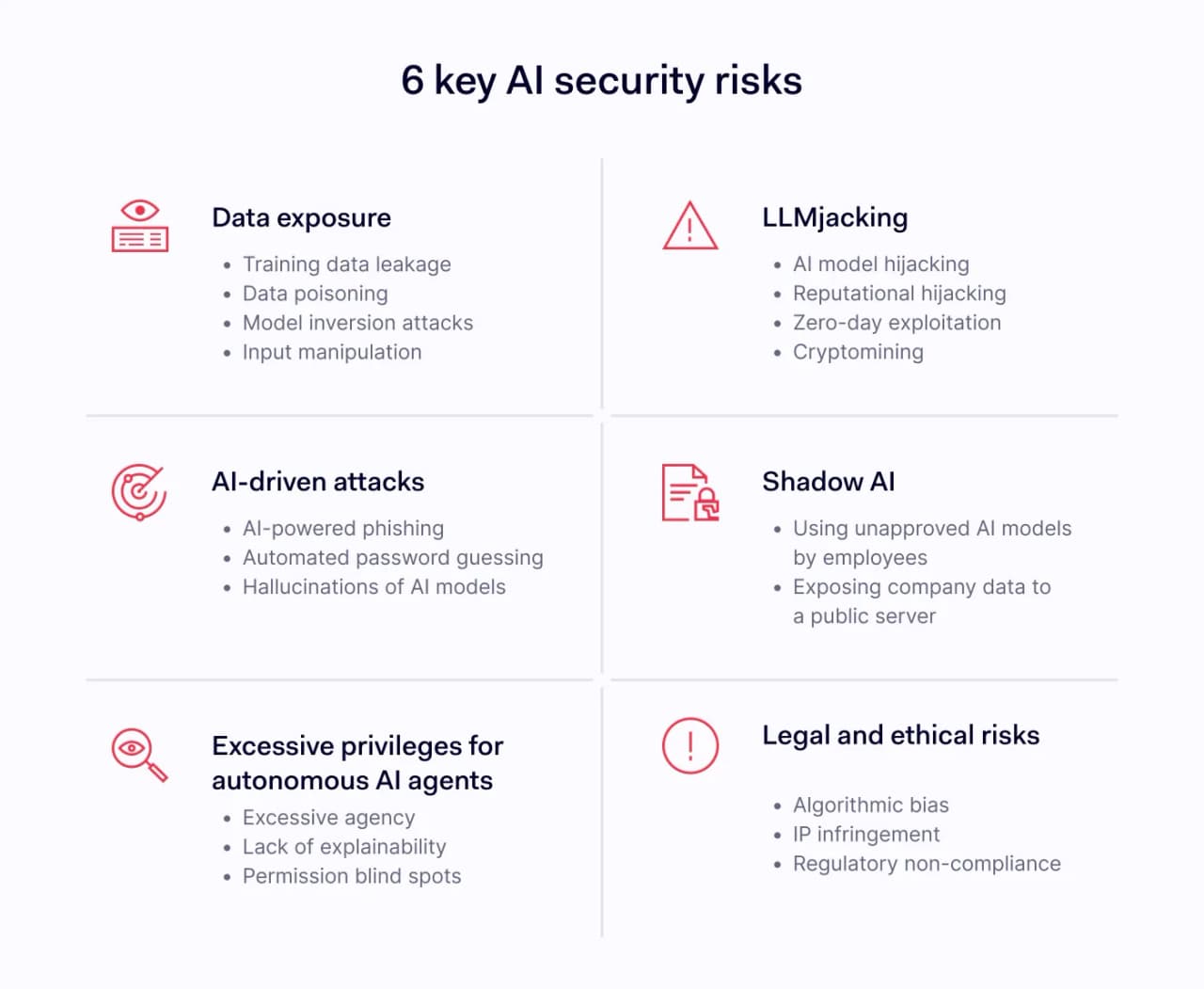
The most critical AI security risks include sensitive data exposure, input manipulation, and over-privileged agency, to name just a few. According to recent industry data, 13% of organizations have suffered a breach that involved their AI models, and 97% out of those incidents happened because the company lacked sufficient access controls
Let’s take a closer look at these key AI risks and how they operate.
1. Data exposure
AI models are trained on vast amounts of information. The thing is that they not only process data, but also store it, and there is always a risk that this data could resurface in the wrong context. By controlling what an AI learns, attackers can turn your helpful AI assistant into a security liability.
Here are the top AI risks related to data exposure:
- Training data leakage AI systems can unintentionally reveal sensitive data like personal customer records or proprietary source code, through their public answers.
- Prompt injection attacks Cybercriminals can create malicious instructions to trick an AI tool into ignoring its safety filters, which can lead to unauthorized system actions and data breaches.
- Data poisoning This involves the fine-tuning of training data in AI models with biased info to influence the models’ decision-making processes.
- Model inversion attacks Bad actors use mathematical algorithms to reconstruct personal information from supposedly anonymous datasets
- Input manipulation. This is the modern version of social engineering—instead of convincing a human, attackers use clever language to get the machine to do what they want.
2. LLMjacking
This is a hijacking attack where threat actors gain unauthorized access to your organization’s AI infrastructure But they don’t target data. Instead, they exploit the massive computing power—specifically GPUs and cloud resources—required to run large language models. The attackers then use these hijacked AI resources to carry out their malicious activities or mine cryptocurrency which degrades system performance and raises operational costs.
Once attackers infiltrate the infrastructure, they can exploit the hijacked environment in several damaging ways:
- Model hijacking Cybercriminals exploit compromised access to resources in AI models to generate unauthorized outputs. This allows them to perform AI-driven tasks at the expense of the victimized organization.
- Reputational hijacking This occurs when an attacker misuses an organization’s AI system to produce harmful or inappropriate content. Because the output originates from the company’s official infrastructure, the resulting loss of trust and reputational damage falls entirely on the organization.
- Zero-day exploitation Using the hijacked AI’s analytical capabilities, threat actors can automate the search for unknown vulnerabilities (zero days) within a network. AI is particularly effective here because it can identify anomalous patterns that traditional security tools might miss.
- Cryptomining This is a frequent form of AI resource exploitation where attackers deploy miners on a company’s AI hardware.
3. AI-driven attacks
Hackers use AI systems to automate their attacks and target the weakest link in any business—human behavior. They can do it with:
- AI-powered phishing AI enables attackers to create perfect emails, deepfake voice messages, realistic impersonation videos, and fake login pages that are almost impossible for employees to distinguish from the real thing.
- Automated password guessing With AI models, threat actors can analyze leaked databases to spot human-predictable patterns and run high-velocity attacks that are far more accurate than traditional brute force attacks
- Hallucinations of AI models These fake or inaccurate outputs contribute to misinformation, which can cause harm, as seen in election campaigns.
4. Shadow AI
The most dangerous AI tool is the one the IT department doesn’t know about. Shadow AI occurs when employees use unapproved AI models to get their work done faster. This means they are uploading company data to a public, third-party server.
- The risk Employees bypass official channels to paste proprietary code, financial files, or client info into public, consumer-grade AI tools.
- The impact This creates a security blind spot. According to IBM, 20% of organizations have already suffered a breach caused by unmanaged AI use.
5. Excessive privileges for autonomous AI agents
AI agents that have too much autonomy can execute harmful actions. Without human oversight and limited permissions, a single AI agent mistake can have serious consequences.
- Excessive agency Configuring an AI agent with the power to perform high-stakes actions, like database deletions, without a human “click” to confirm.
- Lack of explainability The black-box nature of AI makes it hard to see why a model made a harmful decision, which complicates any legal or ethical resolution.
- Permission blind spots One malicious prompt injection can cause an autonomous agent to leak data or alter account settings before anyone notices.
6. Legal and ethical risks
AI data security is now regulated by the EU AI Act. This means mismanaging data in an AI tool could result in the business facing a liability of millions of dollars. Organizations must closely monitor several critical areas to avoid these severe pitfalls:
- Algorithmic bias If the training data is biased, the outcomes will be too. This can lead to discriminatory results in recruitment or healthcare, creating massive ethical and legal issues.
- IP infringement There is still a lot of legal ambiguity surrounding ownership of AI-generated content and the accidental output of copyrighted material by models.
- Regulatory noncompliance Failure to meet the transparency requirements of laws like GDPR or the EU AI Act can lead to administrative fines of up to 7% of annual turnover.
The true cost of an AI-related data breach
Why does an AI breach hurt a business differently than a traditional hack? When a standard database is breached, you patch the software and restore a backup. But when an AI system is compromised, it creates a domino-like effect across your entire infrastructure, and what’s even worse, it threatens business compliance and customer loyalty.
First, there is the financial blow of resource theft In attacks like LLMjacking, for example, cybercriminals can drain expensive GPU power for their malicious tasks, causing your cloud computing bills to skyrocket overnight.
Second, you face system-wide operational downtime If your AI model is hit with data poisoning, you can’t simply reboot it. Your security team has to completely pull the model offline, clean millions of data points, and retrain the AI from scratch—a manual process that can take weeks and stall business productivity.
Finally, the loss of intellectual property and brand trust is often permanent. If a model inversion attack leaks proprietary source code or private client records into the public domain, that data is gone.
AI security best practices
What’s the best way to protect your business from these 6 key AI risks? Start by upgrading your traditional security setup. Build a practical strategy around these core best practices:
- Secure access with zero trust Many AI-related data breaches happen due to poor access controls. Implement multi-factor authentication (MFA) and enforce least-privilege access, which guarantees that employees and third parties only get access to the specific data they need for their roles.
- Validate your data To protect your models from prompt injection and data poisoning, check the data that enters your system. Put strict filters in place to catch malicious instructions before they reach the AI, and rigorously audit your training data to keep out corrupted or biased information.
- Run security audits Conduct regular security audits and penetration testing targeted at your AI infrastructure. Use automated tools to scan for system vulnerabilities, and manually try to trick your models into leaking data, so you can patch any loopholes early on.
- Treat cybersecurity as your priority Adopt a secure-by-design approach by looping your IT and security teams into any new AI project from the very beginning. Create a clear company policy on which public AI tools are allowed to help eliminate the risk of shadow AI.
Why AI security matters
AI models bring automation and productivity. But they also introduce risks that traditional security solutions weren’t designed to handle. Protecting your business requires proactive threat detection and a zero-trust approach—combining strict data governance employee training, and specialized network security to ensure your AI system is an asset rather than a liability.