AI data leakage happens when private, sensitive, or business information is accidentally exposed through an AI tool The data bleeds out when employees paste sensitive company data into an external AI model or when an AI system accidentally reveals memorized data from its training datasets in its public answers.
AI data leakage vs. data breach
The main difference comes down to intent and execution:
- AI data leakage (accidental) This occurs without any malicious intent. For example, a team member pastes a confidential client contract or private company code into an unsecured AI tool to get a quick summary, unintentionally sharing that data with an external provider.
- Data breach (malicious) This is a deliberate attack. A threat actor finds a loophole, breaks through your security defenses, and steals sensitive information from your databases.
What causes AI data leakage
Data leaks in machine learning are difficult to catch because they don’t behave like traditional data breaches. Standard security tools were not designed to monitor how information flows and changes inside an AI’s learning memory.
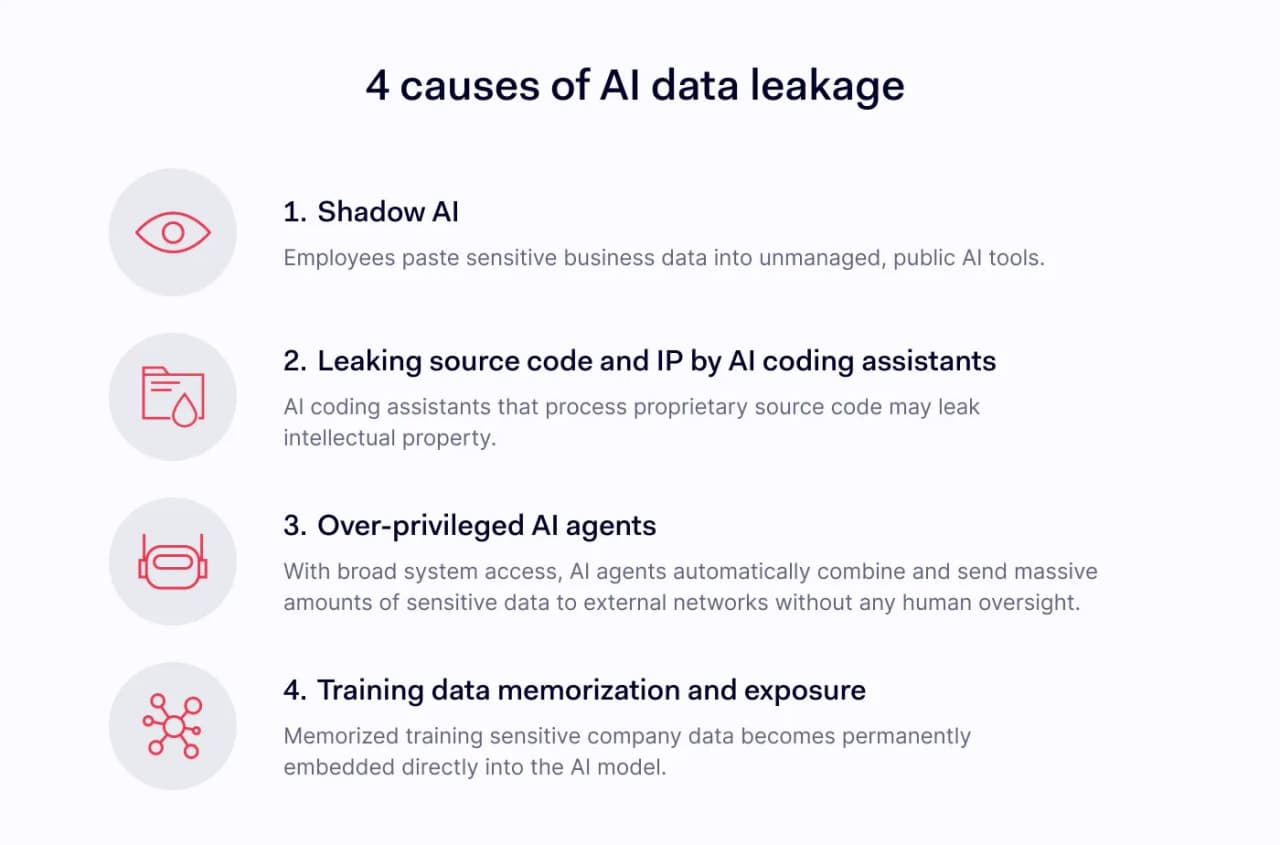
In everyday business, AI data leaks are usually triggered by 4 main causes:
1. Shadow AI
Employees are now under pressure to work faster and be more productive. This often makes them use AI tools without IT or security oversight (known as shadow IT). Pasting sensitive data into these unmanaged models creates blind spots Whether it is an HR manager summarizing a candidate’s professional experience or an executive drafting a strategy based on sensitive company documents, this data goes straight into external server logs.
According to IBM 1 in 5 organizations (20%) has already suffered a data breach caused specifically by a shadow AI security incident.
2. Leaking source code and IP by AI coding assistants
AI coding assistants process proprietary source code by design. Because they often have broad access to entire code repositories, they may leak intellectual property.
Every time a developer uses an AI assistant to debug, rewrite, or review code, they are sending proprietary company logic and trade secrets to an external server Also, cloud-based AI tools can write and suggest code that completely bypasses a company’s internal security scanners.
3. Over-privileged AI agents
More companies are connecting AI agents to their internal systems via APIs These automated tools can search databases, read internal files, and communicate with external web services using the Model Context Protocol (MCP)—often with broader access than human employees have This allows a large amount of sensitive data, such as passwords, source code, financial charts, and private client details, to be combined and sent to an external network in a single step at machine speed, with no human checking it.
4. Training data memorization and exposure
AI systems memorize a great amount of the data used to train or fine-tune them. For example, when a company fine-tunes an AI model using its corporate data, such as customer records, proprietary source code, financial details, or internal strategy documents, that information becomes permanently embedded in the model
Once the training data is woven into the AI’s memory, it creates a permanent leak vector that can be used in extraction attacks where cybercriminals manipulate prompts to force the model to reveal its hidden training data.
5 types of AI data leakage
Data leaks can strike at any phase of the AI lifecycle. Here are the 5 main types of AI data leakage:
- Training data leakage This occurs when a model memorizes sensitive data from its initial training set. Under specific prompt conditions, the model may unintentionally “recite” that data, such as personal customer details, proprietary algorithms, or the code used to build them.
- Deployment-phase leakage Faulty infrastructure surrounding the AI, such as improper encryption in transit or unsecured storage, allows live conversations to be intercepted while the system is running.
- Data pipeline leakage Unsecured APIs or preprocessing stages that move data from your corporate database to the model allow raw input data to be intercepted during data collection.
- Inference leakage Attackers use carefully crafted queries (extraction attacks) to reverse-engineer sensitive details from the model’s logic or determine if specific information was part of the training set.
- Model leakage This involves the theft of the model itself—its internal structure, weights, or parameters. For an enterprise, this is the ultimate intellectual property risk.
What are the real costs of AI data leakage?
Organizations that ignore AI data security may be affected in these 3 areas:
1. How much does AI data leakage cost?
The average cost of a business data breach is $4.44 million However, for companies where employees use shadow AI, breaches cost an additional $670,000 making it one of the 3 costliest factors of a breach.
What kind of data is usually compromised? AI-related breaches compromise customer Personally Identifiable Information (PII) at a much higher rate than “normal” attacks (65% vs. 53%) and regularly result in the theft of proprietary intellectual property (40%).
A lack of an AI governance policy is the cause of 63% of breaches Of the few companies that do have AI guidelines in place, only 34% actually audit their AI systems.
2. Regulatory penalties
Apart from the EU AI Act not all privacy regulations contain AI-specific provisions For example, the California Consumer Privacy Act (CCPA) authorizes the California Privacy Protection Agency (CPPA) to oversee the use of personal data in AI systems.
However, the Health Insurance Portability and Accountability Act (HIPAA) and the General Data Protection Regulation (GDPR) only specify how data should be handled and don’t distinguish between a “normal” breach and an AI breach
Regulation | Penalties for AI data breaches or misuse |
|---|---|
The EU AI Act | Up to €35 million or 7% of a company’s global annual turnover for prohibited AI practices. |
DORA (for financial institutions) | Up to 2% of an organization’s global revenue plus €1 million in personal liability for senior leadership. |
HIPAA | $100–$50,00 for an unknowing violation (civil charges) and up to $1.5 million for a repeat violation |
GDPR | Tier 1 Up to €10 million or 2% of a company’s global annual revenue for administrative failures. Tier 2 Up to €20 million or 4% of a company’s global annual revenue for fundamental breaches. |
CCPA | From $2,500 for an unintentional violation and up to $7,500 for an intentional violation |
3. Reputation and brand damage
AI data leaks destroy customer trust much faster than traditional breaches. Because 60% of consumers believe a company is entirely responsible for protecting their data, a single AI security incident can make customers abandon a brand immediately
If an outsider manipulates a customer-facing chatbot via prompt injection they can trick the AI tool to display offensive, illegal, or completely inaccurate text. Once a screenshot of a rogue corporate chatbot goes viral, the damage to your reputation is done.
On the flip side, robust AI data governance can give your business an advantage, as 75% of consumers are willing to pay premium prices to buy from businesses with safe AI data practices.
Best practices for preventing AI data leaks
Start with a layered approach, and we don’t mean just writing a set of rules. You also need technical tools to see, block, and audit how data in an AI system moves.
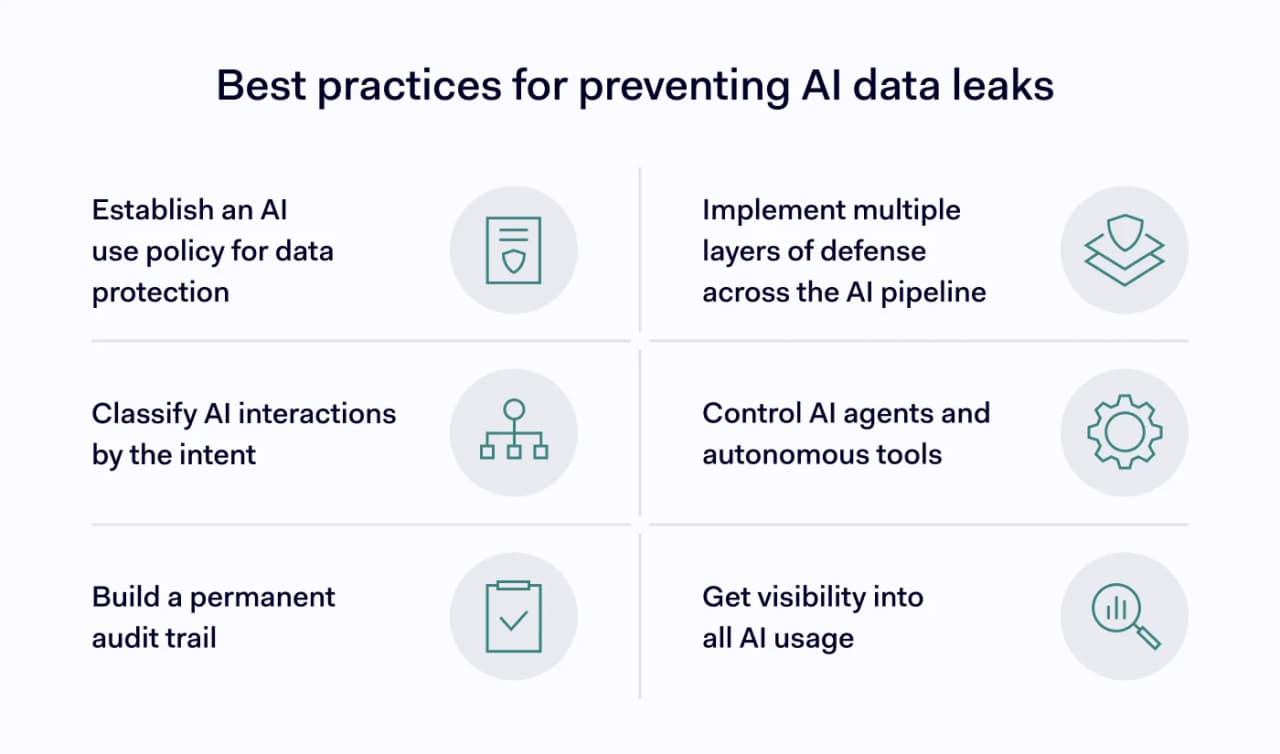
1. Establish an AI use policy for data protection
This policy defines which AI tools are safe to use, which are banned, and what kinds of data are allowed in prompts It ensures that your organization’s AI adoption is secure, ethical, and legally compliant.
Some government bodies are tightening their grip on corporate AI use. With the increasing regulatory focus—such as the strict guidelines issued by the White House and state-level mandates, like those in New York—organizations are now legally required to promote transparency, accountability, and risk awareness for every AI tool they deploy.
2. Implement multiple layers of defense across the AI pipeline
Use a layered strategy to protect your sensitive data from the moment it enters your network until the AI provides an answer.
- Identification and classification Automatically detect and tag different types of sensitive data, such as PII or PHI, financial information, passwords, and proprietary code, as soon as it appears.
- Data minimization The best way to prevent an AI leak is to ensure your platforms never ingest that sensitive data in the first place.
- Sanitization Clean and strip data of its most sensitive parts while still keeping enough of the context intact for the AI to process the request and do its job effectively.
- Redaction and tokenization Mask, hide, or tokenize private information inside all user outputs, system logs, and background storage databases so it can never be read by unauthorized eyes.
- Access control Enforce granular permissions that follow your data through the entire AI lifecycle, from initial retrieval and model processing to final storage.
3. Classify AI interactions by intent
Traditional security tools look for specific keywords or text patterns to detect vulnerabilities. However, AI conversations are full of context. The exact same phrase might be completely safe in one situation but a security violation in another.
What is the solution? Use intent-based classification Instead of just scanning for static words, smart security models look at the context and what the user is trying to accomplish. Here is an example showing how intent-based classification protects a company’s software code:
- Scenario A (safe intent) A junior software developer uploads a standard, open-source code block to an AI tool and asks, “Can you find the bug in this function and explain why it is failing?”
- Scenario B (risky intent) A contractor copies a proprietary encryption algorithm used for the company’s banking app and asks an external, public AI, “Can you rewrite this code to make it run faster?”
4. Control AI agents and autonomous tools
Autonomous AI agents can search databases, call APIs, and complete multi-step tasks all on their own. Because they run independently without a human checking their work, they need strict boundaries.
Treat AI agents as you would a highly privileged human user with the same strict rules This means denying them permanent access and requiring human approval for high-risk actions.
Agent security requires 2 vital stopguards:
- Pre-execution protection Inspecting the prompt and checking what the agent intends to do before it takes action.
- Response protection Checking what the agent created or altered before the changes are saved or delivered.
5. Build a permanent audit trail
To prove your company complies with regulations like the EU AI Act, you need a detailed history of your AI interactions.
Legacy security logs only show that an employee visited an AI website—they don’t show what was typed or what the AI said back. For auditing, you will need to capture the entire two-way conversation An immutable audit trail preserves the exact prompts and answers of both human employees and autonomous AI agents, giving you the proof you need for regular legal audits.
6. Get visibility into all AI usage
Closing the security gap across browsers, native applications, and autonomous agents is essential to protecting sensitive data from leaks.
It works through 3 simple stages:
- Observability Automatically discovers and tracks every AI app, chatbot, and system connection being used across your company.
- Control Uses smart machine learning to enforce company rules, while keeping clear audit logs of who is doing what.
- Protection Stops data leakage in real time by hiding sensitive data before it leaves your network and checking answers before they reach the user.
Bottom line
AI data leakage is a complex threat that traditional security tools simply can’t catch. Whether caused by employee habits, over-privileged agents, or vulnerabilities in training data memory, the regulatory costs of leaving your AI pipeline unprotected can be huge. Securing your AI workflows operations requires implementing automated visibility, real-time tokenization, and strict, intent-based data classification.