
AI compliance is the set of policies, controls, tests, records, and oversight practices which show that an organization uses its AI systems in line with laws, standards, contracts, privacy rules, and internal responsible-AI requirements.
The pressure to get this right has grown fast. McKinsey’s 2025 Global Survey on AI found that 88% of respondents said their organizations regularly use AI in at least one business function, up from 78% a year earlier. At the same time, the EU AI Act introduced fines of up to €35 million or 7% of worldwide annual turnover for prohibited AI practices, and the US Federal Trade Commission has taken enforcement action against companies for deceptive AI claims under “Operation AI Comply.” For most organizations, AI compliance has shifted from an optional topic to a board-level concern.
Understanding AI compliance
AI compliance is the operating model an organization uses to prove that each AI system meets external rules and internal standards across its full lifecycle. It covers the use case, data, model, prompts, outputs, vendors, users, oversight, incident response, and records. It applies whether the organization builds AI models, integrates them through APIs, or uses third-party AI tools.
AI compliance vs. AI governance
The two terms are related but distinct.
- AI governance defines structure: who owns AI risk, who approves new use cases, who reviews vendors, who handles incidents, and what employees may or may not do with AI tools. It sets the rules.
- AI compliance proves that those rules, plus external regulatory requirements, are actually followed through documented controls, test results, audit logs, and reviews (provides the evidence).
Responsible AI works alongside both. It is the set of principles, such as fairness, transparency, and accountability, that shape what governance decides and what regulatory compliance must demonstrate.
What AI compliance covers
A useful way to think about scope is to look at the AI system not only the model. The OECD defines an AI system as a machine-based system that infers from inputs how to produce outputs such as predictions, content, recommendations, or decisions. That means compliance must cover:
- The business use case and its potential impact on people
- The data used to train, fine-tune, and run the system
- The model and any third-party APIs behind it
- Prompts, retrieval sources, and tool integrations
- Outputs and how humans review or act on them
- Vendors, subprocessors, and the wider supply chain
- Users, access rights, and logs
- Incident response and post-deployment oversight
Why AI compliance is harder than traditional IT compliance
Standard IT compliance frameworks were built for systems with predictable behavior. AI systems behave differently in three ways.
First, the same input can produce different outputs, especially with generative AI Second, model behavior can drift as data and usage change. Third, much of the risk is in data and prompts rather than code.
Controls such as change management and access control still matter, but they are not enough on their own.
Why AI compliance matters
There are 5 main reasons:
- Regulation is now enforceable. The EU AI Act entered into force in 2024, with prohibited practices and AI literacy duties applying from 2 February 2025, general-purpose AI obligations from 2 August 2025, and most remaining rules from 2 August 2026. As of June 2026, an Omnibus political agreement would shift certain high-risk enforcement dates to 2 December 2027 and 2 August 2028, pending formal adoption.
- Penalties are material. Under the EU AI Act, fines reach €35 million or 7% of global turnover for banned practices and €15 million or 3% for other breaches. Data protection authorities can add separate GDPR fines
- Customers ask for proof. Procurement teams now request AI security questionnaires, model cards, data sheets, and ISO/IEC 42001 evidence before they sign contracts.
- Generative AI added new risk classes. Prompt injection data leakage, hallucinations, and unsafe agent actions do not appear in older IT risk registers.
- Shadow AI is widespread. Mandiant and Google Cloud have flagged shadow AI and weak AI asset visibility as common gaps, with employees using unapproved tools and uploading sensitive data into them.
AI regulations and standards for business
Some AI regulations and standards are binding laws, others are voluntary frameworks, and several are sector-specific.
1. EU AI Act
The EU AI Act is the main horizontal AI law. It applies to providers and deployers inside and outside the EU when AI systems are placed on the EU market or used in the EU.
The Act takes a risk-based approach with four tiers:
- unacceptable risk (banned),
- high risk (heavy duties),
- limited risk (transparency duties),
- minimal risk.
Article 5 bans practices such as harmful manipulation, exploitation of vulnerabilities, certain social scoring, untargeted scraping for facial recognition databases, and emotion recognition in workplaces and education, with narrow exceptions.
High-risk AI systems must meet detailed regulatory requirements covering risk management, data quality, technical documentation, logging, human oversight, accuracy, and cybersecurity.
2. NIST AI Risk Management Framework
The US National Institute of Standards and Technology publishes the AI RMF a voluntary, cross-sector framework built around four functions: govern, map, measure, and manage.
The NIST Generative AI Profile extends the framework to GenAI-specific risks such as confabulation, data leakage, and content provenance. NIST AI RMF is widely used as the backbone of internal AI governance frameworks in the United States and beyond.
3. ISO/IEC 42001
ISO/IEC 42001:2023 specifies requirements for an AI management system. It mirrors the structure of ISO 27001 and covers leadership, planning, support, operation, performance evaluation, and improvement.
Certification provides external assurance that an organization runs a structured AI management program. For many vendors, it has become the equivalent of SOC 2 for AI.
4. OECD AI Principles and UNESCO Recommendation
The OECD AI Principles, adopted in 2019 and updated in 2024, define an AI system and set five values:
- inclusive growth,
- human rights and democratic values,
- transparency and explainability,
- robustness and safety,
- accountability.
The UNESCO Recommendation on the Ethics of Artificial Intelligence covers human rights, fairness, human oversight, data governance and environmental impact. Both are useful reference points for global programs.
5. UK AI regulation principles
The UK uses a principles-based, regulator-led approach rather than a single AI law. The five cross-sector principles are safety, security, and robustness; appropriate transparency and explainability; fairness; accountability and governance; and contestability and redress. Sector regulators such as the ICO, FCA, and Ofcom apply these principles within their remits.
6. GDPR, UK GDPR, and related privacy laws
Data privacy rules apply whenever AI systems process personal data. The UK ICO's guidance on AI and data protection covers accountability, lawfulness, fairness, accuracy, security, data minimization, and individual rights.
The European Data Protection Board has published opinions on personal data in AI model development and deployment, including the impact of unlawfully processed training data.
In the United States, state laws such as the CCPA and a growing number of state AI laws add further data protection duties.
7. Secure AI guidance
The UK NCSC and US CISA published joint Guidelines for Secure AI System Development structured around secure design, secure development, secure deployment, and secure operation and maintenance.
OWASP maintains a Top 10 list of GenAI and LLM risks including prompt injection, insecure output handling, training data poisoning, supply chain vulnerabilities, sensitive information disclosure, and excessive agency.
Google's Secure AI Framework (SAIF) maps controls across data, infrastructure, model, and application layers.
Key AI compliance components
An AI compliance program is built from a stable set of components. Each one produces evidence that regulators, auditors, and customers can review.
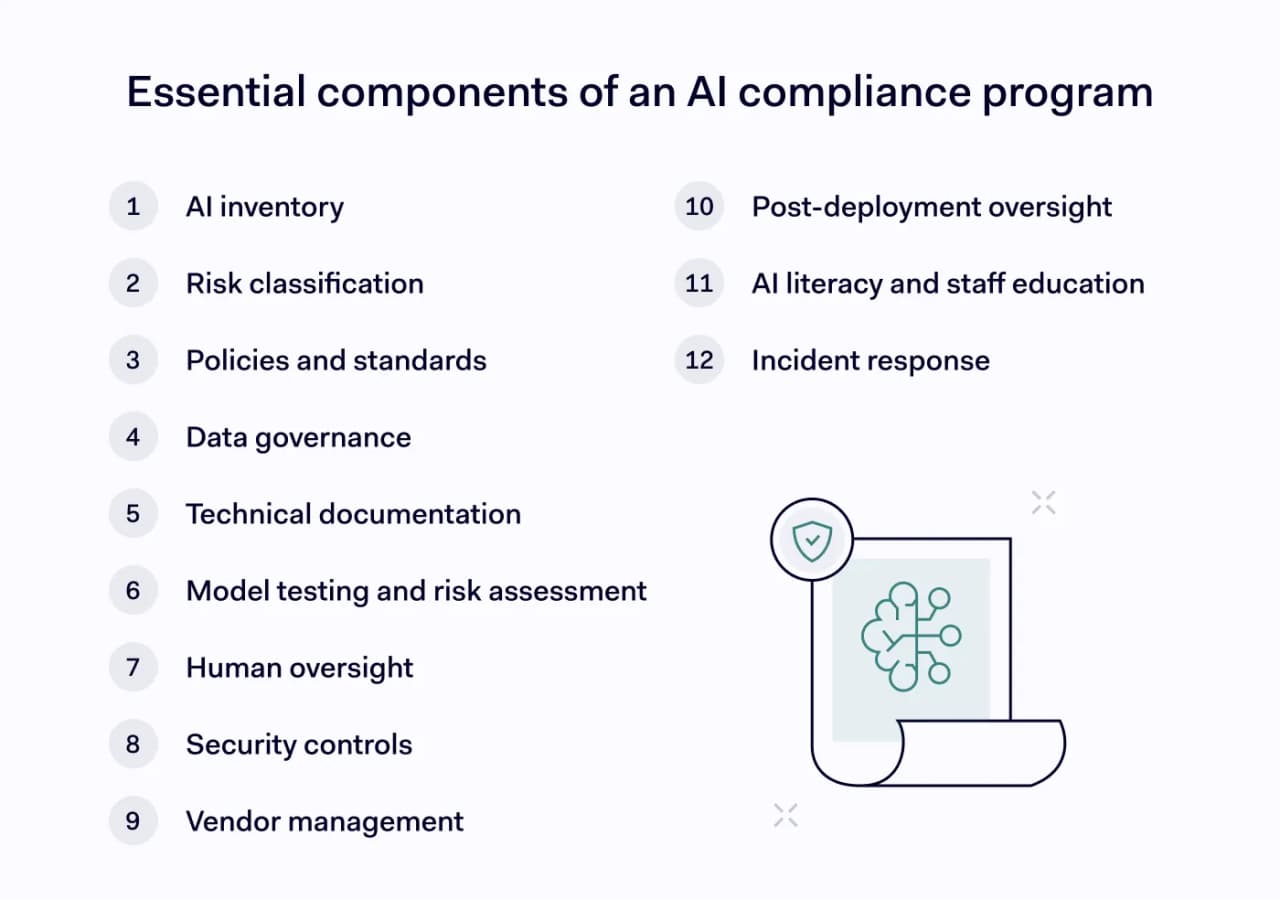
- AI inventory. A live record of every AI system, model, vendor, business owner, data source, and integration in use. Without an inventory, no other control works.
- Risk classification. A method to classify each use case by jurisdiction, data sensitivity, possible harm, autonomy, and whether it qualifies as high-risk under the EU AI Act or other rules.
- Policies and standards. Approved-use policies, vendor rules, data handling rules, and red lines for employees and developers.
- Data governance. Controls for data provenance, lawful basis, consent where required, data quality, bias checks, retention, and deletion.
- Technical documentation. System descriptions, intended use, limitations, performance metrics, risk controls, oversight design, and test results. EU AI Act Article 11 makes this mandatory for high-risk AI systems.
- Model testing and risk assessment. Pre-deployment evaluation for accuracy, robustness, bias, and safety, plus targeted red teaming for generative AI.
- Human oversight. Clear rules on where a person must review, approve, override, or stop an AI-assisted decision.
- Security controls. Threat modeling, access control, secure deployment, log capture, and defenses against prompt injection and data exfiltration
- Vendor management. Reviews of model providers, datasets, subprocessors, contract terms, data use, retention, and audit rights.
- Post-deployment oversight. Continuous checks for drift, bias, security events, misuse, hallucinations, and user complaints.
- AI literacy and staff education. Programs that teach employees which AI tools are approved, how to handle data, and how to report incidents. The EU AI Act has required AI literacy since 2 February 2025.
- Incident response. Playbooks for AI-specific incidents such as model failure, prompt injection, harmful output, or data leak.
AI compliance challenges
Most programs run into the same set of obstacles. Knowing them in advance helps with planning.
- Shadow AI. Employees adopt consumer AI tools faster than approval processes can catch up. Sensitive data often ends up in tools the organization never reviewed.
- Unclear ownership. AI cuts across legal, security, privacy, data science, product, and procurement. When no one owns the program, controls stall.
- Limited visibility into vendor models. Most organizations consume AI through APIs and cannot inspect the underlying model, training data, or safety controls.
- Fast-moving rules. The EU AI Act timeline has already shifted once, and US state AI laws change every few months. Programs need to track regulatory updates as a standing activity.
- Generative AI risks are still new. Prompt injection, hallucinations, and unsafe agent behavior are not covered by older control libraries, and red-team practices are still maturing.
- Hard-to-measure harms. Bias, fairness, and explainability lack single agreed metrics, which makes evidence harder to produce.
- Tooling gaps. AI compliance tools for inventory, evaluation, and post-deployment oversight are improving but rarely cover an entire program end to end.
- Skills shortage. Few teams combine legal, security, and machine-learning skills in one place.
AI compliance best practices
The following best practices apply to most organizations, whether they build models or only consume them.
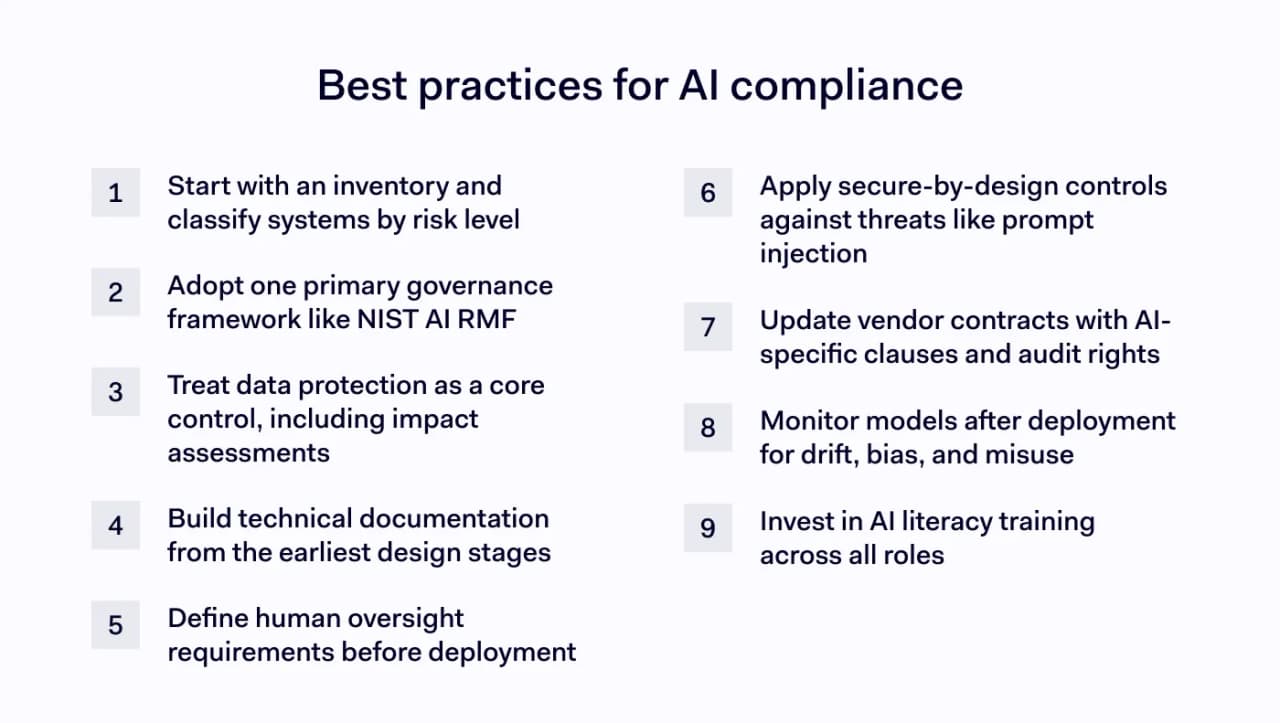
1. Start with an AI inventory and a risk-based approach
Map every AI system in use, including embedded features in SaaS tools. For each one, record the use case, data, vendor, owner, and user group, then assign a risk tier. A risk-based approach focuses effort on the systems that can cause the most harm, in line with the EU AI Act and NIST AI RMF.
2. Build one AI governance framework, not several
Pick a primary AI governance framework, usually NIST AI RMF or ISO/IEC 42001 and map other obligations to it. A single framework prevents duplicate controls and gives auditors one consistent picture across legal, security, and privacy reviews.
3. Treat data protection as a core control set
Run a data protection impact assessment for any AI system that handles personal data. Confirm a lawful basis, document the data sources, apply data minimization, and define retention and deletion rules. Address the use of personal data in both training and inference.
4. Document early, not at the end
Build technical documentation from the first design review. For high-risk systems, the EU AI Act expects documentation that can be handed to authorities or notified bodies on request. Late documentation is one of the most common causes of failed audits.
5. Define human oversight per use case
Decide, before deployment, where a human must approve, review, override, or stop an AI decision. Match the level of oversight to the risk tier. Record the decision in the system documentation so auditors can see the rationale.
6. Apply secure-by-design controls to AI systems and generative AI
Use the NCSC/CISA guidelines, OWASP GenAI Top 10, and Google SAIF as references. Cover prompt injection defenses, output filtering, access control for tools and data sources, log capture, and red teaming. For agentic systems, limit permissions and require approval steps for sensitive actions.
7. Manage vendors with AI-specific clauses
Update vendor reviews and contracts to cover training data, model updates, logging, retention, subprocessors, security testing, incident notification, and audit rights. Ask for evidence such as ISO/IEC 42001 certification, SOC 2 reports or model cards.
8. Monitor AI models after deployment
Track accuracy, drift, bias signals, security events, user complaints, and policy breaches. Feed findings back into risk assessment and model updates. Post-deployment oversight is where most real-world issues surface.
9. Invest in AI literacy across the workforce
Run role-based education for general staff, developers, product managers, and executives. Cover approved tools, prompt safety, data handling, and incident reporting. AI literacy is a legal duty under the EU AI Act and a practical defense against shadow AI.
The bottom line
AI compliance is no longer a future topic. The EU AI Act, NIST AI RMF, ISO/IEC 42001, and active enforcement from data protection and consumer regulators have set a clear baseline.
Organizations that build an inventory, classify risk, secure their generative AI use, and oversee models after deployment will find regulatory checks far easier to pass. Those that wait will face the same work under pressure, with less time and higher stakes.