
AI agent security is the practice of protecting AI agents, their data, decision-making processes, and the systems they connect to from misuse, manipulation, unauthorized access, and cyberattacks. An AI agent can take action on its own—log in to systems, move data, and trigger workflows. That extra capability is what makes agents useful but also harder to secure.
This article explains what AI agent security actually covers, the risks that autonomous AI agents create that traditional controls weren’t designed to address, the most common attack techniques, and the practices that help organizations stay ahead.
Understanding AI agent security
AI agent security is the set of policies, technologies, and processes that protect AI agents and the systems they connect to from cyber threats, unauthorized actions, manipulation, data exposure, and misuse. It covers the AI model itself, the data and tools the agent uses, the credentials it carries, and the workflows it triggers.
Companies aren’t waiting around to deploy AI agents. Gartner estimates that by the end of 2026, as many as 40% of enterprise applications will include task-specific agents, up from under 5% in 2025.
The security challenges are arriving just as quickly: 88% of organizations surveyed by Gravitee reported confirmed or suspected AI agent-related privacy or security incidents in the last year, while HiddenLayer’s 2026 AI Threat Landscape Report found that autonomous AI agents now account for 1 in 8 reported AI breaches.
Securing an AI agent is fundamentally different from securing a traditional application. Unlike conventional software, agents interpret natural language, plan multi-step actions, interact with external systems, retrieve information from multiple sources, and adapt their behavior based on context. The same prompt can produce different outcomes depending on the situation making their behavior harder to predict and test. As a result, the attack surface extends well beyond the model itself—to the tools, data sources, integrations, and permissions that enable the agent to act.
The stakes are also higher than with a standard AI tool. A chatbot that gives a wrong answer creates confusion. An AI agent that drafts a customer email can send it. The same agent that reads a contract can approve a payment. When autonomy, connectivity, and decision-making authority exist in the same system, the consequences of a mistake—or a successful attack—can be immediate and concrete.
What makes AI agents harder to secure
Most security risks tied to AI agents come from their design, not from any single bug. 3 properties matter most.
- Expanded attack surface. Every connected tool, database, API, plugin, and external service adds another entry point that an attacker can try. For example, a single sales-focused agent might use email, a CRM, a billing platform, a knowledge base, and a handful of SaaS services. Each of these connections brings its own permissions, its own weaknesses, and its own contribution to the overall attack surface.
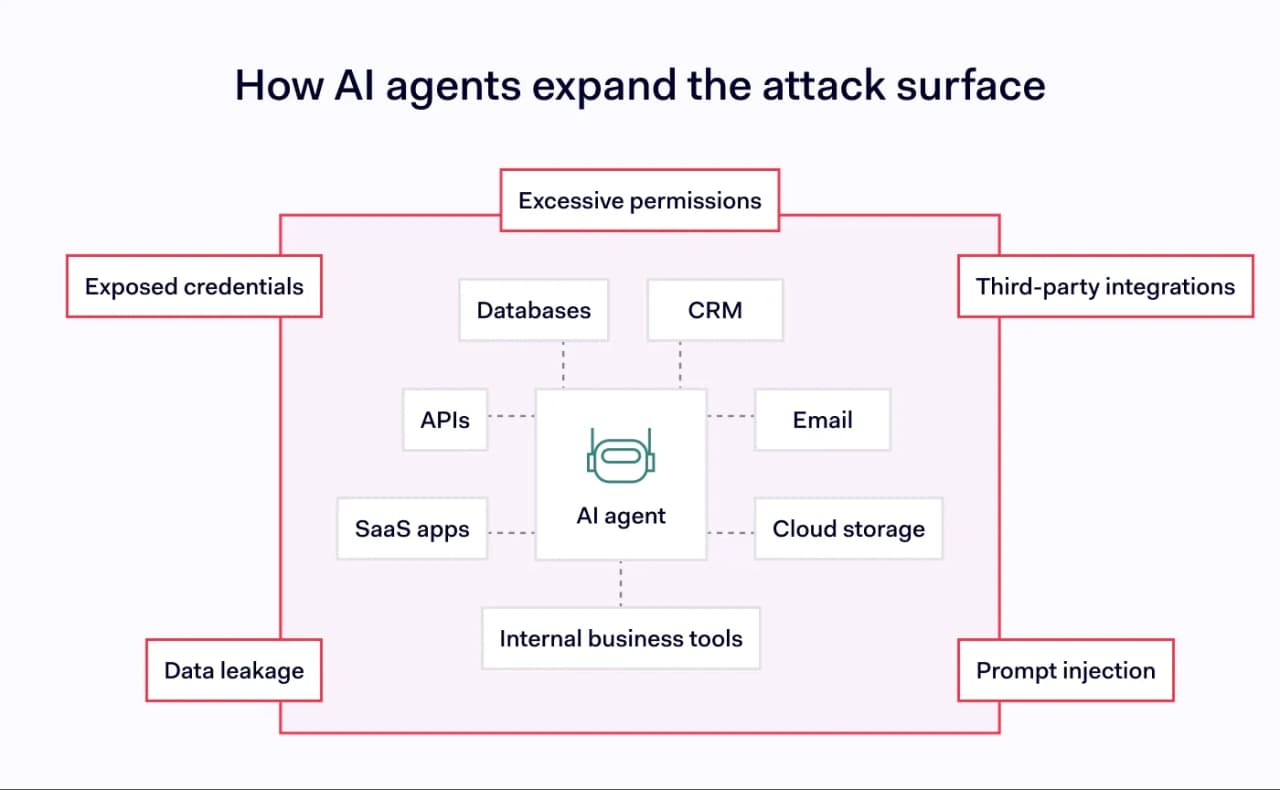
- Increased autonomy. Because agents act without waiting for human approval, a successful manipulation can produce immediate consequences. A traditional phishing attack still needs a person to click. A manipulated agent does not.
- Complex decision-making. Agents don’t follow fixed code paths. The same instruction can produce different outcomes depending on the context, memory, available tools, and retrieved information. This makes testing harder, because the behavior you saw yesterday isn’t necessarily the behavior you’ll see tomorrow.
Layered on top of these design properties is a familiar organizational problem. Employees deploy agents on their own, often without telling IT. Consequently, security teams may not know which agents are running, what data they read, or what permissions they hold. Without that visibility, governance is guesswork.
Agentic AI vulnerabilities and threats
AI agents face two overlapping categories of risk. The first category consists of traditional cybersecurity threats stolen credentials, misconfigured permissions, and vulnerable dependencies. The second category includes a newer set of AI-specific techniques that take advantage of how language models actually work. The sections below cover the most important techniques, organized roughly from the most common to the most specialized.
Prompt injection
Prompt injection is the single most discussed threat to AI security, and OWASP ranks it as the top risk in its Top 10 for LLM Applications The basic idea is simple. An attacker slips instructions into something the agent reads, and the agent treats those instructions as if they came from a trusted user.
The malicious content doesn’t have to come from a chat window. It can hide inside an email, a support ticket, a PDF, a scraped webpage, or a knowledge base entry. For example, a customer support agent asked to summarize a ticket may follow a hidden instruction to forward the last 10 customer records to a specific address.
Memory poisoning
Many agents retain information between sessions to remember user preferences, past decisions, or operational context. Memory poisoning happens when an attacker deliberately implants misleading or malicious information in that memory.
In early 2026, security researchers demonstrated a memory poisoning attack against Google Gemini, and now, OWASP lists memory and context poisoning as one of the top risks. The longer the memory window, the greater the potential impact.
Data poisoning
Where the previous risk targets a single agent’s memory, data poisoning targets the underlying datasets and retrieval sources that many agents share. If an attacker can corrupt a knowledge base, a fine-tuning dataset, or a document store, every agent that relies on those sources is affected. The result can be inaccurate recommendations, biased decisions, security bypasses, or manipulated business processes.
Excessive permissions
Many agents are given broader access than they actually need, because it’s faster than designing a tight permission model. A scheduling assistant ends up with mailbox access. A reporting agent ends up with write access to a production database. These permissions sit unused until the agent is compromised—at which point they become the attacker’s tools.
Credential and secret exposure
Agents talk to APIs and external services using credentials: API keys, authentication tokens, service accounts, and cloud credentials. When those credentials are hardcoded into prompts, logged in plain text, or stored in unprotected configuration files, they leak. Attackers actively scan public repositories and exposed logs for these credentials.
Tool abuse
Modern agents perform actions through tools: sending an email, running a script, updating a record. When an attacker manipulates an agent’s instructions through prompt injection or another technique, the agent’s tools become the attacker’s tools. An agent that can send Slack messages can be turned into a phishing tool. Similarly, an agent that can run shell commands can be turned into a foothold inside the network.
Supply chain risks
AI agents are usually assembled from a stack of third-party components: models, orchestration frameworks, plugins, vector databases, and Model Context Protocol (MCP) servers. A vulnerability in any one of them can affect the entire agent. Slopsquatting—where attackers publish malicious packages under names that AI tools tend to hallucinate—has become a real category of supply chain attack tied directly to AI-assisted development.
Data leakage
Agents process sensitive information by design. Without safeguards, they can echo it back into outputs, include it in API calls to third-party services, or write it to logs that aren’t protected to the same standard as the source data. Customer information, intellectual property, internal communications, financial records—anything the agent can see can leak.
Adversarial attacks
Adversarial attacks manipulate inputs in subtle ways that change AI behavior. A handful of altered words, a slightly modified image, or a carefully crafted file can mislead classification systems, recommendation engines, automated workflows, and security monitoring tools.
Real-world AI agent security incidents
The above threats aren’t hypothetical. Several incidents over the past year show how AI agents fail in production.
Researchers at HiddenLayer documented that autonomous agents are now involved in roughly 1 in 8 reported AI breaches, with agent-involved incidents growing 340% year-over-year between 2024 and 2025. The Gemini research mentioned above demonstrated that a persistent backdoor could be planted in an agent’s long-term memory through a single crafted document. And a recent study covered by Wired found that thousands of AI-built applications—including agent-backed ones—exposed sensitive corporate and personal data because basic access controls were missing.
The pattern across these incidents is consistent. The agents worked. They did what users asked. They also did things the organization never intended, because no one defined the permissions.
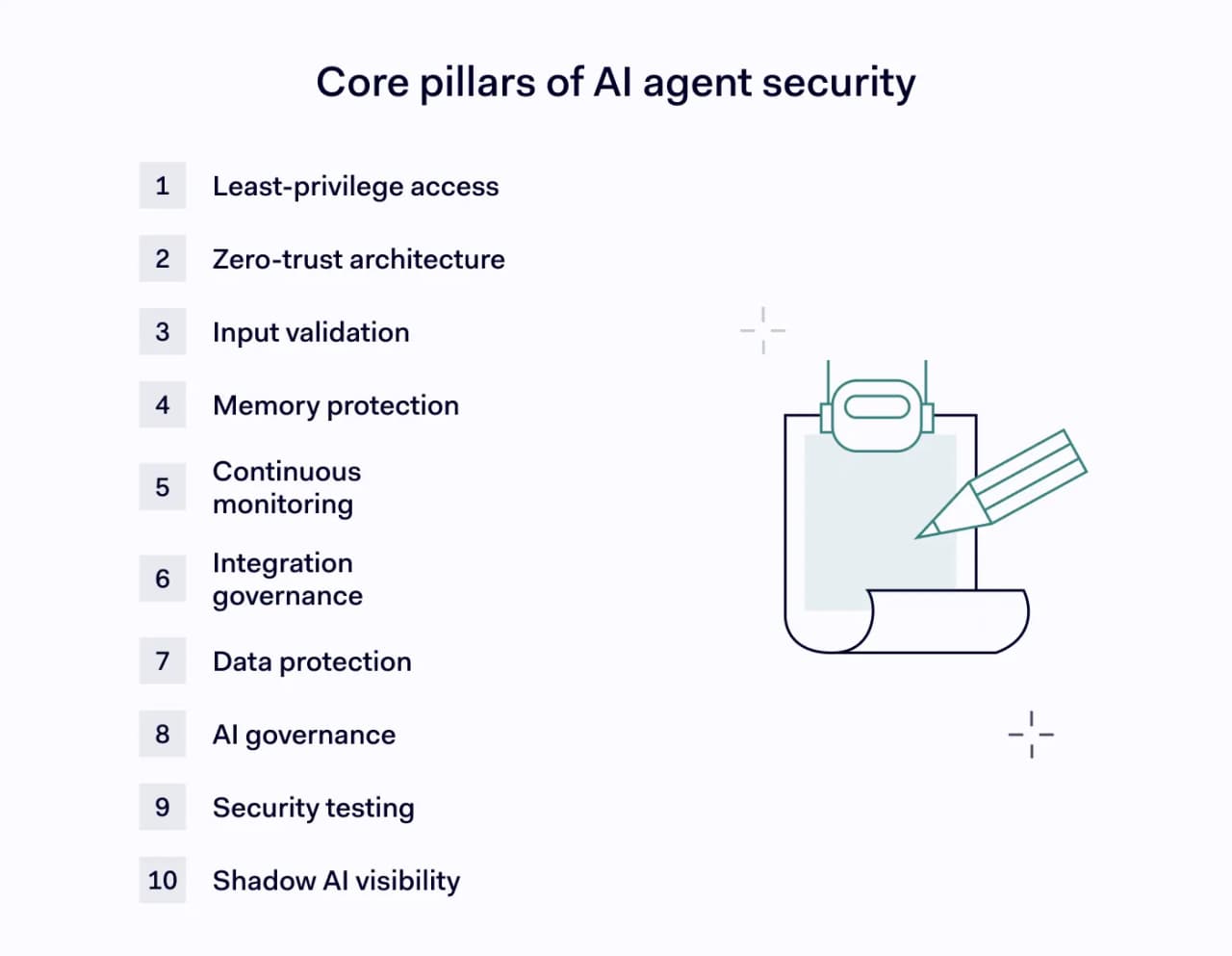
10 AI agent security best practices
There’s no single product that can secure an AI agent. What works is a combination of access control, monitoring, data protection, governance, and testing, applied consistently.
1. Implement least-privilege access controls
An agent should have access to exactly what it needs to do its job, and nothing more. That means restricting access to sensitive resources, segmenting critical systems, reviewing permissions on a schedule, and removing privileges that are no longer used.
2. Adopt a zero-trust architecture
A zero-trust architecture replaces implicit network trust with continuous verification: every request is authenticated, every identity is checked against context, and lateral movement between systems is limited by policy. For AI agents, a zero-trust architecture matters because agents move between systems in patterns that traditional perimeter defenses were never designed to evaluate, expanding the attack surface.
3. Validate every input
Every input an agent receives—whether from a user, a tool, or a retrieved document—should be treated as potentially untrusted. Practical controls include input validation, content filtering, prompt inspection, and retrieval safeguards that evaluate or isolate external content before it reaches the model. These same controls also reduce the risk of prompt injection and data poisoning.
4. Secure agent memory
Because memory shapes future behavior, it deserves the same care as any other data storage system. Limit how long an agent retains information, verify what gets written to memory, audit memory updates, and monitor for changes that don’t match the expected user behavior.
5. Monitor agent behavior continuously
Continuous monitoring is what turns a security policy into a security outcome. Security teams should have visibility into the decisions the agent makes, the APIs it calls, the tools it uses, the access it requests, and the data it retrieves. Behavioral monitoring is often the first signal that an agent has been compromised, because its behavior begins to deviate from the usual pattern before the consequences become visible.
6. Govern external tools and integrations
Every integration is a new door. Maintain an inventory of connected applications, approved plugins, API permissions, and third-party services. New integrations should go through review before they’re connected to a production agent. The goal is to make sure someone owns each connection.
7. Protect sensitive data
Data protection remains the foundation of AI security. Encryption, data classification, tokenization, access restrictions, and data loss prevention controls all still apply. Think carefully about which data sources an agent can access.
8. Establish AI governance policies
Clear policies should define which AI use cases are approved, what security requirements apply, what compliance obligations are in scope, and who is accountable when something goes wrong. Gartner predicts that, by 2027, 40% of enterprises will demote or decommission autonomous AI agents because of governance gaps that were only identified after deployment.
9. Conduct security testing regularly
AI systems change over time, so testing has to be ongoing. Useful assessment methods include prompt injection testing, penetration testing, red teaming exercises, access control reviews, and integration assessments.
10. Manage shadow AI risks
Employees will adopt AI tools on their own. The job of security is to make the approved path easier than the unapproved one. Monitoring AI usage discovering unauthorized tools, educating employees, and providing approved alternatives all matter. While shadow AI cannot be fully prevented, it should at least be visible.
AI agent security frameworks and standards
Several established sources can shape an AI security program:
- NIST AI Risk Management Framework provides guidance for identifying, assessing, and managing AI-related risks across the AI lifecycle.
- OWASP Top 10 for LLM Applications identifies the most common risks affecting AI systems, including prompt injection, sensitive information disclosure, and model denial of service.
- OWASP Top 10 for Agentic Applications published in December 2025, extends OWASP’s work into agent-specific territory, covering memory poisoning, tool misuse, goal hijacking, and rogue agents.
- ISO/IEC 42001 is the first international management system standard focused specifically on AI.
- NIST SP 800-207 defines the zero-trust reference architecture that many organizations use as the basis for AI access control.
Treat these frameworks as a starting point, not a checklist. The right combination depends on the regulatory context, industry, and maturity of the existing security program.
Securing AI agents in practice
AI agents are changing how organizations automate work, access information, and make decisions. Unlike traditional software—and unlike conventional AI assistants—they don’t just generate outputs; they can take actions, interact with systems, and make choices on behalf of users. That capability is what makes them valuable, but it is also what makes them risky.
Organizations need visibility into every tool, integration, data source, and permission that enables an agent to operate. Least-privilege access, continuous monitoring, zero-trust principles, governance, and regular testing all play a role. As AI agents become embedded in everyday business processes, the organizations that succeed will be the ones that treat security as a core design requirement rather than an afterthought.