
A VPN tunnel is a secure, encrypted connection that protects your internet traffic as it travels between your device and a VPN server.
In simple terms, it creates a private pathway through the public internet. Instead of sending data openly, the tunnel wraps it in encryption and routes it through a remote server. This helps keep your activity hidden, your data protected, and your identity masked by replacing your real IP address
VPN tunnels are a core part of how any VPN connection works. Without them, sensitive data—like login credentials, emails, or company files—could be exposed to attackers, especially on unsecured networks.
Key takeaways
- A VPN tunnel is a secure, encrypted connection that keeps your online activity private as it moves across the public internet.
- Different VPN tunneling protocols offer varying levels of speed, security, and compatibility, so it’s important to choose the right one for your needs.
- VPN tunnels help hide your IP address and keep sensitive data safe from hackers, especially on public or untrusted networks.
- Features like VPN split tunneling allow users to control which traffic goes through the encrypted tunnel and which accesses the internet directly.
- Understanding how VPN tunnels work helps you make smarter decisions about securing your connections and protecting your data online.
Knowing the answer to “What is a VPN tunnel?” helps you make smarter decisions about securing your connections and protecting your data online. Now, let’s look at how it works.
How does a VPN tunnel work?
A VPN tunnel works by combining encryption and routing to create a protected path for your data. While the process happens in seconds, several important steps take place behind the scenes:
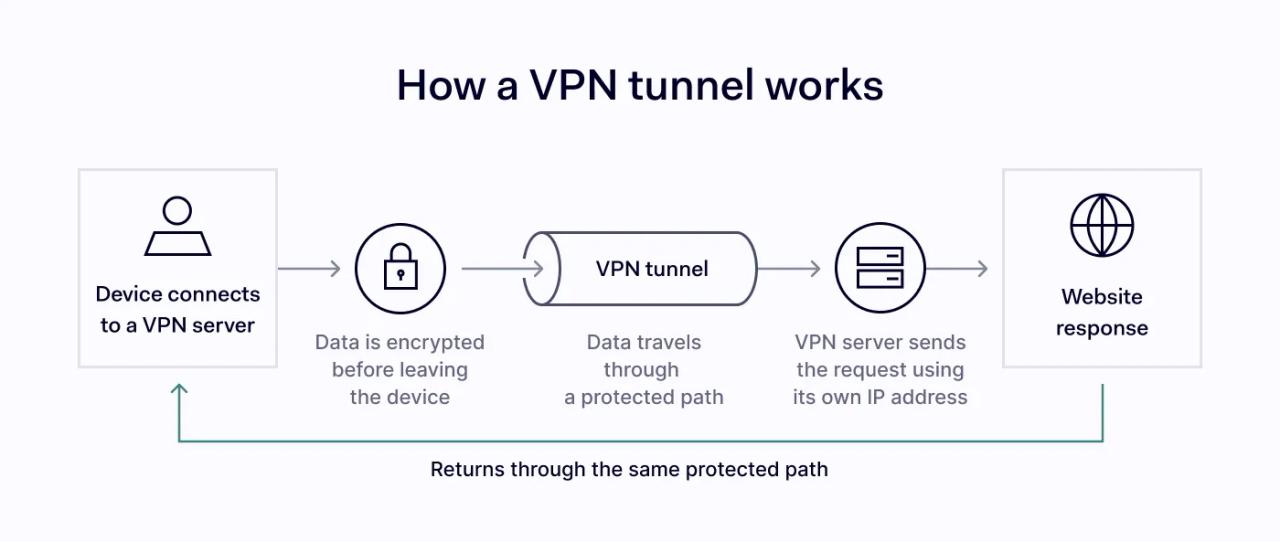
1. Establishing the VPN connection
When you activate a VPN, your device connects to a VPN server. This connection uses a specific VPN protocol which defines how the secure tunnel will be created. At this stage, both sides authenticate each other to confirm that the connection is legitimate and not being intercepted.
2. Creating an encrypted connection
Once connected, your device encrypts all outgoing internet traffic. Encryption transforms readable data into coded information that cannot be understood without the correct decryption key. This step is what turns a regular connection into a protected one.
3. Routing traffic through the VPN tunnel
Your encrypted data is then sent through the VPN tunnel to the VPN server. Because the data is encrypted, anyone who tries to intercept it, such as hackers or unauthorized third parties, will only see unreadable data. This is especially important when using public Wi-Fi, where networks are often unsecured.
4. Masking your IP address
When your data reaches the VPN server, it is decrypted and forwarded to its final destination (such as a website or application). However, instead of using your real IP address, it appears as if the request is coming from the VPN server. This helps protect your identity and location.
5. Returning data securely
The response from the website travels back to the VPN server, where it is encrypted again and sent through the same protected connection to your device. This cycle keeps your internet activity protected at every stage.
However, not all VPN tunnels are created the same—different protocols define how this connection is built, secured, and optimized for performance.
Types of VPN tunneling protocols
VPN tunneling protocols define how a secure connection is created, how data is encrypted, and how efficiently it travels between your device and a VPN server.
While all protocols aim to protect your network traffic, they differ in terms of speed, security, and compatibility. Understanding these differences helps you choose the right VPN protocol for your needs.
OpenVPN
OpenVPN is one of the most widely used VPN tunneling protocols. As an open-source protocol, it is continuously tested and improved by the security community.
It offers strong encryption and high flexibility, making it suitable for both personal and business use. However, setup can require more manual configuration compared to newer protocols. Because of its reliability and wide compatibility, OpenVPN remains a popular choice for business environments—and NordLayer supports both OpenVPN TCP and OpenVPN UDP.
WireGuard
WireGuard is a modern VPN protocol designed for speed and simplicity. It uses modern encryption and a lightweight codebase, which helps improve performance and reduce potential vulnerabilities. WireGuard has gained widespread adoption and serves as the foundation for protocols like NordLynx.
NordLynx
NordLynx is NordLayer’s proprietary VPN protocol, powered by WireGuard. It combines WireGuard’s lightweight codebase and modern cryptography with additional privacy protections, delivering one of the fastest VPN connections available.
NordLynx is the default protocol for NordLayer and an excellent choice for organizations that need both speed and security.
IKEv2/IPSec
IKEv2/IPSec is known for its speed and stability, especially on mobile devices. It can quickly reconnect when switching between networks, such as moving from Wi-Fi to mobile data. This makes it a strong choice for users on the go, although compatibility may vary depending on the operating system or environment.
SSTP
Secure Socket Tunneling Protocol (SSTP), developed by Microsoft, uses SSL/TLS encryption to create a secure connection. It integrates well with Windows systems and can bypass certain network restrictions, but its availability is limited on non-Windows platforms.
L2TP/IPSec
Layer 2 Tunneling Protocol (L2TP) is typically paired with IPSec for encryption. It provides a decent level of security but is generally slower than more modern protocols. Because of this, it is often considered a legacy option and is used less frequently today.
PPTP
Point-to-Point Tunneling Protocol (PPTP) is one of the oldest. It is known for its fast connection speeds and a simple setup. However, its encryption is weaker than modern standards, making it unsuitable for protecting sensitive data in most cases.
Benefits of VPN tunneling
VPN tunneling is essential for maintaining privacy, protecting data, and enabling secure communication over the internet. Here are the key benefits:
- Encrypts internet traffic. The tunnel creates an encrypted connection that prevents unauthorized access to your data. Even if traffic is intercepted, it cannot be decoded without the correct key.
- Hides your IP address. By routing your connection through a VPN server, your real IP address is replaced, making it harder to track your location or identity.
- Improves online privacy. VPN tunnels prevent internet service providers and other third parties from monitoring your browsing activity.
- Secures public Wi-Fi connections. Public networks are common targets for cyberattacks. An encrypted tunnel protects your data even on unsecured networks.
- Supports secure remote work. Businesses rely on VPN tunnels to allow employees to access internal systems safely from different locations without exposing sensitive resources.
- Helps maintain data integrity. Encryption ensures that data is not altered during transmission, protecting it from tampering.
- Reduces exposure to cyber threats. Encrypted tunnels shield your traffic from interception, man-in-the-middle (MitM) attacks, and unauthorized access—even on untrusted networks.
What is VPN split tunneling?
VPN split tunneling is a feature that lets you decide which network traffic goes through the VPN tunnel and which connects directly to the internet.
Instead of routing everything through a secure tunnel, split tunneling gives you flexibility. For example, you can route sensitive work applications through the VPN while allowing less demanding traffic like streaming or local services to connect directly.
This approach helps improve performance and reduce bandwidth usage, which is especially useful for teams that need to balance productivity with access to local resources.
NordLayer offers two types of VPN split tunneling: URL-based split tunneling which routes specific domains outside the tunnel, and IP-based split tunneling which routes only defined IP addresses through the VPN.
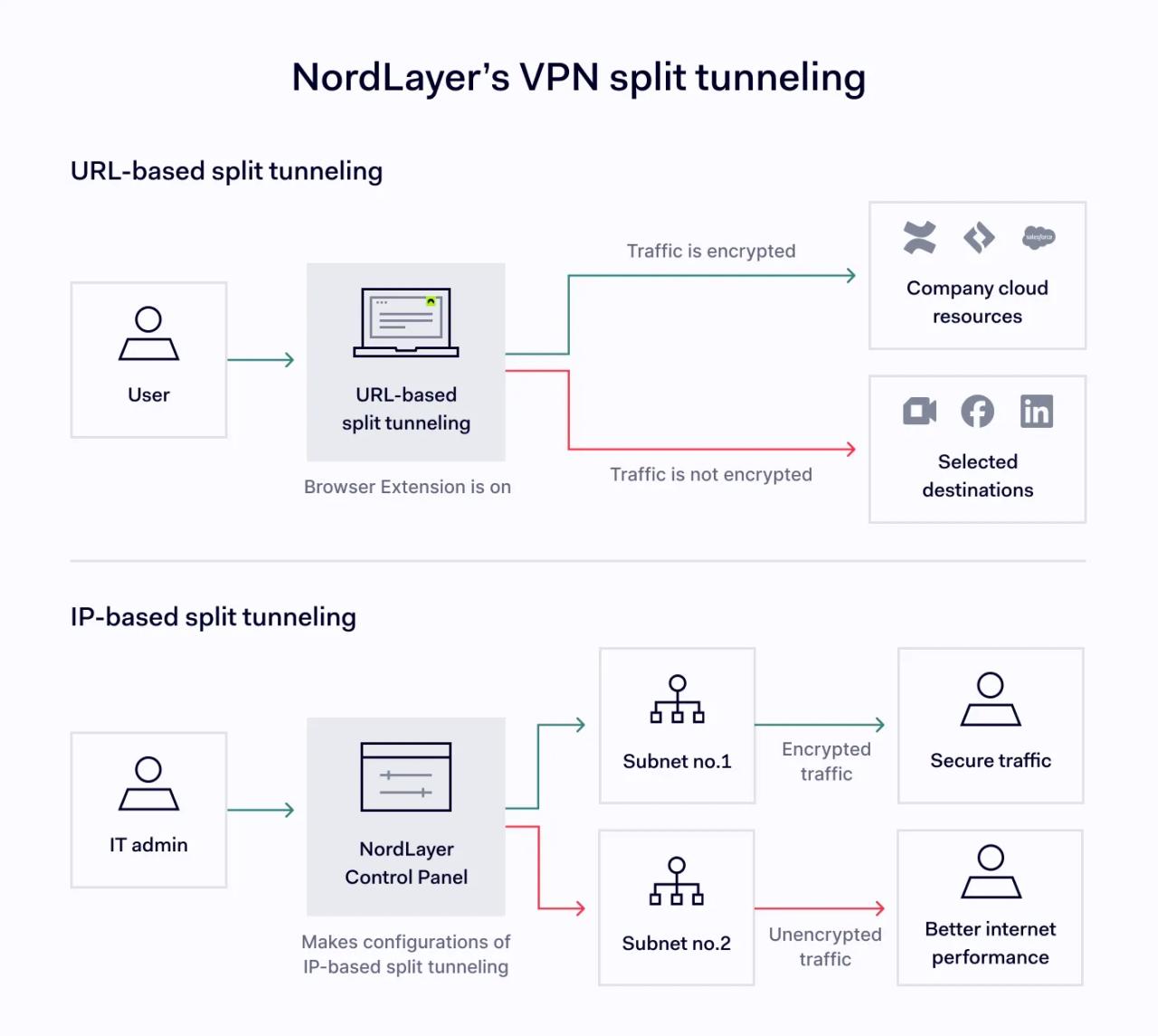
Keep in mind that split tunneling requires thoughtful configuration to make sure the right traffic is routed through the VPN.
When should you use a VPN tunnel?
VPN tunnels are useful in many everyday and business scenarios. While they are often associated with privacy, their role in security is just as important.
You should consider using a VPN connection when:
- Accessing company resources remotely
- Working on public or shared networks
- Handling sensitive data or communications
- Managing distributed teams or cloud environments
- Protecting user activity from monitoring or tracking
For organizations, VPN tunnels are often part of a broader security strategy that includes access control, identity management, and network monitoring.
Common misconceptions about VPN tunnels
Because VPNs are so widely used, there are a few common misconceptions about how VPN tunnels work.
One common myth is that a VPN makes you completely anonymous. While it hides your IP and encrypts your traffic, other factors, such as account logins or browser tracking, can still identify you.
Another misconception is that all VPN protocols offer the same level of security. In reality, the VPN protocol you choose has a big impact on how secure and efficient your VPN tunnel is.
Finally, some users assume that VPN tunnels slow down internet speed noticeably. While encryption can introduce slight overhead, modern protocols like NordLynx and WireGuard are designed to minimize the impact on performance.
Why VPN tunnels matter
Put simply, what is a VPN tunnel? It’s the foundation of every secure VPN connection. It keeps your internet traffic private, your IP address hidden, and your activity shielded from unauthorized access by encrypting data and routing it through a protected path.
With remote work and cloud-based operations now standard for most organizations, VPN tunneling continues to play a critical role in protecting both individuals and businesses. Whether you are browsing from home or managing a distributed workforce, a secure tunnel helps create a safer and more controlled online environment.