
PPTP (Point-to-Point Tunneling Protocol) is a network communication protocol designed to create a secure tunnel between a user and a private network, essentially serving as one of the original building blocks for the VPNs we use today.
If you’re currently trying to figure out which networking setup makes sense for you, you’ve probably noticed there’s no shortage of acronyms out there, and PPTP happens to be one of the oldest ones. It’s been around for decades, and it set the standard for remote internet access back in the day.
Since you’re likely here to figure out what it does, we’ll keep things straightforward. In the next few sections, we’ll walk through how a PPTP VPN works in practice, its benefits, and the limitations you need to be aware of. We will also cover what PPTP passthrough is, and then compare PPTP with the newer protocols available today, so you have the full context.
How does a PPTP VPN work?
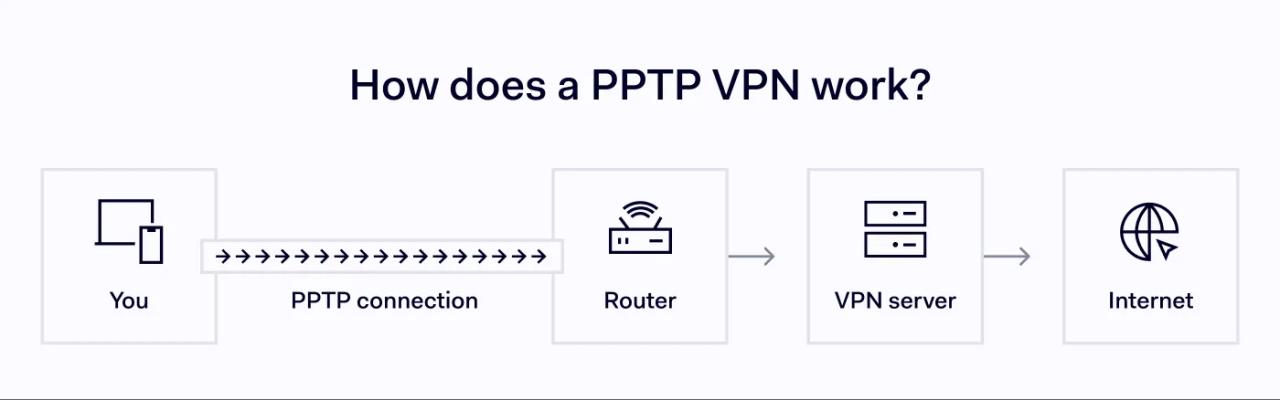
This setup routes everything through a hidden, dedicated path rather than sending your browsing activity out into the open public web. Because the original framework was designed decades ago, the mechanics behind these PPTP connections are fairly simple compared to modern VPN protocols
Here is exactly how that path is built and used, step by step:
- You (the VPN client). The whole process kicks off on your end. The computer or phone you are using acts as the VPN client, sending out an initial request to link up with a remote machine.
- The PPTP connection. The moment that request is accepted, the tunnel goes live. Your device immediately scrambles your outgoing information using specific encryption standards, which ensures that anyone trying to intercept the connection only sees random, unreadable text.
- The router. With your encrypted data secured, it leaves your device and passes through your local Wi-Fi router. The data is already scrambled before it reaches the router, so not even your internet service provider (ISP) can peek at which websites you visit.
- The VPN server. Your data eventually travels down the tunnel and hits the remote VPN server (in this scenario, a dedicated PPTP server). This machine takes the scrambled data, decrypts it back into normal information, and assigns you a new IP address before pushing the request out to the rest of the web.
- The internet. Finally, your now-anonymous request reaches its actual destination. When that website sends a response back to you, it travels in reverse through that same secure, encrypted path until it safely reaches your screen.
This entire sequence skips the complex math required by newer VPN connections, so PPTP VPN connections are established almost instantly. That lightweight design is what gives the protocol its biggest strengths. Because it isn’t slowed down by heavy processing, its raw speed offers practical advantages. Let’s take a look at what they are.
Benefits of PPTP
That lightweight design we just talked about is the main reason this protocol still gets brought up today. While it might not be the go-to secure VPN protocol for handling highly sensitive corporate data anymore, it still has a few specific benefits that modern alternatives sometimes struggle to match:
- Unbeatable speeds. Since PPTP relies on older, much simpler encryption standards, your device doesn’t have to work hard to scramble and unscramble the data. Less processing time naturally means faster VPN connections. So, if you are streaming a video from another region or playing a game and don’t need maximum security, this protocol is efficient.
- Out-of-the-box compatibility. You rarely need to download third-party software to get it working. It has been around for so long that native support for a PPTP VPN is built into almost every operating system on the market, from Windows and macOS to your smartphone.
- Low hardware demands. Setting up a VPN server can require fairly capable hardware, especially when using newer VPN protocols that consume computing power to maintain layers of security. However, PPTP is the opposite. It can run on old computers or cheap legacy routers without slowing down system performance.
- Built-in network workarounds. Sometimes basic home routers misinterpret VPN traffic and block it entirely. To fix this common issue, a feature called PPTP passthrough was widely adopted by router manufacturers, giving these connections a dedicated lane to bypass network translation errors.
Limitations of PPTP
But as you might guess, prioritizing raw speed usually means making a sacrifice somewhere else along the way. In this case, that trade-off happens at the expense of security.
- It is so easy to crack. The 128-bit encryption it relies on is outdated, meaning anyone with enough know-how and the right tools can intercept and read your traffic in a matter of minutes.
- Strict firewalls block it constantly. While legacy router tricks like PPTP passthrough work fine for basic home network issues, they won’t save you from a strict network administrator. A PPTP VPN uses specific, easily identifiable routing methods, so places with strict internet rules, like corporate offices and universities, usually block the traffic.
- Broken authentication. The system it uses to verify your login credentials has known security holes that attackers have been actively exploiting for years.
- Zero forward secrecy. If someone cracks your encryption key during a session, your privacy is fully compromised. Modern VPN protocols automatically generate new keys to protect your past and future browsing in case of a breach, but PPTP lacks this failsafe entirely. If one key is exposed, everything you’ve ever done over that connection is suddenly public.
What is PPTP passthrough?
We have mentioned this term a couple of times now, so it is worth quickly clearing up what it actually does.
Most home routers use a basic system (called NAT) to manage all the different phones, laptops, and smart TVs connected to your Wi-Fi. Normally, this works without a fault. The problem is that PPTP formats its data in an unusual way that standard routers simply don’t recognize. Because the router doesn’t know what to do with that data, it gets confused and just blocks the traffic by mistake.
This is why the passthrough feature was invented. It acts as a built-in translator for your router. When enabled, it forces the network to recognize that specific traffic and let it pass through to your device uninterrupted.
And while this solves the immediate connection issue, it is important to remember that it doesn’t turn PPTP into a secure VPN protocol. It is purely a networking patch to make an outdated system function properly on home Wi-Fi. Since modern VPN protocols are built to handle these router setups natively, they rarely ever require these extra workarounds to get you online.
PPTP vs. other protocols
Protocol | Speed | Security level | Best used for |
|---|---|---|---|
PPTP | Very fast | Extremely weak | Legacy hardware, low-stakes streaming |
OpenVPN | Moderate | Excellent | Everyday secure browsing bypassing strict firewalls |
L2TP/IPsec | Slower | Strong | General security when OpenVPN isn’t available |
WireGuard | Extremely fast | Excellent | High-speed downloads, gaming, modern setups |
IKEv2 | Fast | Excellent | Mobile devices, frequently switching networks |
PPTP vs. OpenVPN
OpenVPN is the current industry standard. It trades a bit of speed for strong, modern encryption. While PPTP might technically be slightly faster, OpenVPN actually keeps your data safe, making it the obvious choice for almost any everyday situation.
PPTP vs. L2TP
L2TP was specifically built to replace PPTP. It doesn’t encrypt data on its own, so it normally works alongside a protocol suite called IPsec Wrapping your traffic twice does slow things down. Still, most people accept that speed hit since it secures their private information.
PPTP vs. WireGuard
WireGuard was built from the ground up with lean code, delivering modern security while outpacing PPTP’s speeds. It is quickly becoming one of the most popular VPN protocols available.
PPTP vs. IKEv2
If you are constantly switching between your home Wi-Fi and cellular data on your phone, IKEv2 is a strong fit. PPTP tends to drop your connection the second your network changes. IKEv2, on the other hand, handles those handoffs smoothly and stays stable, offering similar speeds with much stronger protection.
Final thoughts
PPTP paved the way for modern VPNs, bringing speed and simplicity to the table early on. It’s fast and easy to set up, which explains why it stuck around for so long. But considering the security risks we’ve covered, it really only makes sense for specific, low-stakes networking setups today.