
To demonstrate reliability, many businesses get ISO 27001 certification. NordLayer is one such certified company. This guide explains what ISO 27001 is and why it’s beneficial.
What is ISO 27001?
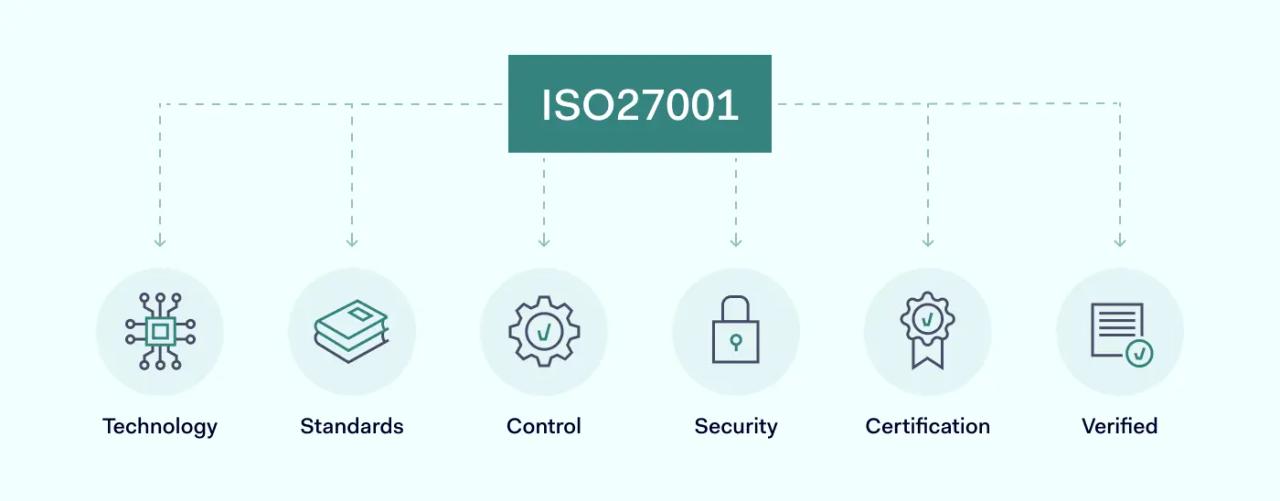
ISO/IEC 27001:2022 is a family of standards that focuses on best practices for information security risk management. Maintained by the International Organization for Standardization (ISO) and the International Electrotechnical Commission (IEC), ISO 27001 covers people, technology, and processes. It provides a clear roadmap to create strong information security management systems (ISMS) that protect data and counter threats.
Key takeaways
- ISO 27001 is a set of data security standards that focus on best practices for information security risk management The framework takes a broad perspective and covers people, technology, and processes.
- ISO 27001 compliance has many benefits. Benefits include global relevance and the inclusion of up-to-date information security guidance. Compliant organizations can guard against data breaches and see improved business performance. Data security builds customer trust and makes it easier to comply with privacy regulations.
- ISO 27001 revolves around three core information security principles The framework deals with the “CIA triad” of confidentiality, data availability, and data integrity. In all three areas, it includes recommendations for risk assessments and mitigation actions.
- ISO 27001 certification involves initial assessment, gap analysis, and designing an information security management system (ISMS) supported by the right information security controls. Organizations must also cover staff training, internal audits and continuous improvement plans. External certification audits by accredited assessors prove that the organization has achieved ISO 27001 compliance.
- ISO 27001 offers a route to data privacy compliance It complements data privacy regulations like GDPR HIPAA and PCI-DSS with a risk-based approach, security controls, documentation, and continuous improvement.
Why is ISO 27001 important?
ISO 27001 is the leading global standard for creating an information security management system (ISMS). The certification process is demanding. As of the most recent ISO Survey the number of valid ISO 27001 certificates worldwide reached 96,709—nearly double the 48,671 recorded the year before—reflecting a sustained multi-year climb from around 58,000 certificates in 2021. This growth is not surprising when we consider the many benefits of ISO 27001 accreditation:
- Up-to-date information security ISO 27001 delivers the latest advice about building security and access controls to protect data. It includes advice about creating effective information security policies and issues like governance and staff training.
- Protection against data breaches ISO 27001 compliance provides a solid foundation to prevent data leaks. The standard includes security controls and policies to counter the external and internal threats that lead to data breaches.
- Business performance Researchers have found that ISO 27001 compliance is related to improved business performance. Compliant companies are more profitable and productive than comparable organizations. Companies also experience reduced costs due to a lower frequency of security incidents.
- Improved compliance ISO 27001 assists companies in complying with the General Data Protection Regulation (GDPR) and the Health Insurance Portability and Accountability Act (HIPAA). The standard sets out strong practices to secure personal data and support privacy.
- Stronger customer trust Customers and other stakeholders expect complex security credentials. ISO 27001 compliance assures outsiders that an organization takes security seriously.
- Organizational knowledge and efficiency ISO 27001 compliance solutions build knowledge within organizations. Compliance spreads best practices across all departments. It nurtures an ongoing culture of compliance and drives continuous improvement.
- Global relevance ISO standards are respected worldwide. Companies that achieve ISO 27001 certification can use that accreditation wherever they operate.
- Resilience Building resilience is a core part of the ISO 27001 family. Compliant organizations maintain effective incident response plans that restore systems and neutralize threats. They are well-prepared for crises and able to adapt to changing security compliance challenges.
How does ISO 27001 work?
ISO 27001 functions around the three pillars of the "CIA triad". This triad includes:
- Confidentiality Information should remain private. Data should only be accessible to authorized individuals. Classification systems should document the most sensitive information. Encryption must protect data against external agents.
- Availability Information must be available when it is needed. Organizations must maintain backup and failover systems. Business continuity management should include disaster recovery strategies and minimize downtime.
- Integrity. The information must remain in its original form. Data must be accurate, trusted, and complete. Organizations need to maintain validation systems to check data integrity. Controls should prevent unauthorized alterations or deletions.
The 27001 standard advises organizations about how to carry out risk assessments covering these core principles. These assessments identify areas of concern and implement mitigation actions to manage an organization’s information security risks.
Annex A of ISO 27001 organizes 93 controls into four categories:
- Organizational (A.5)—37 controls covering policies, roles and responsibilities, supplier relationships, and information security governance.
- People (A.6)—8 controls covering staff screening, onboarding, offboarding, awareness training, and disciplinary processes.
- Physical (A.7)—14 controls covering secure areas, equipment protection, cabling security, and safe disposal of media.
- Technological (A.8)—34 controls covering access control, cryptography, secure development, malware protection, and logging.
The standard is structured around two parts: Clauses 4–10 define the “what”—the management system requirements an organization must meet—and Annex A defines the “how”—the catalog of security controls available to address risks. Clauses 4–10 are mandatory for every certified organization. Annex A information security controls are selected based on identified risks, and organizations must justify inclusions and exclusions in a Statement of Applicability.
Who needs ISO 27001 certification?
ISO 27001 certification applies to a wide range of situations. In general, organizations that handle private data should ensure ISO 27001 compliance or seek formal certification.
Companies in highly regulated sectors need to be confident that their data is secure. They need efficient information security systems that protect data from creation to deletion. ISO 27001 provides this degree of confidence and makes regulatory penalties less likely. 5 industries that most often pursue ISO 27001 certification:
- Healthcare: hospitals, clinics, and health-tech vendors handling protected health information (PHI).
- Financial services: banks, insurers, payment processors, and fintech firms handling account and transaction data.
- Technology and SaaS: cloud providers, software vendors, and MSPs handling customer data on behalf of enterprise clients.
- Government and defense contractors: organizations processing classified or citizen data under public-sector procurement rules.
- Legal, consulting, and professional services: firms handling client confidential data, contracts, and intellectual property.
Note: ISO 27001 certification is not legally mandatory in any jurisdiction. It is a voluntary standard. However, it is often required contractually by enterprise customers, procurement teams, or partners as a condition of doing business—and it can help demonstrate due diligence under laws such as GDPR, HIPAA, or NIS2.
However, security incidents are a concern in all sectors. If you are worried about data leaks, theft of proprietary data, or insider threats ISO 27001 compliance is worthwhile.
How ISO 27001 certification works in different industries
The best way to understand the role of ISO 27001 is to look at how the standards work in practical situations.
Healthcare
The ISO 27001 standards family enables healthcare organizations to create tailored information security management systems.
Healthcare companies almost always handle sensitive data. They collect and store data about medical consultations and procedures. They store genetic information and information about conditions that should remain confidential. However, they also need to process and share this data with business partners.
ISO 27001 helps healthcare bodies understand how they process data. The standard enables them to create secure collection, storage, and disposal processes. Risk assessments also identify data vulnerabilities and implement mitigation measures.
Healthcare companies also face supply chain risks. ISO standards include guidance about sharing data with third parties and writing HIPAA-compliant third-party contracts.
Finance
Financial companies have an interest in protecting client data and preventing data breaches. Many of the controls suggested by ISO 27001 are relevant to banks, brokerages, and credit processors.
Finance firms use ISO 27001 to take a risk treatment approach to data management. The standard guides security teams as they classify information security risks and counter vulnerabilities. And it suggests technical controls to lock down financial data.
After achieving certification, financial companies should have robust access controls and threat mitigation systems. They are more resilient and ready to meet their compliance obligations.
Education
Schools and colleges use ISO 27001 to defend personal data. Educational institutions tend to hold large amounts of sensitive personal data. This data could relate to educational attainment, disciplinary records, or scheduled teaching plans. And it requires protection.
A strong ISMS shields schools against lawsuits and prevents data exposure. It allows institutions to manage finances without fear of data leaks. This means that educational resources will experience minimal downtime, improving the learning experience for students.
ISO 27001 certification requirements
Organizations can seek ISO compliance or full ISO 27001 certification. It is important to know the difference before choosing either strategy:
- ISO compliance entails using ISO 27001 documents to build information security systems. How companies achieve this depends on available resources and their security needs.
- Certification involves an external assessment of a company’s ISMS. The process requires more resources and is more time-consuming, but it provides valuable evidence of compliance, so the investment is often worthwhile.
Organizations that choose certification must meet a strict set of criteria. Core requirements of a compliant information security management system include:
- Governance and leadership
- Creating an ISMS that covers all relevant assets
- Risk assessment policies and procedures
- Creating a comprehensive information security policy
- Implementing security controls
- Documentation of the ISMS, including policies, procedures, and controls
- Staff training to enforce policies
- Regular information security audits
ISO 27001 certification process
There are various ways to achieve these milestones. However, a typical certification process involves the following steps:
- Initial assessment Compliance staff and managers compare ISO 27001 requirements with existing information security systems.
- Project initiation Project managers define the scope of the ISMS project, including a timescale to achieve certification.
- Risk assessment The risk treatment team assesses information security risks and suggests controls using the ISO 27001 framework.
- Creating the ISMS Compliance teams use these findings to design an information security management system. The ISMS should include policies, processes, and information security controls to address critical risks.
- ISMS rollout The compliance team implements the ISMS across all parts of the organization. Staff install necessary controls and calibrate them according to the risk treatment plan.
- Staff training. Training ensures that employees are aware of the ISMS and new security policies.
- Internal audits Internal audits check that the ISMS is functional. They compare the risk management matrix to real-world outcomes.
- Senior management review. Executive-level stakeholders assess the effectiveness of the ISMS.
- Final corrections Project managers check every stage of the process to identify unaddressed vulnerabilities. Final sign-off completes the internal part of the ISO 27001 project.
- External certification audit An accredited ISO certification body executes an external audit.
- Final decision The accreditation body assesses its evidence and makes a final decision about ISO 27001 certification.
- Follow-up audits ISO 27001 certification is valid for three years, with annual surveillance audits in years 1 and 2 and a full recertification audit in year 3. Maintaining a culture of continuous improvement keeps you audit-ready throughout the cycle.
ISO 27001 compliance best practices
Complying with ISO 27001 is complex, and there are many components to think about. However, there are ways to simplify the compliance challenge. Here are some tips to guide organizations as they bring their information systems in line with ISO standards.
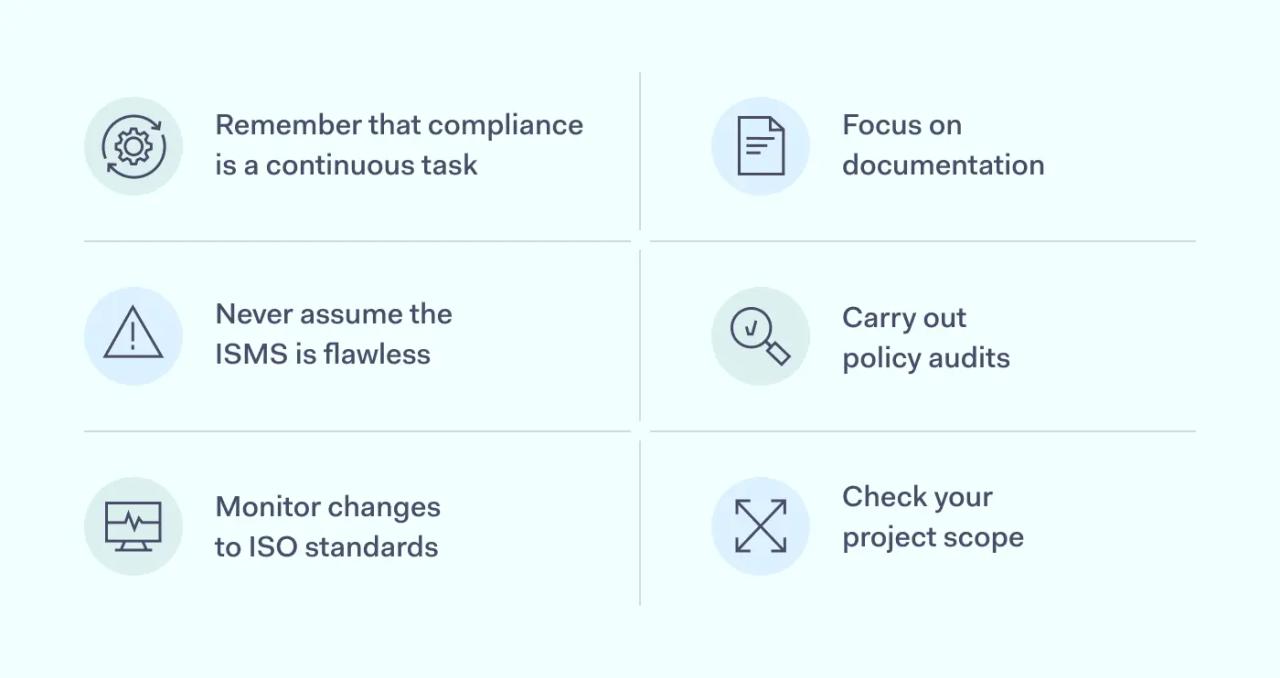
1. Remember that compliance is a continuous task
Assessment bodies regularly audit ISO certification, and holders must renew certificates every three years. When implementing an ISO-compliant ISMS, try to build compliance into day-to-day operations. Schedule annual audits and consultations to remind key stakeholders about their information security roles.
2. Never assume the ISMS is flawless
When security incidents occur (as they will), assess your ISMS. Has it functioned as designed, or are there flaws that require action? Keep a record of changes and identified vulnerabilities. Make mitigation part of your incident management strategy.
3. Monitor changes to ISO standards
ISO updates its standards as threats and technology develop. The move from ISO 27001:2013 to ISO 27001:2022 reorganized Annex A into four categories and reduced the total number of controls from 114 to 93—largely by consolidating overlapping controls—while adding 11 new ones covering areas like cloud services and threat intelligence. All 2013 certificates became invalid after October 31, 2025. Stay informed and fold new ISO guidance into your information security program.
4. Focus on documentation
Document everything related to the ISO process. Make a record of policies, information security controls, access control issues, and incident responses. Document anything that will simplify the auditing process.
5. Carry out policy audits
Documentation must lead to action. Policies are useless if they remain paper exercises. For example, physical security policies should lead to the installation of surveillance and access control systems. Access policies should lock down an organization's confidential data, limiting access to relevant parties.
6. Check your project scope
Organizations change over time. They add new departments and services. They also expand their supply chain, potentially exposing sensitive information. Regularly assess the scope of your ISO 27001 certification. Have you covered all relevant data flows and storage infrastructure?
7. Use compliance automation tools
Compliance automation platforms can pull evidence from your cloud providers, identity systems, and endpoint tools to map controls, flag gaps, and prepare audit-ready reports. They reduce the manual work of tracking control status across dozens of systems and cut the time between internal audit findings and remediation. Choose a tool that supports both the ISO 27001 control set and any adjacent frameworks you follow, such as SOC 2 or HIPAA.
ISO 27001 and data privacy regulations
Data privacy is a fact of modern life, and most organizations must comply with one or more sets of privacy regulations. Organizations that are active in the EU face GDPR obligations. Financial companies must know about Payment Card Industry Data Security Standard (PCI-DSS) rules, while healthcare bodies must be HIPAA-compliant.
ISO 27001 certification contributes to privacy compliance. However, being ISO 27001 certified is not the same as complying with GDPR, HIPAA, or the CCPA This is an important point. It's worth looking at critical regulations individually to explore how ISO 27001 can contribute.
- HIPAA ISO 27001 provides a template for risk-assessing systems that protect healthcare PHI. Companies can use ISO 27001 to build security management systems that secure patient data and restrict access. However, ISO 27001 guidelines are broad. Not all annexes are relevant to HIPAA compliance, and healthcare companies must focus on components that protect healthcare data.
- GDPR The EU's General Data Protection Regulation requires strict access management and security controls. ISO 27001 is useful because it offers a framework for Data Protection Impact Assessments (DPIAs)—a core part of proving compliance. The focus on documentation and systematic risk assessment also helps to build compliant systems across all business operations.
- PCI-DSS Companies that process financial data can use ISO 27001 to build compliant data handling systems. ISO guidelines are a good basis for assessing risks to financial data. They include applicable information security controls while emphasizing the need for policies and continuous improvement—two critical PCI-DSS compliance themes.
- NIS2. The EU Network and Information Security Directive 2 requires essential and important entities to put risk management, incident reporting, and supply chain security controls in place. ISO 27001 provides a ready-made control catalog and management system that maps closely to NIS2's technical and organizational requirements, making it a practical starting point for demonstrating compliance.
- DORA. The EU Digital Operational Resilience Act applies to financial entities and their critical ICT third-party providers. ISO 27001's risk assessment, third-party management, and incident response controls support several DORA requirements, particularly around ICT risk management and supplier oversight, though DORA also has resilience testing and reporting obligations that go beyond ISO 27001.
As a general rule, ISO 27001 will assist compliance with regulations that demand risk-based data protection It makes it easier to assess critical compliance risks and put in place privacy controls. It stresses the need for documented and constant improvement and covers technical, administrative, and operational areas.
Secure your systems with ISO 27001 compliance
ISO 27001 compliance ensures that an organization’s information security practices follow current guidance. ISO 27001 provides a complete framework to assess data security risks and engineer sustainable information security management systems.
All organizations that handle customer data should investigate ISO 27001 compliance solutions By referring to ISO advice, companies can reduce the risk of cyberattacks and data breaches, make their data processing operations more efficient, and ensure compliance with relevant data security regulations.
FAQ
How long does ISO 27001 certification take?
Most organizations complete certification in 6 to 12 months, depending on the maturity of existing controls, the scope of the ISMS, and the size of the business. Small companies with strong security practices can finish in as little as 4 months. Larger enterprises with complex environments may need 12 to 18 months.
How much does ISO 27001 certification cost?
Costs vary widely based on organization size, scope, and whether you use external consultants. Certification audit fees alone typically range from $10,000 to $50,000, and total project costs—including internal effort, tooling, and consulting—often fall between $30,000 and $150,000 for small to mid-sized organizations.
What is the difference between ISO 27001 and SOC 2?
ISO 27001 is an internationally recognized standard that certifies an organization's ISMS against a fixed set of requirements. SOC 2 is a US-focused attestation report produced by a CPA firm that evaluates controls against the Trust Services Criteria. ISO 27001 results in a certificate that is valid for three years; SOC 2 produces a report that is typically issued annually.
Is ISO 27001 certification mandatory?
No. ISO 27001 is a voluntary standard and is not required by law in any jurisdiction. However, enterprise customers, government agencies, and regulated partners frequently require it as a contractual condition, and it can help demonstrate due diligence under laws such as GDPR, HIPAA, NIS2, and DORA.
Disclaimer: This article is for informational purposes only and not legal advice. Use it at your own risk and consider consulting a licensed professional for legal matters. Content may not be up-to-date or applicable to your jurisdiction and is subject to change without notice.