
One of the ways to ensure that your data remains secure, available, and untampered with is compliance with ISO 27001 This global standard helps businesses build, manage, and improve an information security management system (ISMS) and covers everything from employee security training and physical office access to data encryption and incident response workflows. Governed jointly by the International Organization for Standardization (ISO) and the International Electrotechnical Commission (IEC), it is sometimes referred to as ISO/IEC 27001.
The ISO/IEC 27001 requirements include defining the scope of the ISMS and managing data security risks, to name a few. The current 2022 edition officially replaced the older ISO 27001:2013 version, which reduced the number of Annex A security controls from 114 down to 93
Read on to learn about the cost of ISO2700 certification, its essential requirements, the different stages of the certification process, and the milestones companies must reach to maintain ongoing compliance.
Key takeaways
- ISO/IEC 27001 certification is not compulsory However, it helps companies build customer trust and encourages them to build secure practices into their ISMS.
- The 5-step certification process starts with a documentation review and an on-site audit. This is followed by an annual surveillance audit and full recertification every three years
- The cost of ISO 27001 certification varies from $15,000 to $90,000. Factors influencing costs include expenses related to audit preparation, implementation, and certification audit
- Core ISO 27001 requirements include defining the scope of the ISMS and carrying out risk assessments Organizations must also implement the appropriate Annex A security controls
- Measuring ISO 27001 performance is critical. Compliant organizations carry out annual internal audits and ISMS management reviews. External auditors must see evidence of documentation and incident logs.
Do you need official ISO 27001 certification?
While not legally compulsory, ISO 27001 certification is widely recognized and can be a valuable asset for your organization. Organizations can adhere to ISO 27001 requirements without completing the formal certification process. However, pursuing the official certification has significant commercial and operational benefits. Just bear in mind that ISO 27001 certification is only valid for 3 years and after that time, your organization will need to undergo a recertification audit.
To start with, it helps companies satisfy complex regulatory requirements. An organization whose ISMS aligns with ISO standards covers many aspects of the EU’s General Data Privacy Regulation (GDPR) and the Health Insurance Portability and Accountability Act (HIPAA) but doesn’t equate to full compliance.
What’s more, the ISO 27001 certification ensures that an organization’s ISMS has been vetted. It shows that independent, third-party auditors have inspected and approved your security policies, access controls, and physical infrastructure.
For organizations that provide IT or tech-based services, holding the ISO 27001 certification is essential. Passing the audit shows clients that the organization has robust information security processes Conversely, partners are less likely to trust organizations that do not try to achieve a formal security certification.
What are the requirements for ISO 27001?
The International Organization for Standardization updates the requirements of ISO/IEC 27001 periodically to keep pace with new threats. The current edition—ISO 27001:2022—uses the same two-part framework established in the older 2013 version:
- Part 1 consists of 10 main clauses that form the core rules for your ISMS. While clauses 1 through 3 provide introductory context and references, clauses 4 through 10 contain the mandatory rules you must follow to pass the audit.
- Part 2 is paired with Annex A, which lists the 93 recommended security controls that organizations can deploy to meet those high-level ISMS requirements.
The whole certification process is challenging. The best approach is to take a systematic look at policies, procedures, and security measures.
Let’s now take a closer look at the ISO 27001 requirements.
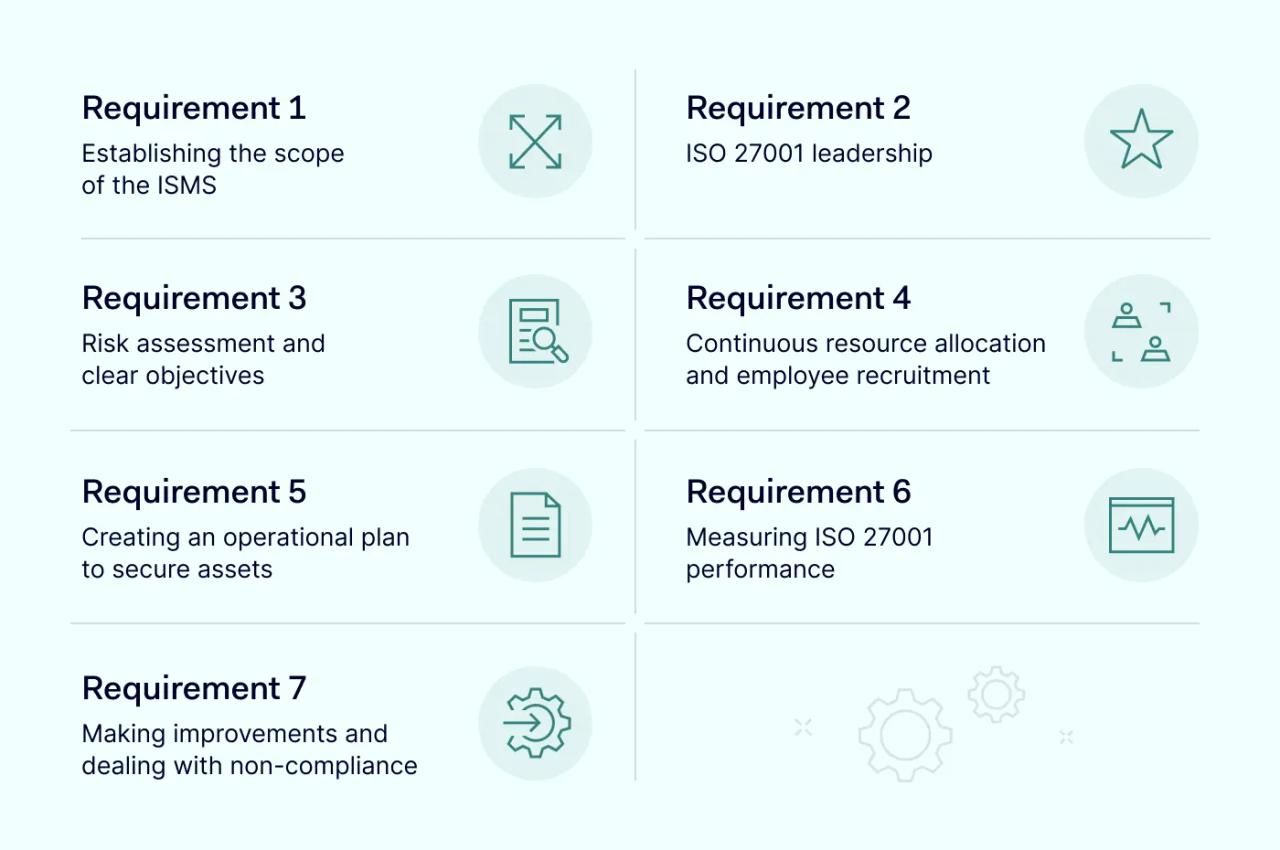
Requirement 1: the scope of the ISMS (clause 4)
The scope of an ISMS refers to how systems protect data. It also defines what information requires protection. Under the ISO 27001 framework, defining this scope requires considering several internal and external factors:
- Stakeholders responsible for the information security management system
- Relevant compliance requirements
- The needs of clients and users
- Standards that apply in specific sectors or industries
- Resources available to create the ISMS
ISO 27001-compliant companies must create a document defining the scope of their ISMS This document details exactly which data categories require protection, the level of security applied to each, and the specific laws or industry standards driving those decisions.
Ultimately, this scoping document forms the foundation of the ISM design process. It sets out the project boundaries and informs external auditors or partners about how the organization safeguards data.
Requirement 2: leadership (clause 5)
Clause 5 requirements focus on getting executive buy-in Compliance teams need executives’ backing, which helps secure resources and collaborate across the organization.
ISO 27001 requirements include the need to approve an information security policy statement Clause 5 requires executives to sign the company’s Information security policy. This sign-off guarantees that resources will be available to implement ISO 27001 guidelines, including ongoing compliance after achieving the certification.
Requirement 3: risk assessment (clause 6)
Companies must constantly manage threats to information systems, and clause 6 of ISO 27001 is the answer to this need. This clause deals with building the risk assessment framework, establishing a risk register, and defining measurable security objectives.
Project teams should also create clear risk management objectives. They must relate to constructing an ISMS compliant with the ISO 27001 requirements. A risk assessment register should document all relevant information security threats. Measurable criteria should assess whether the organization is meeting security objectives.
Clause 6 also recommends creating ISO 27001-compliant structures. For example, companies must integrate information security into all projects, define clear security roles, and segregate duties to reduce information security risks.
Requirement 4: resources, competence, and employee awareness (clause 7)
As we have already mentioned, creating a sustainable ISMS is one of the most important ISO 27001 requirements Security controls and policies are useless without processes to allocate resources and staff roles.
Clause 7 of ISO 27001 requires ongoing training programs for employees and contractors. Training should enable teams to work securely, and educational materials should adapt to reflect new policies or security measures.
Organizations should also screen employees before they are hired, using methods that follow local employment laws. Strict screening applies to roles with access to sensitive data or control over security systems. Employee terms and conditions must also include enforceable information security clauses.
Clause 7 also includes requirements for offboarding employees securely. Organizations must guard sensitive information when individuals leave the organization. There should be a workable disciplinary policy to enforce human security policies.
This part of the ISO 27001 framework demands policies to ensure sustainable compliance. Auditors will check for sustainable compliance. Controls and security systems should function smoothly after the external audit.
Requirement 5: operations (clause 8) and Annex A
Applying risk-based security controls comes next in the list of ISO 27001 requirements.
Clause 8 of the ISO 27001 framework requires companies to create plans to mitigate issues identified in the risk assessment phase. The most critical concerns include:
- Creating an inventory of assets that require protection
- Establishing the ownership of information assets
- Creating secure access control systems and other information security controls to manage the use of assets
Organizations should use their risk register to create a risk treatment plan. This plan defines measures to manage accessing, using, storing, and destroying assets. It also details physical security controls to protect against damage or theft.
Project teams should document every risk-related decision Assessors may decide to avoid or transfer risks. The risk treatment plan should record the reason for this decision. Risk managers may also assign one or more security controls from the Annex A directory. They should state the reason for using all controls.
ISO 27001 auditors verify how organizations classify and mitigate information security risks. And they will want evidence that every risk has a relevant owner responsible for implementing mitigation actions.
Requirement 6: ISMS performance evaluation (clause 9)
Continuous ISMS evaluation is one of the central ISO 27001 requirements.
Clause 9 of the ISO 27001 mandates organizations to run regular ISMS audits and formal management reviews to ensure their ISMS meets internal security goals and remains aligned with ISO 27001 standards.
During these evaluations, the organization tests the effectiveness of its security systems, such as access controls, encryption standards, employee training programs, and physical security. Often, this process includes a gap analysis to identify any hidden operational vulnerabilities and determine the precise steps needed to improve compliance.
To maintain certification, organizations must schedule these internal audits and management reviews at least annually. These exercises must produce detailed, documented evidence of the system's performance, which external auditors will later review to verify that the organization actively monitors and understands its own security posture. Without this evidence, auditors could revoke ISO 27001 certification.
Requirement 7: improvement of non-compliance (clause 10)
While the ISO 27001 framework is a strict set of guidelines, it is designed to be adaptive. Auditors understand that companies cannot be flawless at all times, and assessments may reveal areas of non-compliance. When that happens, organizations have the opportunity to address them without facing penalties.
Clause 10 outlines how to manage an ISMS improvement. Under this clause, organizations must establish processes for improving their ISMS constantly This means having plans to identify and document areas of non-compliance and rectifying security issues as quickly as possible.
When compliance teams detect a non-conformity, they must document the error and schedule a corrective action. Documentation is critical in this context. Auditors expect to see evidence of continuous improvement.
But making changes is not enough. Organizations must have well-evidenced, systematic processes to improve their ISMS when required. Waiting for security incidents is not a good idea. Companies should show auditors that they are proactively seeking areas of improvement.
ISO 27001 clauses and Annex A controls: how they work together
If we were to compare ISO 27001 clauses and Annex A, we could see that the former is the “what” and the latter is the “how.” It is because ISO 27001 only requires an organization to build a security framework, but it doesn’t have any mechanisms to check it
The effectiveness of these security controls is validated during an audit. Auditors use Annex A as a benchmark to measure the effectiveness with which the security controls meet ISO 27001 standards. They check the controls against the list of 93 controls, which we have already mentioned. These controls fall into 4 categories:
- Human or user-related controls
- Technical controls
- Organizational controls (policies and procedures)
- Physical controls
How much does ISO 27001 certification cost?
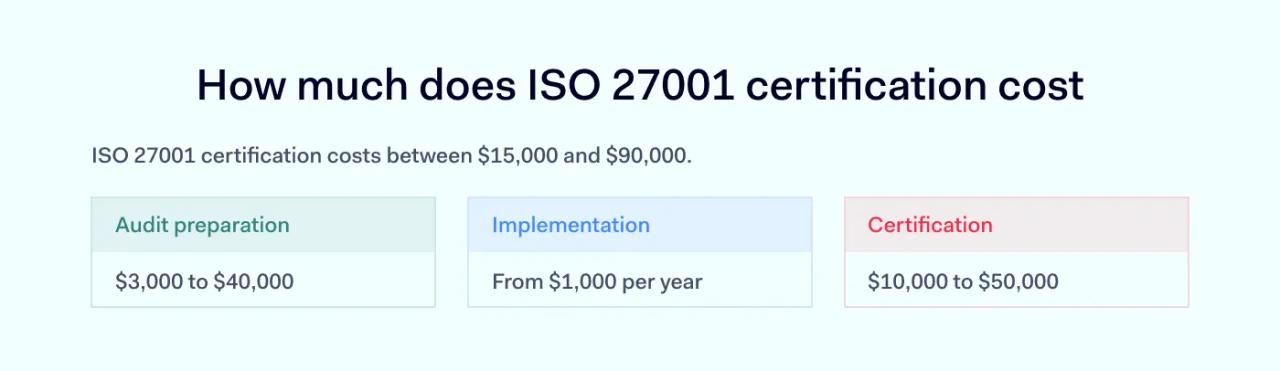
The cost of ISO 27001 certification ranges between $15,000 and $90,000. To understand where these funds go, we can break the total investment down into three operational stages:
- Audit preparation is the most significant expense, averaging between $3,000 and $40,000 This includes risk assessments, sourcing new technology, and securing the resources to conduct internal audits.
- Implementation costs start at approximately $1,000 per year. Costs can rise depending on the complexity of the organization's ISMS.
- Certification audits also have a price tag. An external certification audit typically costs between $10,000 and $50,000.
Ultimately, final compliance bills differ because no two organizations are the same. Larger companies invest more to secure sprawling physical locations and complex IT environments. Similarly, businesses handling highly sensitive data must dedicate extra resources to meet strict compliance benchmarks.
On the bright side, organizations that already have mature security controls and documented policies in place get a massive head start—meaning their final path to certification will be far less expensive.
Achieving robust information security with ISO 27001
A systematic approach enables any organization to achieve and maintain ISO 27001 certification. However, there are no shortcuts in the ISO process. Organizations must allocate enough time and resources to complete the certification project.
Refer to our ISO 27001 checklist as you assess risks and implement Annex A controls. And double-check every certification requirement with internal audits and routine management reviews.
Planning and attention to detail are critical. Solid planning aligns information security management systems and ISO 27001 requirements. Follow our guidance to achieve robust data protection, prevent data breaches, and ensure smooth regulatory compliance.