
Cloud computing is a fundamental part of modern business networks. Worldwide, cloud platforms now store approximately 100 zettabytes of data, and 78% of companies utilize the cloud in most areas of their operations. Reliance on the cloud boosts productivity and innovation, but also creates new security risks. That's where enterprise cloud security comes into play.
This article will introduce enterprise cloud security. We will explore who is responsible for cloud-based security solutions and ECS approaches before providing practical cloud security tips
Key takeaways
- Under the shared responsibility model, cloud providers secure the infrastructure, while clients protect their own data, applications, and access controls.
- Misconfigured storage, weak identity controls, and exposed APIs remain the most common entry points for cloud breaches.
- IAM, encryption, and network segmentation form the foundation of any effective enterprise cloud security strategy.
- Multi-cloud and hybrid setups increase complexity, creating visibility gaps that attackers can exploit.
- Regular staff training and third-party vetting are just as important as technical controls in reducing cloud security risk.
Enterprise cloud security definition
Enterprise cloud security is a cybersecurity approach that includes the policies, practices, controls, and protocols required to secure cloud assets. Enterprise cloud security strategies prevent unauthorized access to cloud environments, monitor user activity, and secure sensitive data and applications. Under the shared responsibility model, both users and cloud providers have key security roles.
Why is enterprise cloud security important?
Approximately 60% of business data now resides in the cloud, and companies rely on enterprise cloud environments for many critical tasks. Cloud providers host sensitive data, enabling sophisticated data analysis and AI implementations. DevOps teams use the cloud to test and develop applications, while eCommerce companies host sales systems on agile cloud platforms. With that level of dependence, breaches come at a high price. IBM’s 2025 Cost of a Data Breach report pegs the global average at $4.4 million.
That cost reflects a real and growing attack surface. Misconfigured storage buckets, weak identity controls, and unsecured APIs rank among the most common entry points for breaches. Attackers can exploit misconfigured cloud resources, weak access controls exposed APIs, or insecure workloads. According to Salt Security’s 2025 report, nearly 1 in 3 organizations suffered an API breach in the past year. That’s why cloud users need comprehensive measures to secure their assets and ensure third parties meet their security obligations.
What does shared responsibility mean in cloud security models?
Enterprise cloud security differs from traditional network security because cloud deployments typically require third-party involvement. Companies are solely responsible for securing data and systems held locally on their own network. In the cloud, that's often not the case.
In the cloud, clients share security responsibilities with their cloud provider. This situation means that providers and users have separate obligations and critical tasks. Shared responsibility can lead to confusion, so it's important to understand where the dividing line lies.
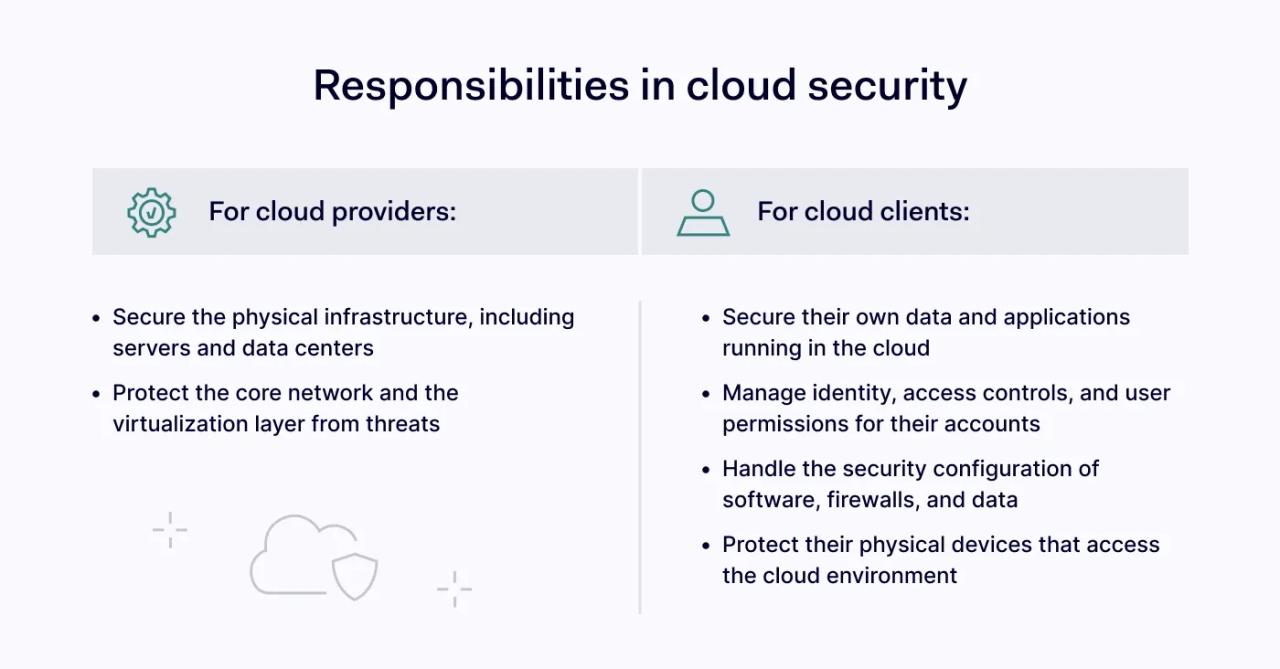
Cloud providers
Cloud service providers must secure the underlying infrastructure that clients use. Providers must guarantee the physical security of servers, data centers, and cables. They must implement strict access controls and ensure continuity during emergencies.
Providers secure components of cloud infrastructure including switches and routers. They protect the hypervisors needed at the virtualization layer, ensuring separation between tenants' assets. Providers also commit to patching firmware and mitigating exploit vulnerabilities.
Some CSPs provide extended security services. For instance, measures to monitor traffic at the application (SaaS) layer, or security services for specific managed databases. However, the primary role of providers is securing infrastructure, not software or user data.
Clients
The clients of cloud providers must secure sensitive data and applications installed on cloud platforms. Clients secure areas of the cloud environment under their direct control. They manage security in the cloud, while providers handle the security of the cloud.
Security teams must classify, segment, and encrypt data held in the cloud environment. Importantly, users are responsible for securing data at rest and in transit. Clients ensure the safe deletion and disposal of data and the secure use of encryption keys.
Moreover, cloud users deal with identity and access management Security teams must implement access controls to allow entry for legitimate users and block malicious actors. Accurate user tracking and logging are also vital to detect threats and audit data access.
Clients also manage software configurations. For example, clients must set up firewalls block public access to data buckets, and secure connections between cloud assets and on-premises networks.
Physical security also matters. Clients need to secure workstations and other endpoints with access to cloud resources. Clients are also responsible for training individual users to avoid phishing attacks and follow secure password practices.
Public, private, and hybrid approaches to enterprise cloud security
Cloud implementations are diverse, and each organization faces unique cloud security challenges. However, it makes sense to divide enterprise cloud security into three distinct approaches: public, private, and hybrid. Let's explore what these approaches involve, and why they might suit your situation.
Public enterprise cloud security
Public cloud environments are multi-tenant services managed by third parties and provided via the public internet. Security in public clouds follows the classic shared responsibility model outlined above.
In the public model, the provider owns and operates every aspect of cloud infrastructure. Clients buy space on the platform and install assets in agreement with the CSP's policies. Amazon AWS and Microsoft Azure are popular examples.
In public cloud computing models, providers cover many security responsibilities. CSPs secure data centers, network connectors, hypervisors, and firmware underlying the platform. Clients secure installed assets, manage access, and ensure data protection via encryption and segmentation.
Private enterprise cloud security
Private clouds are single-tenant environments hosted on dedicated cloud infrastructure This infrastructure could reside on-premises or in separate data centers. In self-managed private clouds, organizations are responsible for securing the full stack, while in hosted or managed private clouds, responsibilities depend on the provider agreement.
Security teams must secure the entire cloud computing stack. This gives companies greater control over how they manage cloud resources, but adds additional security burdens and challenges.
For example, private cloud users must secure physical infrastructure, implement firewalls and network segmentation encrypt data, and manage identity and access management. Teams must test and apply controls and maintain agile patch management strategies across the entire cloud environment.
Hybrid enterprise cloud security
Hybrid clouds combine the features of private and public cloud environments. The hybrid approach enables companies to use third-party providers for some activities (such as website management or data analysis) and use private clouds for secure data protection.
This approach provides flexibility when securing data. However, managing hybrid solutions can be complex.
Security teams need centralized cloud-based security solutions that safeguard connections between public and private cloud resources. Access management policies must encompass the whole cloud environment. Monitoring hybrid settings for misconfigurations and potential vulnerabilities can also be challenging.
Key components of enterprise cloud security
Enterprise cloud security mobilizes a suite of technical tools and approaches to secure cloud resources. Core components of effective ECS solutions include:
- Data encryption Scrambles data at rest and in transit. Attackers cannot easily decrypt data for storage and sale, making data breaches far less likely.
- IAM Assigns users privileges based on their business role. Authenticates user logins via multiple factors, including unique factors like biometrics or one-time access codes.
- Segmentation Divides cloud deployments into logical segments. Allows security teams to implement zero-trust controls limiting access to sensitive resources.
- IP allowlisting. Allows users to control who can access their network with fixed IP allowlisting. This limits access and helps control threats.
- Privileged access management (PAM). Secures and controls accounts with elevated permissions across critical systems. It also combines security policies, credential management, and session monitoring to prevent unauthorized privileged access and reduce the attack surface.
- Cloud security posture management. Detects and mitigates deviations from secure cloud configurations. Includes automated remediation to save time and avoid human error.
- Network security Includes cloud firewalls to filter traffic and block malicious threats. May also include virtual private clouds (VPCs) to reinforce segmentation policies.
- Web application firewalls Protect web-facing apps against SQL injection techniques, blocking a common access point for cloud attacks.
- Data loss prevention (DLP). Tracks sensitive data, alerting security teams to deletions, amendments or transfers that may signify data leaks.
- Service agreements. Set out the shared responsibilities of providers and clients. Ensure everyone understands their roles and expectations.
Understanding enterprise cloud security threats
The emergence of cloud computing has streamlined operations in many ways, enabling cost-efficient storage and data processing. However, cloud environments have also attracted the attention of cybercriminals, leading to a new generation of cloud security threats
Here are some critical threats that security teams need to consider:
- Denial-of-service (DoS) attacks Attackers flood cloud computing platforms with malicious traffic, taking down operations and disrupting business activity. Distributed denial-of-service (DDoS) attacks amplify this threat by coordinating traffic from multiple sources, which makes them harder to detect and mitigate.
- Data breaches Cloud environments face a serious security risk from data breaches. They can result from credential stuffing attacks against weak authentication systems, injection attacks targeting insecure apps, hacking, insider threats, lost devices, or misconfiguration.
- Accidental data leaks. Human error can also lead to cloud data leaks. For example, healthcare employees may inadvertently share cloud credentials with unauthorized contacts.
- Configuration errors Users must apply security settings on cloud applications and storage solutions. Configuration errors leave assets undefended, potentially exposing data to the external internet.
- Cloud ransomware attacks Some forms of ransomware target cloud deployments, spreading throughout the environment and encrypting valuable assets. Aside from ransom payments, this leads to data loss and compliance penalties.
- Exposed APIs. APIs are crucial cloud components that enable applications to communicate seamlessly. However, exposed APIs can open the door to cyberattackers. An exposed internet-facing API or app can give attackers an entry point and, if access controls are weak, help them move further across the cloud environment.
- Credential theft. Stolen credentials allow malicious actors to hijack legitimate user accounts. Criminals bypass security controls to access and extract sensitive data before security teams can respond.
- Third-party risks Cloud partners may fail to implement effective security solutions. Companies need to mitigate this risk by comprehensively assessing cloud providers and routinely auditing third-party risks.
Challenges of enterprise cloud security
As organizations scale their enterprise cloud environments, some challenges can make it difficult to maintain consistent protection.
- Multi-cloud visibility gaps. Most enterprises spread workloads across two or more cloud providers that come with their own security tools, dashboards, and logging formats. This fragmentation can create blind spots where misconfigurations, unauthorized access, or suspicious activity can go unnoticed.
- Shadow IT. Employees and departments frequently adopt cloud applications and services without IT approval. These unsanctioned tools sit outside the organization’s security perimeter, meaning they aren’t monitored, patched, or governed by company policy.
- Regulatory compliance. Cloud deployments often span multiple regions, each with its own data protection laws. Regulations like GDPR, HIPAA, and PCI DSS impose strict requirements on how data is stored, processed, and transferred. Keeping up with evolving compliance mandates across different jurisdictions, while maintaining consistent controls across cloud providers, puts significant pressure on security and legal teams alike.
- Skill shortage. Cloud security requires specialized expertise that remains in short supply. Smaller companies in particular often lack the budget or headcount for dedicated cloud security staff. This forces teams to spread themselves too thin, increasing the risk of misconfiguration and delayed incident response.
Best practices for enterprise cloud security
Cloud environments multiply critical security threats, from DoS attacks to data theft by malicious insiders. Enterprise cloud security mitigates these threats, ensuring smooth cloud operations and cutting compliance risks.
Here are some best practices to implement enterprise cloud security in your organization:
- Implement IAM Identity and access management is the most important tool for securing cloud environments. Security teams must maintain up-to-date user databases and assign role-based privileges for each user. Multi-factor authentication also makes it harder for attackers to gain access via stolen credentials.
- Use strategic cloud network security Use network segmentation to protect critical cloud resources and limit lateral movement. Ideally, use zero-trust approaches that verify user identities continuously. Only allow access to authorized users for limited periods.
- Integrate network security with cloud monitoring Segmentation and authorization should work with cloud monitoring solutions. Security teams need centralized tools to monitor user activity and traffic patterns. Real-time monitoring rapidly identifies threats, enabling efficient incident responses
- Use automated cloud security tools Automated cloud security posture management (CSPM) tools cut the risk of human error and save time for analysis and threat hunting. Configure CSPM to monitor anomalies, compliance violations, and configuration issues. Use automated responses to make instant changes, or escalate incidents via real-time alerts.
- Use robust data encryption. Encrypting data at rest and in transit is both a data protection and compliance essential. Couple the most robust encryption standard available with secure key management.
- Implement API security solutions Insecure or exposed APIs are critical cloud vulnerabilities. Validate and monitor all cloud APIs to detect anomalies and deliver patches as needed. Use rate limiting to counter DoS attacks, and audit APIs via configuration and activity logs.
- Use CASBs. Cloud access security brokers (CASBs) sit between users and cloud environments, centralizing monitoring and threat mitigation tools. CASBs also unify cloud environments. They make every endpoint and storage container visible, easing the implementation of cloud security policies.
- Threat intelligence platforms These platforms monitor existing and emerging cyber threats across sources like the dark web and hacker forums. This allows security teams to proactively spot risks and put protective measures in place before an attack happens.
- Apply third-party security vetting Cloud security solutions must assess all third-party cloud providers. Use robust service agreements that define cloud-based security responsibilities. Apply service agreements to infrastructure providers, external security partners, and SaaS vendors to avoid security gaps.
- Train staff in cloud security basics Training is critically important to cut the risk of human error. Many cloud attacks result from avoidable phishing attacks or poor password hygiene. Ensure staff understand how their behavior can cause cyberattacks and data breaches.
Take action to ensure enterprise cloud security
Enterprise cloud security comprises policies, controls, and practices designed to protect cloud-based assets, data, and applications.
According to the shared responsibility model, cloud security demands collaboration between cloud providers and users. Users protect workloads and data, while providers secure the underlying infrastructure.
Businesses increasingly rely on cloud environments for operations, storage, and innovation. Effective security counters ever-present cyber threats enabling companies to focus on productivity gains.