
NIST SP 800-207 is the foundational guidance for designing a zero-trust architecture (ZTA). It moves away from the assumption that users or devices inside a corporate network are trustworthy, recommending continuous verification of every access request based on identity, device health, context, and risk Published by the US National Institute of Standards and Technology (NIST) this framework has become one of the most widely referenced documents for organizations rethinking how they grant access.
As businesses shift workloads to the cloud, support remote teams, and run hybrid infrastructure, traditional perimeter-based security models fall short. Users, devices, and workloads now operate far beyond the corporate office, which makes identity and continuous verification—not network location—the practical control plane for security.
This guide explains what NIST SP 800-207 is, how zero-trust architecture works, the framework’s core tenets and components, its value in ensuring compliance, and how organizations can begin aligning with its recommendations.
What is NIST SP 800-207?
NIST SP 800-207 is a guidance publication from the National Institute of Standards and Technology (NIST) that explains how organizations can design and implement a zero-trust architecture (ZTA). Published in August 2020 as part of NIST’s Special Publication 800 series, it provides practical recommendations for continuously verifying every access request in place of implicit network trust.
A follow-up publication, NIST SP 800-207A (finalized in September 2023), extends the model specifically to access control in cloud-native and multi-cloud environments, where workloads, identities, and network boundaries change constantly.
NIST SP 800-207 focuses on architectural principles, not specific products. It explains what organizations should achieve—not which vendors or tools they should use. Federal agencies, regulated industries, and private-sector security teams use the publication as a blueprint when adopting zero-trust principles, implementing least-privilege access and strengthening identity-based security.
What is zero-trust architecture (ZTA)?
Zero-trust architecture (ZTA) is a cybersecurity approach that assumes no user, device, application, or workload should be trusted automatically whether inside or outside the corporate network. Instead of granting broad access after a single login, ZTA evaluates every access request by using multiple signals, including:
- User identity
- Device posture
- Location
- Time of request
- Resource sensitivity
- Behavioral risk indicators
- Threat intelligence
If the request satisfies the organization’s security policies, access is granted. If the risk changes—for example, if a device becomes noncompliant or suspicious activity is detected—access can be reduced or revoked immediately.
The goal is simple: give users only the access they need while shrinking the window of time that attackers have to move laterally.
NIST SP 800-207 vs. traditional perimeter security
Traditional security assumes that users inside the corporate network can generally be trusted. Zero trust drops this assumption and requires verification every time access is requested.
Traditional perimeter security | NIST SP 800-207 ZTA |
|---|---|
Trust is largely based on network location. | Trust is never assumed. Every request is verified. |
Users authenticate once. | Authentication and authorization are continuously evaluated. |
Security focuses on protecting the network perimeter. | Security focuses on protecting individual resources. |
Broad network access is common. | The principle of least privilege limits access to only the necessary resources. |
Monitoring often occurs after access is granted. | Continuous monitoring feeds access decisions in real time. |
The difference reflects how modern organizations actually operate. Employees connect from home, airports, customer sites, and personal devices, making network location a weak indicator of trust.
The 7 tenets of NIST SP 800-207
NIST defines 7 tenets in Section 2.1 of SP 800-207. Together, they shape every zero-trust architecture and create an environment where access is continuously evaluated instead of permanently granted.
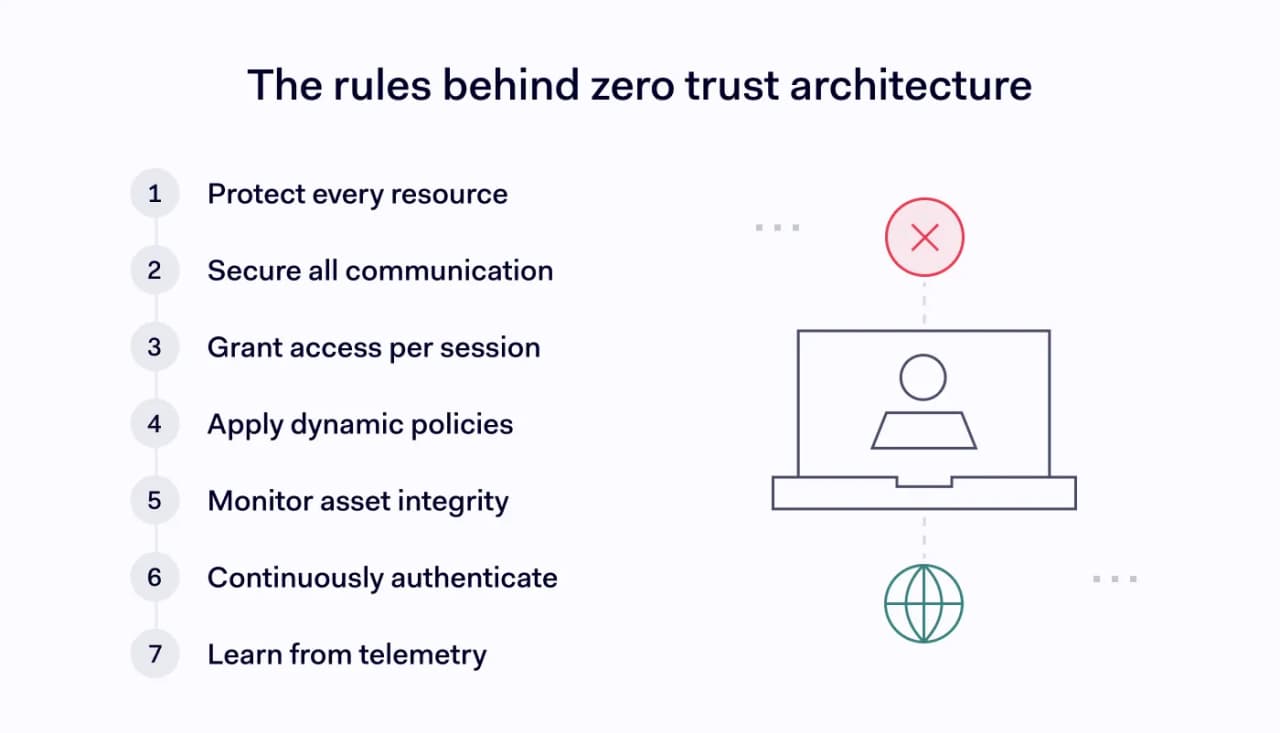
1. Treat every resource as a protected asset
Applications, databases, APIs, cloud services, virtual machines, and endpoints should all be considered assets that need protection, not just the corporate network. Once resources exist simultaneously across SaaS, IaaS, and on-prem systems, the perimeter itself is no longer a meaningful boundary. Each resource needs its own protection, independent of the network it belongs to.
2. Secure communication regardless of network location
Whether users connect from the headquarters, their homes, or public Wi-Fi, their communications should always be protected. Security policies should not depend on a user’s location. Encryption in transit and mutual authentication should be applied to the corporate LAN just as they are to the open internet. Treating the internal network as “safe” is one of the assumptions zero trust is designed to remove.
3. Grant access per session
Every access request should be evaluated individually. Users receive only the permissions needed for that session not broad or permanent network access. A session that grants read access to one database should not automatically extend to a second one. Once the task is complete, the access ends, and the next request starts fresh.
4. Apply dynamic, policy-based access
Access decisions should consider multiple factors, including:
- User identity
- Device security posture
- Requested resource
- Location
- Time
- Current risk level
- Available threat intelligence
Policies should adapt automatically as these conditions change.
5. Continuously monitor asset integrity
Organizations should regularly verify that devices remain compliant with security policies. A compromised device should lose access automatically. Posture checks should be performed before access is granted and continue in the background throughout the session. If a device drops off patch levels or disables its endpoint protection mid-session, the policy engine needs to know.
6. Continuously authenticate and authorize
Authentication is not a one-time event. Users, devices, and applications should be validated throughout the session so that shifting risk conditions can be detected as they happen. Signals like a sudden location change, an unusual data transfer volume, or a failed step-up prompt should be able to trigger re-authentication or session termination. The goal is to keep the trust decision current, not to freeze it at login.
7. Collect and improve using telemetry
Organizations should continuously gather logs, security events, behavioral analytics, and threat intelligence to improve future policy decisions and strengthen their defenses over time. The same telemetry that supports detection also supports tuning. Over time, patterns in access requests and denials reveal where policies are too loose, too strict, or missing entirely.
Core architectural components
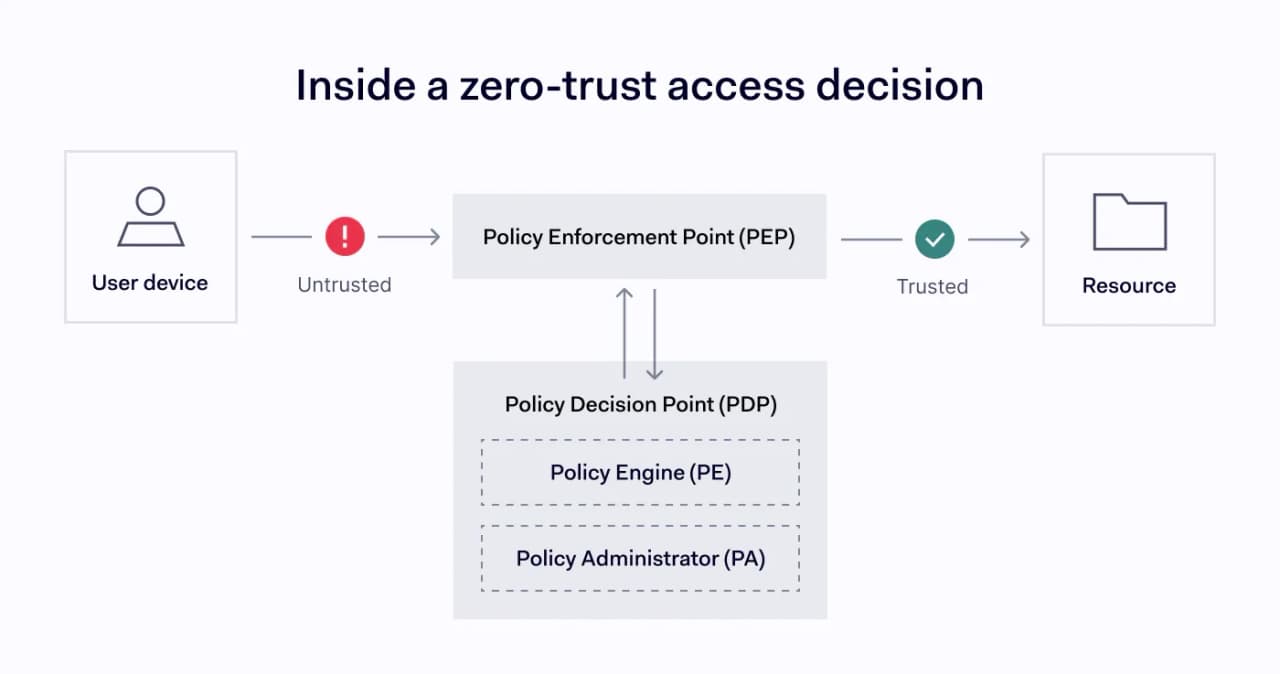
At the center of NIST SP 800-207 zero-trust architecture are two logical components that work together whenever someone requests access: the Policy Decision Point (PDP) and the Policy Enforcement Point (PEP).
1. Policy Decision Point
The Policy Decision Point (PDP) coordinates authentication, authorization, and policy evaluation while ensuring every request follows organizational rules. It does not enforce access itself—it decides what should happen and hands that instruction to the Policy Enforcement Point (PEP). Internally, the PDP is split into two sub-components that divide the work of deciding and executing.
a) Policy Engine
The Policy Engine (PE) is the decision-maker. It runs the trust algorithm—the logic that weighs signals against policy—to grant, deny, or revoke access. To reach that decision, it evaluates numerous inputs, including:
- Identity information
- Device compliance
- Risk signals
- Security policies
- Environmental context
- Threat intelligence
b) Policy Administrator
The Policy Administrator (PA) executes that decision. It tells the Policy Enforcement Point to open or close the session and issues the tokens or credentials the user needs to reach the resource. In short, if the PE decides, the PA acts on that.
2. Policy Enforcement Point
The Policy Enforcement Point (PEP) sits between users and protected resources. After receiving instructions from the Policy Administrator, the PEP either:
- Grants access
- Denies access
- Limits available permissions
- Terminates an existing session if risk increases
Because policy enforcement happens in real time, organizations can react quickly when device posture changes or suspicious activity appears.
How these components work together
The process typically follows these steps:
- A subject—a user, device, application, service, or other entity attempting to connect—requests access to a resource.
- The Policy Enforcement Point (PEP) intercepts the request and forwards it to the Policy Decision Point.
- The Policy Decision Point (PDP) gathers context—identity, device posture, risk signals, and threat intelligence—from its data sources (Policy Information Points).
- The Policy Engine (PE) runs its trust algorithm against enterprise policy and reaches a decision: grant, deny, or revoke.
- The Policy Administrator (PA) executes that decision—it signals the PEP to establish or terminate the session and issues any session credentials or tokens.
- The PEP enforces the decision at the resource boundary: grants, denies, limits, or terminates access.
- Monitoring continues throughout the session, and any change in risk feeds back to the Policy Engine, which can reevaluate and revoke access mid-session.
Rather than making a single trust decision at login, this cycle repeats as often as conditions require—sometimes several times within a single session.
Zero-trust deployment models
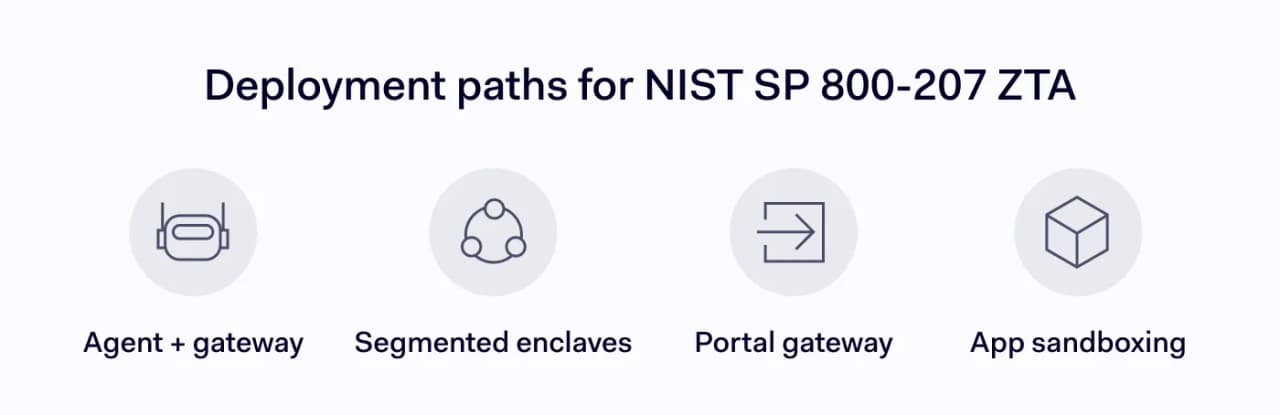
NIST SP 800-207 describes 4 ways organizations can implement zero-trust architecture, depending on their infrastructure.
Device agent or gateway model
Security software installed on endpoints or traffic gateways continuously evaluates users and devices before allowing access to protected resources. This model works well for organizations with managed devices and remote employees.
Enclave-based model
Resources are grouped into secure segments, or enclaves, protected by dedicated security controls. Users only receive access to the enclave required for their work, reducing opportunities for lateral movement if an account is compromised.
Resource portal model
A secure portal sits in front of applications and services. Users authenticate through the portal, which verifies their identity, evaluates their access policies, and grants them access only to approved resources. This approach is commonly used for cloud-based applications and web services.
Device application sandboxing
Trusted applications run in isolated sandboxes or virtualized containers on the user’s device, separated from the rest of the operating system. Each sandboxed application communicates directly with protected resources, so a compromised device cannot reach them. This model fits situations where the endpoint itself cannot be fully trusted, such as with BYOD or contractor devices.
Compliance benefits and challenges
NIST SP 800-207 is guidance, not a compliance standard in itself—but its influence on US and international regulation makes it a practical starting point for meeting several mandates at once.
Where SP 800-207 supports compliance
- US federal mandates. Executive Order 14028 and the OMB M-22-09 memo require federal agencies to adopt a zero-trust architecture, and both point back to NIST SP 800-207 as the reference model. Contractors and vendors serving federal agencies are expected to follow the same principles.
- CMMC 2.0. Access control, identification and authentication, and audit and accountability controls align with the tenets of SP 800-207.
- HIPAA, PCI DSS, and ISO/IEC 27001:2022. Least privilege, continuous monitoring and per-session authorization are already required or recommended across these frameworks. Zero trust gives organizations one architecture that addresses many overlapping controls.
- NIS2 and DORA in the EU. Both regulations expect strong access governance, network segmentation, and incident detection—capabilities that align directly with a zero-trust model.
Where organizations tend to struggle
- Legacy applications. Older systems often can’t enforce per-session authorization or integrate with modern identity providers, forcing teams to wrap them in gateways or portals.
- Identity data quality. Zero trust depends on accurate user, group, and device data. Stale directories and orphaned accounts undermine every downstream policy decision.
- Policy sprawl. Without clear ownership, dynamic policies multiply until nobody can explain why a specific request was allowed or blocked.
- Measuring progress. SP 800-207 does not prescribe metrics. Organizations need to define their own success criteria—for example, percentage of applications behind a policy enforcement point, or the time it takes to revoke access after a device becomes noncompliant.
Compliance is not a byproduct of buying a zero-trust product. It comes from mapping controls to the tenets, documenting the architecture, and auditing enforcement over time.
How to get started with NIST SP 800-207
Implementing a zero-trust architecture is usually a gradual process, not a single deployment. Organizations often begin with their most critical systems before expanding across the environment.
Inventory users, devices, and resources
Identify:
- Users
- Endpoints
- Applications
- Cloud workloads
- Sensitive data
A zero-trust program is only as good as the inventory it runs on. Understanding what needs protection is the foundation of every zero-trust initiative. Most organizations find the exercise itself valuable because it quickly surfaces shadow IT forgotten cloud accounts, and unmanaged endpoints.
Map access relationships
Determine who needs access to which resources and why Many organizations discover excessive permissions that have accumulated over time. Old projects, departed employees, and quietly expanding roles all leave residue in access control lists. Mapping these relationships reveals the discrepancy between what people should have and what they actually have.
Implement the principle of least privilege
Only grant users the permissions necessary to perform their roles. Regularly review access rights and remove outdated or unnecessary permissions. Time-bound and just-in-time access can further reduce standing privilege, especially for admin accounts. The goal is not to make access harder—it is to make excessive access rare.
Strengthen identity verification
Deploy strong authentication methods, such as:
- Multi-factor authentication (MFA)
- Single sign-on (SSO)
- Device certificates
- Conditional access policies
Identity carries most of the weight in a zero-trust architecture.
Evaluate device posture continuously
Before granting access, verify that devices:
- Run supported operating systems
- Have current security updates
- Meet compliance requirements
- Use approved security software
Introduce continuous monitoring
Collect telemetry data from users, devices, applications, and networks to detect suspicious behavior and improve policy enforcement over time. The volume of this data is significant, so investing early in aggregation, retention, and analysis pays off. Monitoring is also what turns zero trust from a static configuration into a system that learns.
Expand gradually
A full infrastructure rebuild is rarely practical; gradually expand zero-trust protections to additional users, applications, and environments. A common approach is to start with a single high-value application, prove the model works, then expand to adjacent systems. Each phase becomes a template for the next, which keeps the program manageable and reduces the risk of large-scale disruption.
Bringing NIST SP 800-207 principles into practice
NIST SP 800-207 doesn’t prescribe specific technologies—it provides guidance for designing a security architecture built around continuous verification and least-privilege access.
NordLayer maps to several SP 800-207 tenets directly:
- Zero-trust network access (ZTNA) provides per-session, identity-aware access to specific resources instead of the whole network, directly supporting the “grant access per session” tenet.
- Business VPN provides encrypted remote connectivity between users and company resources, giving IT admins a controlled entry point they can layer additional zero-trust controls on top of.
- Cloud firewall and virtual private gateways support segmentation and per-resource protection, aligning with the “protect every resource” tenet.
- Device posture security enforces compliance checks before a user account can reach the network, supporting continuous asset integrity verification.
- Single sign-on, MFA, and IP allowlisting strengthen the identity signals that inform policy decisions.
- The Control Panel centralizes policy management and gives admins visibility into connections, devices, and access events.
Used together, these capabilities help organizations put practical zero-trust controls in place across cloud and hybrid environments—without a full-scale infrastructure rebuild.
The guidance outlined in NIST SP 800-207 enables organizations to move away from implicit, perimeter-based trust to a security model that evaluates every request individually, every time.