
Zero-trust architecture is a modern security framework designed to safeguard digital environments by eliminating the notion of trust within a network. Instead of assuming that internal networks are secure and external ones are not, the zero-trust model operates on the principle of "never trust, always verify." This means that every user, device, and connection within and outside the network must be authenticated, authorized, and continuously monitored before access is granted to any resource.
As businesses face rapidly evolving cyber threats, zero-trust framework helps mitigate risks by ensuring that attackers can't exploit implicit trust. It's an approach that has become essential for protecting modern digital environments and is a key strategy in preventing data breaches and unauthorized access.
Key takeaways: understanding zero-trust architecture (ZTA)
- A zero-trust model focuses on verifying users and devices in real time to ensure security follows the user rather than the location.
- Strictly enforcing role-based access controls minimizes your attack surface and prevents lateral movement by confining potential attackers to isolated network segments.
- Assuming a threat is already present shifts the focus from perimeter defense to active risk mitigation through continuous monitoring and the automated isolation of suspicious activity.
- A zero-trust model provides a consistent security framework that scales with your business. It ensures modern compliance with standards like NIS2 or SOC 2 while maintaining a seamless experience for hybrid teams.
Importance of zero-trust architecture
Digital transformation has brought new security challenges, especially with the growing use of cloud services, remote work, and personal devices. Traditional perimeter-based security models, which rely on strong defenses at the network edge, have become less effective because threats can emerge from within the network. Insider threats compromised devices, and advanced cyberattacks can bypass these defenses.
To address this, many organizations are turning to zero-trust architecture. It prevents lateral movement (when attackers move within a network once inside) by continuously verifying and validating all access requests. Organizations that adopt a zero-trust architecture can significantly strengthen their security strategy and reduce the risk of breaches.
How does zero-trust architecture work?
The zero-trust model operates under the assumption that threats can exist both inside and outside an organization’s network. Therefore, it focuses on verifying every connection, no matter the source. The approach can be broken down into key steps:
- User and device verification Every user and device attempting to connect to the network must first be authenticated, regardless of their location. This includes verifying credentials and ensuring that the device is secure.
- Segmentation Instead of one flat network, this strategy divides your infrastructure into small, isolated zones. By creating these perimeters around specific workloads or data sets, you can prevent lateral movement and ensure that a security incident in one area doesn’t spread to the rest of the organization.
- Least privilege access Once verified, users are granted access only to the resources they need to perform their job. Restricted access permissions minimize the attack surface and limit the impact of potential breaches.
- Continuous monitoring Access is constantly monitored and reevaluated. If suspicious activity is detected, access can be revoked immediately.
Following these steps allows zero-trust solutions to provide a more secure and adaptable framework for digital business environments.
Benefits of using zero-trust architecture
Organizations implementing zero-trust architecture gain several key benefits that significantly enhance their security posture. Such advantages include:
- Enhanced security By eliminating implicit trust, zero trust ensures that every request is verified before access is granted. This minimizes the risk of unauthorized access and data breaches.
- Reduced attack surface With the least privileged access, users only have access to the resources necessary for their work, reducing the potential entry points for attackers.
- Protection against insider threats Since zero trust continuously verifies all activities, it helps detect suspicious behavior from users inside the network, preventing potential insider threats.
- Scalability The architecture is scalable, meaning it can grow with the business and adapt to changing security needs, making it ideal for enterprises of all sizes.
- Compliance Many industries require stringent security protocols for compliance with regulations. Zero-trust security provides a comprehensive framework that helps organizations meet these requirements.
- Improved user experience With automation and ZTNA, users experience seamless and secure access to resources, even when working remotely.
Zero trust core principles
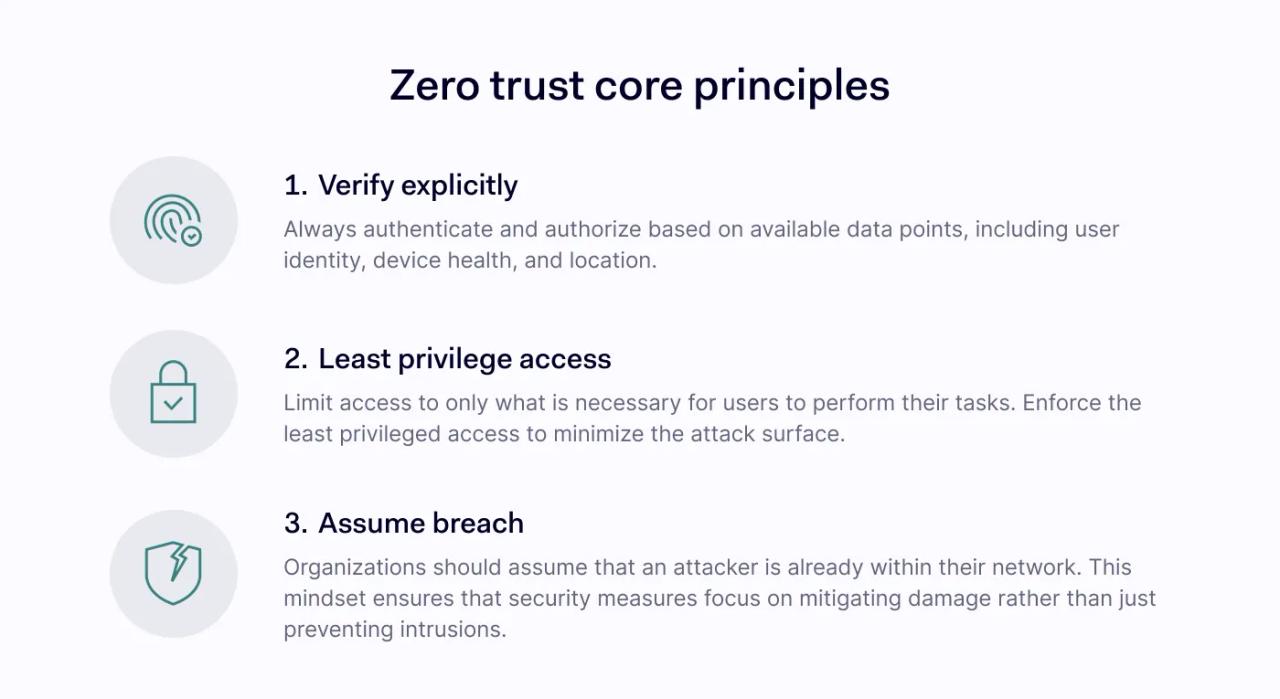
The foundation of zero-trust architecture rests on several core principles. These principles guide how organizations should manage their networks to maximize security:
- Verify explicitly Always authenticate and authorize based on available data points, including user identity, device health, and location.
- Least privilege access Limit access to only what is necessary for users to perform their tasks. Enforce the least privileged access to minimize the attack surface.
- Assume breach Organizations should assume that an attacker is already within their network. This mindset ensures that security measures focus on mitigating damage rather than just preventing intrusions.
For a more detailed discussion of zero-trust principles, you can check this article
Components of a zero-trust architecture
A comprehensive zero-trust architecture includes several components that work together to secure the network. Here are some of the critical components of zero trust:
User identity and access management (IAM)
IAM ensures that only verified and authenticated users can access the network. This often includes enforcing strong password policies and utilizing multi-factor authentication (MFA) to confirm user identities. With IAM, organizations can control and manage user permissions effectively, reducing unauthorized access risks.
Device security
A fundamental aspect of zero trust is ensuring that all devices connected to the network are secure and trustworthy. This includes requiring devices to meet specific security standards, such as updated antivirus software and encryption protocols, before granting access to network resources. This process helps mitigate potential vulnerabilities introduced by compromised or untrusted devices.
Data protection
Data protection is a core component of zero trust, focusing on safeguarding sensitive information, whether in transit or stored. Encryption, along with data loss prevention (DLP) tools, ensures data is secure. Access to critical data is restricted based on user roles, ensuring that only authorized personnel can view or modify sensitive information.
Network segmentation
Network segmentation involves dividing the network into smaller, isolated sections to limit attackers' movement if a breach occurs. By creating distinct zones, organizations can contain security threats and prevent lateral movement within the network, enhancing overall protection and reducing the risk of widespread compromise.
Continuous monitoring and threat detection
Continuous monitoring and threat detection are essential for maintaining network security in a zero-trust environment. These tools analyze network activity in real-time, identifying unusual or suspicious behavior that may indicate a breach. Early detection enables rapid response, reducing the potential impact of cyberattacks or unauthorized access.
Access policies and automation
Dynamic access policies are an integral part of zero trust, adapting to real-time risk assessments and adjusting permissions accordingly. These policies ensure that only legitimate users can access the network. Automation plays a crucial role in responding to threats swiftly, allowing for immediate action, such as revoking access or isolating devices.
Zero trust in practice: common organizational use cases
While the concept of “never trust, always verify” sounds simple, the practical applications of a zero-trust model are what make it a baseline for modern security. By shifting the focus from the network edge to individual identities and assets, you can address specific risks that traditional firewalls simply aren’t built to handle. A strong ZTA ensures that users and devices are continuously authenticated before gaining entry.
Here are a few common ways organizations are putting these principles into practice:
- Securing remote and hybrid work. Instead of relying on a virtual private network (VPN) that grants broad network access, this approach verifies the user’s identity and the security posture of their hardware—including personal devices—before granting access to specific applications.
- Refining access controls. Organizations implement granular access controls to manage who can see what. Using identity-based authentication ensures that only the right people have access to sensitive business information at the right time.
- Mitigating insider threats. The principle of least privilege is to be implemented so that, even if an account is compromised, the attacker is confined to a small segment of your network, thereby preventing them from accessing your entire IP address inventory.
- Managing third-party risk. You can grant contractors access to only the specific tools they need, without exposing your internal infrastructure to external vulnerabilities or cyber risks.
Zero-trust architecture implementation stages
Implementing a zero-trust model requires careful planning and step-by-step execution. Here are the typical stages of deploying a zero-trust strategy:
- Assess current security posture. Start by evaluating your organization's current security setup, and identifying weaknesses and areas that need improvement.
- Define access policies. Create detailed access policies based on least privilege principles, ensuring that users only have access to what they need.
- Implement identity verification. Introduce strict Identity and Access Management (IAM) controls, including MFA and password policies.
- Segment the network. Implement network segmentation to isolate different parts of the network and limit lateral movement.
- Deploy continuous monitoring. Introduce tools to monitor network activity in real-time and automatically respond to threats.
- Test and refine. Regularly test and refine your zero-trust strategy, making adjustments as needed to stay ahead of evolving threats.
How can NordLayer help with implementing zero trust?
NordLayer offers a suite of Zero Trust solutions that help small to medium businesses enhance their security strategy during their digital transformation journey. With features like Zero Trust Network Access and centralized control through a web-based dashboard NordLayer makes it easy to implement and manage a Zero Trust security model.
NordLayer supports continuous monitoring, user authentication, and network segmentation, providing comprehensive protection against modern cyber threats. Whether your organization is in the early stages of Zero Trust implementation or looking to strengthen existing defenses, NordLayer can guide you through the process with its cloud-based security platform.
Adopting a Zero Trust model is a crucial step in safeguarding your business against today's complex cyber threats. By following Zero Trust principles and implementing the right tools and strategies, organizations can protect their data, limit unauthorized access, and maintain a strong security posture.