
Cybersecurity has changed a lot over the past decade. Employees work from home, business applications run in the cloud, and users access company resources from personal devices, managed laptops, and mobile phones. The traditional security model—where everything inside the corporate network is trusted—no longer fits today’s way of working.
That’s why organizations are rolling out zero trust Rather than relying on a trusted network perimeter, zero trust verifies every user, device, and connection before granting access to business resources Making this shift isn’t something organizations complete overnight. It requires changes to technology, policies, and the way access decisions are made across the business.
This guide explains the basics of the zero-trust implementation process and why organizations are prioritizing it, common challenges, and best practices for a successful rollout.
What does zero trust adoption mean?
Zero trust adoption is the process of moving an organization away from the old perimeter-based mindset and onto a model built on zero-trust principles
The idea itself isn’t new. John Kindervag, a principal analyst at Forrester Research at the time, coined the term “zero trust” in 2010. He argued that the old “trust but verify” approach no longer matched how networks actually worked. Kindervag proposed a simpler rule: “never trust, always verify” Every request is checked, whether it came from inside the office or halfway across the world.
More than a decade later, that principle remains central to modern cybersecurity strategies and shapes how organizations design access, identity, and network controls. In practice, this means that every access request is continuously evaluated using signals like identity, device health, location, and risk
The goal is to redesign how users access applications, data, and networks by applying 3 basic ideas:
- Verify explicitly. Authenticate and authorize every user and device using all available signals, such as identity, device health, location, and risk.
- Apply least privilege access. Give users only the permissions they need to perform their jobs and nothing more.
- Assume breach. Design systems as though an attacker is already inside the environment and can spread from one system to another (lateral movement).
These principles form the foundation of a zero-trust framework, a security approach that verifies trust with each request instead of granting it permanently after login.
For most organizations, rolling out zero trust happens in phases rather than as a single project Existing infrastructure, legacy applications, and long-standing business processes usually need to be reworked one layer at a time, starting with identity management, device security, network access, and finally, continuous monitoring.
Why organizations are adopting zero trust
Several technology and business trends have made zero-trust security more relevant than ever.
Hybrid work is here to stay
Employees no longer only work from corporate offices. They connect from home networks, coworking spaces, airports, and customer sites. Traditional perimeter security can’t consistently protect these environments because users rarely connect through a single trusted network.
Cloud adoption has expanded the attack surface
Business applications are increasingly run on SaaS platforms and in cloud environments rather than in private data centers. A single company might use dozens of cloud tools across marketing, HR, engineering, and finance, each with its own login and access rules. As data and applications move outside of corporate networks, organizations need security controls that follow the user, not the office.
Cyber threats have become more advanced
Attackers tend to steal legitimate credentials instead of exploiting network vulnerabilities. Because compromised accounts appear legitimate, organizations need stronger identity verification, tighter access controls, and ongoing monitoring to detect suspicious behavior before attackers can cause damage.
Compliance requirements continue to change
Many regulatory frameworks now expect organizations to demonstrate stronger access controls, identity management, and risk-based security practices. While zero trust isn’t always required explicitly, it helps organizations meet many modern security expectations.
Individually, any one of these trends is manageable. Together, however, they’re the reason zero trust has moved from theory to boardroom priority
Zero trust adoption stages
Every organization follows a different path, but a successful rollout typically progresses through 4 stages.
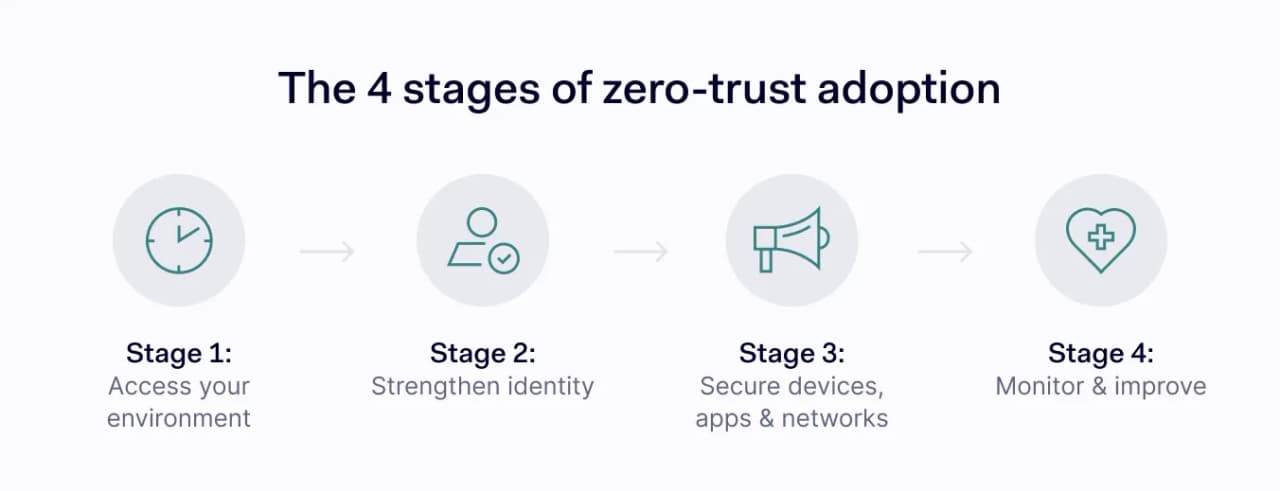
Stage 1: Assess your current environment
Before rolling out new technologies, organizations need to understand what they already have. A clear inventory prevents blind spots and keeps later stages focused. This includes identifying:
- Users and identities
- Devices
- Applications
- Sensitive data
- Existing access policies
- Network architecture
This assessment shows security gaps and helps prioritize improvements.
Stage 2: Strengthen identity and access management (IAM)
Identity becomes the new security perimeter. Organizations typically begin by:
- Turning on multi-factor authentication (MFA)
- Centralizing identity management
- Removing shared accounts
- Granting only the access each user needs
- Reviewing user permissions regularly
Since IAM is central to zero-trust architecture, this stage provides the foundation for everything that follows.
Stage 3: Secure devices, applications, and networks
Once identities are better protected, organizations extend zero trust across endpoints and applications. Common steps include:
- Device compliance checks
- Secure remote access
- Application segmentation
- Conditional access policies (rules that grant or block access based on user, device, and risk signals)
- Network microsegmentation (splitting the network into small zones so a breach in one area doesn’t spread)
- Secure web gateways
Rather than trusting every connected device, organizations verify that each device meets defined security requirements before granting access.
Stage 4: Continuously monitor and improve
The work doesn’t end after deployment. Threats change, employees change roles, applications move to the cloud, and new devices connect every day. Organizations should continuously:
- Review access policies
- Monitor authentication events
- Detect unusual behavior
- Audit permissions
- Strengthen their overall security program
This ongoing improvement is one of the defining characteristics of a mature zero-trust approach.
Core pillars of successful zero trust
Implementing zero-trust architecture requires more than deploying new technology. Organizations need to strengthen several core security areas at the same time.
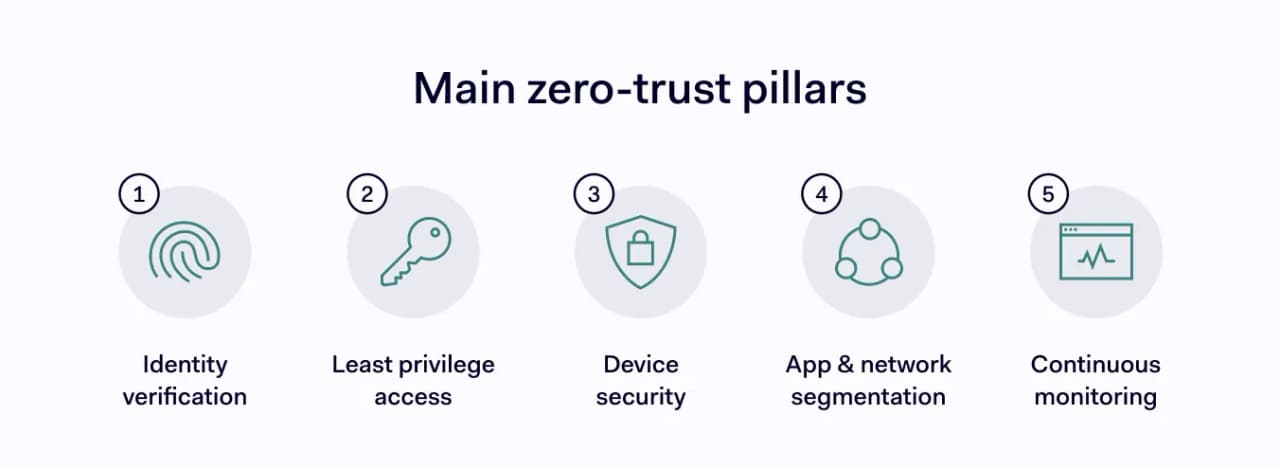
Identity verification
Identity is the cornerstone of zero trust. Ideally, every user should be authenticated using strong authentication methods, such as MFA and risk-based authentication, before accessing business resources. Organizations should also verify identities continuously instead of relying on a single login event.
Least privilege access
One of the most important zero-trust principles is granting users only the access they genuinely need. The principle of least privilege (PoLP) reduces the damage compromised accounts can cause and limits opportunities for attackers to move laterally across systems.
Access permissions should be reviewed regularly as employees change roles or responsibilities.
Device security
Trust should extend beyond users to the devices they use. Organizations should evaluate whether devices meet security requirements before granting access. This may include checking operating system versions, endpoint protection status, encryption, or device compliance.
Healthy devices contribute directly to a stronger overall defense.
Application and network segmentation
Instead of allowing broad network access after authentication, organizations should limit users to the specific applications and resources they require. This cuts unnecessary exposure and reduces the impact of compromised accounts.
Modern zero-trust solutions often provide application-level access instead of exposing entire corporate networks.
Continuous monitoring
Trust should never become permanent. Organizations should continuously monitor activity to detect suspicious behavior, unusual login patterns, device changes, or abnormal data access. Monitoring lets security teams respond quickly when risks emerge rather than relying only on preventative controls.
These pillars work best as a set—strengthening one while ignoring the others leaves gaps attackers can find.
Common rollout challenges
Moving to zero-trust architecture isn’t without obstacles. Many organizations run into similar challenges during implementation.
- Legacy applications. Older systems may not support modern authentication methods or granular access controls. Organizations often need to update applications gradually or introduce compensating security controls.
- Managing organizational change. A zero trust rollout affects employees, IT teams, and business processes. Users may initially see additional authentication or access restrictions as inconvenient, so effective communication and training are essential.
- Complexity across hybrid environments. Many organizations run a mix of on-premises infrastructure, cloud services, and SaaS applications. Applying consistent principles across all environments can be hard without centralized visibility and policy management.
- Permission sprawl. Over time, employees often accumulate unnecessary permissions as they change roles. Without regular access reviews, it’s difficult to keep permissions in check, increasing security risk.
- Limited visibility. Effective zero-trust policies depend on knowing exactly which users, devices, applications, and cloud services are in use. When the inventory is incomplete due to shadow IT personal devices, or newly adopted SaaS tools, those blind spots sit outside every access rule and become easy entry points for attackers.
Zero trust adoption best practices
A zero trust rollout is an ongoing process rather than a one-time deployment. The following practices can help organizations build a stronger foundation.
- Start with your highest-risk assets. Protect critical applications, sensitive data, and privileged accounts before expanding to lower-risk systems.
- Adopt zero trust incrementally. Roll out improvements in manageable phases instead of attempting a complete transformation all at once.
- Use identity as your security foundation. Strong authentication and centralized identity management enable consistent access decisions across environments.
- Review permissions regularly. Conduct periodic audits to ensure users retain only the access they need.
- Automate policy enforcement wherever possible. Conditional access policies and automated workflows reduce administrative effort while improving consistency.
- Invest in continuous monitoring. Monitoring authentication events, device health, and user behavior helps organizations detect threats that preventive controls may miss.
- Measure and improve your security program. Track metrics such as privileged account counts, MFA coverage, access review completion, and policy violations to see progress over time.
Zero trust is a long-term shift, not a one-time project
Adopting zero-trust security doesn’t require replacing every existing security control overnight. Instead, it involves steadily improving how users, devices, applications, and networks are protected through continuous verification and risk-based access decisions.
Organizations that apply the “never trust, always verify” principle can cut unnecessary access, strengthen their security posture, and keep pace with cloud-first, hybrid work environments.
Solutions like NordLayer support the framework by helping organizations implement secure network access, enforce least privilege access, verify users and devices continuously, and simplify the transition toward a modern zero-trust architecture without disrupting everyday work.