
Cyber threats are a constant concern for modern companies, and network access presents a critical security vulnerability. Zero trust is a security framework that helps protect networks by verifying every access request. Universal ZTNA builds on this approach by applying ZTNA to all environments and users, no matter where they are.
This article explains how universal zero-trust implementation works, explores its key components, and offers a checklist to help secure your network.
Universal ZTNA definition
Universal zero-trust network access (ZTNA) refers to implementing zero-trust principles for all devices, environments, and users It verifies user identity and context before granting access to resources, thereby reducing the risk of unauthorized access, whether users connect remotely or from on-premises networks.
How universal ZTNA works
Universal ZTNA is a core component of the security service edge (SSE) framework Rather than acting as a standalone solution, it integrates with a secure web gateway (SWG), a cloud access security broker (CASB), and a data loss prevention (DLP) solution to provide comprehensive security.
Based on zero-trust principles universal ZTNA extends the traditional perimeter security model into an identity-first approach. This is how it works:
1. Identity and contextual verification
Before granting access, universal ZTNA verifies the identity of a user or device and evaluates the context of the request. Authentication is usually handled via multi-factor authentication (MFA) or other advanced methods. If, for example, the device is unmanaged or the user tries to connect from an unusual location, access to the system is denied.
2. Centralized policy enforcement
After authentication, users and devices are granted access only to the specific resources they are authorized to use. This granular control is key to universal ZTNA and is defined by a central policy that applies uniformly across all environments, users, and devices.
3. Access based on resource
With universal ZTNA, access is restricted and clearly defined, which ensures that a single compromised account can’t infect the entire network and keeps resources hidden from public exposure. This minimizes the attack surface and prevents unauthorized lateral movement.
4. Continuous monitoring and verification
User and device verification is an ongoing process, not a one-time event. Universal ZTNA constantly monitors user activity and device behavior. If a device becomes infected with malware or exhibits unusual behavior—such as downloading unusual amounts of data—the system automatically revokes access or triggers a re-authentication prompt in real time.
5. Integration with existing security stacks
Universal ZTNA integrates into your system easily:
- Identity and access management (IAM) verifies user identities.
- Endpoint detection and response (EDR) detects suspicious activity on devices.
- Extended detection and response (XDR) investigates threats across networks, cloud workload, and email data.
- Security information and event management (SIEM) logs every single access request for auditing and forensic analysis purposes.
ZTNA vs. universal ZTNA
Universal ZTNA helps ensure secure access to critical resources, whether users are working in the office or remotely. By eliminating the distinction between on-premises and remote users, universal ZTNA unifies zero-trust principles into a single, consistent security framework for the entire organization.
While ZTNA primarily focuses on remote users, universal ZTNA extends zero-trust principles on-premises to protect all users, devices, and applications
Universal ZTNA is an advancement in access management. According to the zero-trust principles, security policies must constantly verify user identities to ensure secure access to critical resources. The guiding idea is to “trust no one, verify everything.”
Access management tools request user credentials when accessing applications and sign-on portals. They may also require verification to move or delete files, or to access network assets after periods of inactivity. These measures shrink the attack surface for malicious attackers.
ZTNA | Universal ZTNA | |
|---|---|---|
Scope | Secures access to specific apps and resources. | Secures access to the entire network: all users, devices, and resources. |
Device support | Varies depending on implementation. May struggle with certain devices or legacy apps. | Works with everything. Provides consistent access for laptops, devices, servers, and more. |
Coverage | Can leave security gaps depending on the user’s device or location. | Eliminates coverage gaps with one consistent security policy for the whole environment. |
Admin effort | Often requires troubleshooting compatibility issues and managing policy exceptions. | Simplifies management through centralized policies. |
The bottom line | Controls access to defined resources. | Extends zero-trust principles across the whole environment. |
Universal ZTNA applies the same verification principle to all users and devices This solves many problems encountered with traditional ZTNA
For example, a ZTNA solution may allow remote access from certain devices while blocking others. Security teams may also discover compatibility issues relating to critical applications or network architecture.
Universal zero-trust network access solutions work around these issues. Users can connect wherever they are, regardless of their device type. This simplifies the security challenge. Security officers can focus on verifying user identities without worrying about coverage and compatibility.
Benefits of universal ZTNA
Universal ZTNA has several benefits compared with standard ZTNA solutions. These benefits often suit the needs of companies operating under hybrid and remote work systems. The advantages of choosing universal ZTNA include:
Consistent protection across all endpoints
Zero-trust network access solutions may apply inconsistent security policies to on-premises and cloud access. Users connecting from different locations may encounter different levels of verification and access control
Universal ZTNA, however, applies consistent security measures for all connection requests. Every user encounters the same protocols, ensuring consistency and avoiding vulnerabilities. The same security policies apply everywhere.
Simple transition from legacy VPNs
Universal ZTNA is the natural successor to secure remote access tools like virtual private networks (VPNs) Although VPNs encrypt traffic, they may allow unauthorized access if attackers obtain login credentials.
In some cases, organizations may reduce their reliance on VPNs by adopting ZTNA-based access controls. This enables secure access for all network users.
Efficient security that’s tailored to remote connections
Universal ZTNA does not require backhauling via on-premises data centers. Remote users connect directly to the assets they need. Tools verify identities with minimal friction while maintaining strong access controls.
Additionally, users don’t need to juggle many login credentials for services or apps. A single verification is all that's needed whenever they connect to the network.
Simple scaling and cost efficiencies
A universal ZTNA solution scales smoothly as user communities grow or shrink. Companies can add licenses for new users and calibrate their privileges according to the principle of least privilege. Users do not need to purchase ZTNA solutions for different network environments. A unified approach can simplify scaling by applying consistent policies across environments.
Key components of universal ZTNA
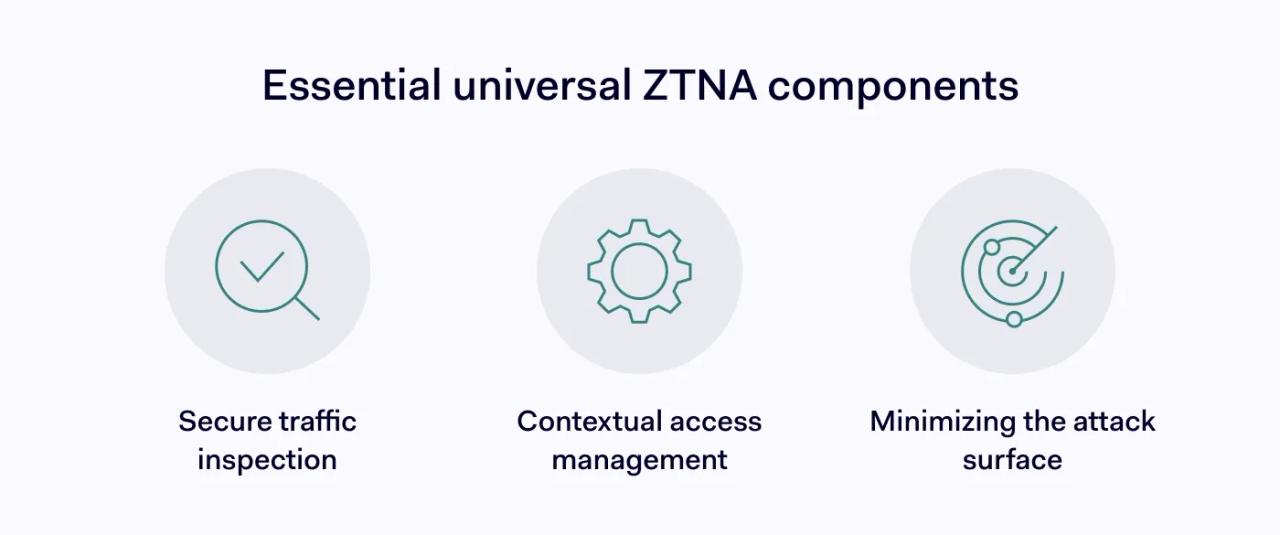
What distinguishes universal ZTNA from conventional zero-trust network access? To qualify as universal, ZTNA solutions must include the following components:
Secure traffic inspection
Many companies rely on firewall pass-throughs to inspect incoming network traffic and detect security threats. However, this approach can leave networks vulnerable, as infiltration can occur before the firewall can trigger mitigation actions.
Universal zero-trust network access takes a different approach. Zero-trust tools terminate connections to websites or cloud apps They use inline proxies to inspect traffic before it reaches network devices and decrypt it to detect concealed threats.
Contextual access management
Universal ZTNA evaluates access requests based on contextual factors Access management tools create a guarded portal that verifies the identities of individuals entering the network by checking their location, device posture, and credentials (username and password), as well as the type of action they wish to perform.
These tools use rich contextual information to determine whether users are who they claim to be and that their requests align with their user privileges.
Contextual verification has another advantage. It is adaptive reacting to changes in the external environment. A good example is when the same user tries to log in via multiple devices. In that case, adaptive controls detect the change and request extra verification.
Minimizing the attack surface
Universal zero-trust solutions apply the least privilege principle to all user requests. Users can only connect to resources if they have a legitimate reason. Access controls block access to everything else without approval.
ZTNA effectively segments the network architecture. Users connect directly to the apps they need, not the entire network. Systems restrict lateral movement, cutting off paths for malware or hackers.
Moreover, zero-trust network access conceals network assets from the external internet This makes it harder for malicious actors outside an organization to scan for vulnerable endpoints or map networks in preparation for attacks.
How to implement a universal ZTNA solution
Implementing universal ZTNA is a practical and feasible option for enterprises of all sizes. Although the implementation process varies by context, it generally includes the following steps:
- Define and map network assets Start by identifying the assets that need protection, including cloud applications, databases, and on-premises resources.
- Implement MFA and identity management. Strengthen network access portals with mandatory multi-factor authentication. Choose an identity provider to manage access and granular user privileges.
- Segment critical resources Create secure segments that contain vulnerable assets. Based on the least privilege concept, limit lateral movement between micro-segments using role-based access controls
- Choose a universal zero-trust network access provider. Universal ZTNA solutions apply in-line traffic inspection, contextual controls, and segmentation. They provide centralized, cloud-native dashboards that make it easy to control ZTNA implementations, making it easy to change settings and add licenses. Choose a reliable partner that meets your security needs.
- Train employees to use universal ZTNA gateways. Users may be familiar with legacy access systems, such as VPNs. Educate staff to follow security policies and ensure they practice safe access.
- Implement monitoring and security audits Put in place real-time event and activity logs. Schedule regular audits to ensure your solution meets ZTNA requirements.
Universal ZTNA brings many benefits to modern businesses. Companies reliant on remote access and hybrid work can balance access with network security. Universal ZTNA solves many of the security and performance issues linked to legacy ZTNA and VPN solutions, allowing flexible access across locations and contexts.