
AI risk management is the practice of finding, assessing, reducing, monitoring, and reporting the risks that come from AI systems across their full lifecycle.
More precisely, a risk management framework for AI is a set of governance practices, processes, measurements, controls, documentation, and review steps that help an organization decide whether an AI system is acceptable for a specific use, under specific conditions, and with specific safeguards.
The most useful reference point for this topic is the NIST AI Risk Management Framework 1.0, released on January 26, 2023. NIST defines AI risk as the combination of how likely an event is and how serious its consequences would be. The consequences can affect individuals, groups, organizations, and society as a whole.
The definition shows that AI risk management is an operating model for answering one question: can we use this AI system safely, securely, lawfully, and with evidence that it works as intended?
A key idea to keep in mind is that AI risk management is a lifecycle discipline. NIST treats governance as a constant requirement, and the EU AI Act requires the risk management process for high-risk systems to be reviewed and updated throughout the life of the system
Why AI risk management is different
AI risk management builds on the work most organizations already do in enterprise risk management and cybersecurity, but it adds questions that traditional software does not raise.
Ordinary software risk asks whether a system is secure, available, compliant, and reliable. Traditional rule-based software usually follows deterministic logic: given the same input and the same conditions, it should produce the same output.
The risks associated with AI go further, because outcomes can depend on training data, model behavior, user prompts, deployment context, human reliance, and changes that happen after release. AI systems rely on statistical models that infer likely outputs from data, prompts, and context, which can make their behavior harder to predict, reproduce, and measure in real-world use.
3 differences help explain why AI technologies need their own risk management strategies:
- AI behavior is context-dependent and hard to measure. A model that performs well in a lab can behave very differently in real-world use.
NIST notes that AI risks can be difficult to define, vary by context, and depend on third-party components, which makes measurement harder than it is for standard software.
Generative AI makes this harder still, because some of its risks are unknown or difficult to evaluate given the scale, complexity, and limited visibility into training data. - AI introduces new failure and attack paths. AI systems can be attacked through prompts, data poisoning, data pipelines, plugins, APIs, and retrieval systems. They can also produce confident but incorrect outputs, reflect bias from their data, or expose private information through prompts, logs, or responses. Generic security controls often miss these AI-specific weaknesses.
- Risk does not stop at deployment. Models drift, vendors update their systems, and employees find new uses that no one approved. Without ongoing monitoring, a system that was safe at launch can become a problem later. AI risk management reduces black-box risk by making systems documented, traceable, monitored, and explainable enough for their intended use, which is important for ethical review and regulatory compliance.
NIST AI RMF vs. ISO 42001: key differences
When people say “AI risk management framework,” they may mean several different things. Two of the most cited are the NIST AI RMF and ISO/IEC 42001 They are related but serve different purposes.
The NIST AI RMF is a voluntary, cross-sector framework that explains how to build trustworthy AI. It defines the traits of trustworthy AI, such as valid and reliable, safe, secure and resilient, accountable and transparent, explainable, privacy enhanced, and fair with harmful bias managed. It then organizes the work into four core functions: Govern Map Measure and Manage
- Govern sets policies, roles, and accountability.
- Map establishes the context and intended use.
- Measure tests and monitors the system.
- Manage decides how to respond to the risks that surface.
ISO/IEC 42001:2023 specifies the requirements for an AI management system, which means a formal, certifiable program for establishing, maintaining, and continually improving how an organization handles AI. It is built for organizations that provide or use AI products and services and want an auditable structure they can certify against.
Aspect | NIST AI RMF 1.0 | ISO/IEC 42001:2023 |
|---|---|---|
Certification | Not certifiable | Certifiable by an external body |
Best use | Understanding and applying AI risk practices | Setting up an auditable, certifiable governance program |
Type | Voluntary guidance framework | Certifiable management system standard |
Main goal | Build and evaluate trustworthy AI | Run and improve a formal AI management system |
Structure | Four functions: Govern, Map, Measure, Manage | Management system requirements (policies, roles, controls, review) |
In short, NIST tells you what good AI risk management practices look like, while ISO 42001 gives you a structure you can certify to show that you follow them.
Two further standards are:
- ISO/IEC 23894:2023, which offers AI-specific risk management guidance for organizations that develop or use AI.
- The EU AI Act which adds binding rules through a risk-based approach with four levels of risk:
- unacceptable,
- high,
- transparency,
- minimal or no risk.
How businesses can reduce AI risks
Reducing the risks associated with AI does not require a separate program for every model. It works best as a repeatable process that any team can follow before, during, and after deployment The steps below turn the 4 NIST functions into actions and give you a foundation for AI risk management practices.
1. Build an AI inventory
Start with a record of every AI system in use: internally built models, vendor tools, AI features inside existing SaaS products, datasets, APIs, agents, and plugins.
Include shadow AI meaning the tools employees adopt on their own. Mandiant reports that shadow AI and a lack of asset visibility are often more urgent problems than novel AI-specific attacks.
2. Classify use cases by risk
Not every use of AI carries the same weight. Separate low-risk productivity tools from systems that affect people’s rights, safety, finances, employment, healthcare, or access to services.
The EU AI Act follows this logic by placing stricter requirements on high-risk systems. A clear classification step lets you focus effort where the impact is greatest.
3. Assign clear ownership
AI risk crosses many teams, so it needs defined owners. Decide who is responsible across product, engineering, security, privacy, legal, procurement, and the business side. The Govern function in the NIST framework calls for policies, processes, documentation, and a risk-aware culture that covers third-party software, data, and systems as well as internal ones.
4. Map, measure, and apply controls
For each significant use case, document:
- the intended use,
- prohibited use,
- affected people,
- data sources,
- foreseeable misuse.
Then test the system before release and on a regular schedule afterward, with methods such as model evaluation, security testing, bias testing, privacy review, and red teaming.
Based on what you find, apply controls Common ones include access management, data minimization, prompt and output filtering, human review, logging, rate limits, vendor due diligence, and incident response plans
5. Decide, then monitor
Use the test results, the remaining risk, the business value, and any legal requirements to decide whether to proceed, change, pause, or retire a system.
After launch, keep watching. Track failures, model drift, user feedback, abuse, security events, and new use cases. Microsoft’s Responsible AI Standard requires documented ongoing monitoring, defined review frequency, and updates when new uses or failures appear.
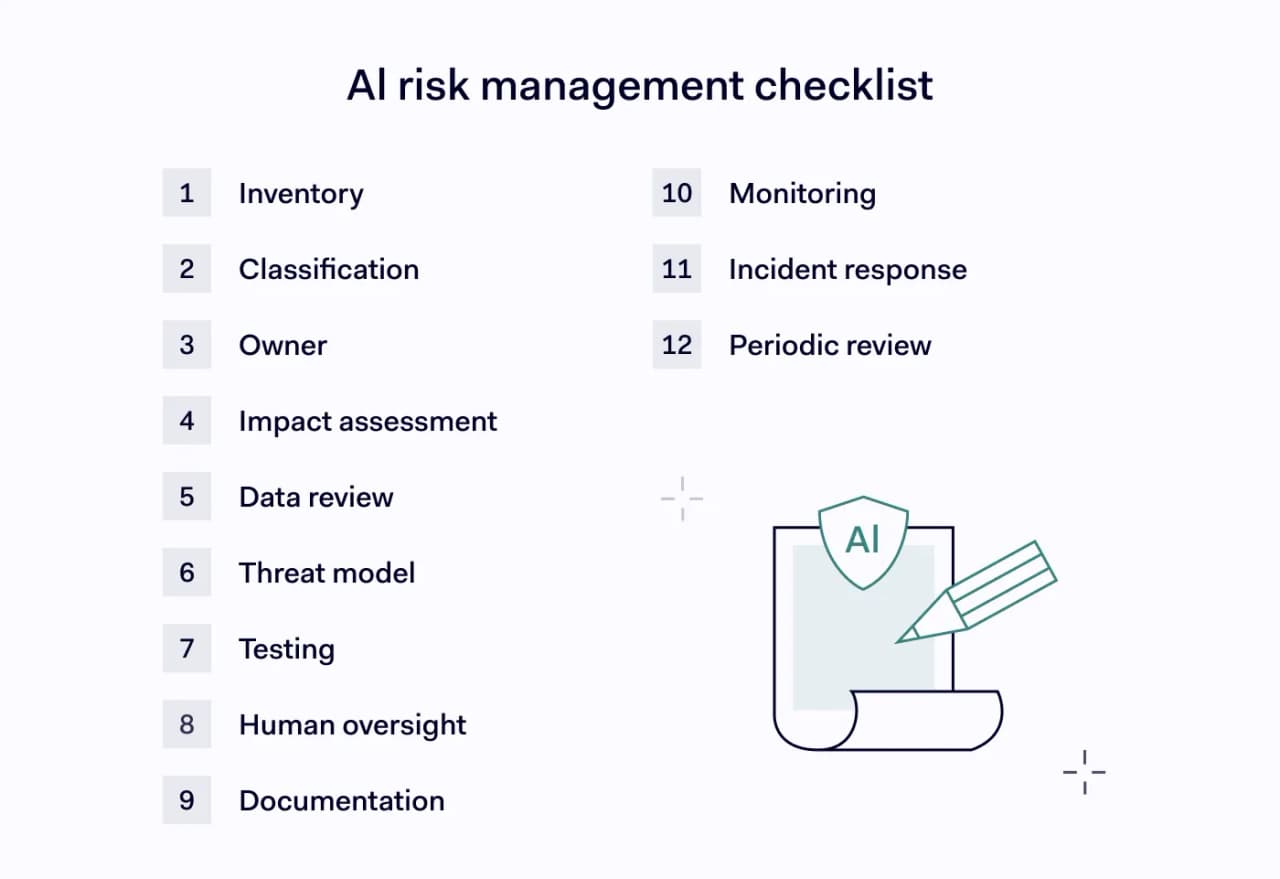
These steps work well as a checklist: inventory, classification, owner, impact assessment, data review, threat model, testing, human oversight, documentation, monitoring, incident response, and periodic review.
A note for teams using generative AI: retrieval-augmented generation and fine-tuning do not remove key risks. OWASP states that both methods fail to fully prevent prompt injection where a user’s input changes a model’s behavior in unintended ways.
Common mistakes to avoid
- Ignoring shadow AI and the AI features already built into everyday SaaS tools.
- Treating AI risk as only a model problem and overlooking the data, infrastructure, identity, and processes around it.
- Applying generic cybersecurity controls while missing AI-specific risks such as prompt injection, excessive agency, and data leakage
- Assuming that pre-deployment testing is enough and skipping post-deployment monitoring.
- Naming human oversight as a control without defining what those humans must actually do.
Reducing AI risk is about consistent habits: know what you run, rank it by impact, assign owners, test it, control access, and keep watching it.
How NordLayer supports AI risk management
A large part of AI risk management comes down to one question: who can reach which AI systems, and from where? NordLayer helps answer it with controls that fit naturally into the steps above.
Identity-based access control. NordLayer applies access rules to AI-related systems by integrating with your existing SSO, MFA, and SCIM provisioning. It helps reduce orphaned accounts, centralize access rules, and ensure that only approved users can reach sensitive AI resources.
Least privilege through the cloud firewall. NordLayer’s cloud firewall can restrict access to AI resources by team, user, destination, and service. This lowers the chance that employees, contractors, or compromised accounts reach systems outside their role, which is a core part of zero-trust application access
Smaller blast radius through network segmentation By separating AI environments from the wider corporate network, NordLayer helps limit lateral movement if an account, device, or AI-connected workflow is compromised.
Controlled access paths. NordLayer routes approved users through encrypted gateways and dedicated IPs, so sensitive AI infrastructure stays available only through known, controlled paths rather than open to the wider internet.
Shadow IT management Through browser activity visibility, NordLayer shows which web-based tools employees use. Admins can spot unsanctioned AI services, review the risk, and decide whether to approve, restrict, or block them.
Acceptable-use enforcement NordLayer can block risky domains, malicious websites, and selected applications. This reduces the chance that sensitive data is copied into unsanctioned tools or that users reach harmful infrastructure.
These capabilities map directly to governance goals:
- control access,
- enforce least privilege
- contain incidents, and
- bring shadow AI into view.
Conclusion
AI risk management is a constant process rather than a single project. A clear risk management framework helps you find the risks associated with AI, test for them, control access, and keep watching after launch. Whether you follow the NIST AI RMF, ISO 42001, or both, the value of AI for risk management comes from consistent habits and the right controls behind every system.