Summary: Endpoints are the primary gateway for cyber threats. Discover how to secure your devices and prevent a single compromise from becoming a network-wide crisis.
If you were asked where threat actors usually launch their attacks, what would you say? You might point to the firewall. You would be wrong.
The real target is the endpoint. IBM’s Cost of a Data Breach Report estimates that as many as 90% of successful cyberattacks originate from devices such as laptops, servers, and mobile phones.
With the average data breach now costing $4.4 million, endpoint securityis a business necessity. As remote work and IoT expand, securing your endpoints serves as your first line of defense. Let’s look at how endpoint security works and how to prevent a single compromised device from becoming a network-wide crisis.
What is endpoint security?
Endpoint security covers all measures taken to defend user devices from direct and indirect threats. It aims to prevent unauthorized access to a corporate network.
What counts as an endpoint?
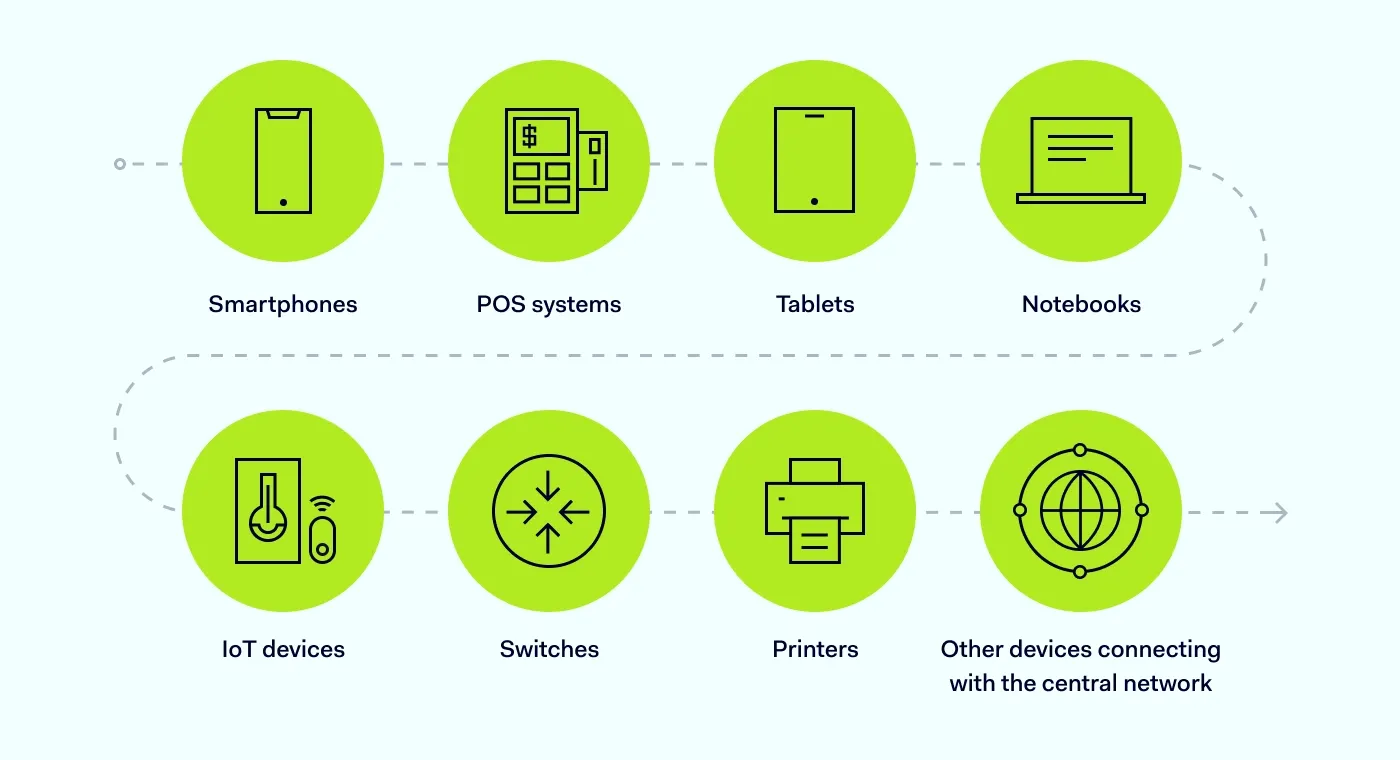
Endpoints are hardware devices and applications connected to a network outside its firewall. Here are examples of endpoints:
Laptops
Tablets
Smartphones
IoT devices
POS systems
Printers
Servers and other devices that connect to the central network
It's important to note that a virtual environment can also be considered an endpoint. If an application or service provides a shared operating environment, it functions as an endpoint. Since every connected device acts as a potential gateway for a breach, securing the entire inventory is essential.
How does endpoint security work?
Endpoint security works through a continuous cycle of data collection, threat detection, and response. An endpoint security solution monitors every device connected to the corporate network, scanning files, processes, and system behavior for signs of malicious activity. Here's how the process typically unfolds:
Endpoint data collection. The endpoint security solution gathers telemetry from every protected device, including event logs, file changes, network connections, and user behavior. This data feeds into a centralized platform where security teams gain full visibility across laptops, mobile devices, and servers.
Threat detection. Using a combination of antivirus tools, behavioral analysis, and threat intelligence, the system flags suspicious patterns. Machine learning models compare real-time activity against known indicators of compromise, catching both familiar malware and previously unseen threats.
Investigation and analysis. When a potential threat surfaces, the endpoint detection and response (EDR) module provides security analysts with detailed context: what triggered the alert, which device and user are involved, and how the malicious activity unfolded.
Automated or manual response. Based on pre-set policies, the system can isolate an infected device, terminate a malicious process, or roll back changes automatically. For more complex incidents, security teams step in to investigate manually, using the detection and response tools to contain the threat before it spreads across the corporate network.
Continuous monitoring and reporting. Endpoint protection doesn't stop after a single incident. The system runs around the clock, so protection is an ongoing cycle rather than a one-off event.
Endpoint security components
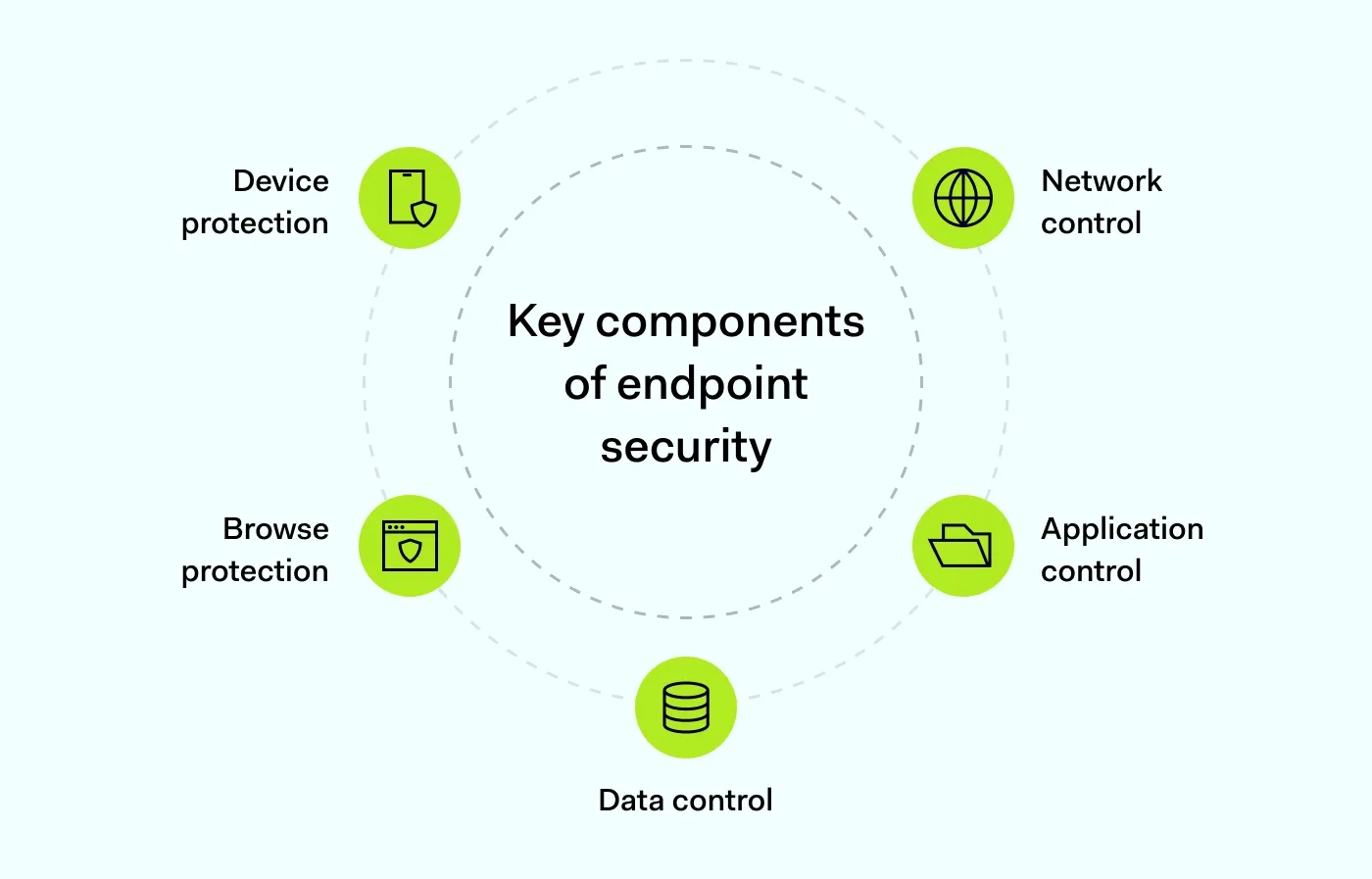
The steps above are powered by a set of functional components that work together within an endpoint security solution. Each one handles a specific layer of defense across the corporate network.
1. Device protection
This module identifies suspicious activities on endpoint devices by tracking and analyzing endpoint event logs. IT security teams can use endpoint protection as a remote antivirus solution that supports detection and response across the corporate network.
2. Network control
An effective endpoint security strategy should secure devices before malware can infect them. Network control tracks, monitors, and filters inbound traffic.. When malicious activity is detected, the traffic is blocked. This bridges the gap between individual device safety and broader network security, keeping cyber threats at a distance.
3. Application control
Enterprise applications are frequent targets for attack. Server access and software installation therefore require strict supervision. Application control monitors usage and blocks unauthorized activity. Because unpatched software creates security holes, some endpoint security platforms include application hardening to reduce the attack surface and eliminate applications as an entry point.
4. Data control
This component handles all data transfer operations and storage. Various tools prevent data leaks and enforce security mechanisms, such as encryption.
It's the most effective way to secure data against unauthorized access and avoid potential data breaches. Well-built endpoint security solutions offer full disk encryption and secure communication tunnels.
5. Browser protection
Browser protection uses web filters to strictly define what users can access, automatically denying everything else. Since malicious links and phishing sites are common infection vectors, browser protection provides granular control over endpoint devices, blocking dangerous websites to minimize risk.
Types of endpoint security
Not every endpoint security solution takes the same approach. Different types of endpoint security address different threat vectors, and most organizations combine several of them to protect their corporate network. Here are the most common types.
Endpoint detection and response (EDR)
EDR tools continuously collect and monitor data from every endpoint, using behavioral analysis, threat intelligence, and machine learning to spot malicious activity (such as fileless malware or ransomware) in real time. When something suspicious is flagged, EDR isolates the endpoint automatically and provides security teams with a clear trail for investigation and remediation. Organizations can catch and contain threats while they're still developing, instead of reacting to breaches after the fact.
Endpoint protection platform (EPP)
While EDR focuses on detection, EPP focuses on prevention. It acts as a point-in-time safeguard, inspecting and scanning every file the moment it enters the network. At its core, EPP relies on signature matching, comparing incoming files against a database of known threat signatures to identify malicious software. Most EPP solutions build on traditional antivirus and anti-malware capabilities, then layer in heuristics and sandboxing to catch threats that signatures alone might miss. It’s the traditional front-line layer most organizations start with.
Extended detection and response (XDR)
XDR picks up where EDR leaves off, extending detection and response capabilities across a wider set of security solutions. While EDR focuses on endpoint data, XDR correlates information from email, cloud workloads, network traffic, and mobile devices into a single platform. It applies advanced analytics and automation to that broader data set, helping security teams spot multi-stage attacks that no single tool would catch on its own.
Managed detection and response (MDR)
MDR is endpoint security delivered as a service. A third-party security operations center monitors your endpoints around the clock, applying threat intelligence and handling detection and response on your behalf. It's a strong option for businesses without a dedicated in-house security team.
Why is endpoint security important?
Remote and hybrid work models have become the new standard, and organizational cybersecurity has shifted its focus. The traditional perimeter has dissolved, leaving endpoints as the primary gateway to internal networks. This development has made endpoint protection a critical priority, since bad actors often exploit devices as their primary point of attack.
The risks associated with endpoints threaten organizational stability. Data loss or ransomware attacks can devastate operations and erode customer trust. At the same time, the surge in connected devices—including the Internet of Things (IoT)—makes effective endpoint protection harder for administrators.
Employees are using their own devices
Bring-your-own-device (BYOD) policies have extended the workplace beyond the traditional enterprise perimeter. When employees use personal laptops and mobile devices for work, the organization's attack surface naturally expands.
This approach introduces BYOD security risks, as these endpoints are often used for personal browsing and online activities, opening the network to outside cybersecurity threats. Endpoint security solutions can address these risks.
The issues of remote work
Decentralized workforces are no longer an exception. But employees frequently connect via vulnerable public Wi-Fi or outdated home routers that may already be compromised (or part of a zombie botnet). Without proper safeguards, these unsecured connections leave the door open to cyberattacks.
Cybercriminals are always targeting the weakest link
Public hotspots—cafés, airports, or public transport—are prime hunting grounds for threat actors, which significantly increases the risk of a breach. This means your employees are your perimeter.
Businesses of all sizes are targets
A common misconception is that only large organizations face data breaches. In reality, no business is too small to be attacked. Smaller companies often lack strong defenses, making them attractive targets for cybercriminals exploiting unpatched vulnerabilities. Modern endpoint security solutions provide the network visibility and control necessary to close these gaps.
Reduce breach risk across endpoints and access
Combine secure access with advanced endpoint detection and response to identify, contain, and manage threats across your environment.
With cyber threats rising in both volume and sophistication, blocking malware is no longer enough. A well-implemented endpoint security solution goes further, strengthening operations, simplifying compliance, and reducing breach costs across the board:
Endpoint protection platforms give IT teams a single dashboard to monitor every laptop, server, and mobile device connected to the corporate network. Instead of managing security device by device, administrators can spot malicious activity, push policy updates, and respond to incidents from one console.
Bring-your-own-device (BYOD) and remote work policies give employees the freedom to work from anywhere on any device. That freedom comes with risk, since every unmanaged connection is a potential entry point for attackers. Endpoint security keeps protection consistent across every device and location, so flexibility doesn't come at the cost of safety. For organizations with distributed teams, it's a practical necessity rather than a nice-to-have.
Endpoint detection and response tools cut the time between an initial compromise and containment. Automated alerts, combined with threat intelligence, let security teams act within minutes rather than days.
Many regulatory frameworks (like GDPR and HIPAA) require organizations to demonstrate endpoint protection measures, data encryption, and audit trails. An endpoint security solution with built-in reporting simplifies compliance by generating the documentation auditors need.
Endpoint security, firewalls, and antivirus software
These three sound similar, but they sit at different layers of defense. Antivirus software is more common among home users, while businesses focus more on endpoint protection. One of the reasons is scope: endpoint protection acts as a distributed antivirus for many computers, whereas home users usually secure one device at a time.
Antivirus software is installed on individual devices to remove malicious programs that may bypass other security measures. Traditional antivirus solutions are effective against a wide range of malware, including keyloggers, rootkits, worms, adware, and spyware. Yet, they aren't as flexible in enterprise environments with multiple devices.
Endpoint security extends beyond basic malware removal. It uses advanced endpoint detection to identify threats before they compromise sensitive data. Modern endpoint protection platforms are installed across networked machines, so administrators can manage endpoint security centrally. This keeps protection consistent across the organization.
FIrewalls are different: they are network security devices designed to prevent unauthorized external access to the network. While some endpoint security software includes firewall-like capabilities, those features are limited compared to dedicated firewalls. Firewalls focus on data packet inspection and monitoring which ports are accessed. Traditional firewalls typically operate only at the network layer.
To recap, endpoint security is a much broader discipline within cybersecurity. A firewall is a network or host traffic control tool, while antivirus software is a cybersecurity solution at the device level.
4 steps for building your endpoint security strategy
An effective endpoint security strategy is key to protecting your business against hacking attempts. If a data breach does occur, that same strategy minimizes the damage or helps make sensitive data inaccessible to cybercriminals. A solid security plan is a practical way to improve network security and resilience. Here are four simple steps you can take to strengthen your defenses.
Step 1: Encourage best practices
It's easy to forget that the biggest cybersecurity threat lies within your company's walls. Users are the primary guardians of endpoint devices.Enterprise endpoint security relies on both technology and user awareness to be effective. Build security habits throughout your organization, particularly among remote employees. Brief your team on protocols and encourage caution when using endpoint devices for work.
Step 2: Encryption
Ensure employees encrypt their traffic in transit. Installing NordLayer on all endpoint devices reduces Wi-Fi breach risks and helps prevent sensitive data from being exposed—NordLayer uses AES-256 and ChaCha20 mechanisms to encrypt data in transit As an adaptive network security solution, it handles the challenge of company-wide implementation and gives users secure access to company resources wherever they are.
Step 3: Remote application control
Outdated systems contain vulnerabilities. Endpoint protection platforms must secure endpoints not only against malware but against these software flaws as well. Legacy software should be sandboxed to limit contact between vulnerable applications and sensitive data.
You will find a wide range of endpoint security solutions on the market. Select a program that allows you to track and limit user activity. This includes blocking high-risk websites or restricting downloads to prevent malware infections.
Step 4: Antivirus software
While it's an old cybersecurity staple, installing antivirus software can be a strong last line of defense when malware bypasses other security checks. An antivirus system is a low-cost solution that effectively removes identified malware types (some of which, like ransomware, are common in businesses).
When used alongside with other cybersecurity solutions, users get full-stack endpoint protection, as threats can be stopped at every stage. This is a strong way to strengthen endpoint protection and fortify the front line of your network.
How can NordLayer help?
NordLayer provides IT security solutions to strengthen your endpoint security within the Zero Trust Network Access (ZTNA) framework. With cloud-hosted and hardware-independent tools, every single device within the network can be secured. This enables remote work without compromising security.
From data encryption to access control implementation, NordLayer can support your digital infrastructure transformation.Use Download Protection on Windows and macOS to add a strong line of defense—it automatically scans and blocks malware-infected files upon download. Meanwhile, integrations with services such as Microsoft Entre ID, Okta, and Google Workspace enable smooth deployment within your current infrastructure. And combining NordLayer with CrowdStrike’s endpoint protection helps you cover every layer of your business.
Endpoint security doesn't have to be expensive or complicated. To find out more, contact NordLayer today.
Frequently asked questions
What is endpoint protection?
Endpoint protection focuses on preventing known threats from compromising devices, such as laptops, smartphones, and tablets. It acts as a shield for these network entry points.
How do endpoint security and protection differ?
The difference lies in their scope. Endpoint protection is just one part of the overall security strategy—it specifically targets the prevention of known, direct threats. Endpoint security, on the other hand, is a broader approach that includes protective measures and also defends against indirect threats, such as network vulnerabilities and human error.
What is the difference between endpoint protection and antivirus?
Endpoint security software protects physical, virtual, and cloud-based devices from breaches. Antivirus is typically just one component of that broader solution. Unlike antivirus alone, endpoint security provides centralized, cloud-based management to prevent sophisticated threats, such as vulnerability exploits, phishing, and fileless malware.
Rūta Tamošaitytė
Cybersecurity Copywriter
A writer with a focus on research and creative content. Rūta works closely on NordLayer’s Intelligence quarterly ransomware trend research and writes about secure remote access, brand protection, attack surface management, and all things dark web. She brings a researcher's eye and a storyteller's instinct to every piece she writes.