CASB vs. ZTNA: what’s the difference?

It’s easy to get lost in the cybersecurity’s never-ending alphabet soup of acronyms. That’s especially true when you’re caught between CASB and ZTNA, trying to decide which is the right fit for your business. Usage of both spiked when working from home became the standard in 2020 during the pandemic. Even now, when people have returned to the office, many businesses offer flexible working models.
So, choosing between the two can feel like splitting hairs, but the distinction is practical. A Cloud Access Security Broker (CASB) acts as a gatekeeper between an organization’s on-premise infrastructure and cloud-based services, while Zero Trust Network Access (ZTNA) focuses on secure, identity-based access to private applications and resources, regardless of where the user is.
What is CASB?
A Cloud Access Security Broker (CASB) extends security controls beyond the traditional network perimeter and sits between cloud service consumers and providers. It’s a tool that helps enforce your organization’s security policies for cloud-based applications, supports data protection, threat mitigation, and compliance with regulations. Now, let’s look at some CASB features and benefits:
- Visibility: detects and monitors cloud services and users outside the company’s network policies.
- Data security: scans and analyzes data to prevent the unauthorized sharing of sensitive information. CASBs also protect sensitive data in transit and at rest with encryption and other security measures.
- Threat protection: detects and isolates unusual behavior within cloud applications, like malware and ransomware, that might indicate a compromised account. This prevents them from compromising the organization’s cloud applications.
What is ZTNA?
Zero Trust Network Access (ZTNA) is a security solution that provides secure remote access by enforcing strict security controls and never inherently trusting any entity within or outside the network. ZTNA ensures that access is only granted after rigorous verification of identity, context, and policy compliance. This means no user or device is trusted by default—even if they are already inside the perimeter. By shifting to this model, you can help minimize the risk of unauthorized access or lateral movement within your network.
Here are the key features and benefits of ZTNA:
- Secure cloud access: by implementing ZTNA, companies can restrict access to their cloud environments and apps.
- Identity-centric: access is granted based on the user’s identity, device, and context to grant access only to the necessary resources.
- Hidden infrastructure: ZTNA makes apps unavailable and restricts access over to the public internet by helping organizations to avoid threats like data leaks and ransomware.
- Compliance: the Principle of Least Privilege (PoLP) enhances compliance with regulatory standards as the organization can verify that all access is authorized and control how employees use applications and data.
Key differences between CASB and ZTNA
While both are common components used in Secure Access Service Edge (SASE) deployments, they solve different problems. To put it simply, CASB is about what happens inside cloud applications, while ZTNA is about who gets through the door.
By integrating both into your network security strategy, you address two different sides of the same coin. While ZTNA focuses on the perimeter—verifying that every user and device is legitimate before they gain entry—CASB secures the interaction between users and cloud applications. In other words, CASB monitors cloud usage regardless of whether users are inside a network perimeter and works for any cloud access, not just post-entry monitoring. This ensures that even when a user is authorized to be in the system, their actions within the cloud remain transparent and compliant with your security policies.
This layered approach means that your network security isn't just a gate at login—it continues while people use cloud apps. ZTNA controls who can access private apps and resources, and CASB applies policy controls to cloud usage, helping limit risky actions and data exposure during the session.
| CASB (Cloud Access Security Broker) | ZTNA (Zero Trust Network Access) |
|---|---|---|
Primary focus | Security and compliance within cloud applications. | Access control to private apps and resources. |
Main goal | Acts as an intermediary between users and cloud apps, enforces security policies and protects data from leaks or misuse in the cloud. | Verify user identity to grant access to specific apps, deny access by default, and limit lateral movement within a network. |
Visibility | Visibility into cloud usage and data movement. | Visibility into who is connecting, from where, and to which apps. |
Challenges | Can be complex to roll out across many cloud apps and data types. | Depends on strong identity management and clear access policies. |
CASB vs. ZTNA: Which one to choose?
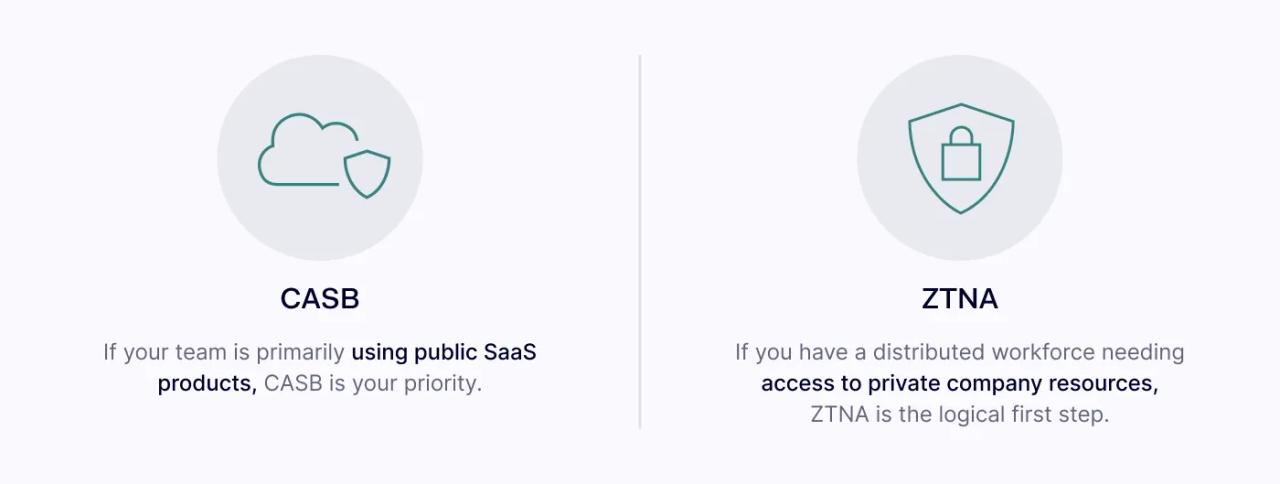
In a modern business, it isn't usually an either-or situation when choosing between CASB and ZTNA. Most network security strategies benefit from both. However, your immediate priority depends on where your biggest cyber risks live. If your team is primarily using public SaaS products, CASB is often the first priority. If you have a distributed workforce that needs access to private company resources, ZTNA is usually the logical first step.
When to use CASB?
- When you need to gain control over shadow IT: CASB allows you to identify which cloud-based applications employees are using without permission, helping you mitigate hidden cyber risks.
- When you need or want to ensure compliance with regulations like GDPR and HIPAA: these security tools help you meet strict data residency and privacy requirements by providing the necessary oversight to protect data and monitor cloud access.
- When you need to manage sensitive or confidential information: if your team frequently moves data into or between clouds, a CASB helps prevent unauthorized access and data breaches by enforcing your security policies during those transfers.
- When you want deep visibility into cloud usage: It provides a clear audit trail of who accessed what and when, making it easier to spot suspicious behavior early.
When to use ZTNA?
- When you want to replace a legacy VPN: traditional VPNs can be slow and often grant too much trust. ZTNA solutions can provide more granular access for a remote or hybrid workforce by connecting users only to the applications they need.
- When you want to prevent lateral movement: If a cybercriminal manages to compromise one device, ZTNA ensures they stay boxed in. Because the rest of your network remains invisible to the compromised user, you significantly reduce the risk of a full-scale breach.
- When you need to provide third-party access: You can give contractors or partners access to specific internal security tools without opening up your entire infrastructure. This need-to-know approach keeps your most sensitive systems hidden while allowing external teams to remain productive.
- When you need to implement identity-based security: If you want to move away from location-based security, ZTNA allows you to enforce strict access control based on the user’s identity and device health, regardless of where they are logging in from.
As work has shifted to the browser, so have cyber risks. NordLayer Browser helps address this by adding centralized control and visibility at the browser level. It implements zero trust best practices by continuously verifying identities and devices, significantly reducing the risk of unauthorized access. Additionally, the browser provides visibility and granular control over web usage typical of a CASB, giving admins a clearer picture of their security posture.
To sum up
The choice between CASB and ZTNA comes down to what you are trying to protect. CASB secures the data within your cloud apps, while ZTNA secures the doors to your network. Together, they form a strong cloud security defense that keeps your business moving and your data—out of the wrong hands.