
A cloud access security broker (CASB) secures data and user activity inside cloud applications, while a secure web gateway (SWG) inspects and filters outbound web traffic to block threats before they reach the browser. The SWG vs. CASB distinction comes down to layer: CASB governs the cloud service; SWG governs the web session Most organizations run both, because a modern CASB vs. SWG decision is rarely either-or.
Both tools show up in the same product bundles and SASE architecture diagrams, which makes it easy to assume they do the same thing. They don’t. A CASB and an SWG solve different problems, protect different layers, and operate in different ways. They overlap, and in many modern deployments, they work side by side, but the distinction matters when you need to choose, configure, or justify either one.
This article breaks down the CASB vs. SWG question: what each tool does, where they differ, and how to decide which fits your environment.
Understanding CASB
A cloud access security broker (CASB) is a security policy enforcement point that sits between cloud service consumers and cloud service providers. Its job is to give organizations visibility and control over how their data, users, and applications behave inside cloud environments.
Early CASB solutions focused on shadow IT discovery finding unsanctioned cloud services that employees adopted without IT approval. Modern CASBs go further. According to NIST SP 800-215, current CASBs enforce security and governance policies for cloud applications, extend on-premises policies to cloud services, protect data in provider-hosted environments, apply data loss prevention (DLP) to data that moves in and out, track threats such as account hijacking, use behavior analysis similar to UEBA, and detect misconfigurations in IaaS and cloud server infrastructure.
How a CASB works
CASB solutions use two main deployment approaches: proxy mode and API mode. In proxy mode, the CASB operates inline, intercepts traffic in real time, and applies controls before data reaches or leaves a cloud application. In API mode, the CASB connects directly to cloud service provider APIs to scan data already stored in the service and enforce security policies out-of-band. Many organizations use both modes together.
That flexibility is one of the strongest reasons SWG vs. CASB is not an interchangeable choice. A CASB can operate partly outside the live web session by using provider APIs to inspect data at rest, enforce sharing rules, or flag policy violations in cloud-based applications that a gateway would never see.
Key benefits of CASB
- Visibility into cloud usage. Teams can identify sanctioned and unsanctioned cloud applications across the organization.
- Data security. CASB applies DLP policies to data stored in and moved through cloud services.
- Threat protection. It detects account compromise, insider threats and malicious activity through behavior analysis.
- Regulatory compliance. CASB enforces data handling and access rules that align with industry and government standards.
- Cloud misconfiguration detection. It spots risky settings in subscribed IaaS and cloud server environments (SaaS posture checks depend on the vendor and the supported app integrations).
CASB use cases and limitations
Where a CASB earns its keep, day to day:
- Shadow IT discovery. Surface every unsanctioned SaaS app in use—from personal Dropbox accounts to that one team's rogue project-management tool—and score them by risk.
- Cloud DLP. Prevent sensitive files (source code, PII, financial records, customer data) from being uploaded, shared externally, or downloaded to unmanaged devices inside sanctioned apps like Microsoft 365, Google Workspace, Salesforce, and Box.
- Misconfiguration detection. Flag risky settings such as publicly exposed storage buckets, over-permissive sharing links, and disabled MFA in IaaS and SaaS environments (SaaS posture depends on which apps the CASB integrates with via API).
The clear limit: a CASB has little coverage of general web traffic. If a user browses a phishing page, downloads malware from a personal website, or visits a newly registered malicious domain, that activity sits outside the CASB’s field of view. This is exactly the gap an SWG is built to close—and the core of the CASB vs secure web gateway trade-off.
Understanding SWG
A secure web gateway (SWG) is a policy-based web security control that governs access to cloud-based applications and the open web. NIST SP 800-215 describes it as a web filter that protects outbound user traffic through HTTP and HTTPS inspection, shields endpoints from malicious or malware-infected sites, and centralizes control, visibility, and reporting across headquarters, branch offices, home offices, and remote locations.
The web is now the primary threat surface—but the payload has changed. CrowdStrike’s 2026 Global Threat Report found that 82% of cyber intrusions are now malware-free: adversaries log in with stolen credentials and use legitimate tools instead of dropping detectable files. Based on Verizon Data Breach Investigations Report (DBIR) 2026 credential abuse accounted for roughly 22% of initial access this year.
The takeaway for SWG buyers: web filtering and HTTPS inspection remain necessary (since most user activity still runs through the browser), but they are not sufficient on their own. An SWG closes the web-session gap; a CASB and identity controls close the rest.
An SWG is fundamentally about the web session. When a user tries to reach a website or a cloud application, the SWG evaluates that request against security policies, inspects the traffic for threats, and decides whether to allow, block, or restrict the connection.
One important boundary: an SWG is not a replacement for a web application firewall (WAF) Inbound protection for enterprise-hosted websites remains a WAF role. SWG solutions focus on protecting users and their outbound web access.
How an SWG works
An SWG inspects outbound HTTP and HTTPS traffic at the network edge or in the cloud. It applies URL filtering, malware scanning SSL/TLS inspection, and application-level controls. When a user requests a web resource, the SWG checks the destination against policy rules, scans the content for threats, and enforces access decisions before the traffic reaches the browser.
Modern SWG solutions go beyond basic URL blocking. They enforce acceptable use policies, restrict access to specific categories of cloud applications, inspect encrypted traffic for hidden threats, and provide centralized reporting across a distributed workforce.
Key benefits of SWG
- Web threat protection. It blocks access to malicious, phishing, and malware-infected sites.
- Policy enforcement across locations. SWG applies consistent web access rules for users in offices, at home, or on the road.
- SSL/TLS inspection. It decrypts and inspects encrypted traffic to catch threats hidden inside HTTPS sessions.
- Centralized visibility. SWG gives teams a single view of web usage and policy compliance across the organization.
- Application access control. It restricts or allows access to specific web and cloud-based applications based on policy.
SWG use cases and limitations
Where an SWG does the heavy lifting:
- Web threat filtering. Block known-bad domains, newly registered domains, phishing sites, and malware-hosting URLs before the browser ever loads them.
- SSL/TLS inspection at scale. Decrypt and inspect encrypted traffic so hidden malware, command-and-control callbacks, and data-theft attempts can’t ride HTTPS past your defenses.
- Acceptable-use policy across locations. Enforce the same category-based rules (no gambling, no adult content, no streaming during work hours) for headquarters, branch offices, home offices, and traveling users—without backhauling traffic to a data center.
Even with TLS inspection enabled, an SWG sees HTTP requests and responses to a sanctioned domain—not the SaaS-layer context around them. It can tell that a user reached Microsoft 365, Salesforce, of Goodle Drive, but it doesn’t natively understand the sensitive spreadsheet being shared with an external contractor, the misconfigured storage bucket, or the OAuth grant to a shady third-party app.
That’s CASB territory, and it’s the other half of the secure web gateway vs. CASB comparison.
Key differences between CASB and SWG
When you compare CASB vs. SWG side by side, both enforce security policies, improve visibility, and can affect access to cloud applications. But they approach the problem from different directions.
The most accurate way to frame the distinction is this: CASB provides cloud-service depth, while SWG provides web-traffic breadth. A CASB is centered on cloud service usage, cloud data, cloud-user behavior, and cloud configuration risk. An SWG is centered on outbound web sessions, web access policy, and web-borne threats.
CASB | SWG | |
|---|---|---|
Primary focus | Cloud service security and governance | Outbound web traffic security |
Traffic direction | Cloud application data (inbound, outbound, and at rest) | Outbound HTTP/HTTPS traffic |
Data protection | DLP for cloud-stored and cloud-transmitted data | Malware scanning and threat protection |
Deployment | Proxy mode and/or API mode | Inline (network edge or cloud-delivered) |
Shadow IT | Discovers and controls unsanctioned cloud services | Can restrict access to unapproved websites and apps |
Misconfiguration detection | Common for CASB, especially IaaS; SaaS posture depends on supported integrations | No |
Behavior analysis | Often includes UEBA or anomaly detection | Visibility and reporting are standard in SWG; UEBA is not the defining SWG capability |
Consider an employee who uploads a sensitive spreadsheet to an unauthorized file-sharing service. An SWG might block access to that service based on a URL or category policy. In API mode, a CASB can scan data at rest and may remediate issues such as risky sharing for supported, connected apps, subject to API limitations. That’s the secure web gateway vs. CASB difference in a single scenario: the SWG stops the connection, the CASB governs the data.
Scope of protection
The two tools protect different layers. A CASB focuses on what happens inside cloud applications: who accesses what, how data moves, and whether configurations meet policy. An SWG focuses on the web session itself: whether a user can reach a destination, whether that destination is safe, and whether the traffic contains threats. Together they cover both layers, but neither is a complete security solution on its own.
Deployment and integration
The two tools also sit differently in the network. SWG solutions operate inline and inspect traffic as it flows. CASB solutions can also operate inline (proxy mode), but their API mode is a distinct capability: it connects directly to cloud provider APIs to scan and enforce policy on data at rest. This means a CASB can protect cloud data that never passes through a gateway.
Data loss prevention
Both tools can help prevent data leaks but a CASB handles DLP at a deeper level. A CASB applies data loss prevention policies to files stored in cloud services, data shared between users, and content that moves through cloud applications. An SWG can block uploads to risky destinations, but it typically does not inspect or govern data already inside a cloud environment. Organizations that need strong data loss prevention will find that SWG and CASB serve different functions in that effort.
Where CASB and SWG overlap (similarities)
The CASB vs. SWG debate often skips over how much shared ground there is. Both categories evolved to secure cloud-era work, and both now share five capabilities:
- Policy enforcement. Both apply centralized, identity-aware policies to user activity—blocking, allowing, or restricting actions based on user, group, device, and context.
- Data loss prevention. Both include DLP engines. An SWG stops sensitive data leaving via web uploads; a CASB stops it leaving via sanctioned SaaS. In many platforms, the DLP rule set is shared across both.
- Threat mitigation. Both detect and block malicious activity—SWG focuses on web-borne malware and phishing; CASB on account takeover, anomalous downloads, and risky OAuth grants.
- Compliance support. Both generate the logs, reports, and access controls needed to evidence GDPR, HIPAA, PCI DSS, and SOC 2 requirements.
- Flexible deployment. Both are delivered from the cloud as a service, with agent, proxy, and (for CASB) API options to fit hybrid environments.
None of this makes them interchangeable. The SWG vs. CASB overlap is real, but the coverage boundaries are different: SWG watches the pipe, CASB watches the app. They are complementary, not substitutes, and that is why nearly every platform ships them together.
CASB or SWG: which one fits your needs?
The right security solution depends on where your risks are.
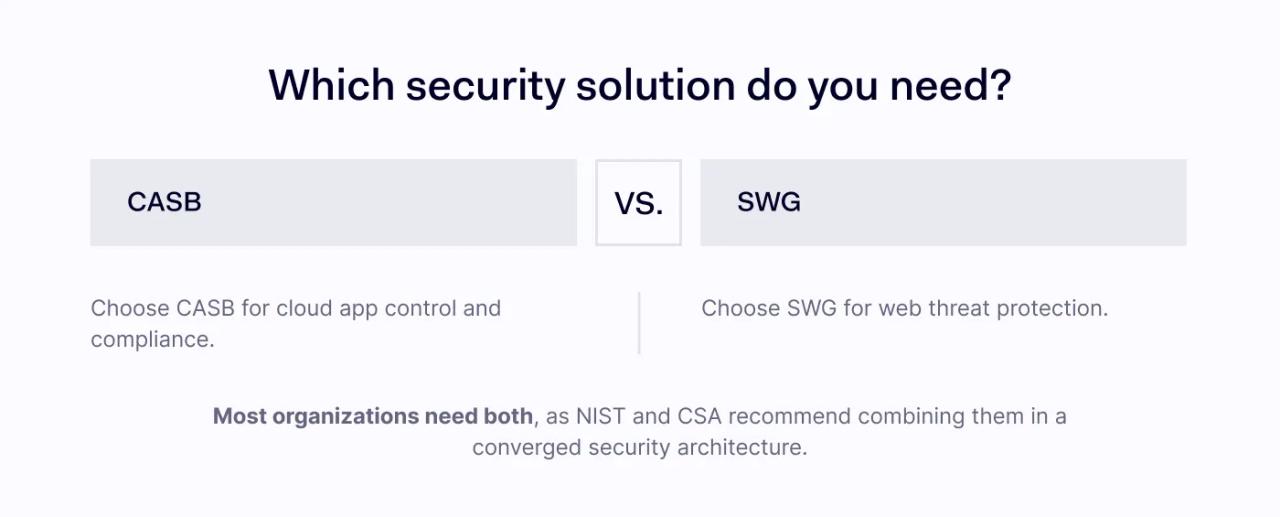
- Choose a CASB when your primary concern is control over how data and users interact with cloud services. If your organization relies heavily on SaaS platforms, stores sensitive data in cloud environments, or needs to enforce regulatory compliance rules across multiple cloud providers, a CASB gives you the depth you need. CASB solutions are also the right fit when you need to manage shadow IT monitor user behavior in cloud applications, or catch misconfigurations in your IaaS infrastructure.
- Choose an SWG when your primary concern is protecting users from web-based threats and enforcing acceptable use policies. If you manage a distributed workforce that accesses the open web from multiple locations, an SWG provides consistent policy enforcement, threat filtering, and centralized visibility across all connection points. SWG solutions are especially valuable when you need SSL/TLS inspection and want to block access to malicious or non-compliant websites.
- Choose both when your organization uses a mix of cloud applications and open web access, which describes most organizations today. The Cloud Security Alliance makes the point directly: a CASB is complementary to web proxies and firewalls, not a replacement for them. In practice, the CASB vs. SWG decision has quietly become a “both, delivered as one service” decision.
How CASB and SWG fit into SASE and SSE
Neither tool lives in isolation anymore. Both CASB and SWG sit inside secure service edge (SSE)—the security half of the stack—alongside zero-trust network access (ZTNA) and firewall as a service (FWaaS). SSE plus SD-WAN, which provides the networking side, together make up the broader secure access service edge (SASE) framework.
Both CASB and SWG sit inside security service edge (SSE) — the security half of the stack — alongside zero-trust network access (ZTNA) and firewall as a service (FWaaS). SSE plus SD-WAN, which provides the networking side, together make up the broader secure access service edge (SASE) framework.
NIST SP 800-215 lists SWG and CASB among the minimal security services in a converged, cloud-delivered SASE architecture, and CISA/FBI joint guidance positions SASE as the target architecture converging SWG, CASB, ZTNA, and FWaaS into cloud-delivered services.
The direction of travel is clear: these controls are converging into one cloud-delivered service, not maintained as separate point products with separate consoles, policies, and vendors.
For buyers, that changes the SWG vs. CASB question. Instead of picking one tool, then bolting on the other, the practical decision is which SASE or SSE platform integrates both cleanly—with shared identity, shared DLP policy, shared logs, and a single admin console. A converged platform gives you cloud-service depth and web-traffic breadth without the integration tax of stitching point products together.
CASB vs SWG FAQ
Can a CASB replace an SWG (or vice versa)?
No. A CASB has limited coverage of general web traffic, and an SWG has limited visibility into data inside sanctioned SaaS apps. Treating one as a substitute for the other leaves a predictable gap—either web-borne threats or in-app data exposure.
Can SWG and CASB work together?
Yes, and in modern SASE and SSE platforms, they are designed to. The SWG inspects the web session and enforces access policy; the CASB governs data and behavior inside connected cloud apps. Shared identity, DLP, and logging make the combined coverage stronger than either tool alone.
What is the difference between an SWG and a firewall?
A firewall filters network traffic across ports and protocols based on IP-level rules; an SWG operates at the application layer, inspecting HTTP and HTTPS content, URLs, and web categories. FWaaS delivers firewall capabilities from the cloud, and in a SASE architecture, it runs alongside—not in place of—the SWG.
What is the difference between an SWG and a WAF?
An SWG protects users making outbound requests to the web. A web application firewall (WAF) protects enterprise-hosted web applications from inbound attacks such as SQL injection and cross-site scripting. Different direction, different target—you typically need both.