
Vulnerability scanning automatically detects known software flaws, misconfigurations, and emerging threats across your ICT environment in real time. This process aligns with 3 DORA articles: Article 6, which establishes the general ICT risk management framework; Article 8, which requires financial entities to identify and continuously monitor every source of ICT risk; and Article 10, which mandates the continuous monitoring and detection of anomalous activity. And when scan results feed into prioritized patching, configuration hardening, and structured incident workflows, they close the loop between threat detection and the operational resilience that DORA demands.
What are DORA and DORA compliance?
The Digital Operational Resilience Act (DORA) is an EU regulation that sets a unified framework for managing ICT risk across the financial sector ICT, or information and communication technology, covers the hardware, software, networks, and cloud services that organizations rely on to operate. In turn, DORA applies to a wide range of financial entities, including banks, insurance companies, investment firms, payment providers, and crypto-asset service providers, along with the critical ICT third parties they depend on. DORA has been in effect since January 17, 2025, meaning affected organizations must already have the required controls in place.
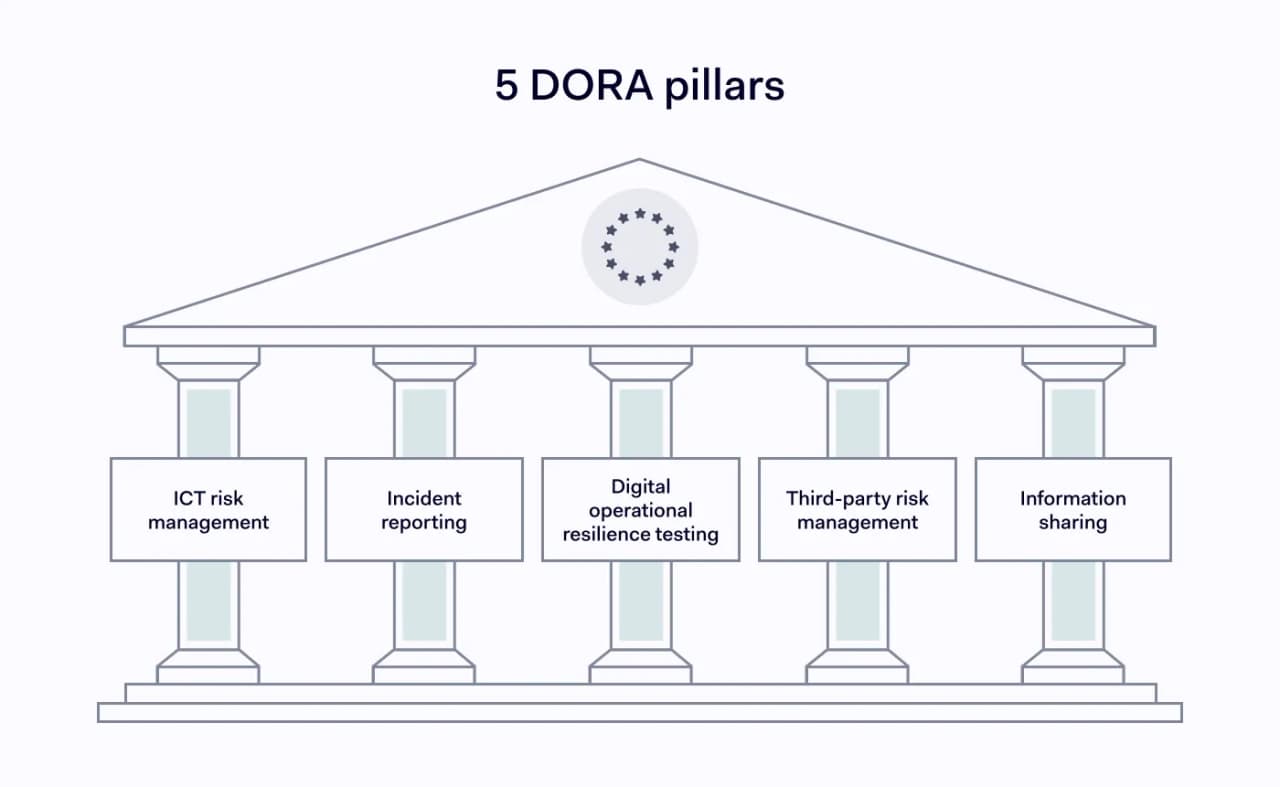
DORA is built around 5 pillars:
- ICT risk management Establishing governance structures, policies, and tools to identify, protect against, and respond to ICT risks on an ongoing basis. This includes assigning clear ownership at the management level, maintaining up-to-date asset inventories, and running continuous monitoring processes that flag new exposures as they appear.
- Incident reporting. Detecting, classifying, and reporting major ICT-related incidents to competent authorities, such as national regulators like BaFin and ACPR, within strict timelines. Financial organizations need standardized procedures for logging incidents by severity, notifying the relevant authorities, and producing post-incident reviews that feed back into their risk management framework.
- Digital operational resilience testing. Running regular tests, from basic vulnerability assessments to advanced threat-led penetration testing (TLPT), to validate that defenses actually hold up.
- Third-party risk management. Monitoring and managing the risks introduced by ICT third-party providers, with binding contractual requirements for critical providers. Organizations must maintain a registry of all third-party arrangements, assess concentration risk, and ensure contracts include clear exit strategies and audit rights.
- Information sharing. Encouraging organizations to exchange cyber threat intelligence and vulnerability data within trusted communities to build a collaborative community. While participation is voluntary, DORA creates a legal framework that removes barriers to sharing indicators of compromise, attack techniques, and mitigation strategies across the sector.
Where vulnerability scanning fits in DORA
Within DORA’s 5-pillar structure vulnerability scanning naturally falls under the ICT risk management pillar. Article 6 requires financial entities to maintain frameworks that can identify ICT risks in a timely, continuous manner. Scanning tools make this possible at scale, scanning servers, endpoints, applications, and network infrastructure to flag known CVEs, misconfigurations, and outdated components as soon as they surface.
DORA also emphasizes the risks introduced by third-party ICT providers, from cloud platforms to managed service vendors. Vulnerability scanning addresses this issue by evaluating the external attack surface, testing APIs and integration points where your systems connect to third-party services. For visibility beyond your perimeter, DORA’s Article 30(3) establishes contractual audit and access rights, giving financial entities the possibility to assess their providers’ environments. When a critical provider introduces a new vulnerability, your scanning tools should catch it before it becomes an incident.
Every scan should generate a timestamped record of the identified weaknesses, their severity ratings, and their remediation status. That data then feeds directly into risk registers, supports prioritized patching decisions, and gives auditors exactly the kind of repeatable, evidence-based reporting DORA expects. Without it, organizations are left estimating their exposure instead of measuring it.
Scanning connects to the other pillars, too. The findings inform resilience testing by highlighting where defenses are weakest. They trigger incident workflows when a scan reveals active exploitation. And they shape the threat intelligence an organization can share with sector peers. In practice, vulnerability scanning acts as a detection layer that the rest of DORA’s requirements build on.
DORA-aligned vulnerability management: the role and process
Standard vulnerability management follows a familiar loop: discover assets, scan for weaknesses, and fix what you find. DORA vulnerability management raises the bar by demanding that each step produce auditable evidence, tie back to a documented risk framework, and operate at a frequency driven by asset criticality and risk, rather than a fixed calendar. Here’s how the process maps to DORA’s expectations:
Governance framework establishment
Start by mapping out who is responsible for each step of your vulnerability management process: identification, assessment, and remediation. Then, with leadership approval, build policies around DORA’s ICT risk management requirements. These policies should fit into your broader risk governance structure and have escalation paths, remediation timelines, and oversight mechanisms.
Asset discovery and classification implementation
Map out every ICT asset in your environment, from hardware and software to cloud services and third-party connections. Then, classify each asset by business criticality and risk exposure. Keep that inventory centralized and dynamic so it reflects changes as systems scale or shift. This asset-level visibility is what drives smart prioritization and gives every subsequent step in the process something solid to work from.
Regular vulnerability assessments
Set up a regular scanning that covers internal systems, external-facing assets, and cloud environments. It’s important to extend that same scrutiny to third-party vendors and service providers, since DORA doesn’t let you treat external risks as solely your vendor’s problem. Additionally, incorporating threat intelligence and exploit data sharpens what your scanners pick up, catching blind spots that database-driven detection alone would miss.
Prioritization and remediation of vulnerabilities
When new vulnerabilities come in, assess them based on 3 things: business impact, exploitability, and the criticality of the affected asset. Start with the highest-risk issues and work down from there. Build patching schedules that match the urgency of each vulnerability, and track remediation progress across IT, security, and risk management so nothing gets stuck in a handoff. A disciplined, risk-based remediation process is how you make that happen and how you prove it to regulators.
Effectiveness monitoring and validation
After remediation, keep monitoring to confirm the fix was actually effective and to catch new exposures as they appear. Additionally, track performance through key performance indicators (KPIs) and key risk indicators (KRIs), and pressure-test your defenses with periodic penetration tests and scenario-based exercises that simulate real-world conditions.
Documentation maintenance and continuous improvement
Documentation is non-negotiable for the DORA framework, so auditors will expect a complete, traceable paper trail. Things like assessments, remediation actions, decisions, and communications—everything needs to be documented. Beyond just compliance this helps you build a feedback loop that puts your policies, tools, and processes under regular review.
Penetration testing
Vulnerability scans tell you where the cracks are. Penetration testing tells you whether an attacker can actually get through them. DORA treats both seriously, requiring financial entities to run regular vulnerability scanning and penetration tests as part of their security testing obligations for DORA compliance. The objective is clear: find and fix vulnerabilities before attackers exploit them.
The baseline expectation applies to all financial organizations. According to Article 24(6), financial entities must test ICT systems and applications that support critical or important functions at least once a year. However, microenterprises are exempt from this annual requirement and instead follow a risk-based testing schedule. Additionally, the general testing program that falls under Article 25 covers a range of test types, with penetration testing reserved for entities that meet specific thresholds rather than being applied as an annual obligation.
This means annual testing that probes systems, networks, and applications for exploitable weaknesses. Entities identified by their competent authority must carry out threat-led penetration testing (TLPT), which is a more advanced exercise that simulates the tactics, techniques, and procedures of real-world adversaries. TLPT must be carried out at least once every 3 years, though the competent authority can adjust this frequency according to Article 26(1). While external testers are required for at least 1 test every 3 years, Article 27 permits internal testers under specific conditions, including competent-authority approval and appropriate safeguards. Each test must cover critical functions that, if disrupted, could ripple across the financial system.