Vibe coding security: risks, challenges, and best practices
Agnė Srėbaliūtė
Summary: Explore vibe coding security risks, real-world incidents, and practical safeguards for securing AI-generated code, applications, and development workflows for your business.
Vibe coding security is the practice of protecting AI-generated code, applications, and coding workflows from security vulnerabilities introduced by AI coding tools. As AI makes software creation faster and more accessible, employees can build applications, automations, and internal tools with little or no programming experience. While this accelerates innovation, it can also introduce hidden risks when AI-generated code enters production without proper review.
This article covers the main vibe coding security risks, real-world incidents, and the practices that help organizations keep AI-assisted development safe.
What is vibe coding?
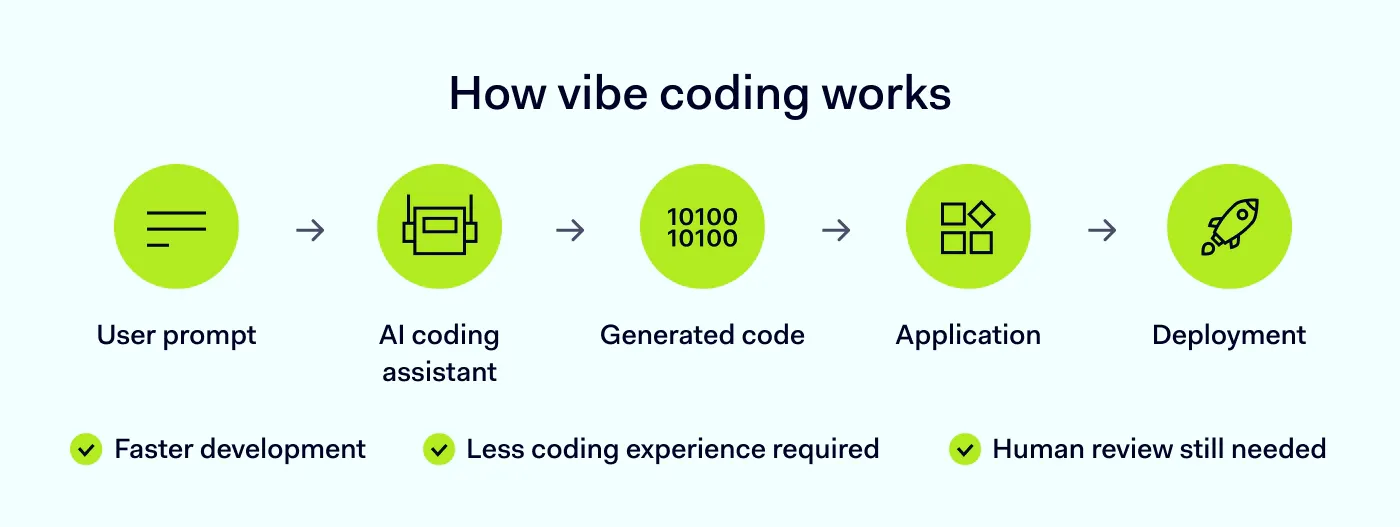
Vibe coding is a software development approach where users rely on AI tools to generate code from prompts, instructions, or conversations instead of writing most of the code by hand.
The term describes a workflow focused on outcomes rather than implementation details. A developer—or a non-technical user—can describe what an application should do, and an AI assistant generates the code needed to build it.
Modern AI coding tools can create web applications, APIs, databases, automation scripts, and integrations within minutes. This speeds up the process for those without a programming background and shortens delivery cycles for those who do.
The trade-off here is application security. Users may deploy AI-generated code without fully understanding how it works or whether it contains security weaknesses.
Why is vibe coding security a growing concern?
AI-powered coding tools have moved from experimentation to everyday business use. Developers use these tools to speed up projects, while non-technical employees use them to build internal tools, dashboards, and automations on their own.
This shift pushes software development beyond traditional engineering teams. As a result, organizations now find themselves running applications created by employees with limited security expertise.
The problem isn’t the AI itself, but rather that AI-generated code can reach production faster than security teams can review it.
Several trends are raising concerns about vibe coding security:
AI coding tools are widely accessible.
Non-developers can now build functional applications.
Development cycles are shorter.
Shadow AI use is rising across organizations. The 2026 Verizon Data Breach Investigations Report logged 858,440 shadow AI events in a single year, making it the third most common insider action.
Security reviews are often skipped to save time.
Without proper governance, these factors increase the likelihood of security vulnerabilities entering production environments.
The security risks of vibe coding
While vibe coding offers speed and convenience, it also introduces several security risks that organizations should be aware of.
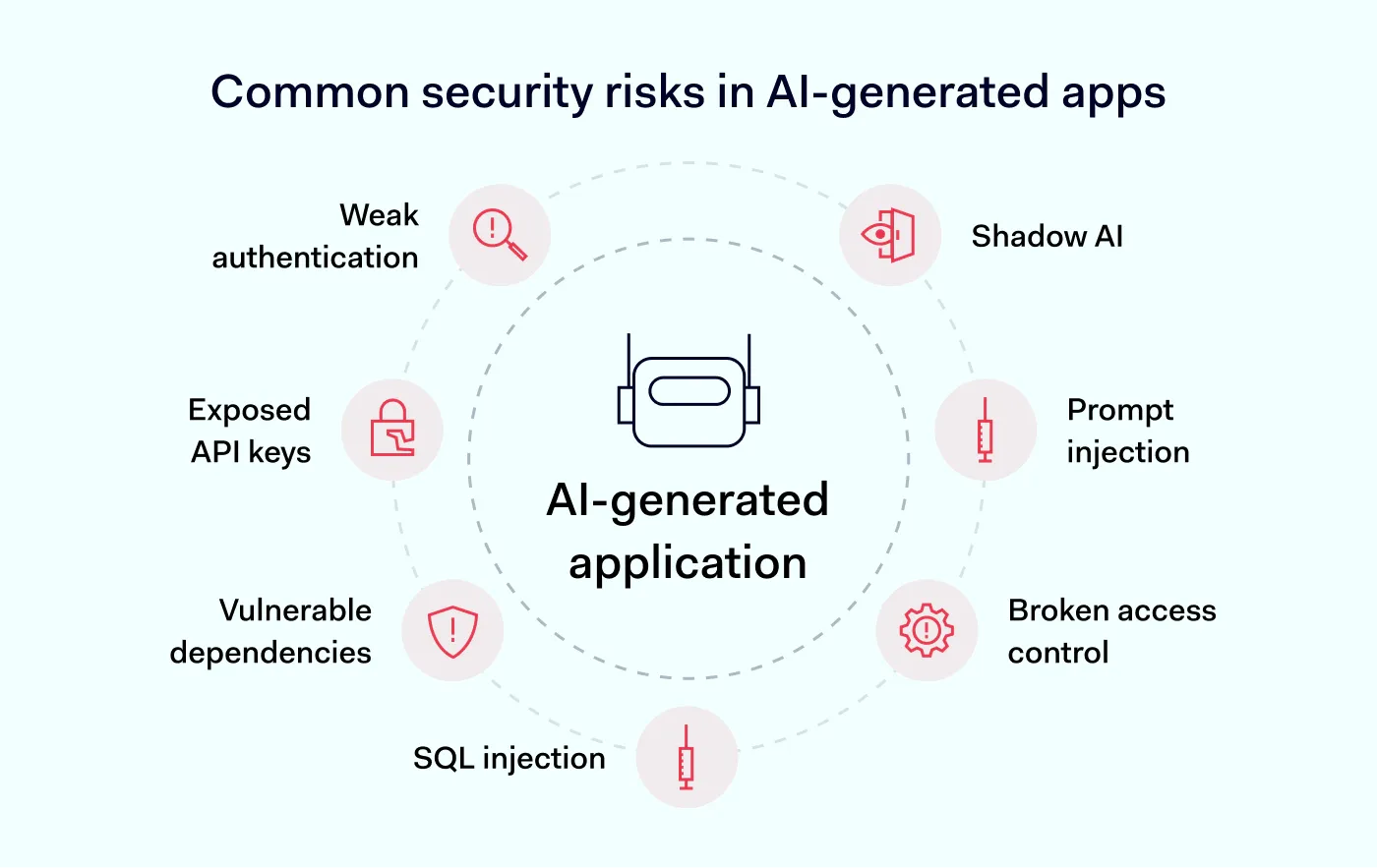
Insecure AI-generated code
AI models generate code based on patterns learned from large datasets. The output may work, but it is not always secure.
AI-generated code can contain:
Weak authentication mechanisms
Overly permissive access controls
Insecure cryptographic implementations
Missing input validation
Database queries that directly include user input, rather than using parameterized statements, making them vulnerable to SQL injection
Path traversal flaws follow a similar pattern: insufficient validation lets attackers reach files outside of the intended directories. Because generated code often looks polished and complete, users may assume it is secure even when important protections are missing. Treat it as untrusted until it has been reviewed and tested.
Vulnerable open-source dependencies
Many AI coding assistants recommend third-party libraries and packages to speed up development.
These dependencies sometimes contain known vulnerabilities, outdated components, or poorly maintained projects. Users who accept AI suggestions without checking them may unintentionally introduce security weaknesses into their applications.
The risk grows when organizations lack software composition analysis (SCA), which creates an inventory of third-party components and flags known issues, or dependency monitoring processes.
Hallucinated dependencies and supply chain risks
AI coding tools sometimes reference software packages that don’t exist. These hallucinated dependencies create a distinctive supply chain risk because attackers can publish malicious packages under invented names—a technique called slopsquatting.
In a 2025 USENIX Security study, Joseph Spracklen and his colleagues analyzed 576,000 code samples generated by 16 popular code-generation models and found that these hallucinated packages follow predictable patterns that attackers can exploit.
Because AI-generated code can introduce both legitimate and nonexistent dependencies, organizations need visibility into the packages, frameworks, and third-party libraries entering their development environments. Maintaining a software bill of materials (SBOM) and governing AI-introduced dependencies can help identify risky components before they reach production.
Exposure of secrets and credentials
Hardcoded secrets are one of the most common application security issues. AI tools may generate code that includes:
API keys
Database credentials
Authentication tokens
Cloud service credentials
If developers fail to remove or secure these values before deployment, attackers may gain unauthorized access to sensitive systems and data. However, secrets management tools and automated scanning catch most of these issues before deployment.
Insufficient access controls
Many AI-generated applications prioritize functionality over security. As a result, access controls may be overly permissive, allowing users to view, modify, or delete data they shouldn’t have access to.
A common pattern is an app that checks whether a user is logged in, but doesn’t check what they’re actually allowed to see. Picture an internal expense tool where every employee can log in, view their own expense reports—and, by changing one number in the page address, pull up a coworker’s report instead. This is the textbook example of broken access control, and the reason broken access control remains the #1 risk in the OWASP Top 10.
Poor authorization logic can create significant business risks, especially in applications that process customer information, financial records, or proprietary company data.
Prompt injection and AI manipulation
Applications that integrate AI functionality may open new attack vectors. For example, prompt injection attacks manipulate AI systems by feeding them malicious instructions that override the developer’s safeguards.
These instructions don’t always come from a user typing into a chat box. Indirect prompt injection hides instructions inside content the AI later reads—a support ticket, a scraped web page, a PDF, an email—and the model treats them as if they came from a trusted source. A customer service bot asked to “summarize this email” can be tricked into emailing the user’s order history to a hacker if the email body contains a hidden instruction to do so.
Without appropriate controls, attackers may use prompt injection techniques to expose sensitive data, alter application behavior, or bypass restrictions.
Lack of security reviews and shadow AI
Traditional software development includes security testing, peer reviews, and approval workflows before deployment. However, vibe coding can bypass many of these steps.
At the same time, as AI tools become easier to use, employees may build and deploy applications without IT approval. These unofficial applications create shadow AI risks: unmanaged software, unknown data flows, and security blind spots. Over time, organizations may lose visibility into what applications exist, who maintains them, and what data they access.
When applications move directly from AI generation to production, vulnerabilities that would otherwise be caught during normal review stages slip through.
You can’t secure what you can’t see.
Get visibility and control into AI activity within your network.
Several recent incidents show why vibe coding security deserves attention.
Exposed business applications
In May 2026, Wired reported that researchers at Red Access scanned more than 5,000 publicly deployed vibe-coded apps. Around 40% of these apps exposed sensitive data, including medical information, financial records, corporate presentations, and customer details.
The Hacker News followed up with a closer look at the dataset, finding more than 2,000 corporate apps that lacked access controls across roughly 380,000 publicly accessible assets. In many cases, the applications worked as intended from a functional perspective but lacked basic security protections.
Leaked API keys and credentials
Security researchers have repeatedly found AI-assisted projects with exposed credentials in public repositories. Developers often copy AI-generated code straight into production environments without removing embedded secrets, creating opportunities for unauthorized access and data exposure.
Public exposure of customer and corporate data
The Red Access study referenced above also documented configuration errors and weak security controls that exposed personal and business information to the open internet.
These incidents point to a recurring pattern: applications built quickly with AI may function correctly but introduce significant application security risks.
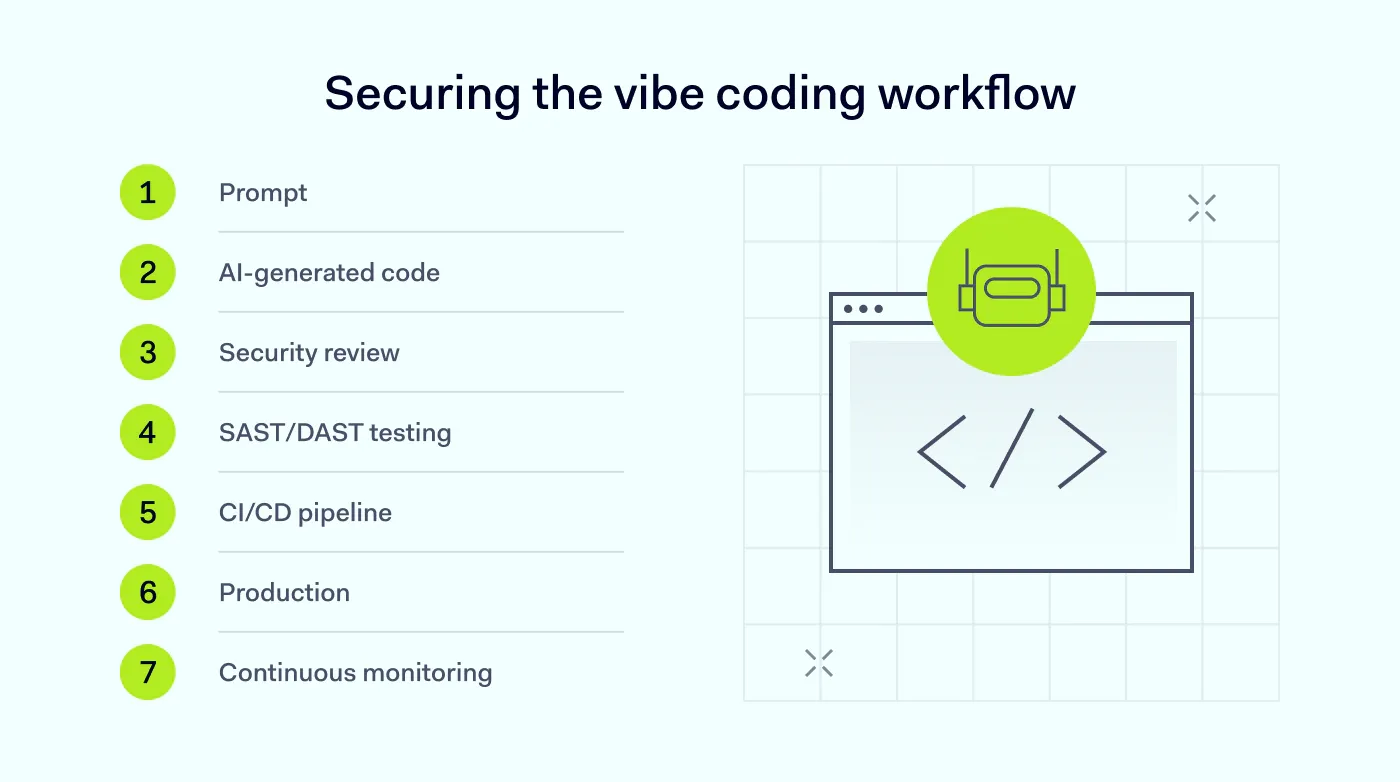
Organizations don’t need to avoid vibe coding entirely. Instead, they should put controls in place that let teams benefit from AI while reducing risk.
Review AI-generated code
Treat AI-generated code like code written by a junior developer. Every significant change should undergo review before deployment. Developers should verify logic, authentication mechanisms, permissions, third-party dependencies, and data handling practices.
Implement secure coding standards
Set clear development guidelines that apply whether code is written by humans or generated by AI. Security requirements should cover:
Authentication
Authorization
Input validation
Encryption
Secret management
Logging and monitoring
Core principles like least privilege, defense in depth, and input validation remain essential regardless of how code is created.
Integrate security into the CI/CD pipeline
Embed security testing directly into the development workflow. Useful practices include:
Static application security testing (SAST), which inspects source code for known weakness patterns
Dynamic application security testing (DAST), which probes a running application for vulnerabilities
Software composition analysis (SCA)
Dependency scanning
Secret detection
Container security scanning
Automated scanning catches security vulnerabilities that a manual review can miss.
Limit access to sensitive resources
AI-generated applications should follow least-privilege principles. Grant only the minimum permissions an application needs to function. Restricting access reduces the impact of compromised credentials or exploited vulnerabilities.
Monitor applications after deployment
Not all vulnerabilities are visible during development. Continuous monitoring shows how AI-generated code behaves in production and helps identify runtime vulnerabilities, misconfigurations, or suspicious activity that testing may miss.
Govern AI-generated dependencies
Establish policies controlling which packages, frameworks, and models can be introduced through AI-assisted development. This reduces risks in the software supply chain and prevents unauthorized components from reaching production systems.
Prioritize findings based on risk
High-volume AI-assisted development can generate large numbers of security alerts. Security teams should prioritize these findings based on exploitability, reachability, business impact, and runtime context to focus on issues that pose the greatest risk.
Governance prevents AI adoption from creating unmanaged security risks.
Train employees on secure AI development
Many risks come from misuse rather than malicious intent. Security awareness training should teach employees how to:
Evaluate AI-generated code
Protect sensitive data
Avoid exposing credentials
Follow secure development practices
Recognize common AI-related threats
Education helps teams use AI tools responsibly while maintaining security standards.
How NordLayer supports secure AI adoption
NordLayer helps organizations reduce risks tied to AI-driven development through network security controls built on zero-trust network access (ZTNA) principles.
Organizations can use NordLayer to:
Secure access to development environments
Enforce least-privilege access controls with cloud firewall rules
Gain visibility into user, device, and access activity
Strengthen identity verification with single sign-on and multi-factor authentication
Combined with broader AI security solutions, these capabilities help organizations support innovation without compromising on security.
Final thoughts
Vibe coding is changing how applications are built by making development faster and more accessible. However, speed and convenience should not come at the expense of security.
When deployed without proper oversight, AI-generated code can introduce security vulnerabilities, weak access controls, exposed credentials, and other application security risks. Organizations that combine AI-assisted development with secure coding practices, security testing, and strong governance can reduce risk while still benefiting from the productivity gains vibe coding offers.
Agnė Srėbaliūtė
Senior Cybersecurity Copywriter
After spending a decade writing across media, PR, and advertising, Agne has been specializing in technology and cybersecurity content, focusing on IP address management, networking, zero trust, and internet infrastructure. She helps businesses understand complex technologies through clear, engaging, and sometimes creative content.