Enterprise application security: challenges, tools, and best practices
Agnė Srėbaliūtė
Summary: Enterprise application security protects apps, data, and access across complex environments. Learn the key challenges, best practices, and tools to reduce organizational risk.
Enterprise application security is the practice of protecting apps, data, users, and supporting infrastructure across an organization’s software environment. As business tools become more distributed and interconnected, security teams need to manage risk across the entire stack, not just the code inside individual apps.
For enterprise organizations, this means combining secure development practices with identity and access controls, monitoring, vulnerability management, and other security tools. The goal is to reduce security risks without making enterprise applications harder to use or manage.
What is enterprise application security?
Enterprise application security is the practice of identifying, preventing, and managing security risks across an organization’s applications and the environments they run in.
Enterprise application security covers the full application lifecycle, from development and testing to deployment, maintenance, and retirement. It can include secure coding, vulnerability management, application testing, identity and access management (IAM), data protection, and monitoring.
The scope is broader than securing application code alone. Enterprise applications often connect to databases, cloud services, APIs, third-party platforms, internal networks, and other apps. These applications may also be accessed by employees, contractors, customers, and partners from different locations and devices.
This makes enterprise application security (AppSec) a shared responsibility. Developers need to build applications securely, while security teams need to control access, monitor for threats, manage vulnerabilities, and respond when something goes wrong.
Why enterprise application security matters
Enterprise applications rarely operate in isolation. A typical organization may use hundreds of applications across cloud and on-premises environments, with different teams accessing them from different devices and locations.
This complexity creates more opportunities for application security risks. For example, a vulnerability in one application, an overly permissive account, a compromised credential, or an insecure integration can expose other systems and data.
Enterprise application security helps organizations establish consistent security controls across these environments. Security teams need to answer questions such as:
Which enterprise applications are in use?
What data does each application access?
Who can access each application?
Which users, devices, and locations are trusted?
What third-party services connect to enterprise applications?
Which application security risks require immediate attention?
How are vulnerabilities and security incidents detected and handled?
Without a coordinated approach, individual applications may have different security requirements and access rules. This makes it harder to maintain visibility and enforce enterprise security policies consistently.
Enterprise application security also supports risk management. Instead of treating every application the same, IT teams can prioritize controls based on the sensitivity of the data, business importance, exposure, and the potential impact of a compromise.
Enterprise application security by the numbers
A few recent data points show why enterprise security programs are under pressure to modernize:
Rising exploitation of vulnerabilities. Vulnerability exploitation was the initial access vector in 31% of breaches in 2026, according to Verizon’s DBIR—a trend that’s pushing application-layer defense higher on the priority list.
Open-source exposure is nearly universal.98% of commercial databases now contain open-source components, which means a single vulnerable dependency can ripple across an entire organization’s application environment.
Breach costs remain steep. The global average cost of a data breach reached $4.99 million in 2026, and the average cost in the US is significantly higher.
Consolidation is the direction of travel. Heading into 2027, 89% of enterprises plan to move to fewer, more integrated platforms to reduce complexity across data-intensive workloads, which would reshape how security tools are bought and deployed.
Code security needs more investment.63% of security professionals believe CISOs aren’t investing enough in code security, reflecting how much application risk originates at the development stage.
Together, these numbers point to the same conclusion: application-layer risk is growing faster than most fragmented enterprise security stacks can handle.
Enterprise application security vs. traditional application security
Traditional application security, or AppSec, often focuses on protecting an individual application throughout its development and operational lifecycles. Enterprise application security takes that foundation and applies it across a larger, more interconnected environment.
Traditional application security
Enterprise application security
Focuses on individual applications
Covers an organization’s application environment
Often emphasizes application code and vulnerabilities
Includes applications, identities, infrastructure, data, and integrations
Security may be managed by a development or AppSec team
Requires coordination between security, IT, development, and business teams
Controls may differ between applications
Aims for consistent security policies across enterprise applications
Usually focuses on application-level threats
Also considers access, third-party connections, cloud environments, and organizational security risks
Often uses tools such as SAST, DAST, and dependency scanning
Combines AppSec tools with IAM, network security, monitoring, vulnerability management, and other security tools
The two approaches aren’t alternatives. Enterprise application security builds on the traditional foundation, and practices like secure coding, code reviews, dependency management, and application testing remain just as important. What changes is the scale and breadth of the program, which now has to account for identities, integrations, and infrastructure alongside the code itself.
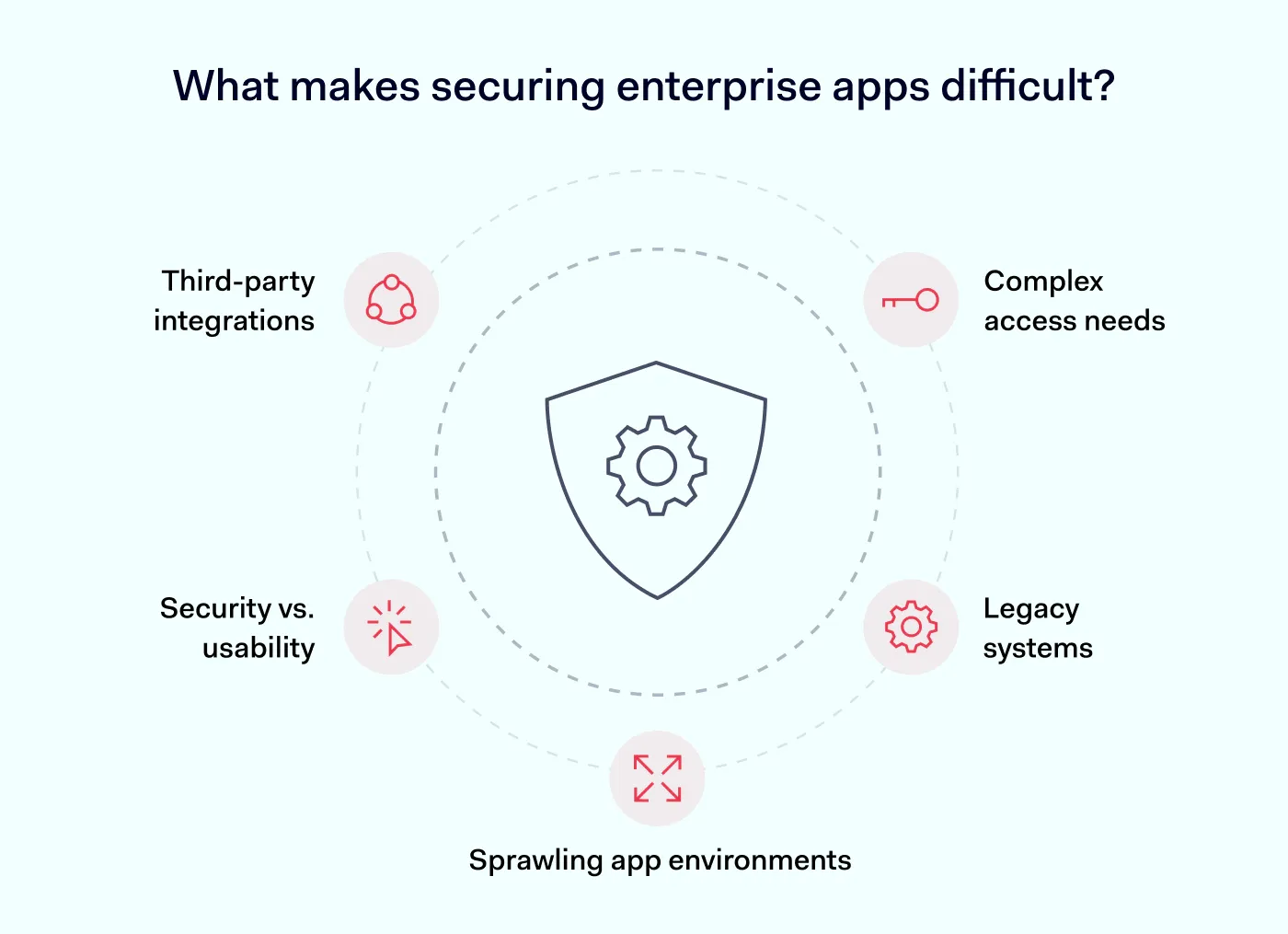
Common enterprise application security challenges
Enterprise environments introduce several challenges that can make application security harder to manage.
1. A large and changing application environment
Organizations can have hundreds or thousands of enterprise applications, including SaaS platforms, custom applications, legacy systems, and cloud workloads. Security teams may struggle to maintain an accurate inventory and understand how these applications connect to each other.
Applications can also be introduced without going through established security processes, increasing the risk of shadow IT and unknown application security risks.
2. Complex access requirements
Enterprise applications may need to be accessible to employees, contractors, partners, and other users in different locations and on various devices. Managing this access at scale is difficult. Excessive permissions can increase security risks, while overly restrictive policies can prevent people from doing their jobs.
Fortunately, identity-based access controls, multi-factor authentication (MFA), single sign-on, and least-privilege policies enable IT teams to manage who gets access to which applications and resources.
3. Legacy applications and infrastructure
Many enterprise organizations still depend on applications that were not designed for today’s cloud-based and distributed environments. Replacing these applications isn’t always practical. Security teams, therefore, need to protect legacy enterprise applications while integrating them with newer systems and security controls.
4. Third-party integrations
Enterprise applications often exchange data with external services through APIs and other integrations. Each connection can introduce additional risks. Teams need visibility into third-party access and should understand what information external applications can access, how those connections are authenticated, and how access can be revoked when it is no longer required.
5. Balancing security with usability
Security controls that create too much friction can encourage users to find workarounds. At the same time, weak controls can leave enterprise applications and company data unnecessarily exposed. That’s why effective enterprise AppSec requires security teams to balance risk reduction with practical business requirements.
Enterprise application security use cases
Enterprise application security can be applied to many everyday scenarios. For example:
Securing remote access. Employees need to access internal enterprise applications from home, public networks, or other locations. Security teams can use identity verification, encrypted connections, and access policies to restrict access to authorized users and devices.
Protecting cloud applications. Organizations can apply access controls and monitoring to SaaS and cloud-hosted enterprise applications, particularly when they handle sensitive business data.
Managing third-party access. Contractors and vendors may need access to specific applications without gaining access to the wider corporate environment. Least-privilege and application-level access controls can limit their exposure.
Protecting legacy applications. Security teams can place additional access controls around older enterprise applications while the organization works toward modernization.
Reducing lateral movement. If an account or device is compromised, segmentation and application-level access controls can limit the attacker’s reach to other resources.
Supporting compliance. Organizations can use application security controls, access logs, and monitoring to support data protection and regulatory requirements.
These use cases show why enterprise application security encompasses more than identifying vulnerabilities in source code. The way users and systems access enterprise applications is also part of the security picture.
A mature enterprise application security program combines technical controls, processes, and collaboration between teams.
Build an application inventory
Maintain an up-to-date inventory of enterprise applications, including their owners, users, data, integrations, hosting environments, and business importance. It’s not possible to effectively manage application security risks without knowing they exist.
Classify applications and data
Not every application requires the same level of protection. Classify enterprise applications according to their business criticality and the sensitivity of the data they handle. This allows security teams to prioritize resources and apply stronger controls where the potential impact is higher.
Apply secure coding practices
Integrate application security into the development process instead of treating it as a final check before release. Use secure coding guidelines, code reviews, dependency management, vulnerability scanning, and security testing throughout the development lifecycle.
Administrators and developers should work together to identify and address vulnerabilities before applications reach production.
Enforce least-privilege access
Give users only the access they need to perform their roles. Review permissions regularly and remove access when users change roles or leave the organization. For sensitive enterprise applications, consider the user’s identity, device, location, and other relevant context before granting access.
Protect APIs and integrations
Take inventory of external connections and apply authentication and authorization controls to APIs. Monitor integrations for unusual activity, and remove connections that are no longer necessary. Third-party access should be treated as part of the organization’s application security risk management, not as an isolated IT issue.
Segment critical applications
Avoid giving users broad access to the entire network simply because they need one application. Network segmentation and application-level access controls can limit access to specific resources and reduce the potential impact of compromised accounts.
Monitor application activity
Administrators need visibility into how enterprise applications are being accessed and used. Monitor authentication events, access attempts, unusual behavior, and other relevant activity. Centralized logging and monitoring can help teams detect potential application security incidents and support investigation and incident response efforts.
Application security doesn’t end when an application goes live. Regular vulnerability assessments, penetration testing, configuration reviews, and security updates can surface new risks. Review security controls whenever applications, integrations, infrastructure, or business requirements change.
Measure security maturity
Track meaningful indicators such as critical vulnerabilities, remediation times, exposed applications, excessive permissions, and unresolved security findings. These metrics show whether your enterprise application security program is improving and where additional investment is needed.
How NordLayer supports enterprise application security
Strong technical controls and mature processes still depend on one thing: consistent, verified access to the apps they protect. Application security depends not only on how software is built, but also on who can reach it and under what conditions.
NordLayer enables organizations to secure access with a set of connected controls, grounded in zero-trust and identity-based access—network segmentation,cloud firewall, device posture security, network visibility, and access management—that protect the paths around enterprise applications. Rather than exposing an entire network to an authenticated user, organizations can restrict access to only the resources each role requires, and complement their existing application security tools with consistent controls across cloud and network environments.
Learn more about NordLayer’s enterprise cybersecurity solutions and how they can help your security teams control access to applications while reducing exposure across your environment.
Agnė Srėbaliūtė
Senior Cybersecurity Copywriter
After spending a decade writing across media, PR, and advertising, Agne has been specializing in technology and cybersecurity content, focusing on IP address management, networking, zero trust, and internet infrastructure. She helps businesses understand complex technologies through clear, engaging, and sometimes creative content.