Summary: AI agent access control is the process of managing permissions, access, and security risks in automated AI environments and workflows. Learn more.
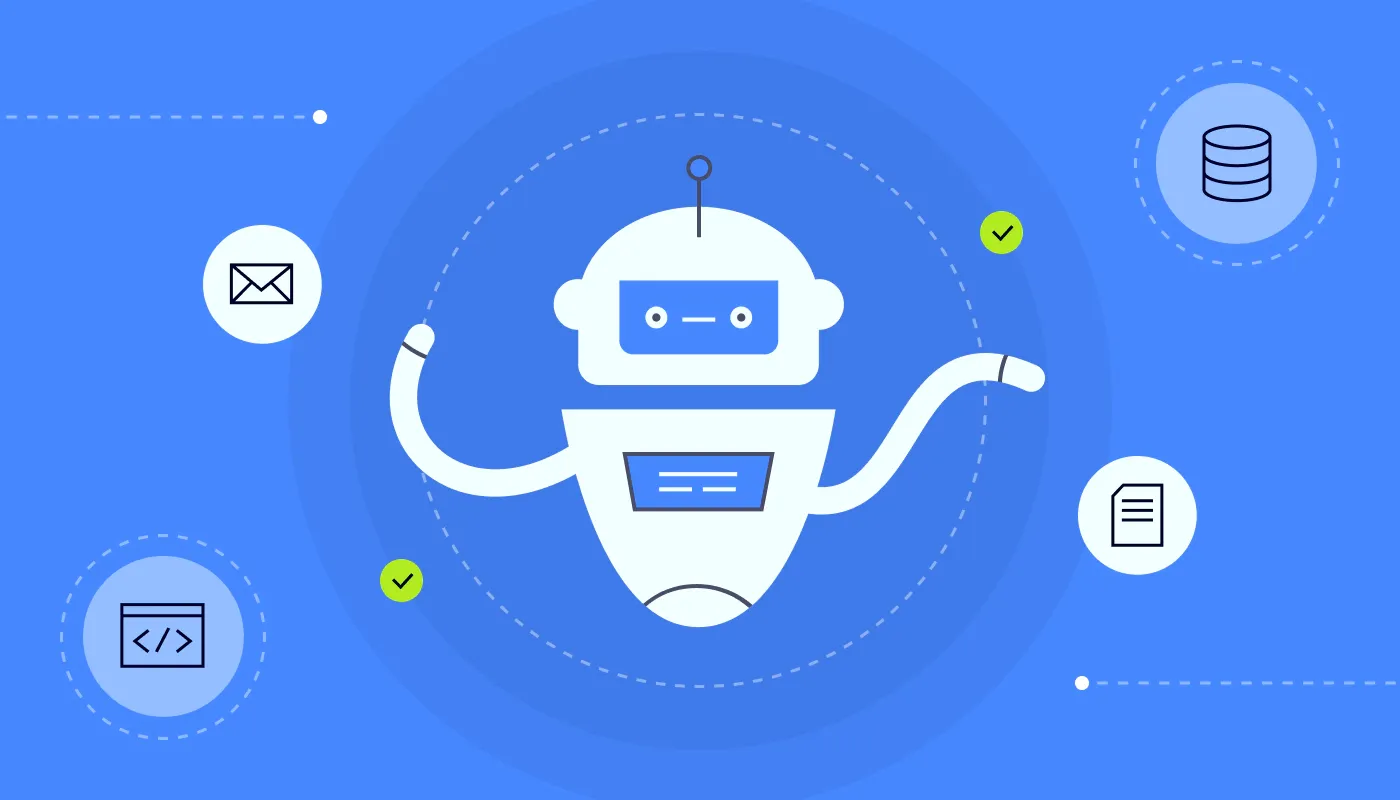
AI can now search databases, update tickets, write code, send emails, connect SaaS apps, and trigger automated workflows across entire business environments. But more access means more risk.
In enterprise environments, non-human identities—including AI agents, API keys, and service accounts—now outnumber human users by as much as 45 to 1. AI agents with excessive permissions or poor oversight can expose sensitive data, trigger unauthorized actions, or become targets for prompt injection and other cyberattacks.
AI agent access control governs what these agents can access, what actions they can perform, and under what conditions. In this article, we’ll explain how AI agent access control works, how it differs from traditional identity and access management (IAM), the risks involved, and best practices for securing automated AI environments.
What is AI agent access control?
AI agent access control refers to the process of managing and restricting what AI agents can access and do within systems, applications, and networks. AI agent access control treats AI agents as non-human identities that require their own permissions, authentication methods, and security policies.
An AI agent can be any AI-powered system capable of performing tasks autonomously or semi-autonomously, such as:
AI assistants connected to company tools
Autonomous workflow agents
AI coding assistants
Customer support bots
AI research agents
AI systems that interact with APIs and databases
Multi-agent systems where AI agents communicate with one another
These agents often operate across multiple environments and services at once. For example, a single AI agent may access emails, analyze files, make API calls, update CRM records, and generate reports automatically.
Because of this broad access, organizations need clear permission management strategies to ensure AI systems only interact with approved resources.
You can’t secure what you can’t see.
Get visibility and control into AI activity within your network.
Even though AI agents can increase productivity and automate repetitive work, they also expand the attack surface. Without controls in place, AI agents may gain unnecessary access to sensitive systems or perform actions outside their intended scope.
As organizations deploy more AI agents, business and security risks also rise; therefore, controlling permissions becomes a way to contain them.
Excessive permissions
Many AI systems are given broad access to simplify deployment. However, excessive agent permissions can expose sensitive data, internal systems, or critical workflows. For example, an AI assistant connected to cloud storage could inadvertently retrieve confidential files unrelated to a user’s request simply because of its unrestricted access.
Prompt injection attacks
In a prompt injection attack, malicious instructions are hidden inside documents, websites, emails, or user inputs. The AI agent may interpret these instructions as legitimate commands and perform unintended actions. For example, an attacker could trick an AI agent into leaking sensitive information, bypassing security policies, or executing unauthorized API calls.
Uncontrolled automation
AI agents can act quickly and at scale. This improves efficiency, but mistakes can spread faster, too. An agent with write permissions across multiple systems could accidentally modify records, trigger workflows, or distribute incorrect information before anyone notices. Without clear access control and monitoring, organizations may lose visibility into what the agents are doing.
Data exposure
AI agents often process large amounts of sensitive business data, including emails, customer information, internal documents, and tickets. If access is poorly configured, AI systems may expose this information to unauthorized users or external services. This is especially important in regulated industries that must meet strict data handling and access control requirements.
Shadow AI
Employees may deploy AI tools without formal approval from security teams. These unofficial AI agents may connect to SaaS apps, databases, or productivity tools using unmanaged credentials and unknown security settings. Shadow IT creates visibility and governance problems, especially when organizations don’t know what systems the agents can access.
These risks show that traditional access management approaches are no longer enough for autonomous AI systems.
Traditional IAM focuses on authenticating human users and assigning permissions based on roles. In contrast, AI agent access control goes further by managing dynamic, autonomous systems that interact with multiple services, process data independently, and make decisions in real time.
Here are some key differences:
Traditional IAM
AI agent access control
Built around human sessions and predictable activity patterns.
Governs autonomous agents operating across systems and APIs.
Permissions are relatively static.
Permissions may change dynamically.
Actions are user-driven.
Actions may be autonomous.
Focuses on authentication and authorization.
Requires continuous monitoring of agent behavior and decisions.
Service accounts are usually predictable.
AI systems may interact with many tools and APIs simultaneously.
Limited context awareness.
Requires context-aware policies and behavioral controls.
In practice, organizations still use IAM foundations like authentication, role-based access control (RBAC), and identity management. However, AI agent access control adds additional layers focused on autonomous behavior, continuous monitoring, and AI-specific risks.
Compared to individual users, AI agents can operate continuously and generate large volumes of API activity across multiple systems simultaneously. This underscores the importance of visibility and agent permission management.
What AI agents can access inside organizations
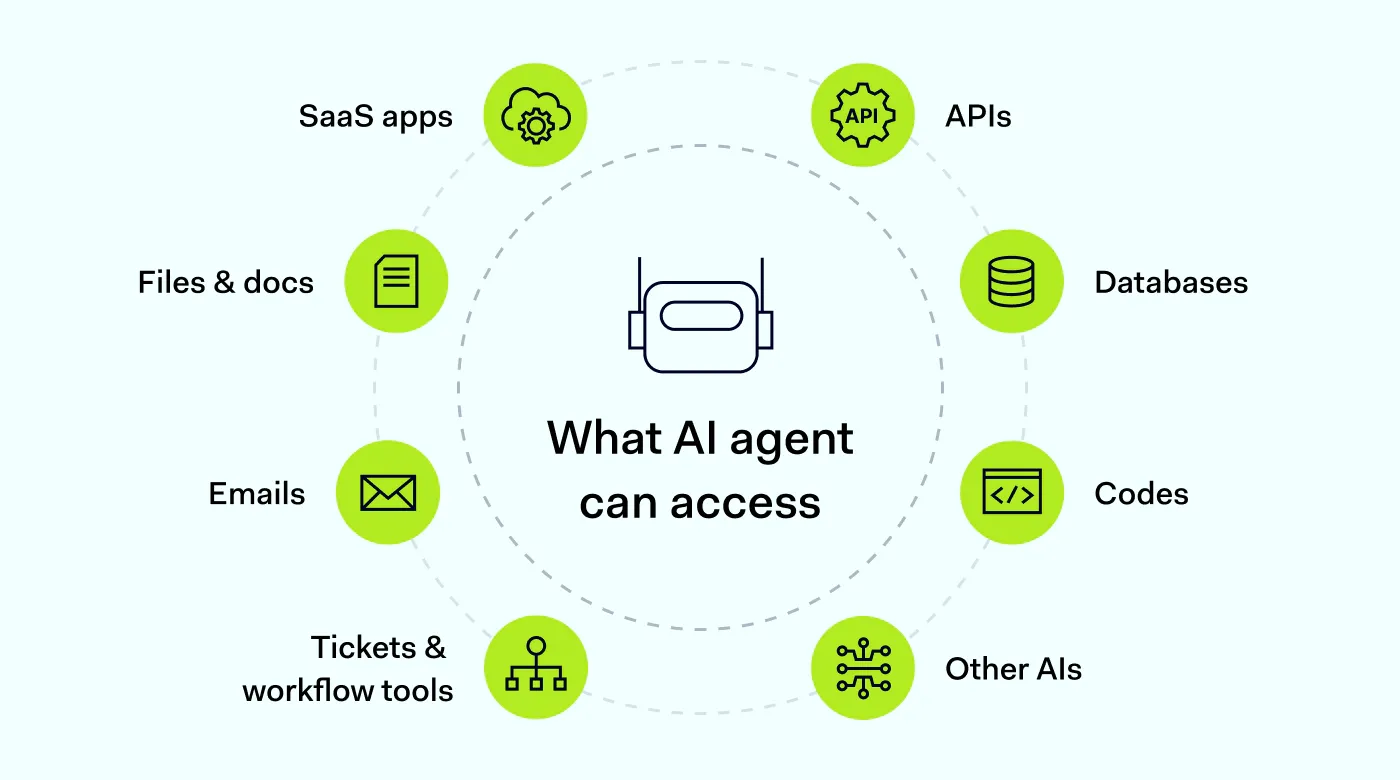
Modern AI agents often operate across multiple systems at once. Depending on their role, they may access:
SaaS applications
AI agents commonly integrate with productivity and business tools such as CRM platforms, messaging apps, project management software, and customer support systems. Because these tools often hold customer data, sales pipelines, and internal communications, even read-only access can expose sensitive information if permissions aren’t properly configured.
APIs
Many AI systems rely on API calls to retrieve information or trigger actions automatically. APIs often provide access to sensitive business functions. A single overprivileged API token can give an AI agent the ability to read, write, or delete data across an entire platform, far surpassing the scope of its intended task.
Files and documents
AI agents may scan cloud storage, shared drives, PDFs, spreadsheets, and internal knowledge bases to answer questions or generate insights. However, without proper access boundaries, an agent searching for a quarterly report could just as easily pull up confidential HR files or legal contracts stored in the same environment.
Databases
Some AI systems connect directly to databases containing customer records, analytics, financial data, or operational information. Database access is especially risky because queries can return large volumes of records at once, and a misconfigured agent could then expose or modify data on a large scale.
Emails and messaging platforms
AI assistants may summarize emails, draft replies, or analyze conversations across communication platforms. This gives them access to sensitive threads—contract negotiations, personnel discussions, or client complaints—that were never intended for automated processing.
Code repositories
AI coding assistants and DevOps agents may access code repositories, deployment pipelines, and development environments. A compromised or misconfigured coding agent could introduce vulnerabilities into production code, leak proprietary source code, or expose secrets stored in configuration files.
Tickets and workflow tools
AI agents used in IT service management and workflow automation can update tickets, assign tasks, or trigger actions. However, these systems often contain detailed descriptions of incidents, outages, and internal processes—information that could be valuable to attackers if accessed without proper controls.
Other AI agents
In multi-agent environments, AI systems may communicate and exchange data with other agents, increasing complexity and expanding security risks. Without proper access boundaries, one compromised agent may influence the behavior or permissions of others.
How AI agent access control works
AI agent access control combines identity management, security policies, monitoring, and authorization mechanisms to govern how AI agents operate. A typical process looks like this:
Assign an agent identity. Each AI agent receives a unique identity, similar to a user or service account. This helps organizations track activity and apply security policies consistently.
Authenticate the agent. The system verifies the agent’s identity using credentials, tokens, certificates, or other authentication methods.
Define permissions. Organizations specify what the AI agent can access, including systems, files, APIs, and workflows.
Apply least-privilege access. The agent only receives the minimum permissions required for its task.
Monitor behavior and API calls. Security teams monitor agent activity to detect unusual behavior, unauthorized access attempts, or suspicious API usage.
Enforce security policies. Policies determine what actions the AI agent can perform and under what conditions.
Review and adjust permissions. Permissions should be reviewed regularly as AI systems change or gain new capabilities.
AI agent access control challenges
Securing AI agents is more difficult than securing traditional applications because AI systems are dynamic, interconnected, and capable of autonomous actions.
Lack of visibility. Organizations may not know which AI agents exist, what tools they connect to, or what permissions they use—making it impossible to assess risk or enforce policies.
Rapid adoption. AI systems are being deployed faster than security teams can govern them, and each ungoverned agent adds another potential entry point for attackers.
Complex integrations. AI agents often interact with multiple SaaS apps, APIs, and databases at once, and each integration introduces its own authentication model and permission structure.
Dynamic behavior. AI agents may behave unpredictably based on prompts, context, or retrieved information, making it harder to define static access rules.
Prompt injection risks. These attacks hide malicious instructions in seemingly ordinary content, such as documents, emails, or web pages, and can trick agents into executing harmful actions that conventional filters won’t detect.
Overprivileged access. AI agents often receive broad permissions during initial setup and are never reviewed afterward, leaving stale or excessive access in place long after it’s needed.
Best practices for implementing AI agent access control
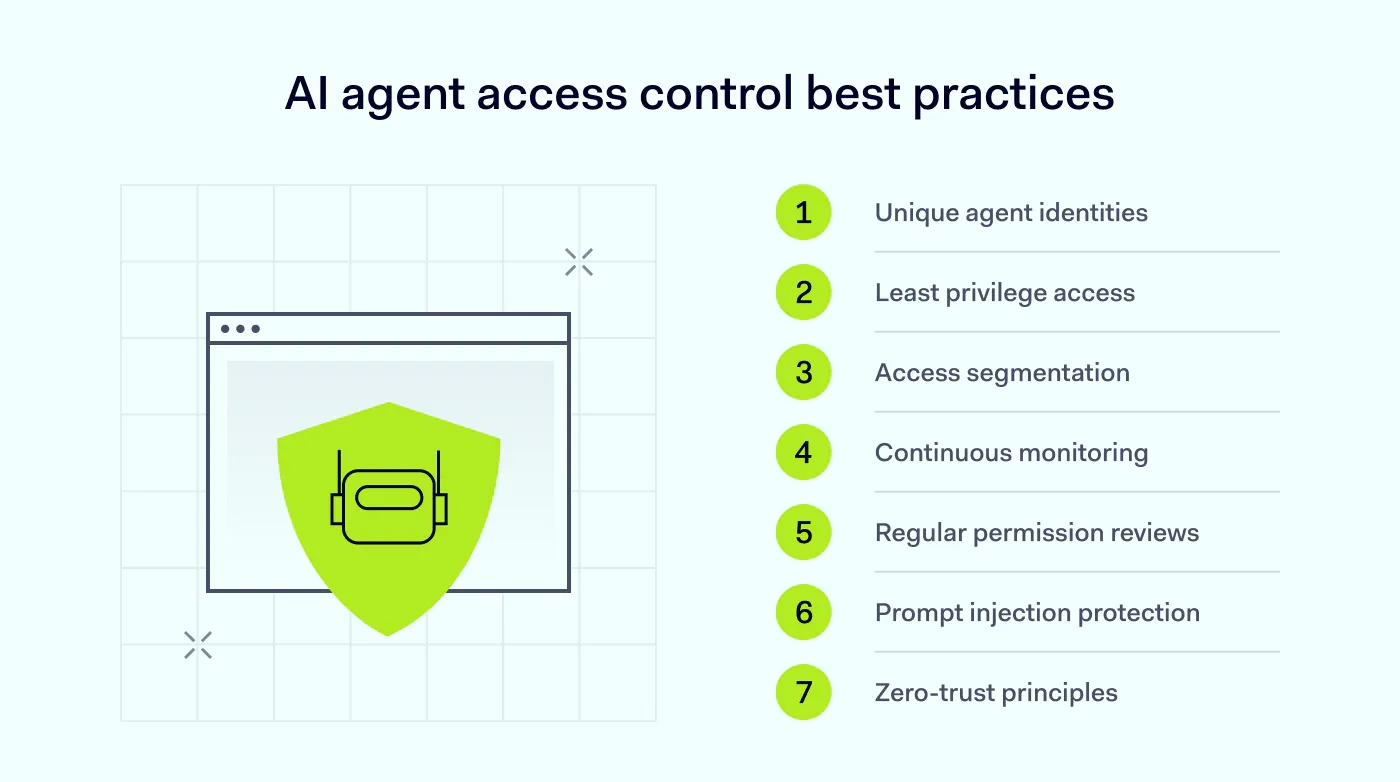
Organizations should approach AI agent access control as part of a broader zero-trust and identity security strategy. While no single measure covers every risk, combining these practices creates a strong foundation for managing AI agents at scale.
Treat AI agents as identities
Every AI agent should have its own identity, authentication method, and audit trail. This makes it possible to track exactly what each agent does, when it does it, and which systems it accesses. Avoid shared credentials or unmanaged service accounts—when multiple agents share the same identity, it becomes nearly impossible to pinpoint the source of a problem.
Apply the principle of least privilege (PoLP)
Only grant the permissions necessary for an agent’s role. Restrict access to sensitive systems, databases, and APIs whenever possible. For example, if an agent only needs to read data from a CRM, it shouldn’t also have write access to financial records. It is far safer to start with minimal permissions and expand only when justified than to grant broad access and try to scale it back later.
Segment access by function
Not every AI agent needs access to the same resources. Separate AI agents based on tasks and environments. For example, a customer support AI agent should not have access to development systems or financial records. This segmentation limits the blast radius if an agent is compromised—an attacker who gains control of one agent can only reach the systems that agent is allowed to access.
Monitor agent behavior continuously
Because AI agents can execute dozens of actions in seconds, problems can escalate before anyone notices. Track API calls, access attempts, and system activity to identify suspicious behavior early. Continuous monitoring helps detect compromised or misconfigured AI systems and gives security teams the data they need to respond quickly.
Review permissions regularly
AI agents change quickly, and permissions can become outdated. An agent that was set up for a specific project 6 months ago may still hold access to systems it no longer needs. Regular audits help identify unnecessary access and reduce risk exposure.
Protect against prompt injection
Validate external inputs and limit what actions AI agents can execute automatically. This is especially important for agents that process content from outside the organization—emails, uploaded documents, or web pages could all contain hidden instructions designed to manipulate agent behavior. Organizations should also monitor for unusual prompts and suspicious workflows.
Apply zero-trust principles
Never assume an AI agent is trustworthy simply because it operates inside the network. Continuously verify identity, permissions, and context before granting access. Zero trust treats every request as potentially risky, which is exactly the right approach for autonomous systems that interact with sensitive data and critical infrastructure.
Together, these practices give organizations a practical framework for managing AI agent access without slowing down adoption. But putting them into action is easier with the right tools in place.
As AI adoption grows, AI access security will become a critical part of cybersecurity strategies. Organizations that establish strong access control policies early will be better prepared to secure AI agents, reduce operational risks, and maintain visibility across automated environments.
Agnė Srėbaliūtė
Senior Cybersecurity Copywriter
After spending a decade writing across media, PR, and advertising, Agne has been specializing in technology and cybersecurity content, focusing on IP address management, networking, zero trust, and internet infrastructure. She helps businesses understand complex technologies through clear, engaging, and sometimes creative content.