What is a zero trust policy?

Zero trust security checks identity, device health, and context before access is granted and, when needed, during the session too. However, without a policy, zero trust stays vague. Clear access rules turn it from a broad idea into daily decisions about user access.
Zero trust policy definition
A zero trust policy is a set of rules that control access to an application, service, or data based on who requests it, from which device, and under which conditions. It tells the system when to allow, limit, deny, or revoke access, instead of assuming trust from network location alone.
Why zero trust security needs a policy
Traditional remote access security assumed that users and devices became trustworthy once they entered the corporate network. That idea made sense when most work happened in one office, on company-owned devices, against a small number of internal systems.
However, modern teams move between home Wi-Fi, coworking spaces, and cloud environments, often within the same day. That is why many security teams adopt zero trust: it fits a world where users, devices, and applications are no longer tied to one trusted network.
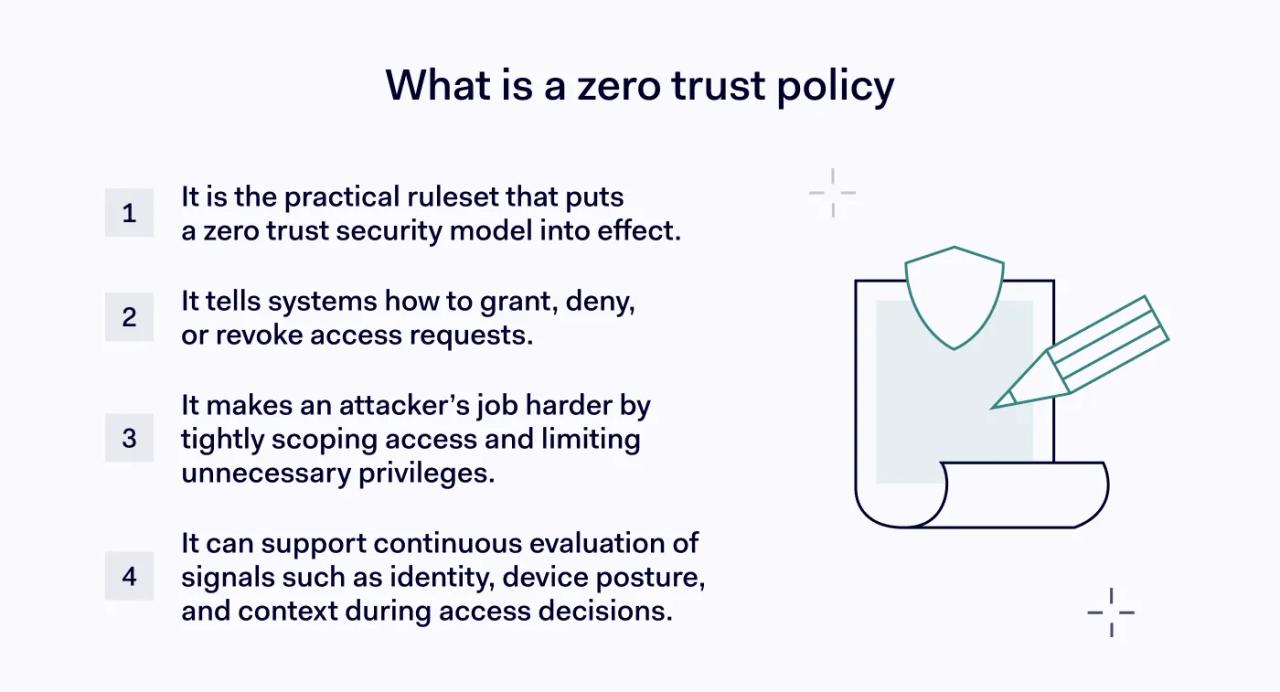
Seen as a whole, zero trust can refer to a security model, a set of principles, or an architecture. To enforce these broad concepts, teams need a policy.
A zero trust policy cannot guarantee that an attack never happens, but it can make the hacker's job much harder. For example, if vendor access is tightly scoped, if sensitive resources sit behind separate access controls, and if each request needs to satisfy current policy, one compromised credential leaves less room for a breach to spread.
That same idea shows up in public-sector guidance. The White House federal zero trust strategy memo is a useful example of how broad zero trust principles get turned into concrete requirements around identities, devices, networks, applications and workloads, and data.
How a zero trust policy works
In NIST’s model, a zero trust policy works when systems enforce policy decisions between a subject and a resource. The subject can be a person, service account, workload, or device. The resource can be an app, database, internal admin panel, SaaS tool, API, or file store. A request arrives, the system evaluates the request against policy, and access is allowed, limited, denied, or revoked.
Google’s BeyondCorp offers a useful example of the same shift. As Google explains it, BeyondCorp shifts access controls from the network perimeter to individual users. This way, zero trust security can support daily work without treating every on-network connection as automatically safe.
User access, access controls, and continuous verification
A good zero trust policy asks several questions in the right order. Who is asking? From which device? To reach which resource? Under what conditions? For how long? They sound basic, yet many older security policies answered only the first one and sometimes not even that well.
Zero trust rules evaluate a mix of signals:
- Identity. The policy checks who or what is requesting access and how strong the authentication is.
- Device posture. This means the check whether the device is managed, patched, encrypted, and otherwise compliant.
- Context. It includes conditions such as time, network, location, behavior, and risk indicators.
- Resource sensitivity. It reflects how sensitive the target is and how much access the requester actually needs.
Each of those signals influences the outcome. A finance employee accessing a normal internal dashboard from a managed laptop may pass with little friction. Then, continuous verification matters. If the same employee is trying to open payroll data 2 hours later while at the airport (the risk picture changes), they may face stronger requirements or get blocked. This way, a device can fall out of compliance after a session starts.
Principle of least privilege
In a zero-trust policy, the principle of least privilege also turns from a concept into a series of narrow choices. Which app does the user need? Which part of the app? Read access or write access? Only during work hours or at any time? Only from managed devices or from any browser?
Role-based access control, or RBAC, usually handles the baseline. However, sometimes roles alone don't capture the context that matters in zero trust security.
Attribute-based access control, or ABAC, helps make authorization decisions based on subject attributes, object attributes, and environment conditions. That means a policy can combine role, device security posture, resource sensitivity, and session context in one decision. In short, RBAC answers whether a user should ever access the resource, and ABAC answers whether access should happen right now, under these conditions.
For example, a cloud administrator may have the role needed to access a production console. Least privilege access still may require phishing-resistant MFA and a stronger approval path for high-risk actions.
Zero trust principles behind the rules
Good rules should not read like a random list of controls, but trace back to a clear model. Several zero trust principles matter most when writing policy:
- Treat all important services as resources. Internal apps, SaaS platforms, APIs, admin consoles, and databases all need policy coverage.
- Authenticate and authorize everywhere. Access should depend on identity and context, not on which subnet a request came from.
- Use multiple signals. Identity alone is rarely enough for sensitive resources.
- Keep monitoring tied to policy. Logs and telemetry should show whether rules are working and where they need review.
- Assume conditions can change. A policy should support deny and revoke actions, not only allow actions.
That last point is especially important. Many teams write access rules as if the only decision is whether to give access. In fact, a zero trust policy rather needs to decide how access is given and what it looks like while active, as well as what should happen when the session no longer meets the rule.
What a zero trust security policy should document
A useful zero trust security policy should help three audiences at once: the people who implement the controls, the people who review them, and the people who need to explain a decision during an incident. As a matter of fact, a vague statement like “verify every request” does not help any of those groups. A stronger document should instead name the resource, the required signals, the decision point, the session limits, the exception process, and the log source.
Most organizations group those requirements around familiar pillars, similar to the structure used in the White House memo: identity, devices, networks, applications and workloads, and data. That makes it easier to map policy to existing teams and tools.
- Scope and resources. First, define which systems, data types, and cloud environments are in scope.
- Identity requirements. Define identity sources, MFA rules, session lifetime, and step-up triggers.
- Device rules. Understand the minimum device security posture for access and what happens when the device falls out of compliance.
- Authorization logic. Explain how roles, attributes, exceptions, and approvals work together.
- Enforcement points. State where access controls sit for critical resources and how deny or revoke actions work.
- Logging and review. Describe which logs must exist, who reviews them, and how often the rules get updated.
The goal of a good policy is to make potential incident questions easier. Teams should be able to answer which rule allowed the session, which signals supported the decision, and which change triggered revocation. If the document cannot answer those questions, the policy likely needs more detail.
How to implement a zero trust policy for cloud environments
Start with known resources, known workflows, and known risks, and expand from there. A practical rollout can look like this:
- Inventory what matters. List critical apps, admin paths, data stores, service accounts, and common user journeys.
- Choose one pilot workflow. Remote access to an internal app or privileged access to a cloud console works well because the value is easy to see.
- Write the policy in plain language. Define who needs access, under which conditions, and what should cause deny, step-up, or revoke actions. “Finance staff can access the invoice system” is too broad. “Finance staff can access the invoice system from managed devices with MFA, and payment approval requires step-up authentication” is much closer to an actual zero trust policy.
- Connect the signals. Make sure identity, device posture, and context data can actually feed the policy decision.
- Test the unhappy paths. Teams often test only the allow path. Deny, timeout, reauthentication, and revoked-session flows matter just as much.
- Review and tune. Use logs to reduce unnecessary friction and close gaps that the first version missed.
Common mistakes that weaken zero trust security
The same mistakes weaken zero trust efforts across many organizations. Most of them come from treating zero trust as a slogan instead of a set of enforceable rules. Once that happens, teams write vague goals, rely on old trust assumptions, and leave obvious gaps in access control.
- Treating network location as a shortcut. Cloud environments and hybrid work make that shortcut unreliable.
- Writing goals instead of rules. Security policies need named controls, owners, conditions, and review points.
- Ignoring third-party and non-human access. Vendor accounts, service accounts, APIs, and workloads often carry more risk than ordinary employee access. The Target breach remains a useful reminder. A single vendor path became dangerous because too much trust and too much movement were possible after entry.
- Skipping continuous verification. Initial authentication is important, but it is only the beginning of the decision.
Zero trust policy aims to reduce both problems at once: too much access at the start and too much freedom after access begins.
Conclusion
A zero trust policy is the practical layer of the zero-trust model. It tells systems how to make access decisions, which signals to use, and when to deny or revoke a session.
Strong policy writing keeps the idea grounded. Teams should be able to point to a resource, describe the rule, name the enforcement point, and show the logs that prove it worked.