
Zero trust has been a cybersecurity buzzword for more than a decade. Because zero trust is a framework, a set of principles, rather than a list of achievable goals, many people still have questions about what zero-trust use cases actually look like for an organization. Or is this term just a marketing gimmick with not much practical sense behind it?
What zero trust is
It's easier to explain what zero trust is not — it's not a single product that one can buy. Instead, it's an architecture, or operational model. According to NIST, zero trust is a set of cybersecurity principles that remove implicit trust that was historically based on network location. Instead, the zero-trust model views all networks as potentially hostile and enforces least-privilege access control, meaning that authentication and authorization to an organization's network happen for every access request.
In short, no user or device is trusted by default in the zero-trust model, and every session must earn trust through verified signals.
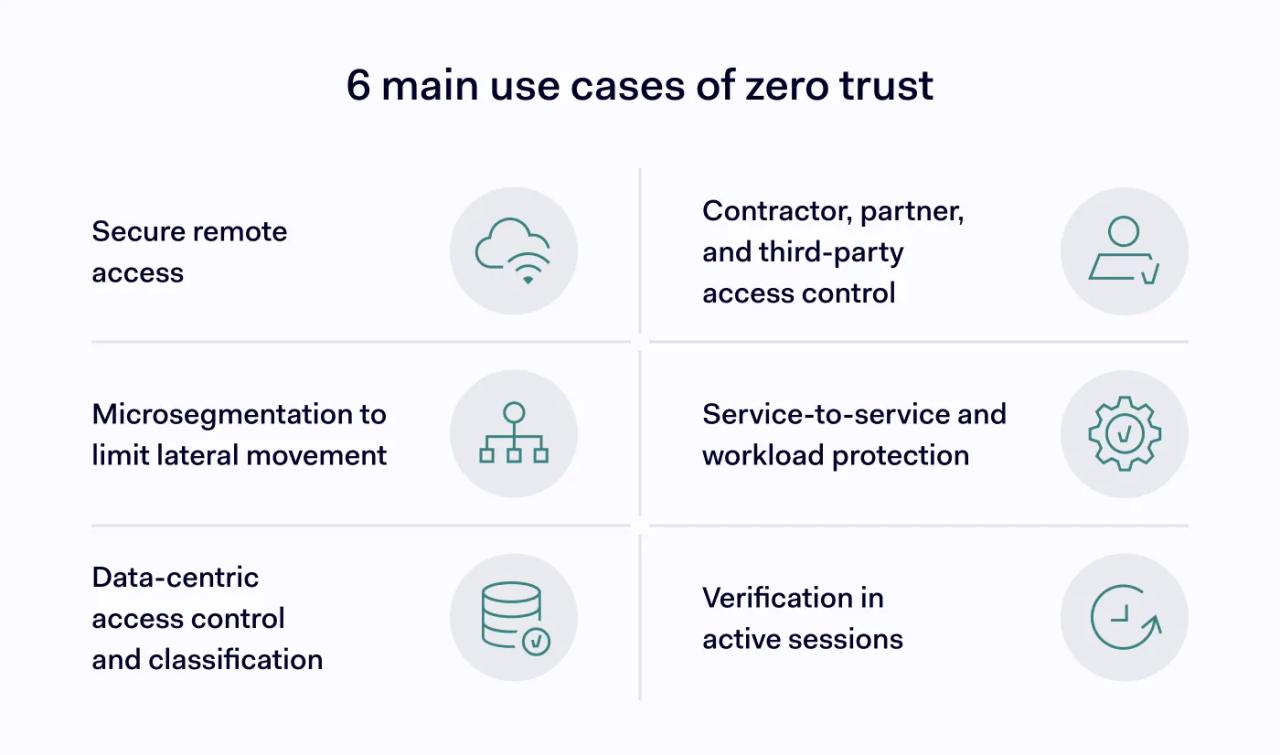
6 core zero-trust use cases
We've compiled the list of use cases that are most relevant to organizations of any size. It is based on guidance published by NIST, CISA, the UK NCSC, and the DoD.
1. Secure remote access
Safe access to network resources from any location is one of the clearest use cases for zero trust because it's how the zero trust concept appeared: when people stopped working only from corporate office networks.
However, it's not enough to encrypt remote traffic with a simple VPN. Once a user connects, a VPN grants them broad access to all network resources. In other words, a VPN was designed to extend the perimeter for a remote user: once the encrypted tunnel is up, the user is “inside” the network.
The benefit of zero trust for remote access is that there is no “inside”. The user connects not to a broad network but to a specific resource. This way, there is no difference whether staff work from headquarters, a home office, or a hotel lobby in terms of how network access is granted.
2. Contractor, partner, and third-party access control
According to Verizon’s Data Breach Investigations Report, the share of data breaches that involved a third party doubled to 30% in 2025. If an organization shares its resources with contractors, vendors, and other types of partners, it's at higher risk.
A zero-trust model helps organizations limit third-party access to only the specific resources that they need. That access can also be time-bound and “least privilege”, meaning that a contractor would be subject to continuous verification.
3. Microsegmentation to limit lateral movement
Microsegmentation is the heart of zero-trust systems. It's needed to limit movement from one resource to another in case a breach happens and an attacker gains access to certain resources. For example, if a hacker gets access to HR records through a third-party compromise of an HR platform, they won't get access to isolated financial systems and cloud infrastructure. If an organization stores customer data across different systems, microsegmentation is crucial.
4. Service-to-service and workload protection
Another zero-trust use case doesn't involve people — it's about applications that rely on APIs, microservices, and automated workflows that communicate with each other without any human involvement. Zero trust can cover machine-to-machine interactions as well. Each service call can be authenticated, authorized, and then logged, which helps protect customer data flowing through automated pipelines and prevent insider threats that exploit trusted service accounts.
5. Data-centric access control and classification
If an organization stores different types of sensitive information, for example customer data, it might need different levels of protection. Zero-trust systems help classify the data and tie user access to its sensitivity. For instance, a user may have access only to certain categories of information within a system. The data-centric access control use case is especially helpful in supporting compliance with regulations and privacy standards.
6. Verification in active sessions
Sometimes, a device can fall out of compliance mid-session. For example, an employee accessed financial systems at 9 AM from the office network, but 2 hours later, traveled to the airport and tried to access it from a public airport Wi-Fi. In this case, the zero-trust model can revoke access in real time. This use case also helps address insider threats, catching behavior anomalies even after initial authentication succeeds.
Zero-trust use cases across industries
The list above addressed cybersecurity questions that any organization might have. But on top of that, there are sector-specific constraints and requirements when you implement zero trust
- In healthcare, patient records must be protected under strict regulations, such as HIPAA Zero-trust systems are great here because they help enforce role-based user access control, so that only clinicians can view sensitive patient data.
- The financial sector is highly regulated as well, as it handles high-value customer data and faces constant fraud risk. Implementing zero trust here often focuses on transaction-level verification, microsegmentation of payment systems, continuous session review, etc.
- Retail and e-commerce sectors must secure customer data across distributed point-of-sale systems and cloud platforms. Third-party vendor access control and segmentation of payment networks would be two of the main zero-trust use cases there.
Whatever the industry, zero trust helps solve the same problem: secure access to sensitive resources.
How to move forward with zero trust
Again, zero trust is not a product that an organization can buy and protect all systems at once. It's a set of principles that need to be enforced all the time across various systems. Organizations that see value in zero-trust use cases can start by creating an inventory of their data, documenting their security policies, and then expanding from there.