
Key takeaways
- Alert fatigue happens when IT teams receive too many security alerts, many of which are false positives, low-priority alerts, or duplicates. Over time, this can lead them to ignore incoming alerts and miss genuine threats.
- Common causes include an excessive number of security tools generating notifications, duplicate findings from multiple systems, and a lack of risk-based alert prioritization.
- The impact on businesses can be significant, with slower incident response times, higher breach costs, and increased analyst burnout.
- Reducing alert fatigue requires optimizing alerts, prioritizing the most important ones, and using automation.
What is alert fatigue?
Alert fatigue is a state of feeling overwhelmed or mentally exhausted by an excess of incoming security alerts, most of which are low-priority or false positives
With some monitoring platforms generating thousands of alerts a day, security teams can come to see these alerts as background noise rather than signals requiring investigation. Consequently, they may start ignoring new alerts and, in doing so, potentially miss genuine threats, allowing them to go undetected until it’s too late to respond effectively.
Why do security teams experience alert fatigue?
Although alert fatigue is not exclusive to security teams, they are among those most impacted, largely because of the sheer scale and around-the-clock demands of monitoring modern IT environments. Here are the key factors contributing to this challenge.
Too many tools generating too many alerts
Most organizations rely on a broad range of security tools, including SIEM platforms EDR solutions, and vulnerability scanners. Each tool generates alerts on its own, often with little shared context or visibility across the security stack.
As a result, the same suspicious activity can trigger multiple alerts from different systems, adding to the growing volume of notifications security teams must review Without a way to consolidate, correlate, and deduplicate the signals produced by these tools, organizations risk burying their analysts in alerts that create more noise than value.
High false positive rates
One of the primary drivers of alert fatigue is the false positive. Every hour spent investigating an alert that turns out to be harmless is an hour that could have been spent addressing real threats—and these lost hours quickly add up across security teams.
Eventually, this repeated influx of false alarms may cause analysts to assume that most alerts are insignificant And that is when they may begin to miss the ones that require their immediate response.
Alerts lacking context and actionable insights
Many security alerts simply inform analysts that something happened but provide little insight into why it matters or what to do next For example, an alert that says, “Suspicious login detected,” is not very useful on its own. It doesn’t indicate which account was involved, which asset was accessed, or where the login originated, so analysts have to piece this information together manually. This may involve pulling WHOIS data, checking breach databases, and cross-referencing threat intelligence before they can even determine whether the alert is a priority or not.
When reviewing alerts requires this level of manual effort, it becomes highly time-consuming. And if the alert ultimately turns out to be a false positive, all the time spent investigating it can feel wasted.
No risk-based prioritization
Not every threat carries the same level of risk, so not every alert requires the same level of attention. Without a system that accounts for these differences, security teams are forced to treat every alert with the same urgency—an exhausting approach that can quickly lead to burnout
Worse still, a critical alert involving a sensitive asset can become buried among hundreds of low-priority notifications, delaying detection and response when it matters most.
How alert fatigue impacts businesses
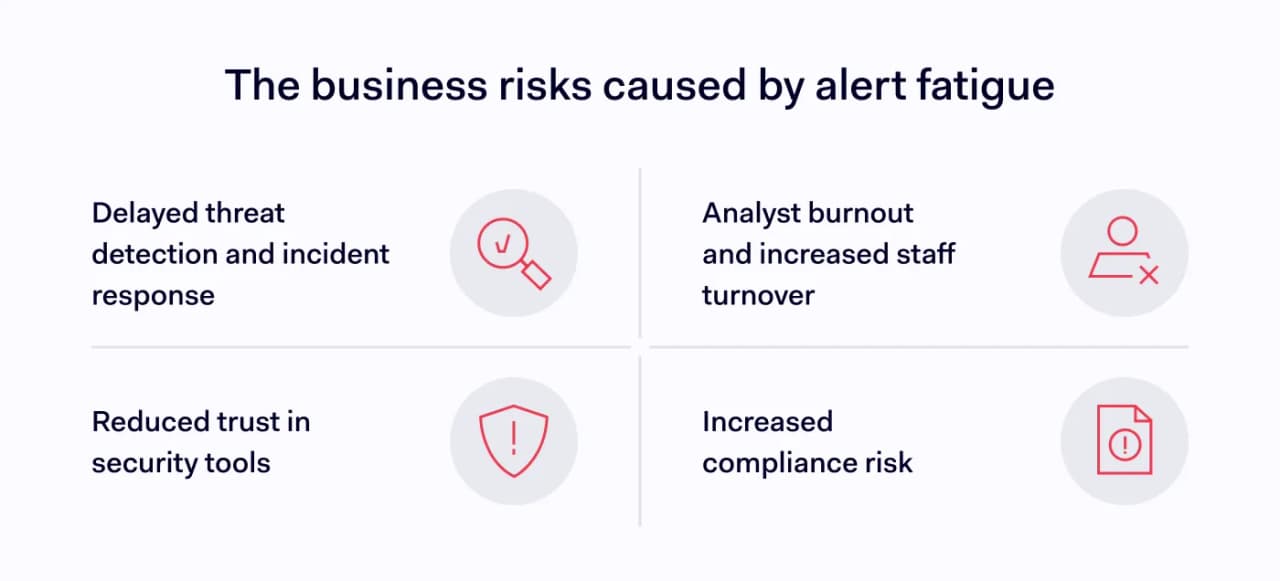
If not addressed, alert fatigue can give rise to multiple problems that go well beyond a security team operating at full capacity, including:
- Missed threats and slower incident response. When analysts are overwhelmed by a constant stream of alerts, real threats can hide among routine events and go unnoticed. A ransomware deployment or credential theft attempt may appear no different from a low-severity event. Even when a threat is eventually identified, delayed response times can give attackers more time to move laterally through the environment and cause damage.
- Lack of trust in the security tools. When security tools generate too many false alarms, analysts can begin to lose confidence in their effectiveness. Over time, this can undermine the value of security investments and weaken an organization’s overall security posture.
- Staff turnover. Reviewing hundreds of alerts that ultimately turn out to be false positives creates a significant mental burden for analysts. This constant pressure can lead them to seek opportunities elsewhere, leaving you in a difficult position, as their knowledge and understanding of your company’s IT environment can be difficult to replace.
- Compliance risks. Some regulatory frameworks require organizations to demonstrate that they are monitoring, investigating, and properly documenting security alerts. When alert fatigue causes security events to be overlooked, it can create compliance gaps that may be exposed during audits.
How distributed and remote security teams experience alert fatigue
Distributed security teams face structural disadvantages that can make alert fatigue worse. First and foremost, without the benefit of close, day-to-day collaboration, remote teams have fewer opportunities to quickly decide which alerts require immediate attention and which can wait
Analysts working remotely may also have less visibility into parallel investigations across the team, which can make it harder to maintain a consistent response approach
Another challenge is that alerts generated outside regional business hours may remain unreviewed until the next shift begins, creating sizable backlogs before analysts even start their day.
These operational gaps can contribute to a fragmented security process where fatigue builds faster, and critical alerts are more likely to be overlooked.
How to reduce alert fatigue: best practices
Overcoming alert fatigue isn’t about randomly dismissing security notifications—it’s about reducing unnecessary noise so that only the alerts that matter are seen and acted upon. Here’s how to do it.
Audit your current alert volume and sources
Start by identifying every tool that generates alerts across your security environment including SIEM platforms, EDR solutions, vulnerability scanners, threat intelligence feeds, email gateways, and cloud services. Any system that produces security notifications should be on the list.
Next, measure alert volume by source on a daily or weekly basis Then, identify the top 5 sources generating false positives and the top 5 systems that produce meaningful alerts. Such a comparison will quickly reveal which tools are providing value and which ones are creating noise.
Define alert tiers and response expectations
As we already mentioned, treating every alert as urgent is one of the main reasons security teams experience burnout. That’s why you need a system that can help analysts understand how serious an alert is and how quickly they need to respond
Having that system built around tiers works really well: one tier can be dedicated to critical alerts that need immediate attention, another to medium-priority alerts that can wait, and the next to low-priority alerts that can be reviewed on a defined schedule.
Assign each tier to a specific team or person so ownership is clear before an alert comes in. It’s also important to define what statuses like “Investigated” mean at each level, since a critical alert may require a full root cause analysis, while a low-priority one may only need a simple note in the system.
Choose platforms that reduce noise by design
Reducing alert fatigue requires using tools that help filter out noise rather than adding to it. That’s why, when you evaluate a security platform, you should ask a few pointed questions: Does it prioritize alerts by risk, or treat everything as equally urgent? Does it consolidate data from multiple sources into a single view, or leave you toggling between dashboards?
It’s also worth checking whether the platform enriches alerts with context automatically and provides periodic reporting alongside real-time alerts A platform that sends notifications like “Suspicious login from an unrecognized device in a new location” gives analysts far more insight than one that simply says “Suspicious login detected.”
Review the quality of alerts regularly
Last but not least, make sure the team learns from past interactions. Review historical alerts to identify patterns, recurring issues, and different approaches to handling them Then, use that information to refine your detection rules, adjust thresholds, and remove alerts that no longer serve a purpose.
The bottom line
As cyber threats increase in scale and security teams are expected to monitor more systems than ever before, alert fatigue is becoming a growing concern. One of the most effective ways to address it is to use tools that automate routine tasks and reduce manual effort.
Solutions like NordLayer Intelligence are built with this challenge in mind. As a threat intelligence solution, it surfaces external risks and prioritizes them automatically, making it easier to identify the issues that require immediate response. It also adds contextual information to found vulnerabilities, giving analysts a clearer understanding of the risks and appropriate next steps.