SASE vs. SD-WAN: key differences

Software-defined wide area network (SD-WAN) is a networking technology for optimizing connectivity, while secure access service edge (SASE) is a framework that converges SD-WAN with cloud-delivered security.
SASE and SD-WAN are often mentioned in the same breath. Yet, they aren’t competitors, so you don’t have to pick just one. In fact, SD-WAN is one of the building blocks that make a SASE framework. As businesses move away from traditional data centers and toward the cloud, understanding how these two interact is the first step in modernizing your infrastructure.
What is SD-WAN?
Historically, WAN was the standard for connecting the enterprise, branch, and data center. However, as organizations move toward cloud-based applications through software-as-a-service (SaaS) and infrastructure-as-a-service (IaaS), traditional WAN architecture struggles to handle the explosion of traffic hitting applications distributed across the globe.
SD-WAN is the architecture designed to solve these connectivity issues. Rather than depending only on costly private circuits like MPLS, it intelligently combines multiple transport types like broadband, LTE, and other available links into a single, software-managed framework. This approach enables dynamic path selection based on real-time network conditions and business needs, ensuring higher efficiency and lower operational costs across your network.
Instead of configuring each device manually, SD-WAN manages distributed sites from a single, central location. By separating the network's intelligence from the actual movement of data, the system can make high-level routing decisions while the hardware focuses purely on forwarding traffic. Every site connects to multiple transports, allowing for continuous monitoring of link-quality metrics like latency and packet loss. This allows for sophisticated traffic management, where the system identifies and prioritizes critical applications based on your business needs. The system uses this real-time information to select the optimal path, rerouting traffic instantly if a link degrades or fails. Since security policies are created once and applied automatically across all sites, the result is a resilient network that delivers consistent performance and faster updates for every location.
The benefits of SD-WAN include:
- Improved network performance. It reduces latency and prevents bottlenecks by automatically directing traffic through the most efficient available routes.
- Cost efficiency. By using standard internet connections—like broadband or LTE—alongside or instead of expensive private lines, you can lower operational expenses.
- Simplified management. Centralized control eliminates the need to configure devices one by one, allowing you to push updates across multiple locations from a single interface.
- Enhanced resilience. Because the system continuously monitors for packet loss and jitter, it can reroute traffic instantly if a connection fails, ensuring your team stays online.
- Consistent security. You can create security policies in one place and apply them automatically to every site in the network, reducing the risk of human error.
What is SASE?
SASE is an architectural framework that converges networking and security functions into a unified, cloud-native service. Introduced by Gartner, this model combines SD-WAN with essential security solutions such as firewall as a service (FWaaS), cloud access security brokers (CASB), secure web gateways (SWG), and zero trust network access (ZTNA). By providing a single offering for both access and protection, SASE secures remote users, offices, and data centers to the resources they need—no matter where they are located or hosted.
In other words, this framework operates on the core principle that security should follow the user, not the location. For example, ZTNA ensures that no user or device is trusted by default, regardless of their location, while secure web gateways protect against web-based threats. Meanwhile, CASB provides visibility over data moving to cloud applications, and FWaaS delivers traditional protections through the cloud, making security instantly scalable across all locations.
The benefits of SASE are:
- Consistent security coverage. Whether an employee is at home or in a branch office, they are protected by the same security policies.
- Infrastructure streamlining. SASE helps declutter your infrastructure by minimizing the total number of IT assets that must be supervised. A centralized interface allows you to monitor the entire network with much greater efficiency.
- Cost efficiency. Implementing SASE components separately can be expensive and often results in a fragmented ecosystem. A unified solution ensures all services work in synergy while reducing upfront costs.
- Easier compliance. For organizations subject to government regulations, SASE is invaluable. It provides the tools and architecture necessary to fully transform a network to comply with modern data protection laws.
- Better flexibility. Cloud-based infrastructure is designed for quick scaling. It allows for rapid growth with lower upfront investment and provides lower latency for users connecting from diverse locations.
- Forward-thinking security. By including concepts like zero trust, SASE is better adapted to tackling modern cyber threats. While these procedures are strict, they significantly minimize risks to the organization.
- Enhanced visibility. A unified platform gives security teams a clear, real-time view of all network activity, making it easier to spot and react to potential threats.
Main differences between SD-WAN and SASE
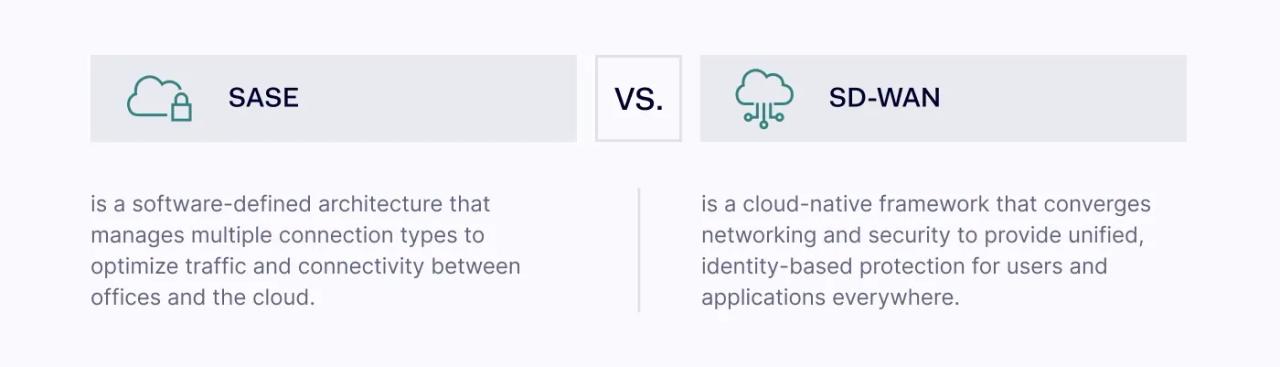
While both technologies aim to modernize the corporate network, they solve fundamentally different challenges. Understanding the architectural gap between SD-WAN and SASE is essential for any organization that wants to balance high-speed connectivity with robust, cloud-native security. To help you visualize how these two differ, here is a quick comparison:
Feature | SD-WAN | SASE |
|---|---|---|
Primary focus | Connectivity and network performance | Convergence of networking and security |
Deployment | Centralized, often tied to data centers or branch offices | Cloud-delivered and identity-centric |
Traffic management and network optimization | Routes traffic based on link quality and application type | Verifies user identity and device posture before routing |
Security | Basic encryption; usually requires separate security tools | Integrated security stack enforcing zero trust |
User Experience | Optimized for office-to-office or branch connectivity | Optimized for remote, hybrid, and cloud-first workforces |
Primary focus
SD-WAN is designed to optimize connectivity and network performance, ensuring data moves efficiently between fixed locations like branch offices and data centers. SASE takes this a step further by focusing on the convergence of networking and security, making protection a core part of the access method.
Deployment
SD-WAN deployment is typically centralized and often tied to physical or virtual appliances at specific hardware locations. SASE is a cloud-delivered, identity-centric model that provides secure access to users regardless of their physical location or the device they are using.
Traffic management and network optimization
SD-WAN optimizes the network by selecting the best available path based on real-time link quality and specific application requirements. SASE enhances this performance by verifying user identity and device posture before determining the most secure and efficient route for that data, ensuring that optimization never comes at the expense of security.
Security
While SD-WAN provides basic encryption and often requires third-party security add-ons to be fully protected, SASE includes a built-in security stack. This integrated approach enforces zero trust principles, ensuring that every connection is authenticated and monitored continuously.
User experience
SD-WAN is optimized for stable, high-performing office-to-office or branch connectivity within a traditional perimeter. SASE is purpose-built for the modern remote and hybrid workforce, providing fast and secure access to cloud-first applications from any location.
Networking and security: how to choose between SD-WAN and SASE
Choosing the right framework depends on your current infrastructure and long-term business goals. While SD-WAN provides the foundation for high-performance networking, SASE offers a comprehensive, cloud-native approach to security and access.
- Choose SD-WAN if your goal is to optimize networking between fixed locations like branch offices and data centers. It is the ideal choice for organizations that already have robust on-premises security and simply need to improve the efficiency and reliability of their private circuits.
- Go for SASE solution if you need to converge networking and security for a distributed or hybrid workforce. SASE is designed for cloud-first enterprises that require consistent security policies and seamless access for remote users, regardless of where they are located.
Ultimately, the SASE vs. SD-WAN decision isn't always about picking one over the other. Many organizations begin by implementing SD-WAN to solve immediate networking bottlenecks and later evolve toward a full SASE architecture as their requirements for cloud-delivered security grow. By understanding the strengths of each, you can build a resilient infrastructure that supports both high-speed connectivity and ironclad protection.