
SASE is a cloud-delivered architecture that converges network security and connectivity into one platform, while CASB is a security control focused on cloud service access and data protection.
You have probably seen SASE and CASB used side by side, sometimes as if they were interchangeable, but they are not. The comparison of SASE vs. CASB comes up often, but they sit at different layers of the security stack. One is an architectural model that combines networking and security services; the other is a cloud-security control that can be standalone or embedded in a broader framework. This article breaks down what each one does, how SASE and CASB differ, and when one or both make sense for your environment.
What is SASE?
Secure access service edge (SASE) is a framework that combines wide area network functions with security services and delivers them together as a cloud service. Gartner coined the term in 2019 to describe an architecture that converges SD-WAN, firewall, secure web gateway, CASB, data loss prevention, and zero trust network access into a single, cloud-delivered platform.
A SASE solution works through globally distributed points of presence (PoPs). Users, branch offices, data centers, and cloud workloads all connect to the nearest PoP, where the platform applies security policies and optimizes traffic before it reaches its destination. This way, SASE replaces the traditional approach in which all traffic flows back through a central data center for inspection.
NIST identifies four primary functions that a SASE solution delivers:
- Traffic optimization to reduce latency and improve availability
- Access control across different IT resources
- Threat protection for users and cloud based resources
- Uniform policy application with centralized visibility across users and devices
Because SASE bundles network security and connectivity, it addresses several needs at once. It secures access to the open web, cloud services, and private applications for remote users and branches. The SD-WAN component handles path selection and bandwidth management, while the security stack handles inspection, threat protection, and policy enforcement. Organizations that adopt SASE typically consolidate multiple point products into one platform, which simplifies operations and reduces the number of vendors they manage.
For enterprise security teams, the appeal is centralized policy and visibility, often with fewer consoles and fewer point products than legacy designs.
What is CASB?
A cloud access security broker (CASB) is a security policy enforcement point placed between cloud service consumers and cloud service providers. Its job is to apply enterprise security rules whenever users access cloud applications and cloud services.
First-generation CASBs focused on shadow IT discovery They showed administrators which cloud applications employees used, often without IT approval. Current-generation CASBs go further. According to NIST, their capabilities now include:
- Protection of enterprise data stored with cloud providers
- Control over data inflow and outflow through data loss prevention (DLP)
- Detection of account hijacking and other malicious activity
- User-behavior anomaly detection (UEBA) to flag insider risk
- Detection of misconfigurations in subscribed IaaS environments and cloud servers
CASBs deploy in two main ways. Proxy-based (inline) deployment routes traffic through the CASB so it can take action in real time. API-based deployment connects directly to cloud services and scans data and activity without placement in the traffic path.
CASB is complementary to proxies and firewalls CASB provides deep visibility into cloud usage and granular cloud-specific controls, while proxies and firewalls address network traffic and web content more broadly. That makes CASB especially valuable for SaaS governance, cloud data security, insider-risk detection, and cloud posture management.
Key differences between CASB and SASE
When you compare SASE vs. CASB, the core distinction is scope. CASB governs access to cloud applications and protects cloud-resident data. SASE covers cloud applications, the open web, private applications, and the network path that connects them all.
Category | CASB | SASE |
|---|---|---|
What it is | A security control category (product capability) | A converged architecture and service-delivery model |
Primary focus | Cloud service access, cloud data security, SaaS governance | Full access security and connectivity for all destinations |
Network role | Does not define WAN connectivity | Includes SD-WAN and global PoPs for traffic optimization |
Deployment | Proxy-based (inline) or API-based | Cloud-delivered through distributed PoPs. Depending on the vendor and use case, access may use endpoint agents, browser-based access, connectors, or remote-network integrations. |
Key capabilities | Shadow IT discovery, DLP, UEBA, cloud misconfiguration detection | SD-WAN, SWG, CASB, ZTNA, firewall, DLP, threat protection |
Best fit | Organizations that need deeper SaaS and cloud-data control | Organizations that need one platform for remote access, branch connectivity, and security |
For example, consider a company with a mature SD-WAN deployment and a solid network security stack that struggles with unsanctioned SaaS usage and data security risks in cloud applications. A standalone CASB addresses those specific gaps.
Now consider a company with a distributed workforce, multiple branch offices, and no centralized way to enforce security policies across cloud services, private applications, and the open web. A SASE platform would cover all of those needs in one service.
Architecture level
CASB is a control category. SASE is an architecture that bundles multiple controls, with CASB as one of them, into a single delivery model. In the SASE vs. CASB comparison, this is the most fundamental difference: one is a component, the other is a platform.
Scope and protected resources
CASB is strongest around SaaS interactions, cloud data protection, and cloud misuse detection. SASE extends coverage to open web traffic, private application access, and branch or remote-user connectivity. Both SASE and CASB play a role in a complete cloud security strategy, but they operate at different levels of scope.
Network security and connectivity
CASB does not handle WAN connectivity. SASE explicitly converges network security with SD-WAN and uses global PoPs to optimize traffic paths. For organizations that need to modernize both their security stack and their network, SASE addresses both in one move.
Relationship to zero trust
Zero trust is a set of principles that removes implicit trust based on network location. NIST treats SASE as one deployment approach that supports zero trust, not as a synonym for it. A SASE platform can enforce zero-trust network access policies, but adoption of a SASE platform alone does not prove an organization has achieved a zero-trust architecture SASE and CASB can both play roles in a zero-trust strategy, but neither one equals zero trust by itself.
Where CASB capabilities live in a SASE platform
The SASE vs. CASB discussion sometimes creates a false impression that organizations must pick one or the other. In practice, CASB and SASE are connected: CASB is one of the core security services inside most SASE platforms.
NIST lists CASB among the minimal security services commonly found in commercial SASE offerings, alongside firewall, SWG anti-malware, IPS, and DLP. Gartner's related concept, security service edge (SSE) describes the security half of SASE and also includes CASB as a standard component.
When an organization adopts a SASE platform, it typically gains CASB capabilities as part of the package, but depth varies by vendor. Some organizations still choose standalone CASB or extra SaaS-security tooling when they need more specialized cloud controls. The difference is that those functions now share a policy engine, a management console, and a data pipeline with the rest of the security solutions in the platform.
For example, a security team that uses a SASE platform can write one DLP policy and apply it to cloud applications, web traffic, and private application access simultaneously. With a standalone CASB plus separate security solutions for web and private app access, that same team would need to maintain multiple security policies across multiple consoles.
Some organizations run a standalone CASB alongside a SASE deployment when the standalone product offers deeper cloud-specific controls. SASE and CASB are not mutually exclusive.
CASB vs. SASE: which one fits your environment?
The choice between standalone CASB and a SASE platform depends on what you already have and what problems you need to solve.
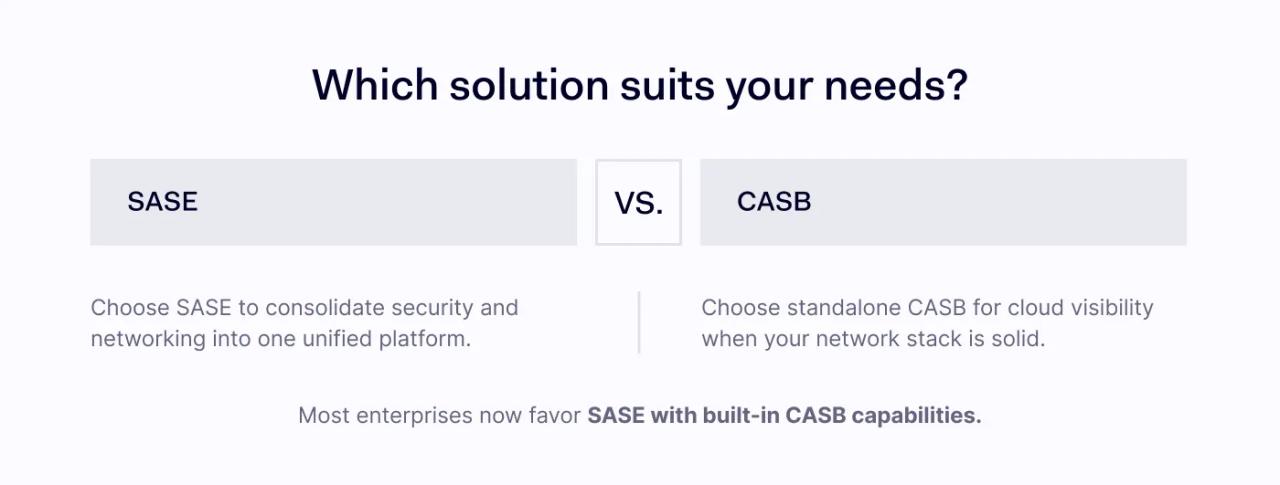
A standalone CASB makes sense when your organization already has a solid network security stack (firewalls, SWG, SD-WAN) and your primary gap is visibility into cloud services and control over cloud data. If the main concerns are shadow IT, risky file shares in SaaS applications, cloud misconfigurations, or suspicious user behavior in cloud applications, CASB targets those problems directly.
A SASE platform makes sense when you need to consolidate multiple security solutions and network functions into one cloud-delivered service. If your organization supports remote workers, branch offices, and cloud workloads and you want consistent security policies, centralized visibility, and simplified operations, SASE provides that unified model. It also fits when SD-WAN modernization is already on the roadmap, since SASE bundles SD-WAN with security by design.
Keep in mind that the market has shifted. Many enterprise security buyers now evaluate SSE or full SASE platforms rather than standalone point products. SASE and CASB are both part of the current cloud security landscape, but standalone CASB purchases are increasingly the exception. NIST, Gartner, and industry guidance all describe a bundled reality in which CASB capabilities ship as one layer inside a broader platform.
Before you decide, you should assess your environment against a few questions:
- Do you need to secure access to cloud services only, or to cloud services, private applications, and the open web?
- Is SD-WAN modernization part of your plan?
- How many separate security solutions and consoles do you manage today, and is consolidation a priority?
- Do you need data security controls that span cloud applications and other traffic types, or only cloud data?
Those answers help guide you toward the right fit. For many organizations, the path forward is a SASE platform with strong CASB capabilities. For others, a standalone CASB still fills a well-defined role.
The SASE vs. CASB question is less about which one wins and more about which layer of the problem you need to solve. Understand the scope of each, map it to your environment, and build from there. Both SASE and CASB have a place in modern cloud security, and the right answer depends on your specific needs.