What is data privacy compliance?

Safeguarding privacy is a critical challenge in modern business. Pew Research Center reports that about 71 percent of Americans are very or somewhat concerned about how the government uses the data it collects about them, and many also worry about how companies handle their personal information. Over 70 percent desire greater privacy regulation, suggesting that the burden on companies may well grow.
In a world of data breaches and public concern, data privacy compliance matters. This article explains what privacy compliance entails and its core components. We will learn data privacy benefits and challenges, and explore best practices to secure your customer data.
Data privacy compliance definition
Data privacy compliance ensures that companies comply with legal regulations that protect individual privacy and personal information. Compliant organizations gather, store, and use sensitive data in ways that protect privacy rights and prevent regulatory violations.
Governments around the world have passed many privacy regulations to counter intrusive business practices, surveillance, and criminal actors. Common data privacy regulations include:
- The General Data Protection Regulation (GDPR): Sets rules for how organizations process personal data of people in the EU/EEA.
- California Consumer Privacy Act (CCPA): Provides broad privacy protections for California residents.
- Health Insurance Portability and Accountability Act (HIPAA): Protects the privacy of US healthcare customers.
- Gramm-Leach-Bliley Act (GLBA): Relates to the data held by US financial organizations.
- Personal Information Protection and Electronic Documents Act (PIPEDA): Canada's federal private-sector privacy law governing how organizations collect, use, and disclose individuals' personal information in the course of commercial activities.
- Personal Information Protection Law (PIPL): China's main personal information law, which regulates processing of individuals' personal data in China and applies extraterritorially in certain cases.
These are just a few of the privacy regulations in effect worldwide. Larger organizations with operations spanning continents and regions may be subject to multiple privacy regulations. As a result, companies need robust processes to obtain consent, secure data, block unauthorized disclosure, and enable access to personal information.
Key components of data privacy compliance
Due to the diverse range of privacy regulations, data privacy compliance is not a one-size-fits-all challenge. However, compliance systems tend to share several elements. Common components of data privacy compliance include:
- Modeling data flows: Compliant organizations understand how they source, store, use, and delete customer data. Data processing models support compliance efforts by identifying relevant assets and critical tasks.
- Data protection policies: Policies explain how companies protect user privacy in line with regulatory requirements. Key policy themes include gaining consent, data security, subject access requests, and access controls.
- Implementing technical safeguards: Technical controls implement policies and safeguard sensitive information. For instance, companies may choose to encrypt customer records, implement network segmentation, and enforce rigorous authentication procedures.
- Data Protection Impact Assessments (DPIAs): DPIAs assess how planned or existing processing affects individuals' privacy and other rights, helping organizations identify and reduce high data protection risks.
- Systematic employee privacy training: Many privacy violations result from human error by employees who fail to understand regulatory requirements. Training programs ensure all network users are informed about their responsibilities and how to access data securely.
- Routine data privacy audits: Privacy protection is a continuous challenge. Regular data governance and privacy audits prevent backsliding and ensure organizations keep pace with evolving regulations.
The importance of data privacy compliance
Data privacy compliance is a necessity. This is partly due to the size and consequences of regulatory penalties.
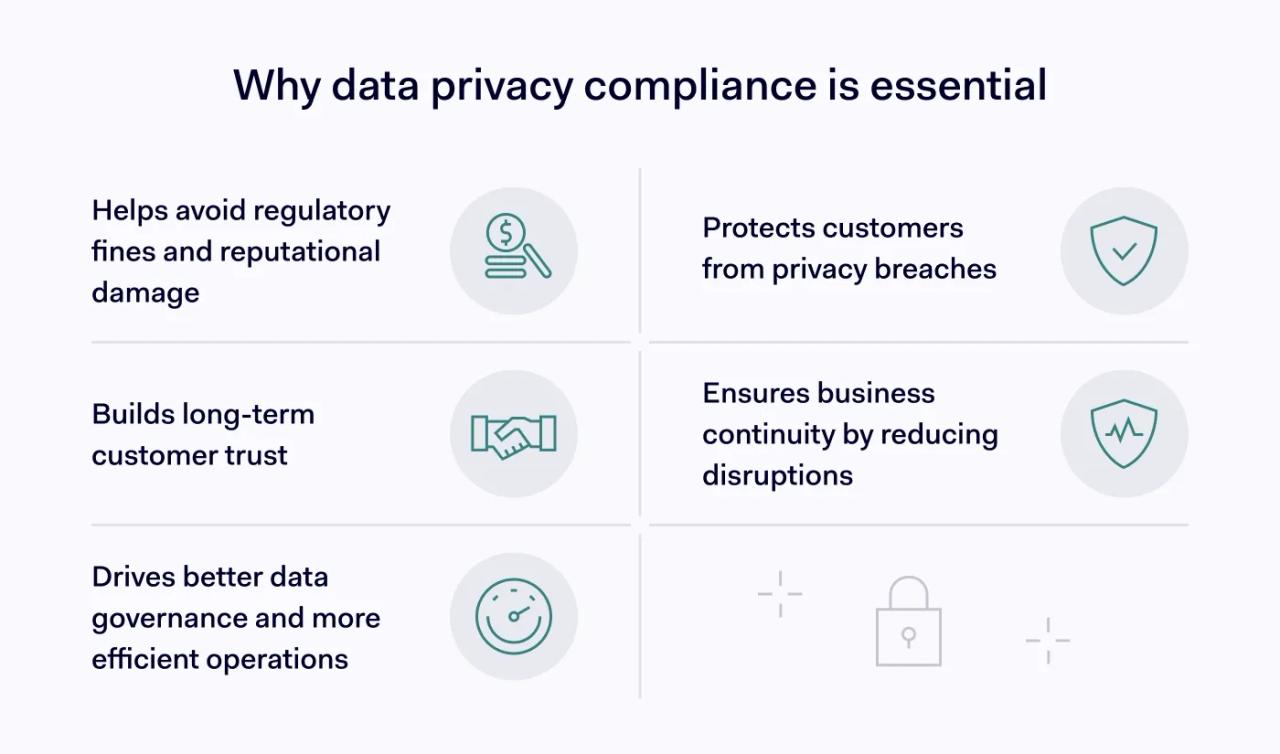
Under CCPA, violations now attract fines above $1 million. Under GDPR, the maximum fine is 4 percent of turnover - potentially vast amounts of money. Moreover, every regulatory penalty carries a reputational risk. Companies that regularly receive fines eventually lose customers and see revenues fall.
However, data privacy compliance is not all about avoiding negative consequences. Compliance also brings several critical benefits. For example, compliant companies protect customers from privacy breaches. This tends to lead to smoother customer relations.
Compliance also signals to potential customers that an organization takes security, consent, and employee training seriously. This builds trust and encourages customers to stay with companies over the long term.
Continuity is another common benefit. Regulatory violations result in business disruption during investigations (and during associated incidents like ransomware attacks). Compliant bodies suffer fewer incidents, leading to less downtime and smoother operations.
Data privacy compliance has another organizational benefit: It encourages stronger data governance and investment in streamlined data storage systems. Compliant organizations understand how they store and use data. They also organize data effectively, making it available for business purposes and user access requests.
Seen in this way, privacy compliance is part of a health business eco-system. Privacy meets compliance obligations while promoting more effective working practices.
Data privacy compliance: critical challenges to consider
Complying with data privacy laws delivers many benefits. However, compliance is rarely simple. Modern companies gather a dizzying array of data from multiple sources. Storing, using, and erasing this data entails extra compliance challenges. Systematic planning is essential.
Here are some common challenges that face data compliance efforts:
- Classifying data: Sometimes, companies struggle to identify the data they collect and hold. However, you cannot protect data you don't know you have. Careful mapping and classification of customer data is a vital first step in data privacy compliance.
- Data retention: Companies should retain data needed for business operations but nothing more. Determining what constitutes a "business necessity" is not easy. The same applies to retention periods. How long will you reasonably need a client's postal address or credit card details?
- Controlling access: Many data breaches result from unauthorized access to sensitive data. Companies need to put in place access controls that support business activities but block access for all other users. However, authentication and access systems need to balance security with accessibility.
- Obtaining consent: Data privacy laws generally require companies to obtain consent before starting data collection. The first request is vital, but it is only the beginning. Managing user preferences, allowing opt-outs, and making subsequent data sharing requests can become a significant challenge.
- Using data legally: When businesses request consent for data collection, they must define why they need that data. How you use data should align with a lawful reason (such as delivering services or protecting customers from harm). Maintaining alignment can be challenging, especially in expanding companies.
- Staying up to date: Regulations change, and data protection measures must keep pace. Companies also expand into new markets and jurisdictions, requiring compliance with previously irrelevant regulations. Annual compliance audits help by assessing the current landscape and scheduling mitigation actions.
- Implementing effective controls: Data breaches following cyber-attacks are serious privacy violations. Data security rests on effective controls (firewalls, encryption, intrusion detection systems, and access controls) and continuous monitoring. Businesses must also apply patches and protect vulnerable applications against exploits or active malware threats.
- Training: Inappropriately shared emails or lost laptops can result in serious data breaches. This makes employee training vital. However, training cannot be a single event. Continuous, properly verified training keeps knowledge fresh and encourages best practices throughout the workforce.
- Fulfilling user rights requests: Data privacy regulations like the General Data Protection Regulation require companies to allow access to customer records. Systems to facilitate requests must be comprehensive, responsive, and fast. Minimizing manual processes is advisable.
- Managing third-parties: Companies often share data with third-parties, such as accounting partners or data storage specialists. However, external partners can leak sensitive data or fall victim to supply chain attacks. Effective contract management is essential.
Consequences of non-compliance with data privacy regulations
Organizations should not view data compliance as a burden or an excuse to cut corners. Failure to comply with data privacy regulations has serious consequences for both small businesses and multinational companies.
Regulatory penalties are the most obvious consequences of compliance failures, and are often highly significant:
- GDPR violations result in maximum fines of €20 million or 4 percent of corporate turnover (whichever is larger).
- HIPAA violations can lead to civil penalties of up to $71,162 per violation, with annual caps of up to $2,134,831 per violation type.
- CCPA violations lead to maximum fines of $7,500 per individual violation. Under the California Consumer Privacy Act, there is no cap on potential penalties.
These are not abstract numbers. In 2024, Irish regulators fined Meta €91 million under the GDPR for failing to encrypt user passwords. Dutch regulators also used GDPR to fine Uber €290 million for illegally migrating private driver data to the United States.
However, the consequences of non-compliance extend beyond fines. Regulators may demand that offending companies cease data collection until they can demonstrate compliance. This could hit revenues by freezing marketing operations or algorithmic analysis.
Non-compliant companies also tend to divert resources to investigations and reforms to overhaul their data governance frameworks. This often takes place under the supervision of regulators, compromising corporate independence and innovation.
External consequences can be equally severe, as violating data privacy laws damages corporate reputations. Around 75% of consumers consider avoiding online retailers that experience data breaches. In that context, trust is a priceless commodity.
Ways to achieve data privacy compliance
Breaching data privacy regulations incurs unnecessary costs and dents customer trust. However, organizations can cut the risk of violating GDPR, CCPA, or HIPAA by following data privacy best practices.
Here are some brief suggestions about how to safeguard privacy and satisfy regulatory requirements:
1. Know your data!
Data mapping and classification is essential before collecting and storing customer data. Assess:
- The type of data you collect
- How you gather data
- Where you store data
- The purpose for using and retaining data
- Whether data is shared with third parties or internal stakeholders
- How you erase data
Use the outcome of this process to model how data flows within your organization. This map serves as a template for protecting privacy and safeguarding data.
2. Understand your regulatory landscape
In terms of data privacy compliance, it's also essential to know what laws apply and what regulators require. At the outset, carry out a regulatory analysis. Determine which jurisdictions you operate in, and which laws apply in those areas. If necessary, plan for future expansion by proactively adapting your consent and data protection systems.
3. Create an effective company privacy policy
Privacy policies dictate how and why you collect information. They inform customers how you will store and use their data, while providing contact details to make access requests or complaints. Moreover, a streamlined privacy policy acts as a foundation for achieving data privacy compliance.
Core elements of privacy policies include:
- Scope: What data do you collect about customers, partners, or employees?
- Purpose: Why do you need to collect customer data? Provide a lawful reason in line with relevant privacy regulations. Examples include meeting contractual obligations, business purposes, or complying with local laws.
- Rights: Explain how individuals can exercise their privacy rights. Provide a contact email for user requests and timescales for fulfilling access requests.
- Data sharing: Explain who you share data with and why. Remember to include options to opt out of data sharing and selling. Include processes for moving data across borders (for example, by applying Standard Contractual Clauses).
- Security: The privacy policy does not need to explain security controls in depth. However, it should include a general assurance that you protect data in line with regulatory standards.
- Data retention: State how long you retain sensitive information and how you will safely dispose of personal data when the retention period expires.
- Accountability: All privacy policies should include a named officer for customer queries (usually the Data Protection Officer). Customers should be able to make contact without incurring additional costs.
- Updates: Briefly inform customers how often you will update the policy and commit to notifying users when updates occur.
4. Use a Data Processing Agreement (DPA) for each supplier
Using third-party vendors and infrastructure providers is unavoidable in modern business operations, but can raise data breach risks.
DPAs govern how you share data with external partners, ensuring third parties follow data privacy best practices. They are legally required under GDPR, and advisable as part of CCPA or HIPAA compliance strategies.
Robust DPAs cover confidentiality requirements, technical safeguards, and the scope of how partners use or share data. For instance, they prevent unauthorized data sales or sharing with subcontractors.
5. Apply the principle of minimization
When collecting and retaining data, try to keep as little as possible. Gather data that is strictly necessary to carry out business operations (in line with the lawful reason for data collection). Avoid vast amounts of irrelevant data. Focusing on essential data is both more efficient and secure.
6. Implement ironclad security controls
Data privacy and data security are intertwined. Encrypt data at rest and in transit using cutting-edge encryption standards. Limit access to those with a relevant business purpose, protect sensitive data within secure network segments, and add multi-factor authentication to block malicious actors.
7. Regularly test your privacy systems
Schedule regular audits to test essential functions. For example, tests should cover access requests and consent procedures, along with security controls and employee behavior. Correlate findings with regulatory standards to ensure your data privacy remains compliant. Proactively mitigate privacy risks as they arise.
Testing also applies to incident response procedures. Make sure you can respond to privacy breaches efficiently and inform regulators according to legally-mandated timescales.
8. Take training seriously
Staff training is probably the most important tool to prevent privacy violations and ensure compliance. Create crystal clear policies that inform employees about confidentiality and privacy standards. Test employee knowledge via digital assessments and workshops. And enforce disciplinary processes if required.
Achieve compliance by making data privacy a priority
Data privacy laws apply to all companies, requiring tight security and streamlined data management. Reliable compliance rests on a strategic framework built on understanding your data, enforcing robust security controls, and maintaining transparent policies.
Privacy compliance can be complex and expensive. However, the benefits include lower penalties, less disruption, more efficient data governance, and stronger customer relations.