Understanding data governance and compliance

How we gather, handle, and dispose of data is critically important. Data governance and compliance achieve these goals. Companies can benefit from data flows and analytical tools without risking regulatory breaches.
Data governance provides a framework for data management. Data compliance ensures that data governance adheres to external legal requirements. The two work together, hand-in-hand. But how does this relationship work in practice?
This article explains how compliance and data governance connect, helping you create a solid foundation for data management.
What is data governance?
Data governance is a system for managing data through its full life cycle, from the moment an organization collects it to secure disposal. It sets clear rules for how teams handle, protect, and use data, and assigns responsibility for keeping it accurate and safe. It also relies on tools and processes that support these rules across everyday operations.
Data governance is a critically important organizational challenge. It enables collective accountability for data security and integrity, while making relevant data available for business activities.
Aspects of data governance include:
- Creating and maintaining data usage policies.
- Assigning roles and responsibilities to meet data governance goals.
- Ensuring organizations collect data in line with relevant privacy regulations.
- Protecting stored data via appropriate security measures.
- Making data available to authorized users and ensuring interoperability.
- Managing metadata to catalog and categorize data.
- Protecting data quality by ensuring it remains in its original state.
- Integrating data governance concerns into digital transformations and business growth.
What is data compliance?
Data compliance involves following regulatory requirements for collecting, storing, using, and erasing data. Requirements vary between industries, but regulatory compliance often relates to GDPR, HIPAA, PCI-DSS, and state data laws like CCPA.
Robust regulatory compliance often emerges from effective data governance practices. However, organizations must verify that their data management practices comply with relevant data security regulations.
Data governance vs data compliance
Data governance and compliance are closely related concepts, but are not identical. Data governance sets out policies and processes for managing data, while data compliance deals with regulatory requirements.
Another way of looking at this is that governance frameworks meet internal business needs. Compliance strategies fulfil external requirements from governments and industry bodies.
The comparison table below explains how these core data concepts differ:
| Data governance | Data compliance |
|---|---|---|
Core aims | Defines how employees collect, store, use, and erase data. | Ensures the organization complies with industry-specific data security and privacy regulations. |
Focus | Internally focused. Deals with processes and policies to control user behavior. | Deals with external requirements. |
Proactive vs reactive | Proactive. Governance teams model data flows and usage needs to ensure smooth operations and meet security goals. | Reactive. Compliance teams react to regulatory changes when advising data specialists. |
Expertise | Governance frameworks rely on strategic expertise. | Compliance depends on legal expertise. |
Static or dynamic? | Frameworks evolve in line with corporate data usage patterns | Compliance strategies evolve as regulations change. |
How data governance and compliance work together
We cannot easily separate data governance and compliance. In practice, businesses need a dual focus on building internal data governance and meeting compliance requirements.
The two concepts support each other, improving data outcomes across organizations. Let's explore how they complement each other.
How compliance drives data governance
Compliance drives data governance by feeding external requirements into the process of managing internal data assets.
Data compliance defines critical areas that data governance frameworks must cover. Analysts define external requirements and assess regulations to balance compliance with financial costs and business activities.
This information is vital for governance teams. Data governance strategies consider compliance requirements when creating policies, training staff, and assigning roles. Compliance teams tailor advice based on governance needs, allowing security and data management teams to act swiftly and effectively.
For example, companies operating in the European Union must comply with the "Right to be Forgotten" under Article 17 of the General Data Protection Regulation (GDPR). Governance frameworks must make data discoverable and permanently erase personal data on request.
In the financial sector, companies must comply with Sarbanes-Oxley (SOX) requirements regarding financial integrity and reporting. Compliance teams help security teams craft governance strategies that meet these requirements without impairing business performance.
Compliance can also become a driver for governance improvements. Governance teams use compliance requirements as guideposts to streamline data collection, storage, and access. Companies can adapt their data management practices without risking compliance violations.
How data governance supports compliance
Data governance also supports compliance by taking actions to meet data compliance goals. Most importantly, robust governance creates a data environment that is well-structured and controllable.
From a compliance perspective, structured data environments include:
- Policy databases that cover core compliance goals such as confidentiality, access controls, and auditing.
- Clearly defined roles and responsibilities for data ownership and management. Specific individuals take responsibility for ensuring data quality and enforcing data governance policies.
- Collection processes that log security events and provide comprehensive audit trails. This makes it easier to verify regulatory compliance and generate reports for external bodies.
- Processes to transmit instructions across the entire organization. Compliance teams can instantly send advice or instructions to relevant stakeholders. This chain of command makes it possible to implement changes and meet evolving compliance requirements.
Governance strategies also create clear definitions of what constitutes private or personal data, how the company uses this data, storage policies, and who has access to confidential data. Governance takes these regulatory definitions and structures internal data in line with compliance needs.
For example, this makes it easier for compliance teams to verify that the organization allows subject access requests under HIPAA or that the company follows GDPR rules over consent to gather information.
Finally, strong data governance enables continuous compliance via proactive audits and data quality controls. Governance teams continuously assess the effectiveness of data security, training, and privacy protection policies - applying compliance metrics to identify problems and schedule mitigation actions.
With a robust data governance framework in place, compliance shifts from a periodic auditing task to an ongoing process. This identifies potential regulatory compliance breaches before they result in data loss or privacy violations.
Best practices for effective data governance and compliance
Establishing effective data governance and compliance strategies is an operational necessity for modern businesses. Non-compliant organizations face significant financial penalties and reputational harm. Poor data governance also reduces the efficiency of data handling and storage - costs that modern businesses cannot afford.
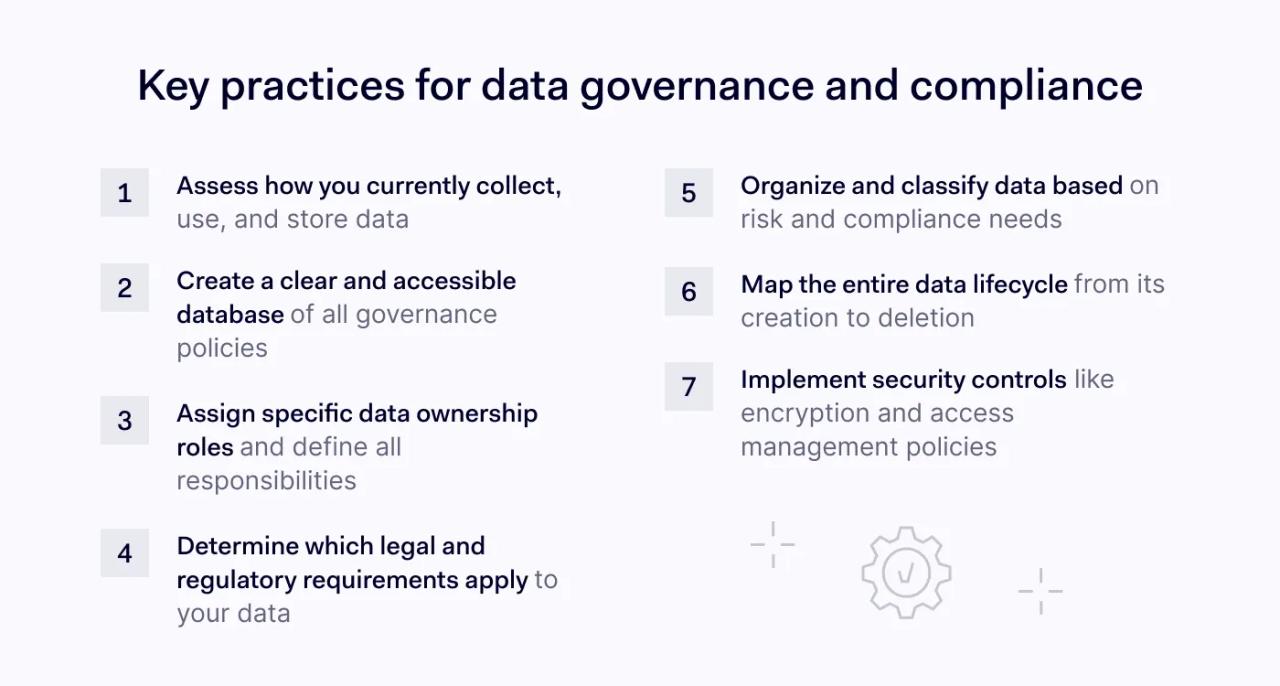
1. Assess your data governance environment
The first step in data governance and compliance is assessing how you collect, use, store, and delete personal data.
How do you collect data from customers or website users? Do you gather sensitive information such as addresses, credit card numbers, or Social Security numbers? If so, where do you store this data, and who has access to it? Do you share sensitive information with third parties or SaaS providers, or is there a risk of accidental exposure?
Aim to develop a comprehensive understanding of how you use data. Remember, data governance strategies cover every stage in the data life cycle. It's essential to model how you collect and erase data, not just storage and access.
2. Create a database of data governance policies
Policies are the foundation of a data governance framework. Essential policies cover data collection, retention, disposal, and classification. Policies should explain allowable data sharing practices, incident response processes, and penalties for breaches.
Use clear language and avoid complex or ambiguous phrases, and make policies available to all stakeholders (and external regulators). Use them as the basis for regular data security and privacy training.
3. Assign roles and responsibilities
Data governance strategies assign every data set or asset to an owner. Data owners are responsible for enforcing privacy and security policies. They may delegate specific roles to data stewards, who execute operational tasks.
Governance frameworks define data owners and stewards. They also create communication channels for raising alerts, issuing compliance instructions, and resolving governance issues.
4. Assess your data compliance needs
Next, determine which laws and regulations apply to your data assets. For example, personal records may fall under HIPAA, CCPA, and GDPR depending on the scope of your business activities, while payment details may fall under HIPAA and PCI-DSS.
5. Organize data in line with compliance requirements
Classify data according to risk levels, from low-risk assets such as promotional materials to high-risk assets like sensitive information. Security and privacy controls should align with risk levels and meet relevant compliance requirements.
6. Use a life cycle model to visualize data management
It often helps to generate a Record of Processing Activities. This is essentially a map of the data life cycle that explains how you gather, store, use, and delete data. Consistent data management at every stage helps you avoid errors like unsafe data retention or consent violations.
Components of the data life cycle include:
- Creation - The point of acquisition when customers interact with websites or purchase products. Companies must secure consent to store personal data and provide information about how they protect customer privacy.
- Data usage and storage - Data should be protected by access controls and available for well-defined business purposes. Back-ups and encryption guarantee data integrity and availability.
- Sharing - Agreements should govern how companies share data with third parties and inform individuals when this occurs.
- Retention - Companies should retain customer data for as long as it remains relevant to business activities, and in line with data compliance requirements.
- Deletion - Organizations should have processes to erase customer data on request and automatically remove data when it is no longer needed.
7. Implement controls and systems to protect business data
Data governance frameworks specify how to secure data. This includes specific security measures such as multi-factor authentication, role-based access controls (RBAC), data encryption, and Data Loss Prevention (DLP) solutions.
Security measures vary between data environments. However, most frameworks cover these core areas:
- Securing access to data via tools like MFA, access controls, firewalls, and email encryption.
- Monitoring sensitive data via behavioral analysis tools, Security Incident and Event Management (SIEM), or DLP software.
- Automated tools to locate private data and meet compliance goals. For example, when fielding subject access requests.
- Third-party risk management. Frameworks should include the use of Data Processing Agreements (DPAs) and regular audits to monitor third-party data access.
- Incident response plans to counter cybersecurity incidents in line with data compliance goals and protect both data quality and availability.
Data governance and compliance are distinct but intertwined concepts that relate to all organizations.
Governance acts as a data management framework. It structures data and sets out policies about how to collect, store, and handle data. Data compliance explains the external rules that data governance frameworks must follow.
The two concepts supplement each other. Establishing robust governance positions companies to meet data compliance demands. It benefits organizations by building trust, preventing breaches, and embedding compliance as a natural part of everyday data management.