What is data compliance?

It starts with a single, innocuous email. An operations manager, rushing before a long weekend, clicks a link disguised as an invoice update. Nothing seems to happen. Weeks later, the company's general counsel receives a letter, not from a disgruntled customer, but from a state attorney general's office. The letter informs them of a catastrophic data breach that has exposed the personal and financial details of 200,000 customers. The stock price wobbles, the headlines are merciless, and the cleanup will cost millions. This scenario, played out in boardrooms worldwide, is a failure of process, policy, and foresight.
Data compliance definition
Data compliance is the practice of ensuring that the way an organization collects, manages, stores, and uses data adheres to the established legal frameworks, industry standards, and internal policies governing data privacy and protection. Fundamentally, it is about respecting the rules. These requirements dictate everything from the type of personal data a firm can hold to how long it can be kept and who is permitted to access it.
Data compliance ensures that an organization's data handling practices are secure, lawful, and ethical. It provides a structured framework for data governance, demanding that companies be accountable for the sensitive information entrusted to them. This involves clear policies for data acquisition, consent management, user access rights, and protocols for responding to a breach.
Compliance moves data management from a disorganized, ad-hoc activity to a disciplined, auditable business operation. It forces an organization to ask critical questions:
- What data do we have?
- Why do we have it?
- Who can see it?
- How are we protecting it?
Answering these questions is the foundation of a resilient and trustworthy enterprise. Ultimately, strong data privacy compliance is a public declaration that the organization values its customers' data privacy as much as its own profit.
Data compliance vs data security compliance
A common point of confusion lies in distinguishing data compliance from data security compliance. The two are related but not interchangeable.
Data compliance | Data security compliance |
|---|---|
Covers the broad collection of laws and regulations an organization must follow when handling data. | Zooms in specifically on the technical and administrative safeguards required to protect that data from threats. |
Sets the destination (what rules you must follow). | Designs the vehicle and plots the route (how you will technically meet those rules). |
Think of it this way: a data compliance regulation like the GDPR mandates that personal data be protected against unauthorized access. This is the "what." Data security compliance provides the "how." It details the necessity of implementing firewalls, encryption for data in transit and at rest, multi-factor authentication, and intrusion detection systems.
One practice is about adherence to the letter of the law; the other is about building the processes that make adherence possible. An organization can have data security measures in place yet still be non-compliant if it collects data without proper consent or refuses to honor a user's request for data deletion. Conversely, having a perfect set of data policies on paper is meaningless without the security infrastructure to enforce them.
Why is data compliance important?
The importance of data compliance extends far beyond merely checking boxes on a legal form. Ignoring it is fiscally irresponsible.
The most immediate motivation for any board of directors is financial. The average cost of a data breach is $4.4 million, according to a 2025 IBM report. This figure does not even account for regulatory fines, which can be exponentially larger. The benefits of a robust data compliance program, however, are proactive rather than reactive. They include:
- Avoiding financial penalties. This is the most straightforward benefit. Regulators are no longer issuing warnings; they are levying fines designed to be painful. A strong compliance posture is the defense.
- Building and maintaining customer trust. Consumers are more aware of data privacy issues than ever before. Demonstrating a commitment to protecting their sensitive information is a powerful differentiator. Trust is hard-won and easily lost; a public data breach can erode it overnight.
- Enhancing data governance and management. The process of achieving compliance forces an organization to map, classify, and understand its data assets. This leads to better data hygiene, reduced storage costs, and more efficient operations. It transforms data from a disorganized liability into a well-managed asset.
- Strengthening data security and resilience. Data compliance standards require strong data security controls. Companies naturally harden their defenses against ransomware, phishing, and other cyber threats, reducing the likelihood of data breaches.
- Creating a competitive advantage. In B2B transactions, proof of compliance is quickly becoming a prerequisite. Being able to demonstrate adherence to regulations like GDPR or data compliance standards like SOC 2 can unlock new business opportunities and partnerships.
- Improving brand reputation. A company known for its rigorous data protection practices is viewed as reliable and ethical. This positive reputation attracts customers, talent, and investors, contributing to sustainable growth.
Ultimately, data compliance acts as both a shield and a business enabler. It protects the organization from catastrophic financial and reputational harm while simultaneously improving internal processes and creating new avenues for growth. It is an investment in operational excellence and longevity.
Navigating the maze of data compliance regulations
Data protection regulations are a patchwork of laws and standards that vary by geography and industry. To build an effective compliance program, leaders must first understand the primary legal frameworks governing their operations. Below are some of the most common examples of data compliance regulations that shape modern business.
Health Insurance Portability and Accountability Act (HIPAA)
Enacted in the United States in 1996, HIPAA is one of the oldest and most well-known data protection laws. Its primary goal is to protect the privacy and security of Protected Health Information (PHI). This includes any individually identifiable health information, from diagnoses and treatment plans to billing information.
The act applies to "covered entities" (healthcare providers, insurers) and their "business associates" (any third party with access to PHI, such as a billing company or cloud storage provider). HIPAA's Security Rule mandates specific administrative, physical, and technical safeguards to ensure the confidentiality, integrity, and availability of electronic PHI, while the Privacy Rule governs its use and disclosure. Violations can lead to significant fines and even criminal charges.
General Data Protection Regulation (GDPR)
The GDPR, which took effect in the European Union in 2018, set a new global standard for data privacy. Its reach is extraterritorial, meaning it applies to any organization in the world that processes the personal data of EU residents, regardless of where the company is located.
The regulation is built on key principles like "data minimization" (collecting only necessary data), "purpose limitation" (using data only for specified purposes), and requiring a lawful basis for processing. It grants robust rights to individuals (data subjects), including the right to access, rectify, and erase their personal data (the "right to be forgotten").
Fines for non-compliance are severe: up to €20 million or 4% of the company's worldwide annual revenue, whichever is higher. Amazon was famously hit with a €746 million fine under GDPR in 2021, signaling regulators' willingness to enforce the law's full power.
California Consumer Privacy Act (CCPA) and California Privacy Rights Act (CPRA)
The CCPA, which became effective in 2020, is California's landmark data privacy law, often seen as the United States' answer to GDPR. It was expanded and strengthened by the CPRA in 2023.
The law grants California consumers new rights over their personal information, including the right to know what data businesses are collecting about them, the right to have that data deleted, and the right to opt-out of the sale or sharing of their information. It applies to for-profit entities that do business in California and meet certain revenue or data processing thresholds.
The CCPA/CPRA has had a domino effect, inspiring other U.S. states to enact their own data privacy laws and compelling companies to adopt a more transparent approach to data management nationwide.
Payment Card Industry Data Security Standard (PCI DSS)
Unlike the others, PCI DSS is not a law but a set of security standards mandated by major credit card brands (Visa, MasterCard, American Express, etc.). Any organization that accepts, processes, stores, or transmits cardholder data must be PCI DSS compliant.
The standard includes twelve high-level requirements, encompassing areas like building and maintaining a secure network, protecting cardholder data through encryption, implementing strong access control measures, and regularly monitoring and testing networks. Failure to comply can result in fines, increased transaction fees, or even the revocation of the ability to accept card payments-a death sentence for many businesses.
How to foster data compliance
Achieving and maintaining data compliance is not a project with a defined end date; it is a continuous, dynamic process that must be woven into the fabric of the organization. It requires a strategic combination of technology, policy, and human diligence.
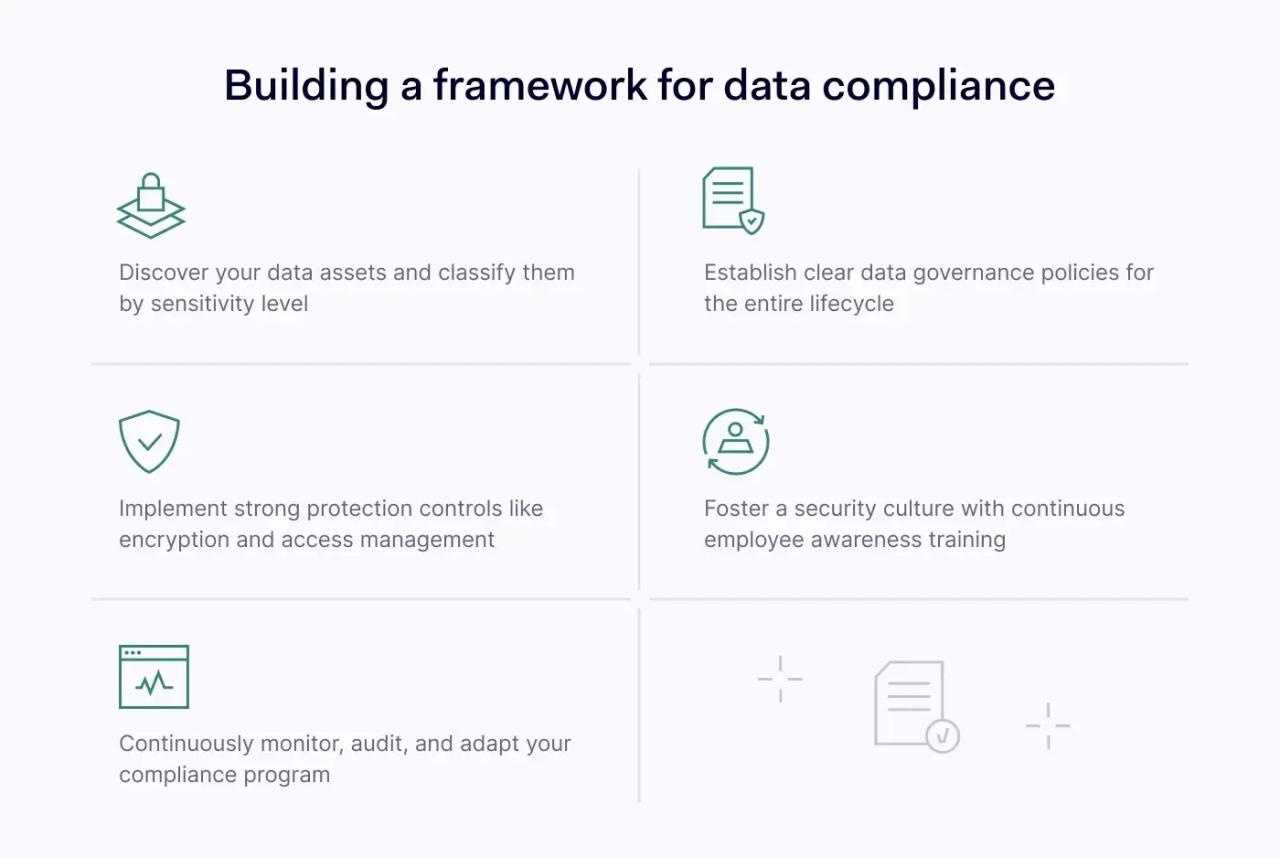
Step 1: Discover and classify your data
An organization cannot protect what it does not know it possesses. The foundational step is to conduct a thorough data discovery process to create an inventory of all data assets across the enterprise; on-premises servers, cloud environments, employee laptops, and third-party SaaS applications. Once inventoried, data must be classified based on its sensitivity. A typical classification scheme might include categories like:
- Public: Information intended for public consumption.
- Internal: Business data not meant for public release but whose disclosure would not cause significant harm.
- Confidential: Sensitive information whose unauthorized disclosure could negatively impact the company (e.g., financial reports, business plans).
- Restricted: The most sensitive data, such as personal data, PHI, or payment card information, whose exposure would result in severe financial, legal, or reputational damage. This classification dictates the level of security controls required to protect each data type.
Step 2: Establish data governance policies
With a clear map of its data, the organization can develop a comprehensive data governance framework. This is the rulebook for data management. It defines policies and assigns responsibilities for the entire data lifecycle, from creation to disposal. Key components of a governance policy include:
- Data ownership: Assigning clear owners for different data sets who are accountable for their quality, use, and protection.
- Access control policies: Defining who can access what data and under what circumstances, based on the principle of least privilege.
- Data retention schedules: Specifying how long different types of data should be kept to meet business needs and legal requirements, and ensuring it is securely destroyed afterward.
- Acceptable use policies: Outlining how employees may use company data and information systems.
Step 3: Implement strong data protection controls
This step transitions from policy to execution, operationalizing the principles of data security compliance. The goal is to establish layers of defense to protect sensitive information from unauthorized access, both from external attackers and internal threats. Essential controls include:
- Encryption: Encrypting all sensitive data both at rest (while stored on a disk or in a database) and in transit (as it moves across the network).
- Access management: Implementing strong authentication mechanisms like multi-factor authentication (MFA) and granular, role-based access controls (RBAC) to enforce the principle of least privilege.
- Network security: Deploying firewalls, intrusion prevention systems, and other tools to secure the network perimeter and segment internal networks.
- Vulnerability management: Regularly scanning systems for vulnerabilities and applying patches promptly to close security gaps.
Step 4: Foster a culture of compliance through training
Technology and policy alone are insufficient. The "human firewall" is often the weakest link in the security chain. A report from Verizon consistently finds that a significant percentage of data breaches involve a human element, whether through error or malicious intent. Consequently, continuous employee training is critical. This should go beyond a once-a-year slideshow. Effective training includes:
- Phishing simulations to teach employees how to spot and report malicious emails.
- Education on secure data handling practices, such as not leaving sensitive documents on a printer or using unsecured public Wi-Fi.
- Clear instruction on company data governance policies and the employee's role in upholding them.
- Establishing clear channels for reporting potential security incidents without fear of blame.
Step 5: Continuously monitor, audit, and adapt
Data compliance is a moving target. Regulations change, new threats emerge, and business processes evolve. A "set it and forget it" approach is a recipe for failure. Organizations must establish a cycle of continuous improvement that includes:
- Automated monitoring: Using security information and event management (SIEM) systems and other tools to monitor for anomalous activity and potential threats in real-time.
- Regular audits: Conducting periodic internal and external audits to assess the effectiveness of controls and verify compliance with data protection laws.
- Incident response planning: Developing and regularly testing a data breach incident response plan to ensure the organization can react quickly and effectively to minimize damage.
- Policy review: Annually reviewing and updating all data compliance policies to reflect changes in the regulatory and threat landscapes.
Building a truly compliant organization is a demanding discipline. But the effort is no longer optional. The regulations are written and the penalties are codified; choosing to ignore them is a demonstrably expensive decision.