Employees are now adopting AI tools at such a pace that many security teams can’t keep up. As a result, companies are losing visibility into what data is shared with AI models, how it’s used, and where it may end up.
That’s why having a clear AI security policy matters. It tells your employees which AI tools they can use and to what extent, so they can benefit from AI without creating security gaps. Let us explain how you yourself can create such a policy for your organization.
Why your business needs an AI security policy
AI tools can introduce major data, governance, and compliance risks if they are not used responsibly. A clear AI security policy helps you stay ahead of these threats and gives employees a practical framework to follow. Here’s what you gain by adopting it in your organization.
Prevent sensitive data leaks
Employees often turn to AI tools because they want to work faster and get more done with less effort. The problem is that this speed can come at a cost when sensitive company data is put into public AI services or other third-party AI tools outside your control.
An AI security policy clarifies what data is off-limits, which helps keep sensitive information such as PII, contracts, and intellectual property protected. In other words, it gives employees a clearer understanding of what they can and cannot share when using AI, so they don’t accidentally disclose anything they shouldn’t.
Keep shadow IT under control
When employees adopt AI tools on their own, IT teams lose visibility into exactly which tools are being used and what data those solutions may access. This, of course, makes it harder to manage risk or respond quickly when issues arise.
A generative AI security policy defines which tools are approved for use across the organization, giving IT teams the oversight they need while still allowing employees to use AI productively. In practice, that means less guesswork and fewer unauthorized AI tools slipping through the cracks.
Stay aligned with compliance requirements
Using AI without any guardrails can lead to privacy, data protection, or regulatory issues. That’s especially important when employees are working with regulated data, customer records, or internal business information.
A strong AI security policy provides clear rules for handling sensitive information, which helps employees avoid putting your business at legal risk. It also makes compliance easier to enforce and audit.
Reduce the impact of inaccurate AI output
AI tools can produce false, biased, or incomplete results, so human review remains essential. When AI outputs are trusted without verification, small errors can escalate into significant business problems.
A generative AI security policy makes this expectation explicit. It reinforces accountability by requiring employees to verify AI-generated content before using it for important decisions or external communications.
What you should include in your AI security policy
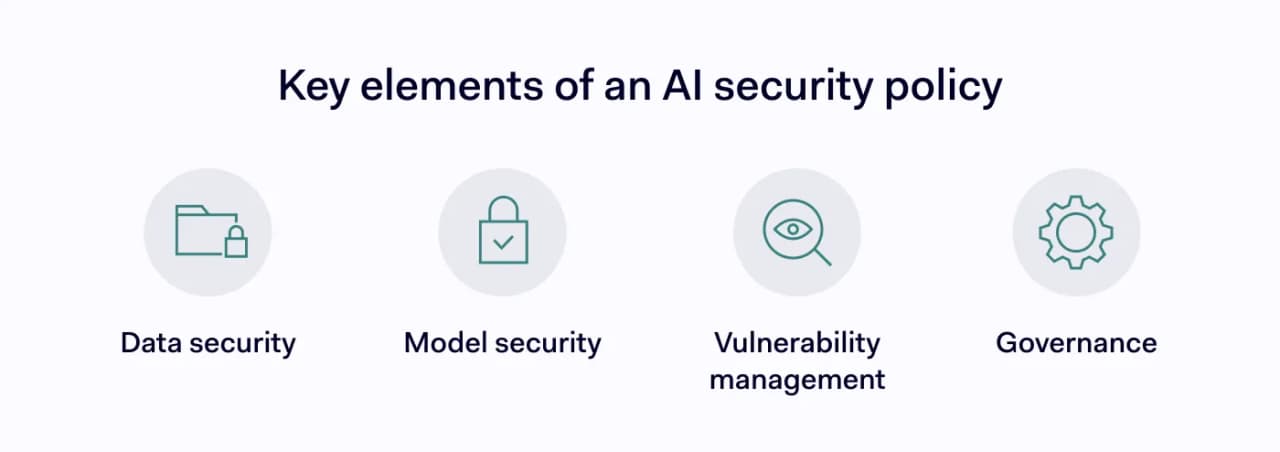
To be effective and practical, a generative AI security policy should be built on 4 pillars. They are:
Data security
AI systems run on data, which is why data protection is a critical part of the policy. It should explain how to protect training data and user prompts from the two main risks: poisoning attacks, where malicious data changes how the model behaves, and privacy leaks, where sensitive information gets exposed.
When this guidance is clear, employees are less likely to upload data that could create legal, operational, or reputational issues.
Model security
An AI security policy shouldn’t focus only on the data you put into an AI system—it also needs to protect the model itself. Without proper safeguards, the model can be exposed to threats like adversarial attacks, where misleading inputs are used to manipulate it, and model extraction, where attackers repeatedly query an API to reverse-engineer its behavior and recreate it.
The policy should define how to identify these threats, who is responsible for responding to them, and what protections are needed to prevent them.
Vulnerability management
Every AI setup relies on APIs, libraries, and critical infrastructure that need ongoing monitoring and maintenance. If those components aren’t managed properly, they can create weak points that attackers may exploit.
Including vulnerability management in your policy makes ownership, patching, and testing part of the AI rollout from the start. It prevents security from being added too late, after the AI tool has already been widely adopted by teams.
Governance
Governance is what turns AI use from an informal activity into a controlled process. This part of the policy should define who owns AI oversight, which standards apply, and how legal, ethical, and regulatory requirements are met.
It should also make clear who’s accountable when something goes wrong. That’s what keeps the policy practical instead of just theoretical.
How zero trust helps you enforce an AI security policy
Zero trust gives your policy a technical backbone. It allows you to control who can use which AI tools and to restrict those tools’ access to other resources.
Identity-centric access
Zero trust helps ensure that only authorized users can access your internal AI models or related systems. Instead of granting access based on network location, it verifies each request against the user’s identity and role. This means no one gets in just because they’re on the right network — they have to prove who they are and that they’re allowed to access it. It gives you more control over who can interact with sensitive AI resources and under what conditions.
Network segmentation
Isolating AI sandboxes from production systems limits how far a security issue can spread. Zero trust keeps AI environments properly separated from critical infrastructure, making it less likely that a malicious prompt, a compromised account, or a misconfigured application will reach sensitive data.
Device posture monitoring
Internal AI tools should only be accessed from compliant, company-managed devices. This can be enforced through a zero-trust approach by requiring continuous device verification, applying device-based access controls, and granting access only when both the user and endpoint meet the defined security requirements.
Why align your AI security policy with standards like NIST and ISO
Creating a generative AI security policy doesn’t mean you have to start with a blank page. Established frameworks like the NIST AI Risk Management Framework and ISO/IEC 42001 give you a strong foundation to build on.
NIST offers practical guidance for identifying, assessing, and managing AI-related risks, while ISO/IEC 42001 provides a structured approach to AI governance, accountability, and continuous improvement. Together, they give you a solid basis for creating a policy that’s easier to implement, maintain, and communicate to stakeholders and leadership.
How to implement an AI security policy step by step
Step 1: Setup and strategy
Start by forming a cross-functional working group with representatives from IT and security, legal, HR, and other teams likely to be affected by AI use. While doing so, assign clear ownership to specific roles to ensure accountability.
Next, define approved AI use cases in your organization, such as content drafting, customer support, and data analysis, and clearly state what is not allowed. Then, set baseline guardrails for reviewing AI outputs, approving new tools, and determining when additional oversight is required.
Step 2: Risk assessment
The next step is to audit shadow AI to identify which unauthorized tools employees are already using. This will reveal where the biggest gaps are and where policy enforcement is needed most. Next, map the types of data that must not be used in public AI models, such as PII, source code, and intellectual property. Finally, review the policy against relevant compliance requirements, including the GDPR, CCPA, and the NIST frameworks.
Step 3: Technical enforcement
Once the policy is defined, it needs to be backed by actual controls. Zero-trust principles are a good place to start, because they verify every user and device before access is granted. You can also use data scrubbing, API monitoring, and access restrictions to limit what users can submit to AI tools and what those tools can reach in your infrastructure. The point is to make the safe path the easy path. If the controls are clear and consistently enforced, employees are far less likely to expose sensitive data by accident.
Step 4: Maintenance
AI changes quickly, so policy maintenance can’t be treated as a one-time project. That’s why you need to assign a dedicated owner to oversee the policy, monitor its effectiveness, coordinate updates, and respond to emerging issues. This person should work closely with the security and legal teams to ensure the policy is up to date with evolving threats, business needs, and compliance requirements.
To keep the policy relevant as AI adoption and risks evolve, make sure it is reviewed and updated at least every 90 days.
And don’t forget regular training, as employees need ongoing reminders of the policy’s requirements and the reasoning behind them.
Bottom line
An AI security policy helps your business use AI tools without losing control. When you combine clear rules with zero-trust controls and regular reviews, you make AI safer to adopt and easier to manage over time.