
AI ransomware is malware that uses artificial intelligence to automate target selection, evade security tools, and adapt its attack patterns in real time. Unlike traditional ransomware, which follows pre-written scripts, AI-powered ransomware can learn from its environment, making it faster, harder to detect, and far more destructive.
In this article, we’ll break down how AI ransomware is built, the attack vectors it exploits, and the steps you can take to protect your organization.
How does AI-powered ransomware work?
Building ransomware once demanded serious technical skill, but AI has compressed the learning curve dramatically. Attackers now use large language models (LLMs) to automate work that used to take days by weaving them into every stage of an AI ransomware attack.
Ransomware groups rely on AI most heavily at the start of an operation to gain a foothold, impersonate colleagues, or escalate privileges. After ChatGPT went public, SlashNext has tracked a 1.265% jump in phishing emails, largely because AI lets attackers produce polished, targeted lures at a speed and scale that manual efforts could never match. Deepfakes raise the stakes further, as generative models can now mimic faces and voices convincingly enough that the NSA, FBI, and CISA have jointly warned about their use in manipulating employees into granting network access. On the vulnerability side, generative and agentic AI ransomware tools are shrinking the window between a flaw being disclosed and an attacker weaponizing it. They parse descriptions, map exploit requirements, and flag weak configurations, compressing research that once took weeks into hours.
Once inside a network, some groups are turning to generative and agentic AI to tighten their hold. AI models scan the environment, pinpoint high-value systems, and sort out which credentials and data are worth pursuing. Automating network mapping and credential harvesting lets attackers move through an organization more efficiently while staying under the radar. It also gives cybercriminals the ability to write, adjust, and debug malicious code with simple prompts. Additionally, some ransomware groups already use AI-assisted coding for specific tasks to speed up development and reduce manual overhead, though the results don’t always match the quality of non-AI code.
In the final phase of an AI ransomware attack, AI shifts to data analysis and extraction. Models can sift through massive file systems to pinpoint the most sensitive information and prioritize what to exfiltrate. Few cybercriminals have adopted this approach so far, but those who have are building custom AI assistants based on commercial or open-source models to analyze and rank stolen data, saving time and effort, even when the theft itself still relies on conventional methods.
Some threat actors have started building malware that queries AI during execution, letting the payload adjust its behavior in real time based on security controls or environmental conditions. These techniques haven’t been widely spotted in live campaigns yet, but in 2025, researchers showed what they could look like with PromptLock AI ransomware a proof-of-concept strain (also called Ransomware 3.0). It used an LLM at runtime to generate scripts on the fly, locate high-value files, steal data, and launch encryption, all without pre-written instructions.
What are AI ransomware attack vectors?
AI doesn’t invent new ways into a network. It just makes the existing ones faster, more convincing, and harder to detect. Here are the main vectors ransomware groups are supercharging with AI.
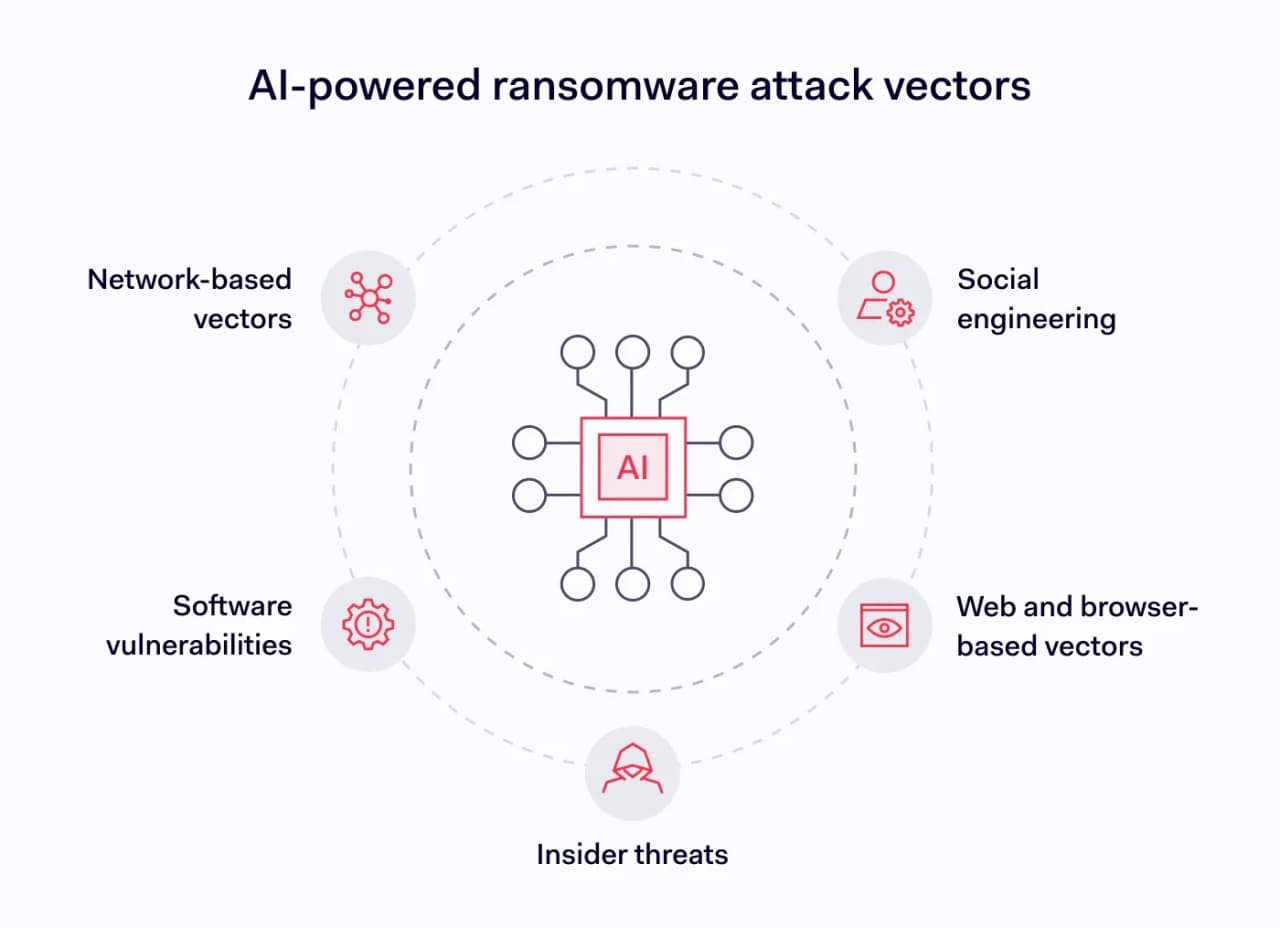
- Network-based vectors. This attack vector targets weaknesses in an organization’s infrastructure: exposed Remote Desktop Protocol (RDP) endpoints, unpatched software, and poorly configured network devices. RDP exploits remain among the most common, with attackers slipping in through weak passwords or insecure settings and pivoting into the wider network. AI speeds each weakness by letting attackers sweep massive IP ranges for vulnerabilities, match flaws against known exploits on the spot, and brute force credentials more efficiently using patterns from leaked password databases.
- Social engineering. At the moment, AI makes the biggest impact here. It allows attackers to generate phishing emails that are grammatically polished, contextually relevant, and personalized, for example, by pulling details from scraped LinkedIn profiles or breached data to target specific employees. Voice-cloning models produce convincing vishing calls, and deepfake videos can impersonate executives on live conference platforms. The traditional advice of “look for typos and broken English” no longer holds up when AI handles the writing.
- Web and browser-based vectors. AI helps attackers build more convincing fake login pages and generate malicious browser extensions that closely mimic legitimate ones. It can identify which websites a target organization’s employees visit most frequently, making watering-hole attacks easier to plan. Malvertising campaigns stand to benefit as well, since AI can quickly iterate on ad creatives and landing pages to maximize click-through rates before security teams catch on.
- Software vulnerabilities. As covered earlier, AI compresses the timeline between a vulnerability being disclosed and a working exploit being deployed. Attackers feed CVE descriptions into AI models that map out the affected software versions, suggest exploit paths, and even generate proof-of-concept code. Ransomware-as-a-service (RaaS) providers are increasingly using these capabilities to stay ahead of patch cycles.
- Insider threats. AI lowers the threshold for malicious insiders. An employee with access but limited technical ability can use LLMs to write data exfiltration scripts, disable logging, or plant backdoors without writing a single line of code from scratch. AI chatbots available on dark web forums walk users through each step, turning a disgruntled employee into a capable threat actor with very little effort.
AI-powered attack autonomy
Most AI-powered ransomware still needs human operators behind the wheel to pick targets, launch payloads, and handle ransom negotiations. PromptLock AI ransomware (Ransomware 3.0) is one of the earliest examples of a fully autonomous, AI-driven attack, created by researchers at NYU Tandon School of Engineering as a controlled experiment, not by threat actors.
PromptLock skips pre-written attack code entirely. Instead, it calls out to open-source AI language models during execution to generate Lua scripts tailored to each victim’s system. Every run produces different code from the same starting prompts, making it far harder for traditional security tools to catch through signature matching or behavioral analysis. Across 3 test environments, the AI correctly identified between 63% and 96% of sensitive files, ran on Windows, Linux, and Raspberry Pi without modification, and even crafted personalized ransom messages referencing specific discovered files.
NYU Tandon noted that the cost of running all of this was roughly 23,000 AI tokens per complete attack, equivalent to about $0.70 at commercial API rates, or nothing at all with open-source models. That price point could put advanced, AI-generated ransomware capabilities within reach of attackers who previously lacked the expertise to build them.
On July 1, 2026, fully autonomous ransomware was observed in the wild for the first time. The Sysdig Threat Research Team documented JADEPUFFER, an agentic threat actor that gained entry into Langflow, a widely deployed open-source framework for building LLM-driven applications, and carried out reconnaissance, credential harvesting, lateral movement, and destructive extortion. According to the Sysdig team, 3 behaviors set JADEPUFFER apart: it talked through what it was doing as it did it, it spotted and fixed its own mistakes in roughly 30 seconds, and it understood decoy instructions written in plain English that the researchers had left in its path.
How AI-powered ransomware differs from traditional ransomware
Traditional ransomware follows a predictable pattern: pre-written code, static encryption routines, and mass-distributed phishing emails that cast a wide net. AI-powered ransomware breaks from that pattern by learning, adapting, and making decisions on its own. Here’s how the two compare at a glance:
Traditional ransomware | AI-powered ransomware | |
|---|---|---|
Speed | Manual reconnaissance and staged deployment over days or weeks | Automated scanning, exploitation, and payload delivery compressed into hours |
Customization | Generic payloads and one-size-fits-all ransom notes | Scripts and messages generated per victim based on system and data profiling |
Evasion | Static code that signature-based tools can fingerprint | Generates and adapts code dynamically |
Skill barrier | Requires coding knowledge or access to pre-built kits | Low-skill operators can generate functional attacks through AI prompts |
Faster, automated attack chains
Traditional ransomware campaigns move in stages, each one requiring human input. An operator scans for targets, picks an entry point, deploys the payload, and monitors progress manually. AI collapses those steps. Automated agents can chain reconnaissance, exploitation, lateral movement, and encryption into a continuous sequence that runs faster than any security team can respond to in real time. What once took days of coordinated effort can now unfold in hours.
Polymorphic, adaptive code that evades detection
Traditional polymorphic malware added a layer of complexity through basic encryption, code substitution, or instruction reordering, but the variations followed predictable patterns that security teams could eventually crack. AI-powered ransomware goes further by generating genuinely new code with every execution, changing logic, structure, and syntax with each run. Some strains query AI models at runtime to adjust behavior based on the environment they encounter.
Lower barrier to entry for less-skilled actors
Launching a traditional ransomware campaign used to require real technical ability: writing exploits, building infrastructure, and testing payloads against security tools. AI cuts through most of that complexity. Now, an attacker with minimal coding knowledge can generate functional malware, craft convincing phishing lures, and troubleshoot errors through simple prompts. Ransomware-as-a-service platforms are beginning to integrate AI capabilities as well, giving affiliates plug-and-play tools that lower the required skill level even further.
Smarter targeting
Traditional campaigns cast a wide net, sending phishing emails to thousands of addresses with no real precision. AI enables a more deliberate approach. Attackers can analyze employee directories, technology stacks, and leaked credentials to identify which organizations are vulnerable and worth pursuing, then use deepfake video and voice cloning to impersonate trusted figures within those specific targets.
AI ransomware prevention
Currently, AI is increasing the speed and scale of ransomware operations rather than changing core tradecraft. The strategies below won’t make your organization bulletproof, but layered together, they form a strong foundation for AI ransomware protection that reduces the chances of a successful attack and limits the damage if one gets through.
Monitor systems and network, and update software
Keeping software up to date remains one of the simplest and most effective defenses. AI-powered attackers are compressing the window between vulnerability disclosure and exploitation, so delayed patches are riskier than ever. Automate updates wherever possible, and prioritize patching for internet-facing systems like VPNs, firewalls, and RDP endpoints. Pair that with continuous network monitoring to catch unusual traffic patterns, unexpected lateral movement, or spikes in data transfer. The faster you spot anomalous behavior, the less time an attacker has to establish a foothold.
Monitor the dark web for early leak and extortion signals
Ransomware groups often signal their intentions before launching an attack, or before publishing stolen data. Credentials, access tokens, and internal documents frequently surface on dark web forums and marketplaces in the lead-up to an extortion attempt. Monitoring these channels gives your security team an early warning that your organization may be a target. It can reveal whether employee credentials have been leaked, whether access to your network is being sold, or whether stolen data has already been posted. Acting on these signals early can mean the difference between preventing an attack and responding to one.
Strengthen detection
Signature-based antivirus tools struggle against AI-generated polymorphic malware that changes with every execution. Stronger AI ransomware detection requires behavioral systems that flag suspicious activity based on what a process does rather than what it looks like. Endpoint detection and response (EDR) platforms, network detection and response (NDR) tools, and AI-driven security analytics can identify patterns like rapid file encryption, mass credential access, or unusual outbound data transfers.
Develop incident response plans
Build a detailed incident response plan that assigns clear roles, defines escalation paths, and outlines communication protocols for both internal teams and external stakeholders. Run tabletop exercises that simulate AI-driven ransomware scenarios specifically, including those with polymorphic payloads, deepfake social engineering, and rapid lateral movement. Test your plan regularly and update it as the threat evolves. A rehearsed team reacts faster and makes fewer costly mistakes under pressure.
Backups, segmentation, and zero-trust access
These 3 controls work together to limit what an attacker can reach and hold hostage. Maintain offline, immutable backups that can’t be encrypted or deleted by malware, and test restoration regularly. Segment your network so that a breach in one area doesn’t grant access to everything. Implement zero-trust access principles, where no user or device is trusted by default, every request is verified, and permissions are limited to the minimum needed. Even if an attacker gets in, segmentation and zero trust make lateral movement far more difficult, and reliable backups take the leverage out of a ransom demand.
Raise awareness among your employees
Technology alone won’t stop an AI-powered phishing email that’s grammatically perfect, contextually relevant, and personalized with details pulled from LinkedIn. Train your teams to verify unexpected requests through a separate channel, question urgency-driven messages, and report anything suspicious without hesitation. Update training materials to reflect AI-driven tactics like deepfake calls and voice cloning. Simulated phishing exercises that incorporate AI-generated lures give employees realistic practice and help you identify areas where additional coaching is needed.
Conclusion
AI-powered ransomware has accelerated the game. Attacks move faster, phishing is harder to spot, and the skill needed to launch a campaign keeps dropping. The defenses that worked against traditional ransomware still matter, they just need to be sharper, faster, and applied more consistently. Keep your software current, segment your network, enforce zero-trust access, and make sure your people know what modern threats actually look like. The organizations that adapt now will be the ones best positioned to withstand what comes next.