
AI is no longer some future risk—it is speeding up cyberattacks on an unprecedented scale. The widespread adoption of artificial intelligence means that the very same technology that drives productivity is also being exploited by hackers in AI-powered attacks
For security teams, AI automates threat hunting and spots unusual network behavior instantly. For cybercriminals, it makes data theft cheap and fast, and enables them to launch hyper-realistic phishing campaigns and AI-powered attacks on a large scale.
In this guide, we will break down the most urgent AI security threats, such as prompt injection and shadow AI along with security best practices needed to protect your data and business.
How AI is changing cyber threats
In the past, launching a sophisticated cyberattack required deep technical knowledge, flawless language skills, and weeks of manual research. Today, with generative large language models (LLMs), the barrier to entry is low, even for low-skilled attackers They can now automate, scale, and accelerate attacks with AI at a terrifying pace.
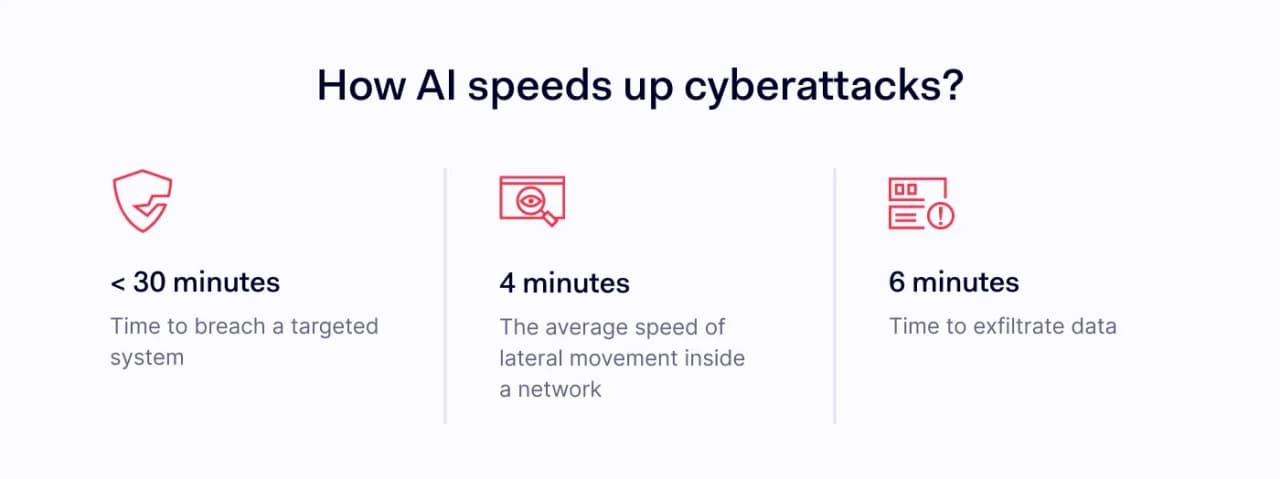
According to recent data, attackers can breach systems in under 30 minutes using AI tools Also, the average speed of their lateral movement inside a network is only 4 minutes, which is 85% faster than that of a human operator. AI-powered scripts help cybercriminals automatically map networks and steal login tokens the moment they breach a device.
But the most staggering stat is the drop in data exfiltration time—the amount of time it takes a hacker to find your sensitive files and upload them to their own server. To give you a perspective, in 2024, the fastest recorded data exfiltration time was over 4 hours. Now, it takes just 6 minutes
AI helps attackers enter a system, identify the most sensitive data, and steal it before a human can even finish reading the initial alert. What does it mean for security teams? It leaves them with very little time to detect and kill a session before the entire network is infected
So, what are the most urgent AI-powered cybersecurity threats right now?
1. Hyper-personalization and social engineering
Before the AI era, phishing emails were quite easy to spot because of poor grammar, generic greetings, and obvious red flags. Now, hackers use AI to scrape public data from LinkedIn, corporate directories, and B2B platforms
AI analyzes an individual’s role, recent posts, and professional connections, and based on that, it can instantly craft hyper-personalized fraudulent communications These emails are impossible to detect as they mimic the exact tone, vocabulary, and context of a legitimate business partner or executive.
2. Vishing and deepfakes
Let’s explore how attackers manipulate people with deepfakes and vishing (voice phishing).
Vishing
Voice phishing is a social engineering attack that uses advanced, AI-based voice-cloning tools to trick people into disclosing sensitive data How does it work? First, cybercriminals obtain a short audio clip of, for example, a company executive from an interview, video, or speech. Then, they clone the executive’s voice with perfect accuracy. Finally, they use these cloned voices during real-time phone calls to pressure staff into transferring money or exposing network credentials.
The most recent vishing statistics are alarming. In 2026, there were 442% more vishing incidents. In 93% of them, threat actors impersonated authority figures. However, employees who complete AI-assisted vishing simulations are 80% less likely to fall for these scams
Deepfakes
The goal of a deepfake—an AI-generated video, image, or audio file—is to deceive people. These videos can be used maliciously in disinformation campaigns and to impersonate high-profile business executives in cyberattacks
For example, cybercriminals may join video meetings and impersonate your CEO or a major vendor, demanding urgent wire transfers or sensitive data. Last year, these highly convincing impersonation scams increased by 148%
According to the Trends in Identity Report deepfakes and AI tools are used to fuel 5 common types of impersonation scams:
- Business Posing as representatives from reputable companies to trick victims into sending money or disclosing confidential data.
- Financial institution Pretending to be bank staff and creating artificial urgency or fear of account loss to force wire transfers.
- State agency Posing as government officials, demanding fake fines or personal information to exploit fear of legal trouble.
- Police Claiming to be law enforcement officers and threatening immediate arrest to extort money.
- Friend/family Impersonating loved ones in distress to exploit a victim’s empathy and guilt for quick cash.
How can AI be dangerous? Let’s talk adversarial AI.
One of the biggest cybersecurity threats to organizations from AI is adversarial AI In this attack tactic, bad actors target the machine learning (ML) models themselves Instead of trying to steal data through a traditional network breach, adversarial AI manipulates the logic, inputs, or training data of an AI system to force it into doing what the attacker wants.
The recent research from Frontiers in Communications and Networks puts a spotlight on the growing discrepancy between the capabilities of AI and the fragile security of the systems hosting them Because machine learning models rely on mathematical patterns rather than human logic, they can have algorithmic blind spots. If an attacker understands how an AI model processes data, they can blind defense systems, corrupt decision-making, or steal highly sensitive data.
What are the risks linked to manipulating AI systems?
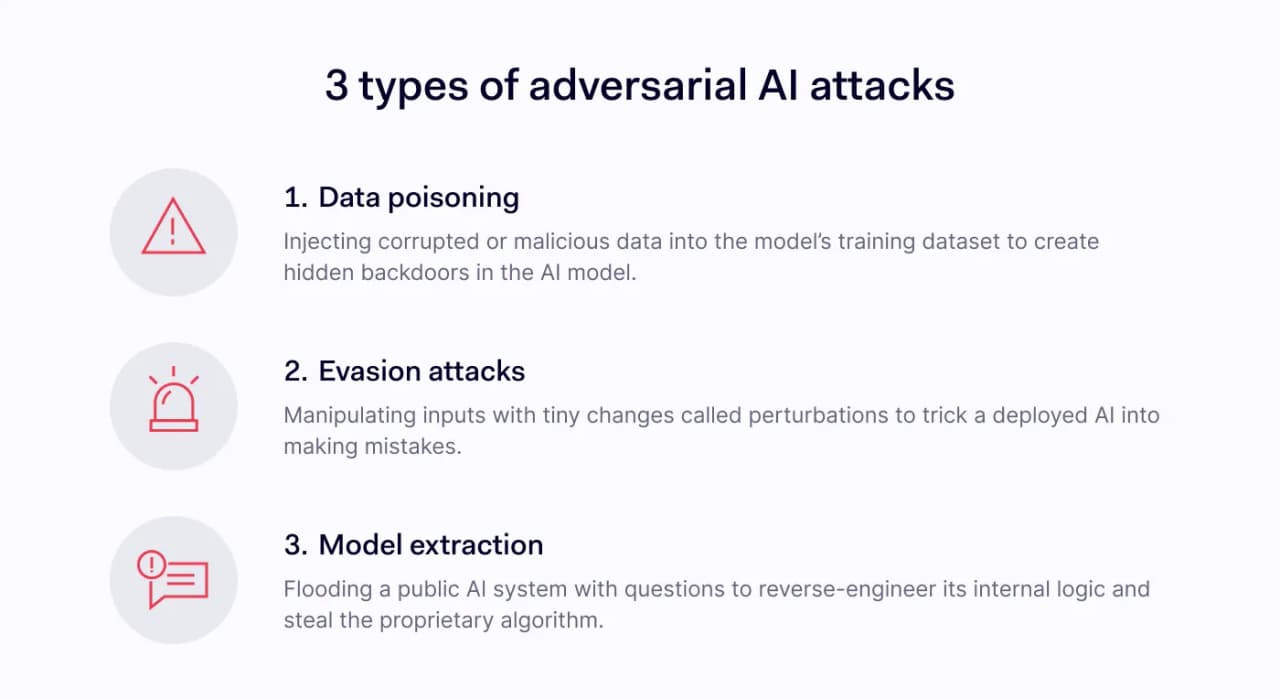
1. Data poisoning
Machine learning models are shaped by what they are taught. Data poisoning happens during the training phase when an attacker injects corrupted, misleading, or malicious data into the model’s training dataset. By doing this, they can create a hidden “backdoor” inside the AI system.
For example, a corrupted model might function perfectly most of the time, but the second it encounters a highly specific trigger phrase or file type inserted by an attacker, the backdoor activates. This could cause a financial AI system to misclassify fraudulent transactions as safe, or trick a medical system into misreading critical logs.
2. Evasion attacks
These kinds of attacks occur after a model is already deployed. Hackers manipulate the inputs they send to an AI system by making tiny, mathematically calculated changes called perturbations. To a human reviewer, the file or prompt looks completely normal but to an AI algorithm, the math is entirely broken.
Evasion attacks are often used against AI-based malware scanners. A bad actor can take a piece of known malicious software, inject subtle, microscopic modifications into its code structure, and send it through a network perimeter. The AI scanner misclassifies this file as safe and enables the malware to slip into the system completely undetected.
3. Model extraction
This is essentially corporate espionage via API querying.
Instead of breaching a corporate server to steal the code directly, an attacker repeatedly floods a public-facing AI system with questions and analyzes the responses. By observing how the model behaves across thousands of interactions, a hacker can reverse-engineer its internal logic. The adversary can then build a near-perfect clone of the proprietary algorithm at a fraction of the cost or map out its vulnerabilities to launch a devastating evasion attack later on.
How AI is used in ransomware and malware
The era of traditional, manual ransomware is over, and it has been replaced by a swarm of agile operators powered by AI. In fact, as many as 80% of ransomware groups now use automation and AI in their operations. This means you aren’t fighting a human hacker, but high-speed software
Let’s take a closer look at how cybercriminals use AI to build mutating malware and automate ransomware attacks.
Automated malware
LLMs are really good at writing code. This capability helps developers, but also gives an advantage to hackers. While commercial AI tools have built-in guardrails to stop users from generating malicious code, attackers routinely find loopholes to bypass them. They can embed machine learning engines within the malware itself This means the software can modify its own structure, encryption keys, and file signatures every time it moves to a new device. Because the code looks entirely different during each execution, it effortlessly slips past traditional security scanners
Once this AI-generated malware is deployed, it can mutate dynamically. Historically, security tools have relied on signature-based detection, which blocks files that match a database of known malicious code hashes. Generative AI completely shatters this defense.
The most advanced AI-driven malware can actually study a network’s behavior in real time. It then changes its own operations to look like normal system traffic, letting it slide right past detection tools undetected.
High-speed ransomware
Once inside a network, AI-powered scripts help cybercriminals automatically map systems, find high-value files, and steal data before an internal security team can even process the initial alert.
For businesses, this calls for a completely new cybersecurity strategy:
- Defense in depth over single-layer controls Does your business rely on an antivirus tool or firewall? It may be exposed to zero-day threats. Security architectures must use multiple, overlapping layers of defense—from the network perimeter down to individual device behavior.
- Behavioral detection is the only answer Since AI-generated malware looks completely legitimate, defenders must use behavioral AI tools These tools don’t care what a file looks like; they monitor what it does instantly flagging anomalies like a sudden burst of file encryptions or a single, suspicious remote access request.
- Fighting machine speed with agentic AI To stop an attack that can finish its mission in under 10 minutes, human intervention is too slow. Organizations must deploy agentic AI defenses capable of executing machine-speed responses, such as automatically locking compromised accounts or rewriting firewall rules the instant an anomaly is spotted.
AI security requires more than protecting your infrastructure. It also requires helping employees recognize and avoid the risks that come with AI-enabled threats.
How your businesses can reduce AI-driven cyber risks
How can you defend your business from AI attacks that move at machine speed and are extremely effective? Create a layered security strategy that focuses on the following pillars:
1. Adopt a zero-trust architecture
One of the best defenses against AI-driven lateral movement and credential theft is a zero-trust framework. Zero trust operates on a simple principle: never trust, always verify
In a zero-trust environment, every user and device must be continuously authenticated, authorized, and validated before they are granted access to the system. Together with network segmentation zero trust helps prevent unauthorized access to your systems.
For example, if an AI-powered script steals an employee’s login token, the attacker is trapped in an isolated segment of the network and can’t access high-value corporate assets.
2. Deploy AI-native security monitoring
It’s nearly impossible to fight AI-powered threats with manual human oversight. To win this battle, businesses must fight fire with fire. This means deploying AI in cybersecurity. AI-native security monitoring tools use behavioral machine learning to establish a baseline of your normal network activity.
The moment an anomaly occurs, such as an automated script attempting to map a network or a sudden burst of file encryption, the defensive AI tool flags it instantly. The tools can also trigger automated incident responses, like locking compromised accounts or blocking malicious IPs, in milliseconds.
3. Implement employee red-teaming
With generative AI, hackers can scale hyper-personalized phishing and deepfake scams. That’s why your team needs regular training on the evolving AI threats.
Ongoing red-teaming simulations are designed around AI threats. You can launch safe, simulated vishing calls and hyper-targeted social engineering emails based on actual public data. Testing your team trains them to spot the subtle indicators of AI deception This helps build an active human firewall that drops your organization’s vulnerability to social engineering scams by up to 80%.
Bottom line
At the end of the day, AI is a trade-off. It enables hackers to create faster and more convincing cyberattacks, but it also gives you the automated tools you need to fight back. By moving to zero trust, automating threat monitoring, and regularly training your team on AI threats, you can keep your business safe.