Internal and external threats: what’s the real risk to your business?
Joanna Krysińska
Summary: External threats come from outside attackers, while internal threats involve authorized users. Both can cause breaches, disruption, fraud, and data loss for organizations.
Internal and external threats differ in where they start, how they operate, and how they are detected. A recent Verizon report found that external threats cause roughly 88% of all breaches, while internal ones account for “only” 12%. But frequency isn’t the whole story. Insiders already have legitimate access to company systems and sensitive data, which can make their activity more challenging to spot and potentially more damaging.
Read on to see how your organization can effectively defend against both threats.
Key takeaways
External threats originate outside the organization, while internal threats involve people or accounts with legitimate access.
External actors account for most breaches. Verizon’s 2026 DBIR found that 88% of threat actors were external and 12% were internal.
Phishing, ransomware, DDoS attacks, credential abuse, impersonation, and vulnerability exploitation are the most common external threats.
Insider threats can be malicious, negligent, or the result of compromised employee credentials.
Internal activity can be harder to detect because the user may already have authorized access, and their activity may look normal.
Both threat types can cause data loss, downtime, fraud, regulatory penalties, and reputational and financial damage.
Organizations need controls for both external exposure and internal access, including threat intelligence tools, identity controls, least-privilege access, behavioral monitoring, and incident response.
What are external threats?
External threats are malicious attacks or events that originate from outside your organization. The actors behind them—cybercriminals, hacktivists, or nation-sponsored groups—don’t have authorized access to your systems. They exploit system vulnerabilities, stolen credentials, weak security measures, or human behavior. In fact, human error is a cause of 74% of data breaches.
Attackers target public-facing assets, infrastructure, data, or employees, with the goal of stealing data, disrupting operations, extorting money, or damaging reputations.
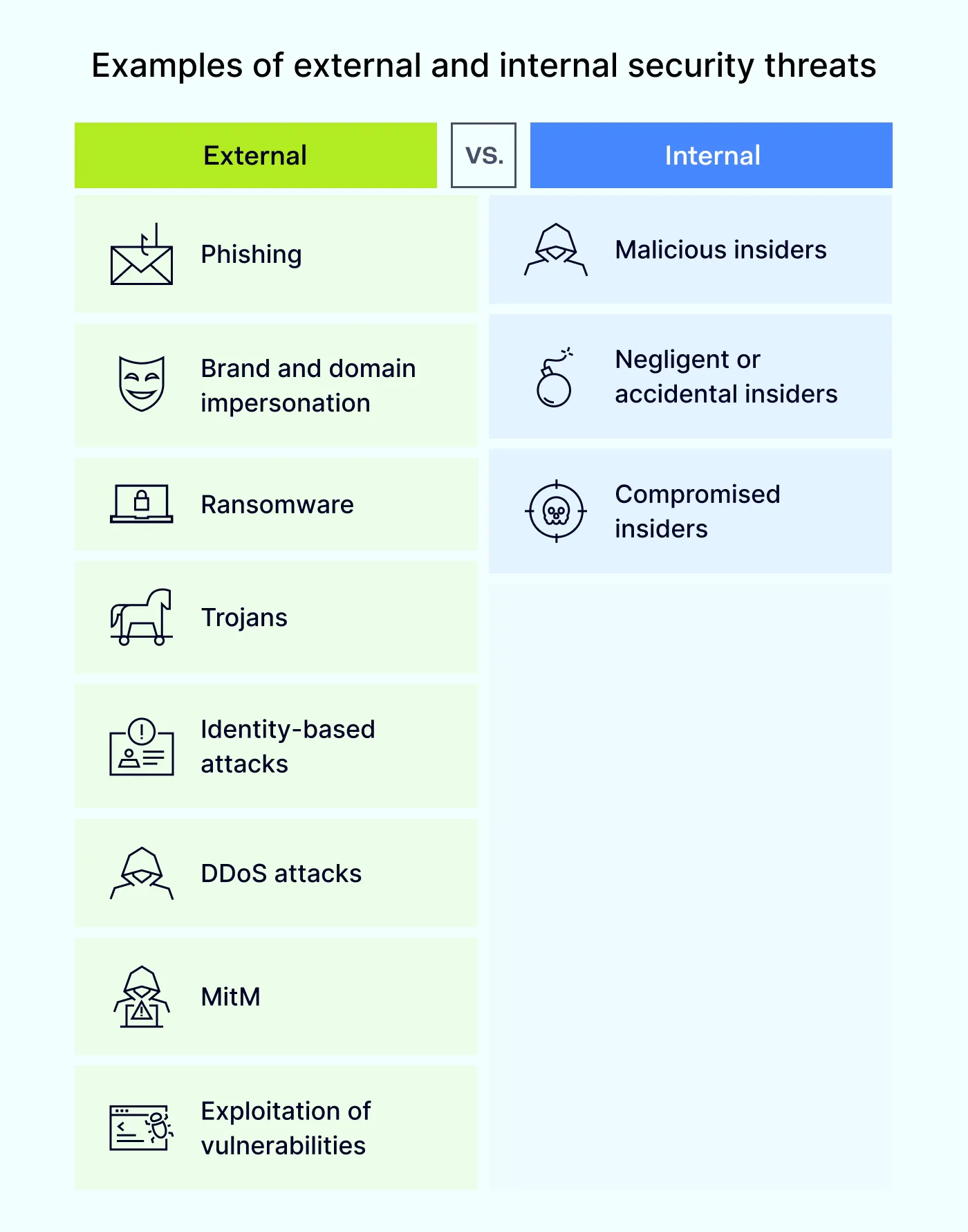
Here is how external threats break down:
Social engineering
Phishing. Deceptive emails, messages, or calls that manipulate employees into disclosing sensitive information, granting access, or downloading malware.
Business email compromise. Attackers impersonate executives, vendors, or trusted partners to trick employees into sending money, sharing sensitive data, or changing payment details. The FBI’s Internet Crime Complaint Center has ranked business email compromise as one of the costliest categories of cybercrime, with annual losses amounting to billions of dollars.
Brand impersonation. Attackers copy a trusted company’s brand identity or online presence to make fraudulent content appear legitimate. This includes fake websites, social media profiles, support accounts, ads, and emails.
Domain impersonation. Cybercriminals register or use lookalike domains that resemble a legitimate company’s domain to deceive users. These domains can be used for phishing, fake login pages, or other types of fraud.
Malware
Ransomware. It often combines encryption with data theft to put more pressure on victims to pay the ransom. It is one of the most impactful threats. According to a recent report from NordLayer Intelligence,ransomware attacks in the first half of 2026 rose 20% compared to the year before.
Trojans. This type of malware disguises itself as legitimate software or files and often tricks the user into installing or opening it. Once it is active, a Trojan can steal data, download more malware, give attackers remote access, or change system settings.
Network attacks
Identity-based attacks. Stolen, leaked, or brute-forced credentials are used to access systems.
DDoS attacks. Distributed denial-of-service (DDoS) attacks overwhelm servers or networks to disable operations.
Man-in-the-middle attacks (MitM). A bad actor intercepts and sometimes alters communications between 2 parties. These attacks can occur through rogue Wi-Fi access points, compromised networks, DNS manipulation, or other techniques.
Exploitation of vulnerabilities
Threat actors exploit known flaws in outdated or unpatched software and internet-facing systems to gain access or execute malicious code. Regular vulnerability assessment helps organizations identify these weaknesses before attackers can use them.
What are internal threats?
Internal threats (or insider threats) come from people with legitimate access to at least one organizational resource. These authorized users misuse their access, either intentionally or accidentally.
There are 3 sources of insider threats:
Malicious insiders. Disgruntled or former employees who still have access deliberately steal data, sabotage systems, or sell access. Their motives range from money to revenge and ideology. They can also be recruited by external actors.
Negligent or accidental insiders. Bypassing security controls to save time, using weak passwords, or falling for social engineering can lead to a breach. More than half of insider threats (53%) are linked to careless insiders.
Compromised insiders. If attackers obtain the credentials of an authorized user at your vendor or business partner, they can impersonate that user.
Internal vs. external security threats: a comparison
External threats are harder to keep out but easier to spot once triggered. In contrast, internal threats are easier to control access-wise, but much harder to catch in progress.
External threats
Internal threats
Source
Cybercriminals, hacktivists, and nation-state actors.
Disgruntled current or former employees, contractors, and vendors.
Data theft, privilege misuse, misconfigurations, and negligence or carelessness.
Access
Must break in or log in using stolen credentials.
Already has valid credentials.
Examples
Social engineering, malware, network attacks, and vulnerability exploitation.
Malicious, negligent, accidental, or compromised insiders.
Detection
Detection varies by attack method. Known malicious infrastructure or exploit activity may trigger existing controls.
Legitimate access can make malicious or negligent behavior harder to distinguish from normal activity.
Impact
Brand and financial damage, fraud, downtime, and regulatory exposure.
Higher per-incident cost.
Why does detection difficulty differ between internal and external threats?
External and internal threats can produce different signals.
Some external attacks are easier to identify because security tools can detect known malicious infrastructure, malware, exploit attempts, or unusual network traffic. However, external attackers can also use stolen credentials, legitimate cloud services, or compromised accounts, all of which can make their activity look normal and, therefore, harder to detect.
Internal threats present a different detection problem. Employees, contractors, and other authorized users may legitimately access the systems and data involved. Detecting misuse often requires looking at how that access is used, such as unusual downloads, unexpected privilege changes, access at unusual times, or activity outside a person’s normal role.
The same challenge applies when an external attacker compromises an employee account. The attacker remains an external actor, but their activity may appear to come from a legitimate user.
How external and internal threats impact the business differently
Both external and internal threats can lead to data theft, downtime, fraud, regulatory penalties, and reputational damage. The difference often comes from how attackers gain access and how long they remain undetected:
External attackers usually need to find a way into an organization. They may exploit vulnerabilities, steal credentials, use phishing tactics, or target exposed services. These attacks can interrupt services, compromise customer data, or give external attackers access to internal systems.
Insiders, on the other hand, already have legitimate access to at least one of the company’s resources. A malicious or negligent insider may expose sensitive data, misuse privileges, or access information beyond their role. Because this activity looks normal, it may take longer to detect.
Some malicious insider breaches can also be expensive. IBM’s 2025 Cost of a Data Breach Report found that breaches initiated by insiders were the costliest initial attack vector and amounted to $4.92 million.
How to detect and prevent external threats
As external threats start outside the organization, security teams need visibility into what attackers can see and exploit before an attack begins. The following controls can help you shrink that exposure:
Monitor external threats. Scan the open web, dark web, forums, and social media for signs that cybercriminals are discussing or targeting your organization. These could be, for example, impersonation attempts or references to planned attacks.
Map your external attack surface. Maintain an up-to-date inventory of internet-facing assets, such as domains, subdomains, cloud services, remote access portals, and exposed applications. This way, you can find forgotten or misconfigured assets before threat actors do.
Use threat intelligence. Threat intelligence feeds can provide information about malicious domains, IP addresses, malware infrastructure, and threat actor activity. Security teams can use this data to improve detection rules and investigate suspicious activity faster.
Strengthen email security. Deploy spam and malware filtering, URL analysis, and attachment scanning to protect your team from phishing attempts.
Manage vulnerabilities. Regularly run vulnerability scans and patch your software, as it can reduce the number of exploitable weaknesses in internet-facing systems.
Train your team. Teach your employees how to identify phishing emails, fake login pages, impersonation attempts, and other social engineering tactics.
How to detect and prevent internal threats
Apply the principle of least privilege. Give users only the access required for their role, and review permissions regularly.
Use privileged access management (PAM). Restrict elevated accounts and record or monitor privileged sessions where appropriate.
Adopt zero-trust access principles. Do not grant trust based only on network location or device ownership. Use identity, device state, and other context when making access decisions.
Monitor user behavior. Look for activity such as unusually large downloads, unexpected privilege changes, access to unfamiliar systems, or unusual login patterns.
Protect credentials. Use multi-factor authentication, strong authentication policies, and controls that can identify compromised accounts.
Revoke access during offboarding. Remove accounts, sessions, API keys, and other access when employees or contractors leave or change roles.
Control third-party access. Limit vendor and contractor permissions by scope and time, and review them regularly.
Create an insider-risk response process. Security, HR, legal, and other relevant teams should know how suspected insider incidents are investigated and handled.
Building a unified defense strategy for both threats
Internal and external threats often overlap. For example, an external attacker may steal an employee’s credentials, while an insider can expose information that later helps an external attacker.
A combined approach should include:
Mapping existing controls against both threat sources. Review which tools cover exposed assets, vulnerabilities, phishing attempts, leaked credentials, account misuse, unusual user behavior, and vulnerability management processes.
Identifying gaps in coverage. Check whether the organization can detect both activity coming from outside sources and suspicious use of legitimate internal access through monitoring, anomaly detection, and investigation workflows.
Defining ownership. Assign responsibility for external exposure, identity and access, insider risk, incident response, and third-party access.
Creating separate response procedures where needed. An external intrusion and a suspected insider incident can require different evidence handling, access restrictions, HR involvement, and legal review.
Tracking useful security metrics. Measure detection and containment times, number of privileged and dormant accounts, failed access attempts, and coverage of monitored systems to see whether controls are working.
Prioritizing based on risk. Consider the likelihood and potential impact of each threat, affected assets, control gaps, and regulatory requirements when deciding where to invest.
Dark web monitoring, attack surface management, and brand monitoring tools can also create multiple alert streams. NordLayer Intelligence brings external threat findings into one view, including asset discovery, leaked credentials, brand impersonation, and dark web mentions, and ranks them by severity.
FAQ
Internal vs. external threats: which is more dangerous?
It is hard to determine. However, external actors account for most breaches. Verizon’s 2026 Data Breach Investigations Report found that 88% of threat actors involved in breaches were external and 12% were internal.
Although internal incidents are less frequent, they can still be costly. According to IBM’s 2025 Cost of a Data Breach Report, breaches initiated by malicious insiders averaged $4.92 million, the highest average among the initial attack vectors.
Can an external threat become an internal one?
Yes, an external attacker can compromise an internal account and operate using legitimate credentials.
However, the classification depends on the framework being used. Under some threat taxonomies, the attacker remains an external actor because they do not have legitimate authorization. Conversely, insider-risk frameworks may describe the same situation as credential theft, account compromise, or a compromised insider scenario.
How do you detect insider threats early?
Limit access through least-privilege policies and monitor how legitimate access is used. Security teams can look for signs such as unusually large downloads, unexpected privilege changes, access to unfamiliar systems, unusual login patterns, or attempts to reach data outside a user’s regular role. Identity monitoring, behavioral analytics, PAM, and DLP can help identify this activity.
What tools help defend against external threats?
These tools include external threat intelligence, attack surface management, external vulnerability scanning, monitoring of leaked credentials, brand and domain monitoring, and dark web monitoring. They help teams identify exposed systems, known vulnerabilities, leaked credentials, impersonation attempts, and other risks outside the organization’s network.
Joanna Krysińska
Senior Cybersecurity Copywriter
Joanna writes about zero trust, network security, access control, and threat prevention, but her cup of tea is compliance and how regulations shape security controls.
Her work also includes the dark web topics and the methods cybercriminals use to target companies, such as social engineering or ransomware attacks, for example.