AI adoption has outpaced the security models many enterprises still rely on, namely cloud security posture management (CSPM), AppSec, identity and access management (IAM), and endpoint controls. They remain essential but can’t fully see how prompts, models, training data, vector stores, agents, and tool calls create new paths for data exposure and misuse.
AI security posture management (AI-SPM) is a security discipline that gives organizations visibility into every AI component in their environment. It includes models, training and grounding data, prompts, vector stores, AI libraries, model endpoints, agents, and the tools those agents can call. AI-SPM also assesses the risks tied to those components, maps them to controls, and feeds findings into remediation workflows.
In short, while cloud security posture management tells you whether your cloud infrastructure is exposed, AI-SPM tells you whether the AI system built on that infrastructure can be manipulated, leak sensitive data, call unsafe tools, use poisoned data, or violate governance requirements.
Why is AI-SPM important?
AI-SPM helps close the visibility and security gaps created by hasty AI adoption. Enterprise teams build chatbots and autonomous agents at a pace that traditional security tools were never designed to keep up with. Each new AI feature can add a vector database or a third-party library that no one has inventoried. To defend those new assets, security teams need a new, AI-aware posture layer.
The nature of the risk has also changed. A misconfigured storage bucket is a static problem. But an AI system is dynamic: its behavior can change when the underlying model is updated, when grounding data is refreshed, or when a prompt template is edited. That’s why NIST’s AI Risk Management Framework treats AI risk as a lifecycle issue across the Govern Map Measure and Manage functions, which means a one-time configuration scan is not enough AI-SPM tools are built to monitor those parts continuously, as they change.
4 benefits drive AI-SPM implementation in most organizations:
- Complete visibility into shadow AI. AI-SPM solutions discover unsanctioned tools (for example, when employees experiment with public LLM APIs, plugins, and open-source models) and bring them under a single inventory, so security teams know what is running and who owns it.
- Data integrity. AI-SPM helps prevent sensitive data leakage through prompts and responses, and it protects training sets from data poisoning or unauthorized exposure. It also tracks which datasets feed which models. This is critical when a privacy team needs to answer a deletion request or trace the source of a wrong answer.
- Risk mitigation. AI-SPM tools proactively identify AI-specific vulnerabilities such as prompt injection paths, overprivileged agents, weak authentication on model endpoints, and vulnerable AI library dependencies.
- Regulatory compliance. AI-SPM helps automate compliance with frameworks such as the NIST AI Risk Management Framework, ISO/IEC 42001 and the EU AI Act It produces the logs, model documentation, control mappings, and access records that auditors expect to see.
Why traditional CSPM is insufficient for AI
Cloud security posture management still is a foundational control. It scans cloud environments for misconfigurations, exposed secrets, public storage, weak identity policies, and broken compliance baselines across Azure, AWS, and GCP.
However, AI risk isn’t limited to cloud configuration, so AI-SPM extends CSPM. AI systems introduce new security variables: model behavior, prompt handling, data provenance, and output trust are just some of them.
A traditional CSPM scan will tell you that a virtual machine is reachable from the internet, but won’t mention that the LLM hosted on that machine accepts unsanitized user input, retrieves documents from a vector store that contains malicious instructions, and then calls an internal API with broad permissions.
This idea is highlighted by the CISA and NCSC Guidelines for Secure AI System Development The guidance recommends teams to monitor system behavior, prompts, queries, and inputs throughout operation since changes to data, models, or prompts can change how the system behaves.
Then, the OWASP Top 10 for LLM and generative AI applications describes the risks that sit above the cloud layer:
- Prompt injection
- Sensitive information disclosure
- Supply chain weaknesses
- Data and model poisoning
- Improper output handling
- Excessive agency
- System prompt leakage
- Vector and embedding weaknesses
- Misinformation
- Unbounded consumption
None of them are visible to a bucket misconfiguration scanner.
Finally, agentic AI widens the gap. The NSA’s 2026 joint guidance on agentic AI describes additional categories of risk introduced by autonomous agents:
- Privilege risk
- Design and configuration risk
- Behavior risk
- Structural risk
- Accountability risk
Posture management for these systems has to cover what an agent can do, which identity it uses, which tools it calls, and whether its actions are reversible.
Traditional CSPM was simply not built for that scope.
AI-SPM framework capabilities
A good AI-SPM solution rests on 4 pillars that form an operating model, turning AI governance from a written policy into practice.
1. Complete visibility
The first pillar is the ability to see every AI asset in the environment. Some examples of such assets are: AI applications, model endpoints, autonomous agents, data sources, prompt templates, vector stores, AI frameworks and libraries, containers, infrastructure-as-code definitions, APIs, and the owners attached to each asset. According to Microsoft’s A-SPM documentation teams should create a generative AI Bill of Materials (AI BOM) that pulls together application components, data, and AI artifacts from code to cloud.
Visibility extends to dependencies as well. In case of an incident, an organization must be able to answer basic questions: “Which applications use the affected library?” “Which models were trained on the compromised dataset?” and “Which agents have access to the leaked credentials?” That’s why AI-SPM tools track:
- The provenance of models (where they came from, which version is deployed, which licenses apply).
- The provenance of datasets (which sources, which lineage, which quality checks).
- The open-source AI libraries in use, such as TensorFlow, PyTorch, and LangChain.
Visibility also has to reach shadow AI. Many AI deployments start as side projects AI-SPM solutions correlate cloud telemetry, code repositories, and network signals to bring all assets into the same inventory as sanctioned systems.
2. Contextual policy enforcement
The second pillar is the ability to apply controls based on both configuration and context For example, a public model endpoint is not automatically a risk. But a public model endpoint with weak authentication, connected to a vector store that holds sensitive customer data, and is reachable by an agent that can call an internal payments API, definitely is. AI-SPM tools use attack path analysis to detect these combinations and prioritize them.
Microsoft Defender for Cloud for example, uses attack path analysis to detect and reduce AI workload risks, such as data exposure during fine-tuning and externally reachable endpoints with weak authentication. It then recommends controls such as private endpoints, restricted endpoints, managed identity, and identity-based authentication.
Policy enforcement also covers identity and permissions of non-person entities, such as AI agents. OWASP’s guidance on excessive agency explains that damaging outcomes often come from excessive functionality, excessive permissions, or excessive autonomy. AI-SPM tools surface where controls like user approval for high-impact actions, downstream authorization checks, monitoring, or rate limits are missing, and where agents hold more privileges than they need.
3. Data and threat protection
The third pillar defends against AI-specific threats and protects the data that flows through AI systems. Sensitive data often shows up in prompts, responses, retrieved chunks, logs, and evaluation datasets. AI-SPM solutions help classify this data, track its movement, and flag risky combinations, such as when personal information is passed to a third-party model.
Threat protection covers the catalog of AI-specific attack techniques described by OWASP, MITRE ATLAS, and similar sources. Prompt injection is the most discussed example, but the full list is broader: jailbreaks, data and model poisoning, supply chain compromise, or unbounded resource consumption that drives up costs or results in denial of service.
Detection of AI-specific threats requires more than static scans. CISA and NCSC guidance recommends constant monitoring of AI system behavior and inputs, with logging of prompts and queries. AI-SPM tools collect this telemetry and apply guardrails: input validation, output filters, groundedness checks, and adversarial test results. Many also support structured AI red teaming, in which security teams test the model as if it were an untrusted user to find weaknesses before attackers do.
4. Centralized governance
The fourth pillar pulls everything into one place so that risk owners, security engineers, compliance teams, and executives can all work from the same source of truth. Centralized governance covers ownership records, risk acceptance decisions, policy mappings, tickets, remediation status, exceptions, control evidence, and executive reports.
The NIST AI Risk Management Framework’s Govern function describes exactly this scope: organizational processes, documentation, compliance, and accountability across the AI lifecycle. ISO/IEC 42001 takes the same idea further with a formal AI management system that requires policies, objectives, processes, risk assessments, and risk treatments.
AI-SPM is the operational layer that feeds both: it maintains a live record of AI assets, risks, controls, ownership, and corrective actions.
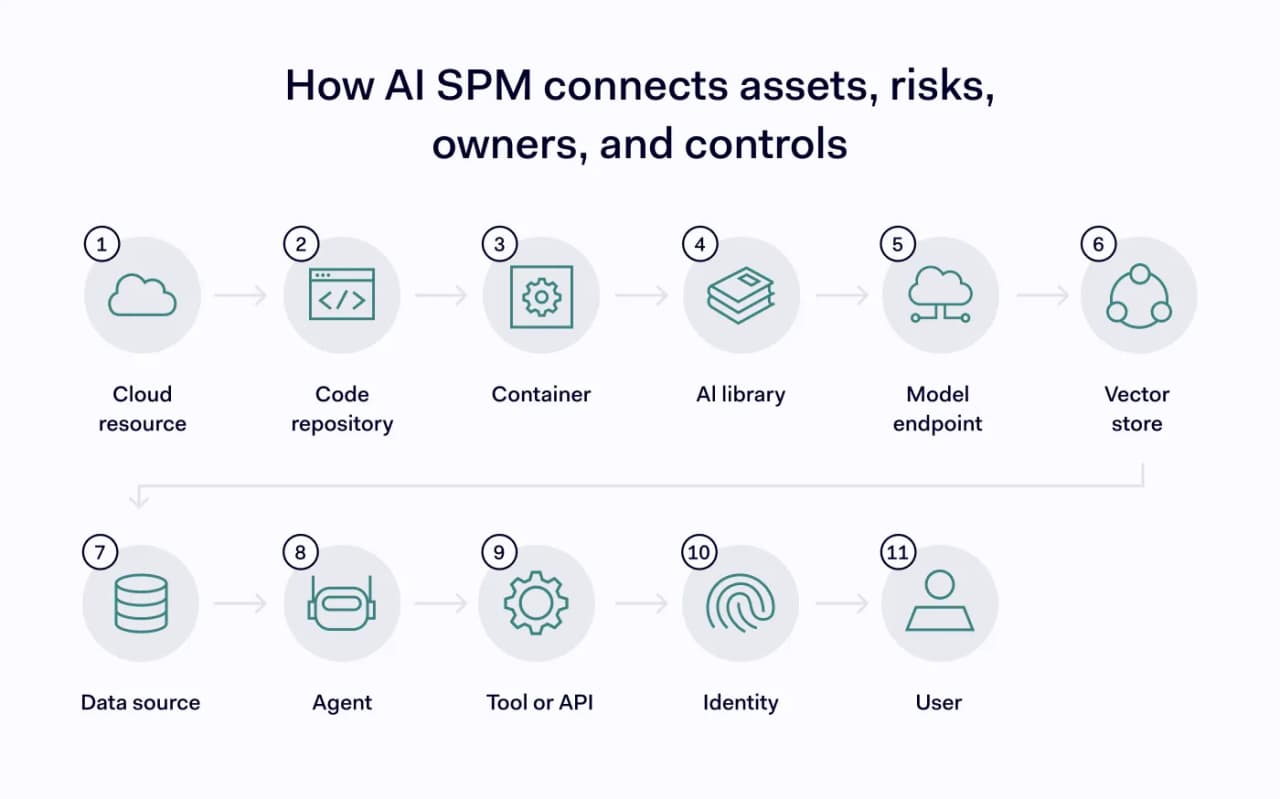
AI-SPM solutions trace this chain end-to-end. They are useful for both day-to-day security and for the structured evidence regulators ask for.
How AI-SPM supports compliance
The role of AI-SPM in compliance is to act as a governance layer that guarantees AI adoption matches both internal policies and global regulations. It does not declare an organization compliant on its own.
1. Automated regulatory alignment
AI-SPM tools map their findings to the controls described in major AI frameworks and regulations. The NIST AI Risk Management Framework and its July 2024 Generative AI Profile provide a voluntary baseline for trustworthy AI, with the core functions of Govern Map Measure and Manage ISO/IEC 42001 sets out the first AI management system standard, with requirements to establish, implement, maintain, and continually improve an AI management system. The EU AI Act applies risk-based obligations to high-risk systems, including risk assessment and mitigation, high-quality datasets, traceability logs, documentation, human oversight, accuracy, robustness, and cybersecurity. OMB Memorandum M-25-21 directs US federal agencies to apply minimum risk practices for high-impact AI and to stop the use of AI systems whose risks cannot be mitigated. Finally, the Cloud Security Alliance AI Controls Matrix offers a vendor-neutral catalog of 243 control objectives across 18 security domains, mapped to ISO/IEC 42001, ISO/IEC 27001, NIST AI RMF 1.0, and BSI AIC4.
AI-SPM solutions take these control catalogs and apply them automatically to the discovered AI environment. This allows security teams to see live coverage reports: which controls apply to which AI systems, which are satisfied, and which are gaps.
2. Shadow AI and asset governance
Compliance frameworks consistently require an inventory of AI systems. The NIST AI RMF treats AI system inventory as a governance requirement. The EU AI Act requires providers and deployers of high-risk AI to document their systems. ISO/IEC 42001 expects organizations to know what AI assets they operate.
This is impossible without continuous discovery. AI-SPM tools detect new model endpoints, vector stores, AI services, and agent identities as they appear in cloud accounts, code repositories, and SaaS integrations. These tools then tie each asset to an owner, a business purpose, and a risk classification. Shadow AI becomes a finding with a workflow.
3. Data sovereignty and privacy protection
Privacy laws and AI regulations both pay close attention to the data that AI systems consume and produce. AI-SPM solutions classify sensitive data across prompts, responses, training sets, embeddings, and logs. These solutions track which datasets cross regional boundaries and which third-party model providers receive which data, and flag situations in which personal data, health information, or trade secrets reach systems that are not approved for that data class.
Microsoft’s AI compliance guidance describes how this evidence supports regulatory programs in practice: organizations log and retain AI interactions, detect noncompliant use, run eDiscovery on AI conversations, document model name, version, purpose, and evaluation metrics, perform privacy impact assessments, and use templates aligned with the EU AI Act, ISO/IEC 42001, ISO/IEC 23894, and NIST AI RMF.
4. Audit-ready logging
Audits require structured records. AI-SPM solutions produce logs that auditors can read: who accessed which model, which prompts ran on which dataset, which guardrails fired, which remediation actions closed which findings, which exceptions were approved by whom, and which AI red-team tests confirmed control effectiveness. These logs support traceability obligations under the EU AI Act, control evidence under ISO/IEC 42001, and measurement and management evidence under the NIST AI RMF.
For organizations that work with regulated or public-sector customers, the audit-ready posture is critical. OMB M-25-21 is one signal among many that AI governance is becoming part of operational expectations.
A short reference of common frameworks and the AI-SPM evidence they expect:
Framework or regulation | What it expects | AI-SPM evidence |
|---|---|---|
NIST AI RMF | AI governance, context mapping, measurement, risk treatment, lifecycle monitoring | AI inventory, risk register, AI BOM, model evaluation records, control mapping, red-team results, remediation history |
NIST GenAI Profile | Generative AI risk management based on the AI RMF | Prompt-risk tests, hallucination and data leakage controls, model and data lineage, guardrail test results |
ISO/IEC 42001 | AI management system with policies, objectives, risk assessment, treatment, continual improvement | AI policies, ownership model, lifecycle process records, risk treatment plans, exceptions, corrective actions |
EU AI Act | Risk-based obligations; for high-risk AI: mitigation, dataset quality, logs, documentation, human oversight, robustness, cybersecurity, accuracy | Logs, traceability records, data quality checks, model documentation, access controls, human approval workflows, security tests |
OMB M-25-21 | Minimum risk practices for high-impact AI in US federal agencies | Impact assessments, risk controls, operational monitoring, mitigation evidence, stop-use decision records |
CSA AI Controls Matrix | Vendor-neutral AI control objectives for cloud-based AI systems | Control coverage reports, maturity gaps, audit evidence, security-domain mapping |
How AI-SPM and zero trust work together
A-SPM provides the visibility, but NordLayer (SASE and zero trust) provides the control. Zero trust, as defined in NIST SP 800-207 removes implicit trust based on network location or asset ownership and treats every user, asset, and resource as something that must be verified before access is granted. Applied to AI, every user, application, model endpoint, agent, data source, tool, plugin, and API becomes a resource subject to that same explicit verification process.
AI-SPM strengthens zero trust by supplying the context that access controls need. Zero trust, in turn, strengthens AI-SPM by turning posture findings into enforceable controls.
If AI-SPM flags an external AI endpoint with weak authentication, zero-trust network access (ZTNA) replaces broad network exposure with identity-aware, least-privilege paths. ZTNA gatekeeps who can reach AI training environments, model APIs, vector stores, and agent management consoles, so that only verified users and services connect, and only to the specific resources they need. The combination of AI-managed security and AI-enabled security management closes both the visibility and the access side of the same problem.
Putting AI-SPM into practice
AI security posture management is an operational discipline that builds on the foundations already in place: CSPM for cloud configuration, IAM for identity, data security posture management (DSPM) for data, and zero trust for access. AI-SPM solutions add the missing layer: visibility into models, prompts, data, agents, and tools, plus the policy, threat, and governance controls that those assets require. Teams that start with discovery, then layer in contextual enforcement, data and threat protection, and centralized governance, end up with an AI environment they can actually defend and audit.