
AI governance is the framework of policies, processes, and controls that helps organizations use artificial intelligence safely, responsibly, and in compliance with legal and ethical requirements.
AI adoption is accelerating across industries, but so are the risks. According to IBM’s Global AI Adoption Index more than 40% of large organizations actively use AI in their operations, while concerns about data privacy, transparency, bias, and security remain among the biggest barriers to wider adoption.
These concerns are especially evident in the context of generative AI: in IBM’s IBV study 80% of business leaders cite explainability, ethics, bias, or trust as a major roadblock to generative AI adoption**.** At the same time, governments worldwide are introducing new AI regulations to help organizations manage AI models responsibly.
Understanding AI governance
AI governance is the set of policies, standards, processes, and accountability mechanisms that guide how AI systems are developed, deployed, monitored, and managed. Its goal is to ensure that AI technologies operate safely, ethically, transparently, and in accordance with business objectives and regulatory requirements.
Without proper oversight, AI can expose businesses to security incidents, compliance violations, reputational damage, and operational risks. That’s why AI governance has become a critical part of modern cybersecurity, risk management, and digital transformation strategies.
This article explains what AI governance is, why it matters, the key principles behind responsible AI governance, and how organizations can build an effective AI governance program.
AI governance vs. AI compliance
AI governance and AI compliance are closely related, but they are not the same thing.
AI compliance focuses on meeting specific legal, regulatory, and industry requirements. Examples include complying with the EU AI Act, privacy regulations, sector-specific rules, and internal corporate policies.
AI governance is broader. It establishes the overall framework that helps organizations make responsible decisions about AI use. Regulatory compliance is one outcome of effective AI governance, but governance also addresses ethical considerations, risk management, accountability, and operational oversight.
Put simply:
- AI governance defines how AI should be managed.
- AI compliance helps those practices meet regulatory requirements.
AI governance vs. data governance
Data governance is the management of data throughout its lifecycle. It defines how data is collected, stored, accessed, shared, protected, and maintained.
AI governance builds upon data governance but extends further. In addition to governing data, it also addresses:
- AI models
- Decision-making processes
- Model performance
- Security controls
- Human oversight
- AI-related risks
Good data governance is often a prerequisite for effective AI governance because AI systems depend heavily on the quality, security, and integrity of the data they use.
Why AI governance matters
As organizations keep relying on various AI models daily, the consequences of poor governance become more significant. AI systems influence hiring decisions, customer service interactions, fraud detection, cybersecurity operations, healthcare recommendations, and countless other business functions.
Several factors make AI governance essential.
Managing security risks
AI systems create new attack surfaces. Threats, such as prompt injection, data poisoning, model manipulation, and shadow AI can introduce security vulnerabilities that traditional controls may not detect. Therefore, organizations need governance processes to identify, assess, and mitigate these risks before they affect operations.
Supporting regulatory compliance
Governments around the world are introducing new AI regulations designed to increase accountability and protect individuals from harmful AI outcomes. However, the regulatory picture is fragmented, which creates challenges for multinational organizations that must meet different requirements and ethical standards across jurisdictions.
A few examples show how varied the regulatory environment is:
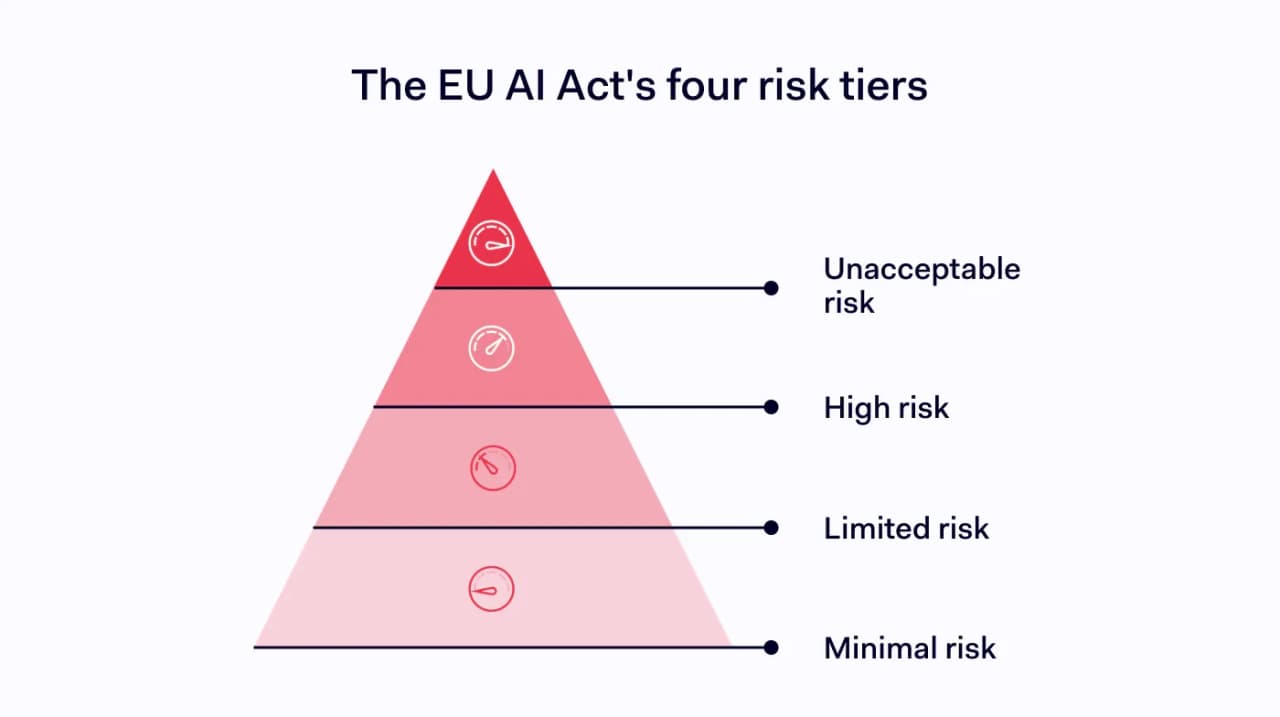
- The EU AI Act takes a risk-based approach and groups AI systems into 4 levels: unacceptable risk, high risk, limited risk, and minimal risk. Each level has its own governance requirements.
- China issued its Interim Measures for the Administration of Generative Artificial Intelligence Services in 2023, requiring providers to respect individual rights and avoid harming users’ health or privacy.
- The United States has not yet passed comprehensive federal AI legislation, but state-level laws—including those in California and Colorado—and sector-specific regulations are filling the gap.
Effective governance helps organizations prepare for compliance requirements and avoid costly penalties.
Protecting sensitive data
Many AI models process large volumes of sensitive information, including customer records, employee data, financial information, and intellectual property. Without proper controls, organizations risk data leaks, unauthorized access, and privacy violations.
Strong governance helps maintain data protection measures throughout the AI lifecycle.
Building trust
Employees, customers, partners, and regulators increasingly expect transparency around AI use. Organizations that demonstrate responsible AI governance are often better positioned to build trust and encourage the adoption of AI-powered solutions.
Reducing operational risk
AI-generated outputs can be inaccurate, biased, or inconsistent. Governance frameworks help organizations monitor AI performance, detect issues early, and maintain appropriate human oversight when critical decisions are involved.
Core principles of AI governance
While governance frameworks vary, most programs are built around several common principles.
- Accountability. Organizations should clearly define who is responsible for AI-related decisions. Accountability gives individuals, teams, and leadership clear ownership of their roles in managing AI risks, approving deployments, and responding to incidents.
- Transparency. Stakeholders should have visibility into how AI systems operate, what data they use, and how decisions are made. Transparency helps users understand AI outputs and supports compliance requirements related to explainability.
- Fairness. AI systems should avoid creating unjustified bias or discriminatory outcomes. Organizations should regularly evaluate AI models for fairness and take corrective action when unintended bias is identified.
- Security. AI governance must include cybersecurity controls that protect AI systems, training data, models, APIs, and supporting infrastructure. Security measures help reduce the likelihood of unauthorized access, manipulation, and data breaches.
- Privacy and data protection. Responsible AI governance requires strong safeguards for personal and sensitive information. Organizations should implement privacy controls, access restrictions, encryption, and data minimization practices throughout the AI lifecycle.
- Human oversight. AI should support human decision-making, not replace it completely in situations involving significant business, legal, or ethical consequences. Human review helps identify errors, challenge questionable outputs, and maintain accountability.
- Continuous monitoring. AI systems can change over time as data, environments, and user behavior evolve. Continuous monitoring helps organizations detect performance degradation, emerging risks, and compliance issues after deployment.
Leading AI governance frameworks and standards
Organizations rarely build governance programs from scratch. Instead, many use established frameworks to guide implementation. Some of the most influential AI governance frameworks include:
- NIST AI Risk Management Framework (NIST AI RMF). Developed by the US National Institute of Standards and Technology, this framework helps organizations identify, assess, manage, and monitor AI-related risks throughout the AI lifecycle.
- EU AI Act. The European Union’s landmark regulation introduces a risk-based approach to AI governance, classifying AI systems according to their potential impact and imposing corresponding requirements.
- OECD AI Principles. These internationally recognized principles—formally the OECD Principles on Artificial Intelligence—emphasize transparency, fairness, accountability, security, and human-centered AI development, and have shaped national AI policies in dozens of countries.
- ISO/IEC 42001. The world’s first international AI management system standard specifically designed for AI governance. It provides organizations with a structured framework for managing AI responsibly.
- NIST Cybersecurity Framework (CSF). While not AI-specific, many organizations use the NIST CSF to strengthen the security aspects of their AI governance programs.
- European Commission’s Ethics Guidelines for Trustworthy AI. A non-binding but widely referenced set of guidelines that defines 7 requirements for trustworthy AI including human agency, technical robustness, privacy, transparency, fairness, societal well-being, and accountability. Many organizations use it as a checklist when assessing generative AI projects.
- Industry-specific frameworks. Healthcare, finance, and critical infrastructure sectors often supplement broader frameworks with industry-specific guidance and regulations.
Rather than choosing a single framework, many organizations combine multiple standards to address their unique operational and regulatory requirements.
What an effective AI governance framework should include
An AI governance framework should cover the entire lifecycle of AI systems, from initial development to retirement. Key components often include:
- AI inventory management. Maintain visibility into all AI systems operating across the organization.
- Risk assessment procedures. Evaluate potential business, security, privacy, and compliance risks before deployment.
- Data governance controls. Establish standards for data quality, access management, retention, and protection.
- Model governance. Define processes for model development, testing, validation, deployment, and retirement.
- Access controls. Limit who can develop, modify, deploy, and interact with AI systems.
- Monitoring and auditing. Continuously evaluate AI performance, security, and compliance status.
- Incident response procedures. Create plans for responding to AI-related security events, misuse, or failures.
- Documentation requirements. Maintain records of model design, training data sources, testing results, and governance decisions.
- Third-party risk management. Assess vendors, AI providers, and external models used by the organization.
- Policy and governance oversight. Establish governance committees or leadership structures responsible for AI-related decisions.
Together, these components help create a consistent and repeatable approach to managing AI risks.
How to build an AI governance program
Building an AI governance program does not need to happen all at once. Organizations can start with basic controls and mature their capabilities over time.
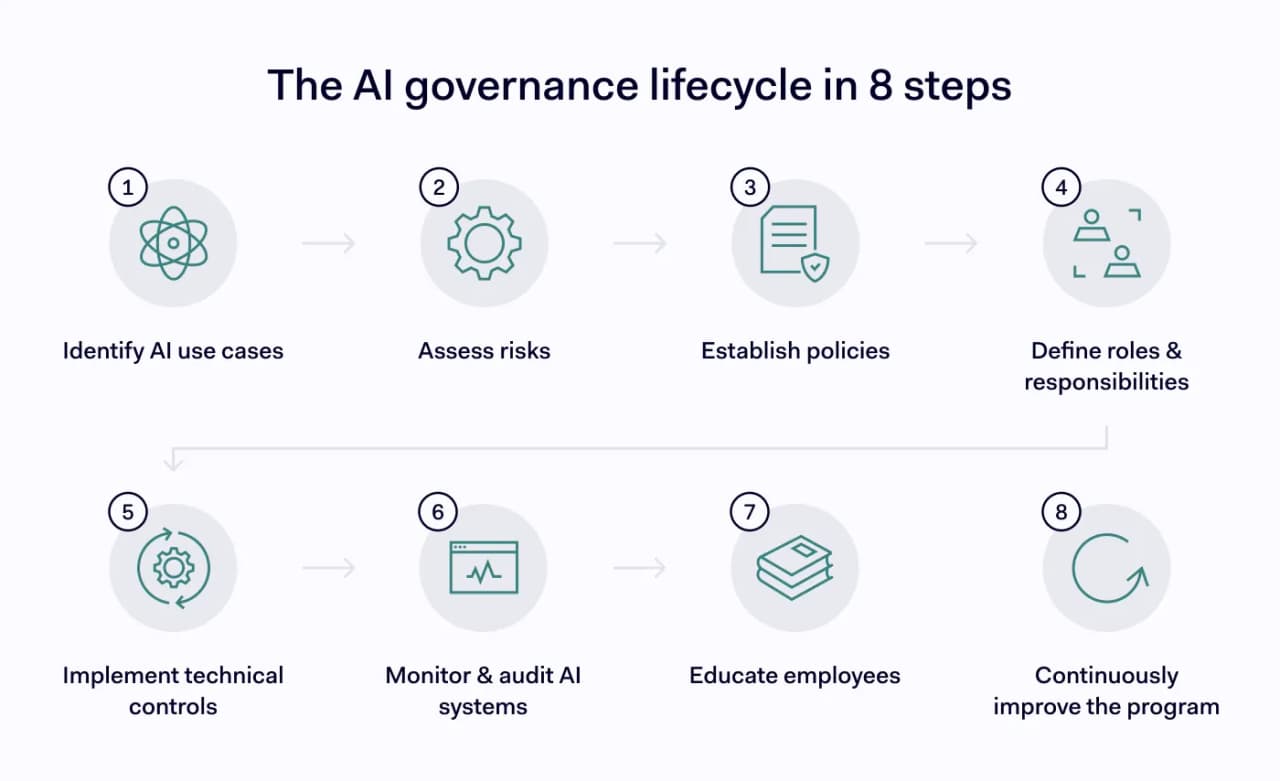
1. Identify AI use cases
Begin by identifying where AI is already being used. This includes approved AI deployments as well as unauthorized tools that may have emerged through shadow AI adoption. Visibility is essential before governance can be effective.
2. Assess risks
Evaluate the risks associated with each AI use case. Consider factors such as:
- Data sensitivity
- Security exposure
- Regulatory obligations
- Business impact
- Potential bias
- Operational dependencies
Risk assessments help prioritize governance efforts.
3. Establish policies
Create clear policies that define acceptable AI use. Policies should address:
- Approved tools
- Data handling requirements
- Security controls
- Human oversight expectations
- Compliance obligations
Employees should understand both the opportunities and limitations of AI technologies.
4. Define roles and responsibilities
Assign ownership for AI governance activities. This may include leadership teams, security personnel, legal departments, compliance officers, data teams, and business stakeholders. Clear accountability helps prevent governance gaps.
5. Implement technical controls
Policies alone are not enough. Organizations should deploy controls such as:
- Access management
- Encryption
- Monitoring systems
- Security testing
- Audit logging
- Data loss prevention solutions
These controls help enforce governance requirements consistently.
6. Monitor and audit AI systems
Governance is an ongoing process. Organizations should continuously monitor AI models for security issues, performance changes, compliance violations, and emerging risks. Regular audits help verify that governance controls remain effective.
7. Educate employees
Employees play a major role in AI governance success. Training should cover:
- Responsible AI use
- Security risks
- Data protection requirements
- Shadow AI risks
- Reporting procedures
Education reduces the likelihood of accidental misuse.
8. Continuously improve the program
AI technologies, regulations, and threats evolve rapidly. Organizations should regularly review their governance policies, controls, and risk management practices to keep them effective.
AI governance roles and responsibilities
Successful AI governance requires collaboration across multiple teams. Common roles include:
- Executive leadership that provides strategic direction, funding, and accountability.
- An AI governance committee that oversees governance policies, risk management, and program effectiveness.
- Security teams that manage cybersecurity risks, access controls, monitoring, and incident response.
- Legal and compliance teams that interpret AI regulations and support compliance efforts.
- Data teams that maintain data quality, integrity, privacy, and governance standards.
- AI developers and engineers who build and maintain AI systems according to governance requirements.
- Business stakeholders who define objectives, evaluate outcomes, and ensure AI aligns with organizational goals.
Effective governance depends on coordination across all of these groups.
Building trust through responsible AI governance
AI offers real opportunities for innovation, efficiency, and business growth. At the same time, AI systems introduce new challenges involving security, privacy, fairness, and regulatory compliance.
Strong AI governance helps organizations manage these risks while maintaining trust and accountability. By combining clear policies, risk management practices, continuous monitoring, and established governance frameworks, organizations can adopt AI technologies—including generative AI—responsibly and confidently while supporting long-term business objectives.