What is executive protection, and who actually needs it?
Joanna Krysińska
Summary: Executive protection covers physical safety, privacy, and cyber risks. It helps security teams monitor and respond to threats that high-profile individuals face.
The term executive protection goes back to the 1970s, when the US Secret Service popularized it. Since then, the risks that executives face have changed.
Many threats start online now and have less to do with a title and more to do with exposure. A public-facing leader can draw impersonators or harassment without ever sitting in the C-suite. Senior IT admins can be targets, too, because their privileged access is a backdoor into executive accounts. Yet, many companies still treat executive protection as something reserved for Fortune 500 CEOs.
The goal of executive protection is to prevent threats before they happen. It covers several areas, such as threat intelligence,privacy protection, and emergency response. Here is how it works.
Key takeaways
Executive protection is a security discipline that protects high-profile professionals from physical, privacy, cyber, operational, and reputational threats.
It covers physical security, privacy, and cyber risks that affect executives.
Protection should be based on exposure, access, location, and current threats, rather than on job title alone.
The most common digital threats include phishing, account takeover, doxxing, and impersonation.
Executives are easier to target because open-source intelligence (OSINT) can reveal their roles, contacts, travel plans, and relationships.
Protection also needs to cover board members, executive assistants, IT staff, and family members because attackers may use them as a path to the executive.
Effective executive protection solutions continuously monitor, assess, alert, and respond to threats and exposed information linked to a specific high-value individual.
What is executive protection, and why does it matter?
Executive protection is the security discipline that protects executives, board members, and other high-profile professionals from physical danger, privacy exposure, cyberattacks, and reputational harm. Its goal is to prevent security incidents and reduce their impact when they occur.
The field began with physical protection, including bodyguards, secure travel, residential security, and event planning. These measures are still important when a leader faces a credible physical threat. But today, most incidents start online. A home address, travel schedule, leaked password, or fake social profile can facilitate fraud, account takeover, stalking, or a physical attack.
Protection needs also vary by person and situation. Public exposure, location, organizational role, and the likely consequences of an incident all matter. For example, a lower-ranking employee working in an area with a high kidnapping risk may require more protection than a CEO working in a lower-risk office. Published in 2025, the Executive Protection Standard by ASIS International recommends a risk-based approach built around threat, vulnerability, and risk assessments rather than job title alone.
Threats against executives are becoming more common. The Executive Threat Environment report shows that in 2025, 72% of security professionals observed an increase in public threats to executives, and 61% reported more direct threats.
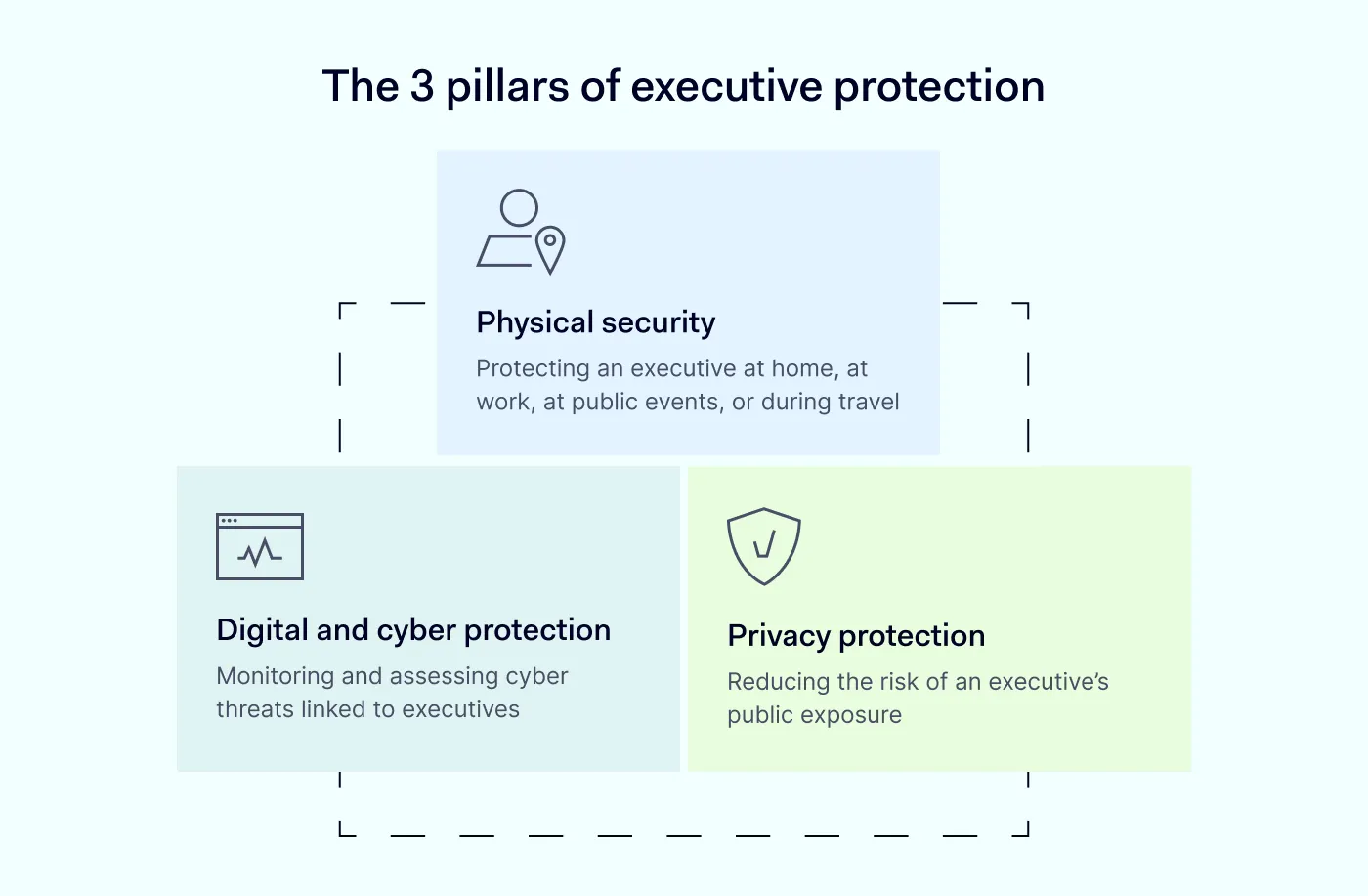
The 3 pillars of executive protection
These 3 pillars are interconnected. An executive’s public fitness route may reveal their home address. A leaked phone number could lead to a SIM swap or targeted phishing attempt. A fake profile may help an attacker contact an assistant and obtain a travel schedule.
Physical security
This area focuses on protecting an executive at home, at work, at public events, or during travel, and it includes:
Trained protection staff
Secure transportation with defensive driving techniques
Route planning, for example, avoiding predictable patterns
Location scouting
Venue and residential security checks
Emergency and evacuation procedures
In some countries, high-profile professionals may be at risk of kidnapping, extortion, or targeted violence. Executive protection agents often have backgrounds in law enforcement or the military, and threat assessment methods also draw on research such as US Secret Service studies of attacks against public figures.
Some companies invest heavily in physical executive protection. For example, Meta has spent around $24 million per year in recent years on Mark Zuckerberg’s personal security, while Alphabet has disclosed about $8.8 million for Sundar Pichai’s security.
Privacy protection
According to the Executive Threat Environment report cited earlier, 82% of security teams use open-source intelligence (OSINT) for threat assessment. The catch is that cybercriminals can also use these publicly available sources to identify and collect information about executives. This leaves high-profile professionals vulnerable to business email compromise (BEC), tailored spear-phishing attacks, and physical security threats.
The goal of privacy protection is to reduce that exposure. Security teams may check for and remove, where possible:
Personal phone numbers
Private email addresses
Home addresses and family members’ names
Travel plans and location data
Records listed by data brokers or public websites
Digital and cyber protection
This pillar focuses on protecting an executive’s accounts, credentials, online identity, and data. Today, executive digital protection programs rely on threat intelligence. Security teams use it to monitor for cyber threats linked to executives, assess them, and track how risks develop over time. Examples of threats monitored include:
Stolen passwords and infostealer logs
Phishing pages and lookalike domains
Impersonation accounts
Criminal discussions that mention the executive on dark web forums or Telegram channels
Executives have authority. They control money, access sensitive data, and make business decisions. If an attacker compromises an executive account, they may use it for:
Business email compromise (BEC)
Data theft
Fraudulent payments
Ransomware or further access to company systems
The FBI’s 2025 Internet Crime Report recorded 24,768 cases of business email compromise (BEC), resulting in over$3 billion in reported losses. The report doesn’t specify how many of these complaints involved executives, but executive impersonation is a common BEC tactic.
Executives are also easier to research than many other employees. LinkedIn, company bios, conference pages, interviews, press coverage, and social media can reveal information about their roles, contacts, travel, and relationships.
Personal accounts, home networks, and family members can also create extra exposure as they are outside of corporate security controls. For example, a family member’s public posts can reveal an executive’s locations, routines, or relationships.
What is executive cyber protection?
While cybersecurity protects an organization as a whole, executive cyber threat protection focuses on senior leaders and other high-value professionals who face targeted threats, such as:
Digital executive protection can also include online privacy, data broker removal, personal account protection, and threat intelligence. Monitoring high-profile people’s exposure in real time is one of the most important parts of executive cyber protection. If cybercriminals discuss a specific individual, either on the dark web or a Telegram channel, the security team gets an alert and can take measures to stop an incident.
However, as the Executive Threat Environment report shows, many organizations still have gaps. Only 42% of security teams say they are fully capable of protecting executives’ digital assets and communications, compared with 57% who consider this highly important.
7 executive protection threats to watch
Executives can face both digital and physical threats. Here are common ones that affect executives:
Doxxing. Exposure of home addresses, phone numbers, family details, or schedules.
Phishing and BEC. Targeted messages designed to steal credentials, data, or money.
Account takeover. Unauthorized access to corporate or personal email, social media, the cloud, or financial accounts.
Executive impersonation. Fake profiles, deep fakes, or lookalike domains that pretend to represent an executive.
Credential exposure. Passwords, session data, or account details found in data breaches or infostealer logs.
Extortion and reputational attacks. Threats to publish stolen, private, or fabricated information.
Physical threats. Online information about addresses, routines, events, or travel routes that can be used for stalking, swatting, kidnapping, or other targeted attacks.
What data tells us about threats targeting executives
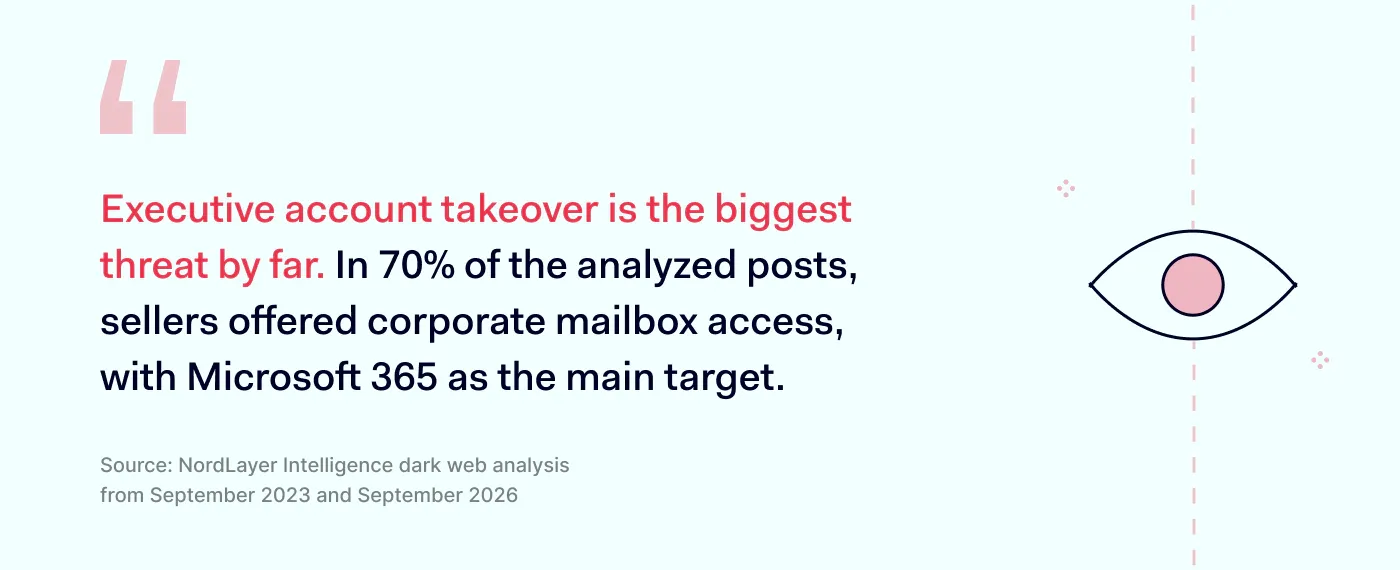
NordLayer Intelligence analyzed dark web listings between September 2023 and September 2026 and found that executive account takeover is the largest market for cybercriminals targeting executives. In 70% of analyzed posts, sellers offered corporate mailbox access,with Microsoft 365 as the main target.
According to Mantas Sabeckis, Senior Analyst from NordLayer Intelligence, sellers trade Office 365 and SMTP credentials in bulk packs and price them by freshness, urging buyers to move quickly before credentials expire.
Executive impersonation works differently. It is never sold as a packaged service—attackers build it step by step. Vendors sell executive and high-net-worth lead lists along with bank-customer datasets, giving attackers the names and contact details they need to reach the right person.
Executive protection and cybersecurity: how it works
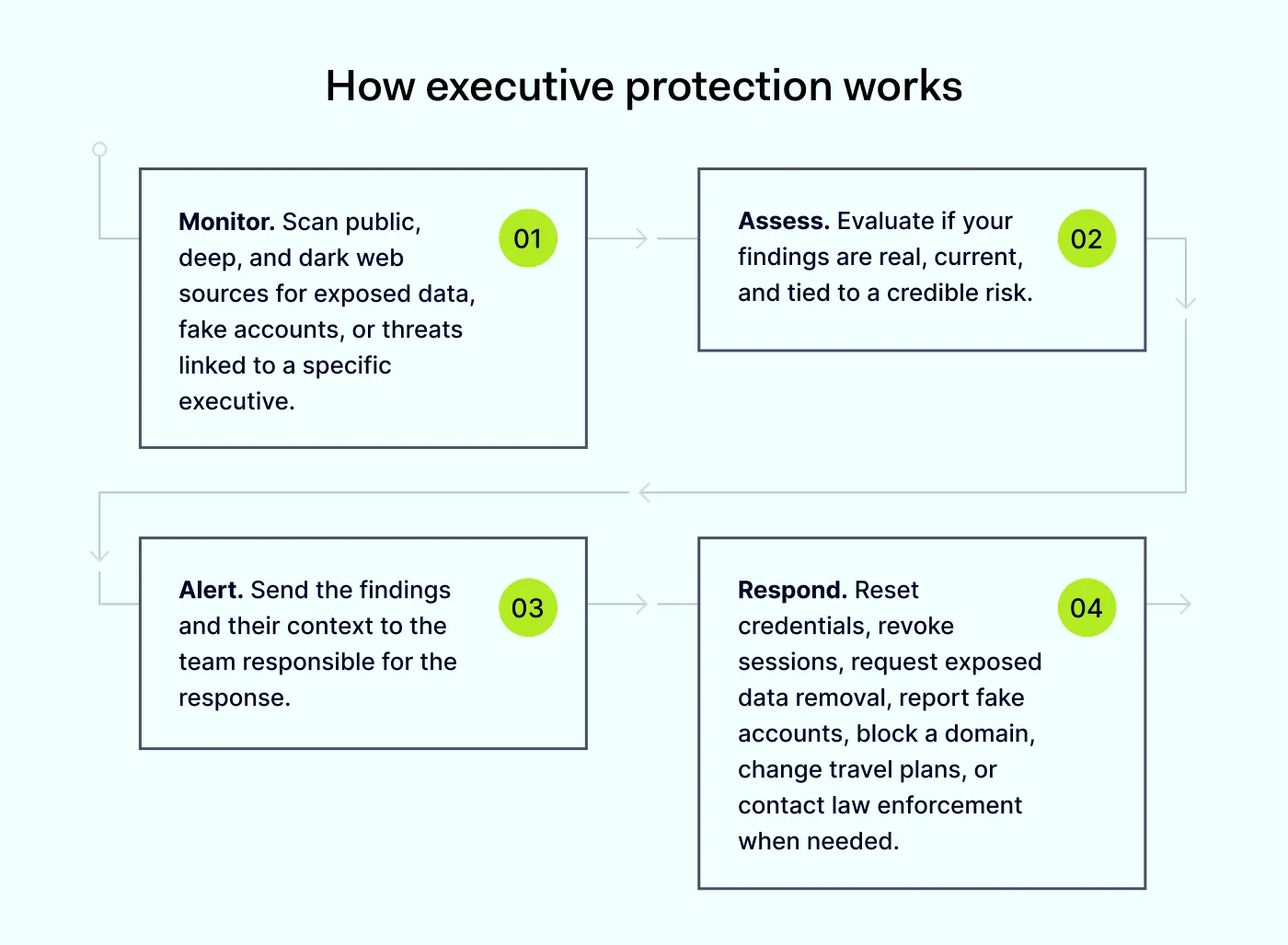
The above threats require a clear process. Executive protection programs include cyber threat intelligence, which helps identify and address online harassment, doxxing, BEC, impersonation, and other risks. The executive protection process involves the following steps:
Monitor. Scan public, deep, and dark web sources for exposed data, fake social media profiles, leaked credentials, or threats linked to a specific executive.
Assess. Check whether the findings are real, current, and tied to a credible risk.
Alert. Send the findings and their context to the team responsible for the response.
Respond. Reset credentials, revoke sessions, request removal of exposed data, report fake accounts, block a domain, change travel plans, or contact law enforcement when needed.
Automation helps teams scan more sources and check them more often. However, human review is still needed because a leaked password and a threat against an executive’s home require very different responses.
This process should also be paired with a crisis plan that defines:
Who makes decisions
Who contacts emergency services or law enforcement
Who supports the executive and family
Who handles legal, HR, and communications issues
How recovery is managed
Teams should also have a backup communication channel in case mobile networks, corporate messaging systems, or internet access fail. The plan should include current contact details, check-in times, and who confirms that everyone is safe.
How to choose an executive protection solution
Once you know what executive threats to watch for, the next step is choosing how to monitor them. When comparing executive protection tools, look at:
Coverage. Does the tool scan the surface, deep, and dark web, or only social media? Relevant coverage includes public websites, data brokers, breach collections, infostealer logs, criminal forums, illicit marketplaces, and cybercrime channels.
Alert quality. Fast alerts help, but relevance matters too. Too many false positives slow the team down.
Integration. Check whether findings can be fed into the security tools and case-management workflows your team already uses.
Build vs. buy. Decide whether your team wants to manage monitoring in-house or add it through an existing security platform.
Security teams that want to monitor leaked executive credentials, exposed personal data, and online threats can use NordLayer Intelligencefor digital executive protection.
It monitors selected executives for exposed data, dark web mentions, and other threat signals, and sends alerts with details about the affected person and the exposed information. The service runs through a web application, so executives do not need to install software on their devices.
This approach can also protect other high-value people outside the corporate C-suite. For example, Vilnius Tech added the personal phone numbers of vice-rectors, deans, and IT staff to the monitoring system. Its 5-person security team used leaked-credential alerts to block accounts and require password resets. The university reported that it stopped 15 incidents before they escalated and saved more than an hour of manual threat hunting each week.
Want to see what information about your executives may already be exposed online? Talk to our sales team about protecting the people who matter most to your business.
Frequently asked questions
Is executive protection only for CEOs or large companies?
No. Board members, finance leaders, IT administrators, founders, public spokespeople, and assistants may face similar risks. In fact, a lower-ranking employee in a high-risk location may need more protection than the CEO. The decision should reflect access, authority, public visibility, location, and current threats rather than job title or company headcount.
What should a company do if an executive’s credentials are leaked?
Reset the affected password, revoke active sessions, check for password reuse, and review recent sign-ins and account changes. If an infostealer caused the leak, inspect the device and remove the malware before the executive signs in again. Preserve evidence and review connected accounts for further access.
Can executive protection stop every attack?
No. Monitoring can find exposure and provide earlier warnings, but it cannot erase every copied dataset, prevent every phishing message, or secure every unmanaged device. Companies still need identity controls, device security, user training, incident response, and physical protection where the threat calls for it.
Joanna Krysińska
Senior Cybersecurity Copywriter
Joanna writes about zero trust, network security, access control, and threat prevention, but her cup of tea is compliance and how regulations shape security controls.
Her work also includes the dark web topics and the methods cybercriminals use to target companies, such as social engineering or ransomware attacks, for example.