How to take down a website that could harm your brand
Joanna Krysińska
Summary: A malicious, illegal, or plagiarized page can harm your brand. Taking down such a website protects your business from losing customer trust and incurring financial losses.
One of the most common tactics of threat actors is launching a scam website to harvest credentials, intercept payments, or distribute malware. If these malicious pages remain online, they can turn into data breaches, operational disruptions, and the long-term erosion of user trust. Taking such content down is the only way to protect your business and customers.
In this guide, we’ll show you how to legally take down a website, neutralize the bad actor, and protect your brand without adding to your team’s daily alert fatigue.
Key takeaways
A website takedown is the systematic process of removing unauthorized, infringing, or malicious domains from the internet.
The most common legal grounds for taking down a website are phishing domains, cloned websites, fake executive profiles, fraudulent applications, and trademark violations.
The execution of the website takedown starts with collecting evidence and contacting the website owner. Next, a DMCA takedown notice is sent to the website’s host, registrar, or platform.
For copyright infringement cases, you can send an abuse complaint to the domain registrar or contact ICANN.
Manual takedown procedures are time-consuming, prone to human error, and allow malicious websites to remain active for far too long, while automated takedowns are fast and efficient.
Automated solutions detect malicious websites early on and take them down before the damage spreads.
What is a website takedown?
A website takedown is the formal process of shutting down and removing a malicious website from the internet. By “malicious,” we mean a page that infringes on copyrights, contains illegal content, or is harmful to your organization. It can be, for example, a fake brand store or a lookalike domain mimicking your company’s website.
What does the takedown process involve? First, the hosting provider is identified, and the infringement is documented. Next, a cease-and-desist (C&D) letter or a Digital Millennium Copyright Act (DMCA) notice is sent to the relevant service provider. These notices give the offender one last chance to remove the harmful content before legal action is taken.
Website takedowns help reduce the cyber risks that malicious content poses to your organization, customer base, and your brand.
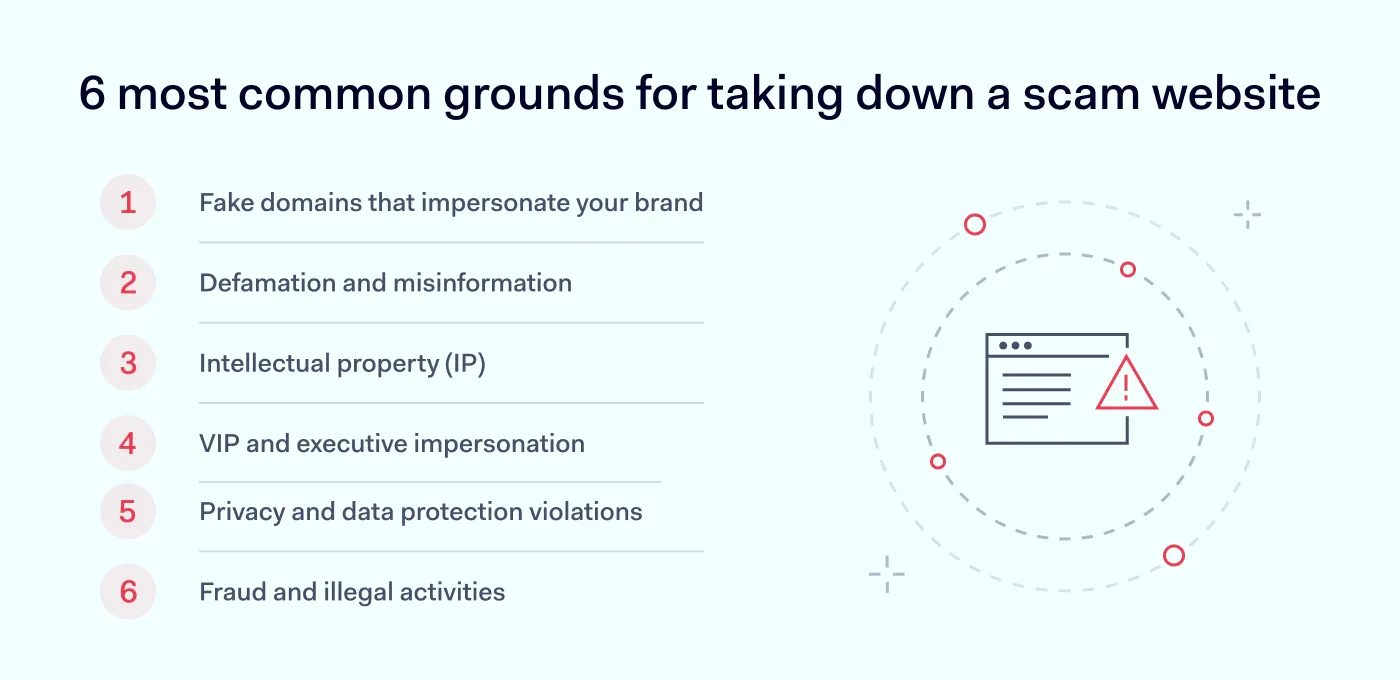
6 most common grounds to take down a malicious website
When a malicious site is live, you should act immediately. Neutralizing it fast helps protect your brand, maintain compliance, and keep your revenue safe.
1. Fake domains that impersonate your brand
When threat actors create fake domains that look like your organization’s website, they want to trick users into sharing sensitive data and login credentials. They usually use the techniques of typosquatting or cybersquatting:
Cybersquatting. When someone registers your desired domain name—or variations of it—intending to sell it back to you for a profit. In other cases, cybercriminals use the squatted domain to imitate your brand.
Typosquatting. Malicious actors register domain names that are highly similar to yours but contain slight misspellings or visual tricks. This includes adding extra letters (e.g., "teapotts.com"), swapping characters (e.g., "teaspots.com"), or exploiting visual lookalikes like using a capital "I" instead of a lowercase "l", or two "V" s instead of a "W" ("vvater.com").
Once this malicious website is active, bad actors launch phishing campaigns, deceptive social media posts, or malicious ads to lure clients to the fake address. This can cause huge financial losses and erode customer trust.
2. Defamation and misinformation
False statements, defamation, and deepfakes can ruin your organization’s reputation and finances. For example, fake reviews mislead consumers and cost businesses $152 billion worldwide.
When customers trust a brand, they are more likely to buy its product, even if it is expensive. That’s why acting fast and demanding the removal of fake content helps limit damage to the brand’s reputation before it impacts consumer loyalty.
3. Intellectual property (IP)
Using your product photos, descriptions, text, logos, or unique brand names without permission is an IP violation.
Trademark violations and asset infringement can cause serious financial damage and the loss of market position, especially for retail companies selling online. It also leads to costly lawsuits or compliance issues that smaller businesses cannot survive if left unaddressed.
Laws like the Anticybersquatting Consumer Protection Act (ACPA) make it illegal to register, sell, or use an internet domain that matches someone else’s trademark if done with malicious intent. The ACPA protects brands and consumers from confusion while allowing victims to sue for domain transfers and monetary damages.
4. VIP and executive impersonation
Cybercriminals create fake websites, domains, and social media profiles to pose as CEOs, board members, or other key executives. They then use these profiles to launch business email compromise (BEC), run investment frauds, or publish fake endorsements.
These scams exploit the personal trust placed in authority figures. The consequences include major financial losses, operational disruption, and reputational damage that can take years to repair.
5. Privacy and data protection violations
Cybercriminals create fake websites that mimic legitimate brands to trick users into entering personal or sensitive data, such as login credentials or payment details. Once this data is harvested, it can be used for unauthorized actions and may result in data protection and privacy violations for the affected persons.
Consumers are very protective of their personal information—and rightfully so. If they discover their stolen data on a scam website impersonating your brand, your organization will face high legal penalties and a permanent loss of customer trust.
6. Fraud and illegal activities
Bad actors often use malicious websites to process fraudulent payments, misrepresent official corporate affiliations, or host criminal activities like trafficking, hacking, and online harassment.
Reporting these websites to their hosting providers, domain registrars, and payment processors allows you to cut off the scammers’ infrastructure and protect consumers.
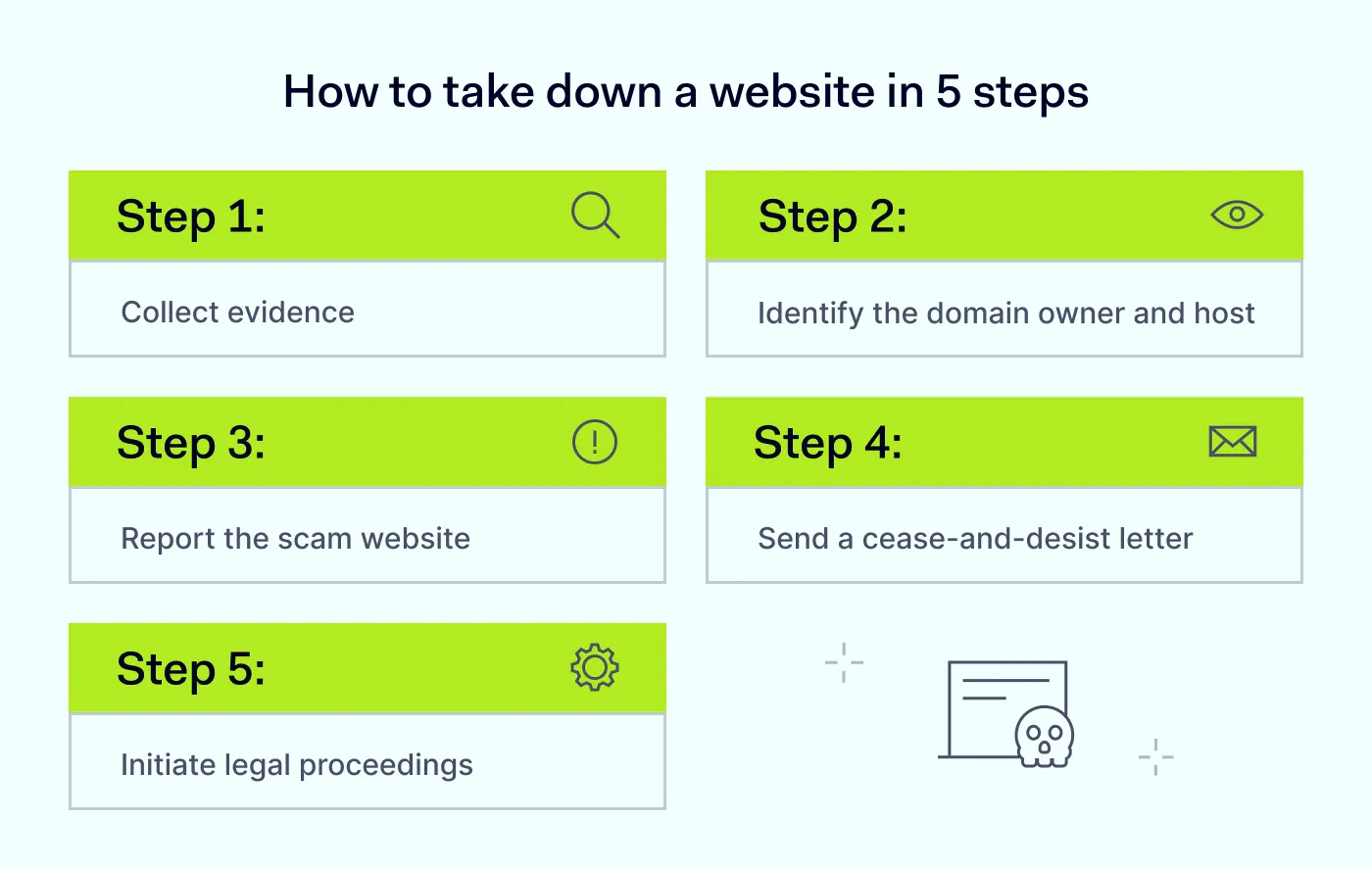
How to take down a website legally in 5 steps
You usually cannot take down a website just because you don’t like it. You need legal grounds for it, such as copyright or trademark infringement, defamation, fraud, or privacy violations. The most effective way to protect your brand, your users, and your revenue is to move quickly to neutralize a rogue domain.
1. Collect evidence
Before you alert an official entity, compile all the evidence of the infringement. This includes:
The fake website name and its URL
Screenshots that show the domain and URL
Plagiarized content, images, logos, and anything that belongs to your brand
Copy of your official logo, website, or other intellectual property that has been misused
Connected domains or profiles using the same infringed material
Be thorough. The reports that are well-documented are more likely to be responded to faster.
2. Identify the domain owner and host
In this step, you must investigate who owns the domain, who hosts it, and who the operator is. Start with checking ICANN LookUp, which publishes the public registration data of domains.
Finding the hosting provider often requires digging past a visible IP address, which may only point to a content delivery network (CDN) or reverse proxy rather than the origin server. To identify the true host, review:
Current and previous DNS records
HTTP headers
Hosting-lookup services
Platform-specific assets or unhidden account paths
Keep in mind that the registrar rarely hosts the website. Also, while a CDN can restrict or cache traffic, it can’t delete content stored on the origin server.
3. Report the scam website
There are two different courses of action for addressing copyright infringement and trademark abuse, fraud, or defamation.
Copyright infringement: a DMCA takedown notice
For this kind of scam, use the Digital Millennium Copyright Act (DMCA). The DMCA asks service providers located in or connected to US jurisdictions to remove or disable access to harmful content.
A valid DMCA notice should include the following:
A statement that the use of the website is unauthorized
The exact domain location. (i.e., URL and its IP address)
Clear identification of the original protected asset
A signature from the authorized copyright owner
A properly written DMCA notice can prompt the host to disable orremove access to the infringing content within 10 days. However, there might be cases when the takedown can last longer than 8 weeks.
Trademark abuse, fraud, or defamation
Reporting the incident directly to the hosting provider or website platform is often the fastest way to get content removed.
A complete complaint should cover:
Your name, company, and explicit authorization to submit the report
The full domain name and the exact URLs of the infringing pages
An explanation of the violation, alongside links to your official brand website and the original materials
Relevant trademark or copyright documentation, with clear screenshots of the scam site
The specific action you want the provider to take
However, due to the complex nature of legal issues, it is recommended to contact an attorney, especially in cases of defamation or illegal content.
4. Send a cease-and-desist letter
It is a formal legal demand telling a website operator or an intermediary to disable or remove illegal content immediately. A cease-and-desist letter usually sets a deadline for compliance.
Sending one is highly effective when:
You want to inform the website owner officially that they have been caught
It concerns trademark abuse, domain scams, or defamation
You want to build a documented, pre-litigation case in case your team needs to escalate the issue to a courtroom later
If you want to apply maximum pressure, you can send identical copies to the domain registrant, the CMS platform, and the infrastructure hosting provider at the same time.
5. Initiate legal proceedings
Many hosts are unresponsive or anonymous. Some are just uncooperative offshore hosting networks or complex criminal groups. In such cases, ordinary abuse reports hit a wall. This is when a legal team must step in and file for formal injunctions or seek international court orders.
However, you should also consider the challenges and nuances that may accompany the process:
The website owner can file a counterclaim or initiate legal action to challenge your takedown request.
As we have mentioned here, if your takedown attempt isn’t successful the first time, you may need to take formal legal action against the website owner. This public conflict can lead to sudden reputational issues, negative publicity, or unintended public backlash.
Challenges of managing a takedown process manually
Relying on manual, do-it-yourself tasks to execute a website take-down creates operational bottlenecks, drains your team, and exposes your business to ongoing risks.
Malicious websites reappear after removal
Cybercriminals never stop. The moment your team successfully completes a website takedown, the rogue operator can spin up an identical copy on a different lookalike domain within minutes. Manual tracking can’t keep pace with this cycle.
Untraceable website owners and hidden infrastructure
Finding the hosting provider often takes a lot of work. It goes beyond identifying a visible IP address, which may only point to a CDN or reverse proxy rather than the origin server. Security analysts must manually review DNS configurations, network metadata,and platform footprints to identify the real host.
The website owner can also use privacy protection services or hide behind uncooperative hosting providers who will deny your claims. This makes locating the target operator even more difficult and time-consuming.
Increased time and costs
Finding an infringed website manually takes hours. Preparing an abuse report also incurs costs and consumes the team’s resources.
Fortunately, brand protection solutions help tackle these challenges.
How brand protection solutions help with the takedown process
A brand protection platform, such as NordLayer Intelligence, helps detect the misuse of your brand by identifying fake domains, profiles, and apps. Once infringing content is found, NordLayer initiates its takedown.
Here’s how it works:
It continuously scans domains, websites, social media platforms, and app stores looking for your brand’s lookalike domains, fraudulent websites, fake social media profiles, and cloned apps.
It analyzes the detected assets for signs of impersonation, phishing, cloned apps, or other malicious activity.
It takes down the fake website, content, or app.
How to choose a website takedown service provider
Before you decide to hire a takedown provider, there are a few things you should consider.
Use this list of questions to evaluate your options and find a provider that will help you protect your brand.
Key evaluation metrics
What should you ask a takedown service provider?
Speed
What is the average turnaround time from initial fake website detection to its removal?
Transparency
How does the provider present every active case?
Success rate
What percentage of filed abuse submissions and registrar disputes end in a verified content removal or domain suspension?
Legal support
Can the provider help you handle DMCA reports, registrar disputes, and cross-border cases?
Post-takedown monitoring
Does the provider continue tracking the offending channels after a successful removal?
Want to move away from slow, manual website takedowns? Contact our sales team to learn how Nordlayer Intelligence can help you streamline the whole process.
Joanna Krysińska
Senior Cybersecurity Copywriter
Joanna writes about zero trust, network security, access control, and threat prevention, but her cup of tea is compliance and how regulations shape security controls.
Her work also includes the dark web topics and the methods cybercriminals use to target companies, such as social engineering or ransomware attacks, for example.