External attack surface management: find what attackers see before they exploit it
Agnė Srėbaliūtė
Summary: Learn how external attack surface management uncovers hidden internet-facing assets, validates real risks, and helps security teams prioritize remediation before attackers strike.
Every internet-facing asset your organization owns is a potential entry point for attackers. Some are obvious, such as your public website, VPN gateway, or customer portal. Others are easy to overlook: an abandoned subdomain, an exposed development server, an expired cloud instance, or a forgotten API left running after a product launch.
For security teams, the challenge isn’t only protecting known assets—it’s also discovering the ones they don’t know exist. According to Trend Micro’s 2025 research, more than 70% of cybersecurity incidents that year involved unknown or unmanaged assets, and Picus Security reports that 69% of organizations have suffered breaches linked to external assets they didn’t know they had.
That’s why, instead of looking at infrastructure from inside the network, external attack surface management (EASM) takes the attacker’s perspective. It continuously discovers internet-facing assets, identifies exposures, and helps security teams reduce risk before adversaries exploit them.
This results in fewer blind spots, better prioritization, stronger governance, clearer accountability, and measurable risk reduction.
Key takeaways
External attack surface management (EASM) is the continuous process of discovering, monitoring, and securing all internet-facing assets associated with an organization.
Your external attack surface includes domains, subdomains, IP addresses, cloud services, APIs, SSL/TLS certificates, email infrastructure, web applications, and third-party assets.
EASM solutions first identify assets you may not know exist, then assess whether their exposures are actually exploitable.
EASM continuously monitors change instead of relying on one-time assessments.
Combining EASM with external threat intelligence helps security teams prioritize the exposures attackers are actively targeting.
Organizations that continuously manage their attack surface shorten exposure windows, focus remediation on validated risks, and improve cyber resilience.
What is external attack surface management?
External attack surface management is the practice of continuously identifying, monitoring, assessing, and reducing risks across all internet-facing assets that belong to an organization.
EASM gives you continuous visibility into everything an attacker can discover about your organization on the public internet—and increasingly, whether those exposures can actually be exploited. Rather than focusing on assets inside your network, EASM looks outward. It discovers publicly accessible infrastructure, evaluates exposure, and tracks changes that introduce new risks.
The attacker-centric perspective is what separates EASM from most traditional security categories. Endpoint detection and response (EDR), security information and event management (SIEM), and network monitoring solutions are built around internal telemetry from managed devices and infrastructure. EASM, on the other hand, takes the opposite view and asks a different question: what can an attacker see from the outside, before compromising anything?
The answer is usually a longer list than security teams expect: a forgotten development environment, a recently acquired company’s legacy infrastructure, cloud storage left open during testing, or an API endpoint still reachable months after launch.
Every one of these expands the organization’s external attack surface—and that surface changes constantly. Cloud deployments happen daily, developers spin up temporary environments, marketing launches microsites, business units subscribe to SaaS platforms without informing IT, and mergers introduce entirely new infrastructures overnight.
Because of the constant change, EASM is a continuous operational discipline, not a one-time assessment.
What makes up your external attack surface
An organization’s external attack surface extends far beyond its primary website. The most common categories:
Asset type
Why it matters
Domains and subdomains
Frequently expose forgotten applications and development environments
DNS records
Reveal infrastructure relationships and internet-facing services
Public IP addresses
Let attackers identify exposed systems and services
Open ports
Provide direct entry points into the infrastructure
Web applications
Common targets for exploitation and credential attacks
APIs
May expose sensitive data or authentication weaknesses
Cloud services and storage
Misconfigurations can expose confidential information
SSL/TLS certificates
Help attackers discover additional domains and infrastructure
Email infrastructure
Supports phishing, spoofing, and business email compromise
Third-party services
Extend organizational risk through the supply chain
Every new internet-facing asset expands your digital footprint—and every new asset is another opportunity for attackers to find a weakness.
Internal vs. external attack surface management
Organizations often assume that endpoint security, vulnerability scanners, and a SIEM add up to sufficient visibility. In reality, internal attack surface management (IASM) and external attack surface management solve different problems because they look at different sides of the same environment.
IASM focuses on assets that live inside the corporate perimeter: managed endpoints, servers, internal applications, and infrastructure that the organization owns and can authenticate against. EASM focuses on everything an attacker can see on the public internet, including assets no one on the security team has documented yet.
IASM
EASM
Maps assets inside the corporate perimeter
Maps assets exposed to the public internet
Covers endpoints, servers, and internal applications
Covers domains, subdomains, APIs, cloud services, and third-party assets
Uses authenticated visibility from inside the network
Uses the same unauthenticated visibility available to attackers
Relies on an inventory that the organization maintains
Discovers known and unknown assets, including shadow IT
Detects activity and misconfigurations after deployment
Detects exposure as assets appear online
Focuses on managed, sanctioned systems
Focuses on unmanaged, forgotten, or unsanctioned assets
Responds to internal security events
Reduces opportunities for exploitation before attacks occur
Both are necessary. IASM gives deep visibility into the systems you control, while EASM gives visibility into the systems attackers can already see. Together, they produce a much more complete picture of organizational risk.
Why organizations struggle with external attack surface visibility
Attack surfaces don’t grow because teams are careless—they grow because most of the people creating new assets don’t work in security. These 4 factors do most of the damage.
1. Shadow IT and unknown assets
Business units adopt SaaS platforms and collaboration tools without formal IT involvement. Developers spin up test environments. Marketing launches campaign sites. Consultants deploy cloud infrastructure. Months later, many of these assets are still publicly reachable long after they’ve stopped serving a purpose. Industry research suggests the average enterprise has close to 975 unknown cloud services in use, whereas IT only tracks about 108. Furthermore, roughly 42% of company applications are the result of shadow IT.
2. Cloud and DevOps velocity
Cloud resources can be created and destroyed in minutes. Infrastructure as code enables rapid deployment but also multiplies the chance of misconfiguration. Containers, serverless functions, and short-lived test environments make manual inventories obsolete almost immediately.
3. Mergers, acquisitions, and subsidiary networks
Acquisitions bring more than employees and customers—they bring domains, IP ranges, cloud accounts, legacy applications, and historical security debt. Ownership rarely transfers cleanly, leaving forgotten inherited systems that become attractive targets.
4. Decentralized IT across business units
Regional offices, subsidiaries, and product teams often manage infrastructure independently—registering domains, deploying cloud services, exposing APIs, and buying SaaS on their own. Each decision adds to the external attack surface, usually without central security knowing. At that scale, maintaining an accurate inventory through spreadsheets or manual audits stops being realistic.
Why external attack surface management matters
Discovery is valuable on its own, but the real payoff comes from reducing organizational risk before attackers can act on it. A well-run EASM program helps security teams:
Identify shadow IT before it becomes a liability.
Detect forgotten domains, cloud instances, and legacy infrastructure.
Reduce exposure to ransomware and opportunistic attacks.
Extend visibility beyond traditional network boundaries.
Prioritize remediation based on internet-facing risk, not internal noise.
Support compliance efforts through continuous asset visibility.
Shorten the gap between asset deployment and security assessment.
Give analysts actionable findings instead of overwhelming inventories.
For CISOs, this adds up to stronger governance and a more measurable reduction in risk. For analysts, it means spending less time searching for assets and more time securing them.
How external attack surface management works
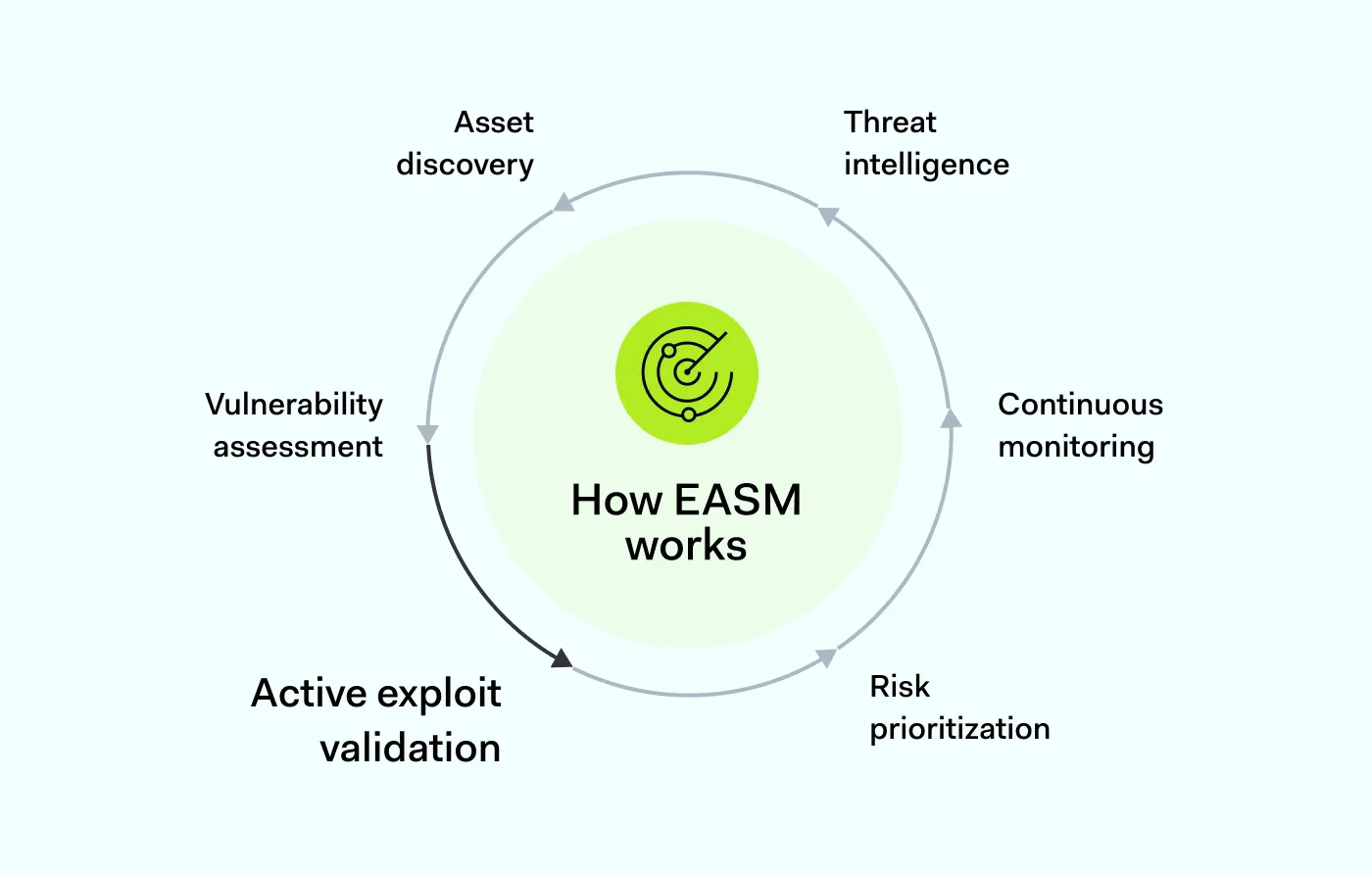
External attack surface management does more than list exposed assets. It continuously discovers new ones, uses active exploit validation to verify which exposures are exploitable, prioritizes risk, and monitors change. These capabilities should be the baseline when evaluating solutions.
The 6 capabilities below make up that baseline, in the order they typically occur.
Automated asset discovery
The first step in external attack surface management is building a complete inventory of internet-facing assets. Discovery typically draws on DNS records, SSL/TLS certificates, WHOIS data, IP ranges, cloud metadata, and internet-wide scanning. Because new assets appear every day—as developers deploy applications, business units launch services, and cloud environments expand—discovery has to run continuously to keep the view up to date.
External vulnerability assessment
Once assets are identified, the next step is evaluating exposure from the perspective of an attacker on the public internet. This uncovers things like exposed admin interfaces, open ports and unnecessary services, outdated software versions, weak or expired SSL/TLS certificates, misconfigured cloud storage, publicly accessible development environments, and vulnerable web applications and APIs.
The goal is understanding which exposures present realistic opportunities for compromise without disrupting production.
Active exploit validation
This is where mature EASM programs differ from basic scanners. A discovered vulnerability does not necessarily mean it is exploitable, and most alert queues overwhelm analysts with theoretical severity. Active validation, which uses dynamic analysis (DAST) and safe exploit simulation, confirms whether a CVE, misconfiguration, or exposed admin panel can actually be used against you. The output is a much shorter list of verified issues that genuinely need attention.
Risk scoring and prioritization
Even with validation, large organizations still have plenty of findings to work through. Effective risk models weight severity, exploit availability, evidence of active exploitation in the wild, asset criticality, internet exposure, and any leaked credentials tied to the asset. The result is a prioritized list that analysts can actually work through, not a wall of equal-priority alerts.
Continuous monitoring and change detection
Attack surfaces don’t sit still. Any change to your public-facing infrastructure—a new subdomain, a DNS update, a newly issued certificate, an unknown cloud service, or a configuration change that flips something from private to public—can introduce fresh exposure between quarterly assessments. Continuous monitoring flags these changes as they happen, shortening the window between exposure and detection, so attackers don’t get there first.
Threat intelligence integration
Discovery becomes far more valuable with threat intelligence layered on top. While an exposed server deserves investigation, an exposed server tied to leaked employee credentials, mentioned on a dark web forum, or targeted by an active ransomware group requires immediate action. Correlating discovered assets with external intelligence, such as leaked credentials, infostealer log data, dark web marketplace activity, brand impersonation campaigns, and known exploit campaigns, gives teams the context to make good prioritization calls.
How to implement external attack surface management
Building an external attack surface management program doesn’t mean replacing your existing security stack. Instead, it complements vulnerability management, SIEM, endpoint protection, and incident response by identifying risks before they become incidents.
Inventory your known internet-facing assets. Document every public-facing domain, IP range, application, cloud environment, API, and email service you own. This is your baseline.
Discover the unknown ones. Compare that baseline against what an EASM solution finds. Look specifically for forgotten subdomains, legacy websites, cloud instances, development environments, third-party hosted applications, and subsidiary infrastructure. Unknown assets typically represent the highest risk because they have received the least oversight.
Validate ownership. Not every discovered asset is yours—especially after an M&A or infrastructure migration. Confirm ownership before starting remediation, and make sure findings reach the right team.
Prioritize internet-facing risks. First, focus on assets that combine high business value, public accessibility, known vulnerabilities, evidence of active exploitation, weak authentication, or sensitive data exposure. Risk-based prioritization delivers faster results than trying to fix everything at once.
Layer in external threat intelligence. Discovery tells you what exists. Intelligence explains what matters. Correlating your findings with leaked credentials, breach data, exploit campaigns, and brand monitoring will make your remediation decisions much easier.
Monitor continuously. New exposure shouldn’t go unnoticed for weeks. The goal is an accurate inventory, not a perfect one.
Done well, these 6 steps help you build EASM into your regular security workflow. Once that foundation is in place, choosing the right platform becomes much simpler.
Choosing an external attack surface management solution
Not every EASM solution is built the same way. When evaluating external attack surface management tools, look past raw asset discovery counts and focus on how effectively a solution helps you prioritize and reduce risk. Useful questions include:
Does it continuously discover new internet-facing assets, including shadow IT?
Does it provide continuous monitoring and detection of infrastructure changes?
Does it validate whether discovered vulnerabilities are actually exploitable, or just theoretically vulnerable?
How does it prioritize risk?
Does it integrate with external threat intelligence, leaked credential data, and breach monitoring?
Does it reduce analyst workload by filtering noise and highlighting validated risks?
What matters most is whether an EASM solution helps your team reduce real-world risk, not just discover more assets.
See what attackers see before they act on it
The most effective security teams combine continuous asset discovery with contextual intelligence and active exploit validation to understand which exposures matter most, not just what’s exposed.
NordLayer Intelligence by NordStellar brings those capabilities together in one attack surface management solution. It follows a continuous 4-phase process: asset discovery, active vulnerability verification, risk-based prioritization, and remediation guidance. This allows security teams to work from a validated, ranked list instead of a raw alert queue.
Request a free trial to see the validated, prioritized findings from your own environment.
Final thoughts
The external attack surface expands every time a new application is deployed, a cloud instance is spun up, or a business unit signs up for another SaaS platform. Keeping pace with that change is one of the harder problems in modern security.
EASM provides a continuous, attacker-focused view of your public-facing infrastructure. It uncovers unknown assets, identifies exploitable weaknesses, and prioritizes remediation based on real-world risk. When combined with threat intelligence and active exploit validation, EASM stops being an inventory exercise.
Instead, it becomes a way to see your environment the way adversaries do, close gaps before they’re targeted, and make smarter decisions about where to allocate limited security resources.
Agnė Srėbaliūtė
Senior Cybersecurity Copywriter
After spending a decade writing across media, PR, and advertising, Agne has been specializing in technology and cybersecurity content, focusing on IP address management, networking, zero trust, and internet infrastructure. She helps businesses understand complex technologies through clear, engaging, and sometimes creative content.