What is an incident response plan (IRP)?

You never know If your organization faces a ransomware attack tomorrow. If it happens, panic is your enemy, and speed is your ally. The difference between a minor operational interruption and a disaster often comes down to one thing: preparation. A well-structured incident response plan helps ensure that your team isn't improvising in the most stressful moments.
Incident response plan (IRP) definition
An incident response plan (IRP) is a written document that provides instructions for detecting, responding to, and recovering from cybersecurity incidents. It clarifies roles, responsibilities, and procedures to help organizations manage the lifecycle of a security incident, from the initial alert to post-mortem analysis.
Why is an incident response plan important?
Security tools detect incidents, but people respond to them. To resolve the situation, you need a checklist.
Without a solid incident response plan, organizations often fall into panic mode. Decisions are made emotionally rather than logically. Evidence gets destroyed by well-meaning technicians who reboot servers too quickly. Communication breaks down, and the legal team finds out about the breach from social media instead of the CISO.
Compliance mandates like PCI DSS and the HIPAA Security Rule require incident response policies and procedures. A documented incident response plan shows due diligence to regulators and customers.
Finally, an incident response plan saves money. The longer a threat actor dwells in your system, the more expensive the cleanup becomes. A good incident response process reduces the “mean time to respond” (MTTR). It helps limit the damage and get business operations back online faster.
How to create an incident response plan
First, it’s a process. It requires input from IT, legal, HR, and public relations. Importantly, it must be a living document.
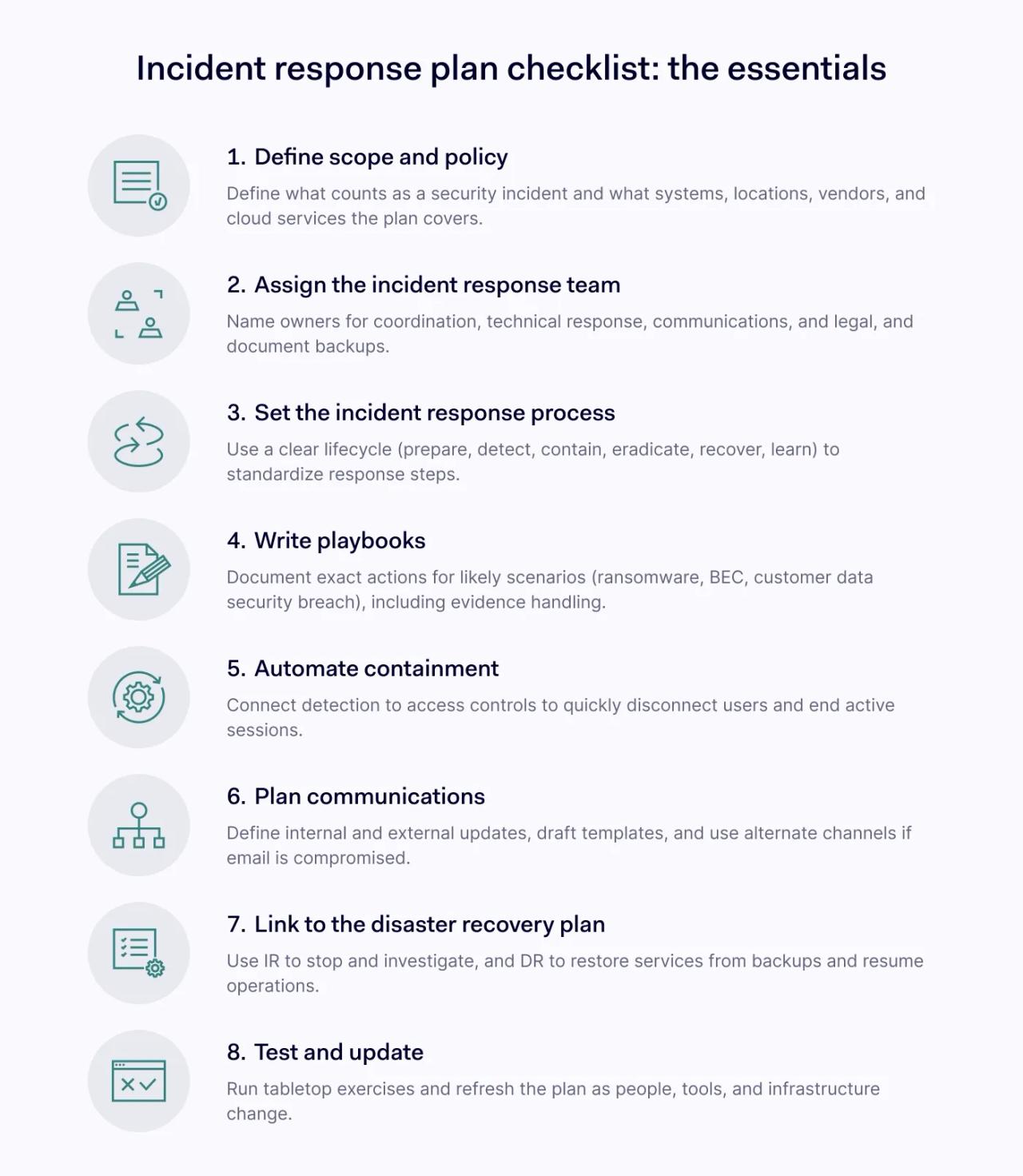
1. Define the scope and policy
First, you must define the rules of engagement. Your incident response plan should start with a clear policy statement that defines what actually counts as a security incident. Is a lost laptop an incident? Is a phishing email that nobody clicked an incident?
Define the scope clearly. Does the plan cover all regional offices? Does it include third-party vendors and cloud environments? All these boundaries help prevent confusion later.
2. Build your incident response team
You cannot execute an IR plan without people. You need a designated team, aka Computer Security Incident Response Team (CSIRT), with clear roles.
- Incident manager. The person who coordinates the response, makes key decisions, and holds overall authority during the incident.
- Technical leads. People who analyze logs and isolate systems.
- Communications lead. The person who speaks to the press and employees.
- Legal counsel. The advisor on liability and regulatory notification.
List these people in your incident response plan, including their backup contacts for weekends and holidays. If the primary contact is on a flight during a breach, the plan must say who steps up next.
3. Develop the incident response process (the lifecycle)
Structure your plan around a proven framework to keep everyone organized. Many organizations follow the NIST or SANS models. A standard incident response process generally includes:
- Preparation. Configure tools and train staff.
- Detection and analysis. Monitor alerts and triage potential threats.
- Containment. Stop the spread (disconnect systems).
- Eradication. Remove the malware or threat actor.
- Recovery. Restore systems and data.
- Post-incident activity. Learn from the event.
4. Create actionable playbooks and procedures
Generic advice like “handle the virus” isn’t helpful. You need playbooks for high-risk scenarios.
Write a playbook for ransomware. Write another one for business email compromise. And another one for a security breach involving customer data. For each scenario, the incident response plan should list the exact steps the incident response team must take.
Don't reinvent the wheel, start with a template. Customizing a template ensures you don't miss critical categories like evidence preservation or chain of custody.
5. Automate containment with custom integrations
Speed is critical during the containment phase, especially early. If your incident response team has to manually log in to twenty different dashboards to revoke access for a compromised user, the attackers have already moved laterally.
This is where integrating network access tools with threat detection matters. For example, NordLayer offers custom integrations that allow you to automate the containment step.
Custom integrations allow you to connect NordLayer directly to your security stack (like your EDR, SIEM, XDR, etc.) via API. You can configure your detection tool to send a webhook alert to NordLayer the moment a high-severity threat is detected.
Once triggered, NordLayer can instantly:
- Disconnect the user. Immediately sever the connection to company gateways.
- Invalidate active sessions. Log the user out and force re-authentication before they regain access.
The automation happens in real time, often before a human analyst opens the ticket. It allows you to create up to 10 distinct integrations. Whether the alert comes from your endpoint protection or your email security, the response is instant.
6. Establish a communication plan
A technical fix may be useless if you lose the public trust war. Your incident response plan must detail who communicates with whom.
- Internal. How do you tell employees the email system is down without alerting the hackers that you know they are there? (Hint: Don't use the compromised email system.)
- External. Who talks to the media? Who notifies customers? Who contacts law enforcement?
Many incident response plan templates include pre-written notification drafts. In the middle of a stressful security breach, you don't want to be drafting a press release from scratch.
7. Differentiate from the disaster recovery plan
It is common to confuse an incident response plan with a disaster recovery plan (DRP). While they complement each other, they are distinct.
The incident response plan focuses on stopping the attack. The disaster recovery plan focuses on restoring IT infrastructure and business continuity after the dust settles. If a server is wiped by ransomware, the IR plan guides the investigation and containment, while the disaster recovery plan guides the restoration from backups. Your documentation should clearly link the two.
8. Train, test, and update
An untested plan is just a theory. You must exercise your incident response plan at least from time to time. Run tabletop exercises where the incident response team talks through a simulated attack.
Did the communication flow work? Did the technical leads have the access they needed? Did the incident response plan template cover the specific nuances of your cloud environment?
Use these tests to refine the document. Technology changes fast, and if your incident response plan references servers you decommissioned three years ago, it’s a liability.
What creates a successful incident response plan?
A successful plan is one that is actually used. It shouldn't be a 300-page thesis. It should be a collection of checklists, flowcharts, and contact lists that a stressed human being can follow at 3:00 AM.
The best incident response plan balances rigidity with flexibility. It provides a rigid structure for communication and authority (so everyone knows who is in charge) but allows flexibility in technical execution (because every hack is different).
It also relies on visibility. You cannot effectively execute an incident response process if you don't know what assets you have. Ensure your plan includes an up-to-date inventory of critical assets and data maps.
Summary
The goal of an incident response plan isn't to prevent every attack (that’s impossible). The goal is to ensure that when a security incident occurs, it is a manageable event rather than a company-ending catastrophe.
Clearly define your incident response team, automate critical steps like containment through tools like NordLayer, regularly test your procedures – and you build resilience.
Start planning, don’t wait for a breach. Find an incident response plan template, gather your stakeholders, and start building your IR plan this month. When there’s a security breach, you’ll be glad you did.