What is GRC (governance, risk, and compliance)?

Organizations must innovate, protect their assets from threats, and operate within a complex legal framework. Managing pressures in silos is inefficient and dangerous. A fragmented approach leads to duplicated efforts and poor visibility that can result in financial loss.
One of the solutions is an integrated approach known as governance, risk, and compliance (GRC). A well-designed GRC program aligns an organization's strategy, processes, technology, and people to achieve objectives and act with integrity.
This article explores the fundamentals of governance, risk, and compliance, its components, and how it drives business value.
- Taxonomy and libraries: Standardized vocabulary for risks, controls, assets, and regulations to ensure everyone speaks the same language.
- Roles and responsibilities: Clear ownership for every part of the GRC program. A well-defined GRC model should guide the creation of this framework.
3. Conduct a comprehensive risk assessment
The heart of any GRC program is a thorough understanding of the risk landscape. Using the taxonomy defined in your GRC framework, conduct a top-down and bottom-up risk assessment. Engage leaders across the business to identify strategic, operational, financial, and compliance risks.
Prioritize these risks based on their potential impact and likelihood. This list of risks becomes the focus of your control and mitigation efforts.
4. Select and implement supporting GRC tools
Managing GRC on spreadsheets is not scalable. To achieve maturity, you need purpose-built GRC tools. These technology platforms automate workflows, centralize data, and provide dashboards and reporting.
When selecting GRC tools, look for a solution that supports your defined framework and can grow with your program's maturity. The right platform will integrate information from across the three pillars of GRC.
5. Establish monitoring and reporting
Governance, risk, and compliance is an ongoing discipline. Implement processes for monitoring of controls and key risk indicators (KRIs). This allows you to detect issues early and mitigate risks before they become major problems.
Establish a regular reporting cadence to provide stakeholders-from the board of directors to front-line managers-with relevant insights. A feedback loop is essential for refining your program and advancing along your GRC capability model. Progress against the model itself should be a key metric.
To summarize, a systematic approach to governance, risk, and compliance is essential for both survival and growth. With a cohesive GRC program, organizations can enhance visibility, drive efficiency, and build a more resilient enterprise. The journey toward a mature GRC capability transforms risk and compliance from a cost center into a strategic asset. To unlock it, businesses need a platform that unifies data, automates processes, and provides actionable intelligence.
What is GRC?
Governance, risk, and compliance is a framework for managing risk and meeting regulatory compliance by synchronizing an organization's activities. A successful governance, risk, and compliance program ensures that an organization operates in accordance with its risk appetite, internal policies, and external regulations.
The concept of governance, risk, and compliance emerged from the need to overcome the inefficiencies of siloed operations. Historically, departments managed their own governance activities, performed their own risk assessment processes, and tracked compliance obligations. This created a fractured view of the organization's risk profile.
A GRC strategy breaks down these barriers. It creates a unified system where information from one area informs decisions in another.
For example, an employee shares sensitive data in a way that violates privacy rules. This compliance failure (C) exposes a security weakness (R), prompting leadership to update the data handling policy (G).
This interconnectedness is the foundation of governance, risk, and compliance.
The strategic importance of GRC
Effective governance, risk, and compliance is a strategic enabler that builds a more resilient organization. When properly implemented, a GRC program moves beyond simple rule-following.
The primary importance lies in its ability to provide a holistic view of the organization. Leaders can't afford to make critical decisions with incomplete information. A unified GRC framework provides a single source of truth, offering a comprehensive view of how risks, controls, regulations, and policies interact.
This helps with better decision-making at all levels. Executives can allocate resources to the most significant risks and opportunities. Managers can design more effective controls. Employees understand their roles in protecting the organization's integrity.
Governance, risk, and compliance ensures that the organization pursues its objectives in a controlled and predictable manner. It helps answer critical questions, such as: Are we taking the right amount of risk to achieve our growth targets? Do we have the controls in place to mitigate risks associated with new initiatives? Are we prepared for the upcoming regulatory changes?
Moreover, a well-designed governance, risk, and compliance program builds trust with stakeholders. Investors, customers, and regulators have greater confidence in an organization that can demonstrate proactive risk management. This trust translates into a lower cost of capital, enhanced brand reputation, and smoother regulatory interactions.
The three pillars of GRC
Governance, risk, and compliance consists of three distinct yet interrelated components.
- Governance refers to the overall management, direction, and control of an organization. It encompasses the rules, policies, processes, and structures that direct an enterprise and hold leadership accountable to stakeholders. It ensures that activities are aligned with business goals. Governance involves defining corporate objectives, establishing a culture of integrity, establishing policies, and ensuring that decision-making authority is clearly defined.
- Risk management means identifying, assessing, and controlling threats to an organization's capital and earnings. These threats may stem from various sources, including financial uncertainty, legal liabilities, strategic management errors, accidents, and natural disasters. A meaningful risk management process involves:
- Finding potential risks that could hinder business objectives
- Analyzing the likelihood and potential impact of each identified risk
- Developing and implementing strategies to mitigate risks (for example, avoiding the risk, accepting it, transferring it, or controlling it with new procedures).
Within a governance, risk, and compliance model, risk management provides the critical information about where to focus resources and efforts.
- Compliance means adhering to stated requirements. This includes following external laws, regulations, and industry standards, as well as internal policies and procedures. The goal is to ensure the organization operates legally and ethically. This involves monitoring regulatory changes, translating them into actionable business requirements, and implementing controls. Effective regulatory compliance protects the organization from fines, penalties, and reputational harm, reinforcing the principles established through governance.
Key benefits of an integrated GRC program
Adopting an integrated approach to governance, risk, and compliance brings significant benefits across the organization. By moving away from siloed functions toward a cohesive GRC framework, businesses enjoy new levels of efficiency, intelligence, and resilience. A good GRC program is a driver of sustainable growth.
- An integrated governance, risk, and compliance gives leaders a holistic view of risks, opportunities, and compliance obligations. This enables executives to make informed, risk-aware decisions that align with their strategic goals, rather than reacting to isolated incidents.
- Siloed efforts lead to redundant work. Multiple departments often conduct similar risk assessments, test duplicate controls, and report on the same regulations. GRC eliminates duplicated effort and reduces the administrative burden on business units, freeing up resources.
- By consolidating governance, risk, and compliance activities, organizations can lower costs. This includes reducing fees paid to multiple audit and consulting firms, as well as minimizing the financial impact of unexpected fines or losses.
- A GRC framework creates clarity around roles and responsibilities. It establishes ownership for risks, controls, and compliance tasks. This provides greater transparency to the board, management, auditors, and regulators.
- Organizations with mature governance, risk, and compliance capabilities are better prepared to handle disruption. By conducting a risk assessment on potential threats, organizations can develop mature contingency plans to mitigate risks effectively. This helps withstand unforeseen events, protect brand reputation, and maintain stakeholder confidence during a crisis.
GRC use cases
The principles of governance, risk, and compliance apply across the entire enterprise. A flexible GRC can be adapted to address a wide range of operational areas.
IT & cybersecurity management is one of the most common applications of governance, risk, and compliance. IT teams use a GRC model to manage technology-related risks, such as data breaches, system failures, and cyber-attacks. A GRC helps them prioritize security investments, ensure compliance with regulations, and demonstrate to stakeholders that digital assets are protected.
Next, third-party risk management. Each third party introduces new potential risks, from supply chain disruptions to data security vulnerabilities. GRC provides a structured process to onboard vendors, conduct due diligence, perform a risk assessment, and ensure third parties comply with regulatory obligations. This is crucial to mitigate risks in the extended enterprise.
Internal audit teams also use governance, risk, and compliance principles to move from a cyclical, checklist-based audit approach to a more dynamic, risk-based methodology. A unified framework, supported by modern GRC tools, allows auditors to focus their attention on the areas of highest risk and provide more strategic assurance to the board.
Finally, policy and procedure management. Managing the lifecycle of internal policies is a core governance, risk, and compliance function. A GRC approach ensures that policies are consistently created, reviewed, distributed, and attested to. This connects policies directly to the risks they are designed to mitigate and the regulations they are meant to address.
How to build a mature GRC capability
Implementing an effective governance, risk, and compliance strategy is a journey. It requires a clear vision and a structured methodology.
A GRC capability model is an invaluable tool in this process, providing a roadmap to measure maturity and guide development. This model helps an organization understand its current position and where it needs to go.
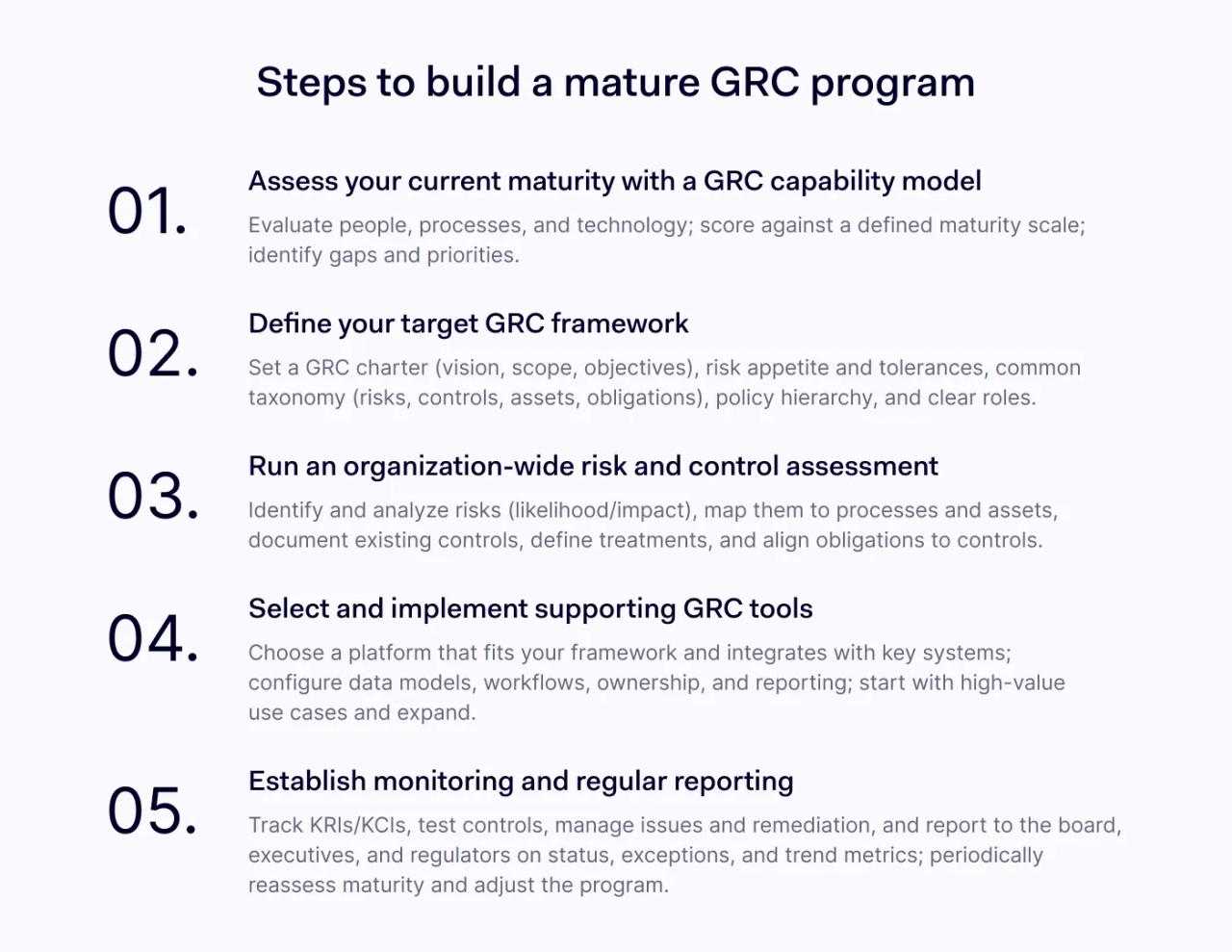
1. Assess your current state with a GRC capability model
Before building, you must understand your foundation. Start by evaluating your existing governance, risk, and compliance processes, people, and technologies. Use a formal GRC capability model to benchmark your current maturity level. The model provides a scale-often from ad-hoc and reactive to optimized and integrated-to score your current state. This assessment will highlight strengths, weaknesses, and critical gaps. The output of the GRC capability model analysis is your starting point.
2. Define your GRC framework
With a clear understanding from your GRC capability model assessment, the next step is to design your target-state GRC framework. The framework is the blueprint for your GRC program. It should define:
- GRC charter: A mission statement that outlines the program's vision, scope, and objectives.
- Risk appetite statement: A formal declaration of the amount and type of risk the organization is willing to accept.
- Taxonomy and libraries: Standardized vocabulary for risks, controls, assets, and regulations to ensure everyone speaks the same language.
- Roles and responsibilities: Clear ownership for every part of the GRC program. A well-defined GRC model should guide the creation of this framework.
3. Conduct a comprehensive risk assessment
The heart of any GRC program is a thorough understanding of the risk landscape. Using the taxonomy defined in your GRC framework, conduct a top-down and bottom-up risk assessment. Engage leaders across the business to identify strategic, operational, financial, and compliance risks.
Prioritize these risks based on their potential impact and likelihood. This list of risks becomes the focus of your control and mitigation efforts.
4. Select and implement supporting GRC tools
Managing GRC on spreadsheets is not scalable. To achieve maturity, you need purpose-built GRC tools. These technology platforms automate workflows, centralize data, and provide dashboards and reporting.
When selecting GRC tools, look for a solution that supports your defined framework and can grow with your program's maturity. The right platform will integrate information from across the three pillars of GRC.
5. Establish monitoring and reporting
Governance, risk, and compliance is an ongoing discipline. Implement processes for monitoring of controls and key risk indicators (KRIs). This allows you to detect issues early and mitigate risks before they become major problems.
Establish a regular reporting cadence to provide stakeholders—from the board of directors to front-line managers—with relevant insights. A feedback loop is essential for refining your program and advancing along your GRC capability model. Progress against the model itself should be a key metric.
To summarize, a systematic approach to governance, risk, and compliance is essential for both survival and growth. With a cohesive GRC program, organizations can enhance visibility, drive efficiency, and build a more resilient enterprise. The journey toward a mature GRC capability transforms risk and compliance from a cost center into a strategic asset. To unlock it, businesses need a platform that unifies data, automates processes, and provides actionable intelligence.