Summary: DLP governance explained: the framework, components, build steps, cloud and browser realities, best practices, and challenges that shape modern data loss prevention programs.
Organizations generate, share, and store more data every year. As it moves across endpoints, browsers, cloud applications, and collaboration platforms, protecting sensitive information gets harder. Most companies invest in a data loss prevention (DLP) solution, but technology alone is rarely enough to prevent data leakage or reduce the risk of a data breach. That’s the job of DLP governance.
A strong DLP governance framework helps organizations define responsibilities, set controls, align security objectives with business goals, and keep sensitive data protected wherever it lives. Organizations use governance to create repeatable processes that support long-term data protection and regulatory compliance.
Key takeaways
Data loss prevention governance provides the policies, accountability, and decision-making processes that make data loss prevention work across the organization.
A DLP solution enforces controls; DLP governance decides what should be protected, who owns the data, and how incidents should be handled.
Most data governance programs include DLP governance as a focused layer for preventing unauthorized exposure of sensitive data.
A successful framework combines people, processes, technology, and continuous monitoring to strengthen data security and reduce the risk of a data breach.
Cloud services, SaaS applications, and remote work expand DLP governance past traditional network boundaries.
What is DLP governance?
Data loss prevention (DLP) governance is the set of policies, processes, roles, and oversight mechanisms that guide how an organization protects sensitive data from unauthorized access, sharing, or loss.
Where technical controls stop, governance begins. It defines who is responsible for protecting information, how data risks are assessed, what DLP policies should be implemented, and how compliance is measured over time.
The primary goal is consistent data protection practices across the organization that still support business operations, regulatory requirements, and wider data governance initiatives.
DLP governance vs. DLP tools
Organizations often confuse the two. A DLP solution handles the technical work: monitoring user activity, inspecting files, restricting uploads, and blocking unauthorized transfers of sensitive data. Governance sets the rules these technologies follow.
DLP governance
DLP tools
Defines policies and accountability
Enforces policies technically
Determines what data needs protection
Monitors and controls data movement
Establishes incident response procedures
Detects policy violations
Aligns security goals with business objectives
Generates alerts and reports
Oversees ongoing improvement
Executes automated controls
Governance decides what should happen; the DLP solution makes it happen.
DLP governance vs. data governance
Data governance and DLP governance are related but distinct.
Data governance covers the overall management of organizational data throughout its lifecycle: ownership, classification, data quality, compliance, accessibility, and wider data management objectives.
DLP governance deals specifically with preventing unauthorized exposure of sensitive data and reducing the risk of a data breach.
Data governance
DLP governance
Strategic discipline
Security-focused discipline
Covers the entire data lifecycle
Focuses on data protection and security controls
Improves data quality and consistency
Prevents data loss and exposure
Supports wider data management goals
Supports data loss prevention goals
Addresses ownership and stewardship
Addresses security responsibilities and controls
It is a specialized subset of data governance, not a competing approach. Strong data governance gives the discipline a working foundation.
Why DLP governance matters
Modern work has stretched the attack surface. Employees access cloud applications from multiple devices, collaborate through browser-based tools, and exchange information across dozens of platforms.
Without structured governance, organizations end up with inconsistent controls, unclear ownership, and fragmented security practices. Done well, it helps organizations:
Reduce the cost and likelihood of a data breach.
Gain visibility into how regulated data is handled.
Strengthen regulatory compliance efforts.
Apply consistent data protection across departments.
Improve data security end-to-end.
Improve accountability for data access.
Align security initiatives with the wider data governance strategy.
As data governance matures, DLP governance becomes the layer that protects the data assets that matter most.
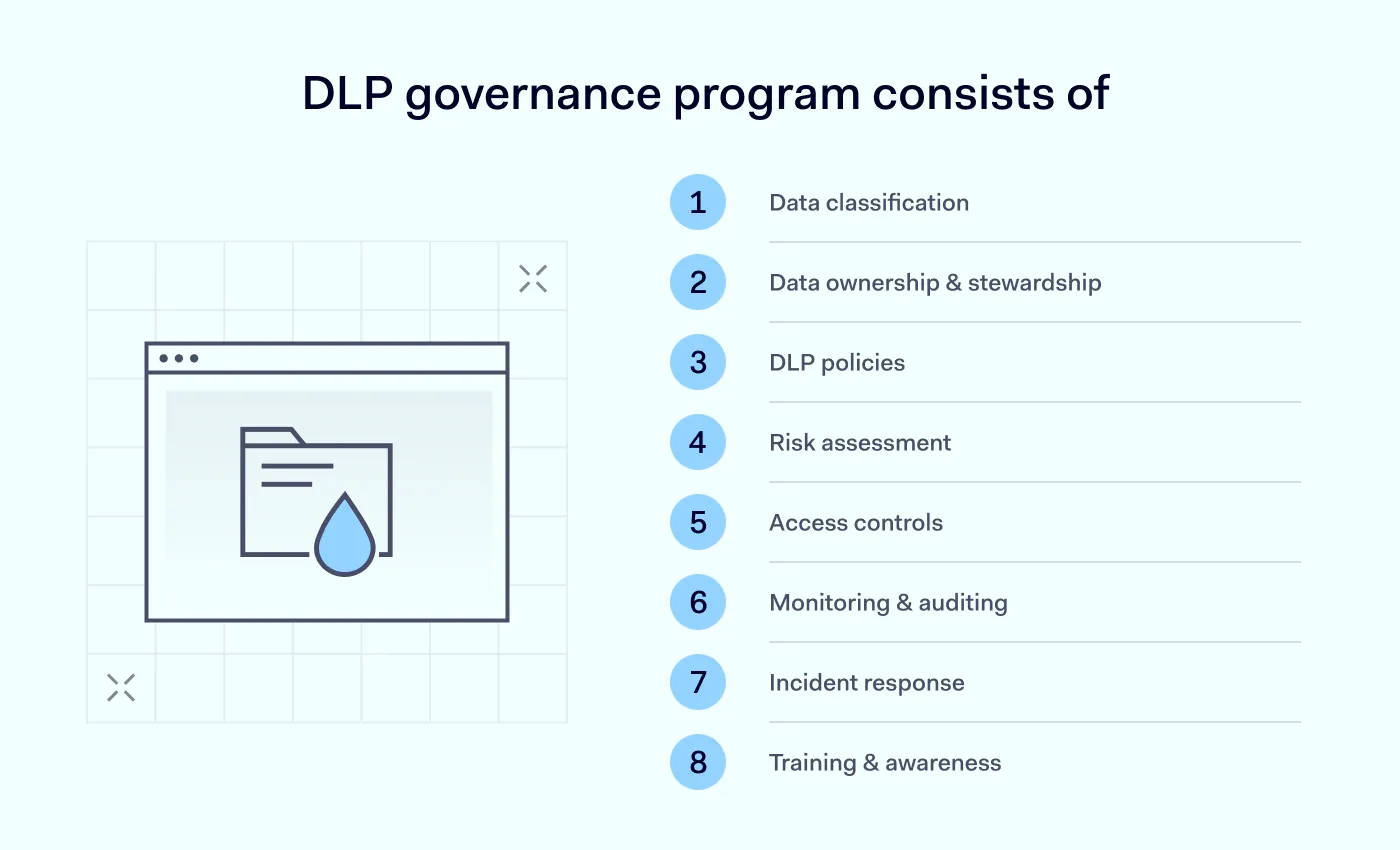
Key components of a DLP governance program
A DLP governance program rests on a handful of building blocks that work together—drop one and the others lose effect. The components below are the standard set; the mix and depth of each depend on your data, regulatory load, and risk tolerance.
Data classification
Organizations must identify and categorize sensitive data based on business value, regulatory requirements, and risk levels. Strong classification supports both data governance and DLP governance. A workable taxonomy usually lands at three or four tiers—public, internal, confidential, restricted—with clear examples for each so business units classify the same data the same way.
Data ownership and stewardship
Named owners drive accountability for data management, access approvals, policy enforcement, and compliance requirements. Ownership should sit with the business function that generates the data—HR for employee records, finance for transaction data, product for customer telemetry—rather than defaulting to IT or security.
DLP policies
Well-defined DLP policies set rules for handling, sharing, storing, and transferring confidential data across systems and users. The strongest policies also specify the response: monitor only, warn the user, require justification, or block outright, with the level of enforcement matched to the sensitivity of the data and the context of the action.
Risk assessment
Regular risk assessments surface vulnerabilities, map potential exposure scenarios, and prioritize remediation before a data breach occurs. Effective assessments go past asset inventories and look at how data actually moves: which SaaS apps employees paste into, which third parties receive exports, and which workflows route sensitive content through unmanaged channels.
Access controls
Least-privilege access reduces unnecessary exposure and strengthens overall data protection. Just-in-time access and scheduled entitlement reviews keep permissions from accumulating silently as people change roles, which is one of the most common paths to over-privileged accounts.
Monitoring and auditing
Continuous monitoring lets teams detect unusual behavior, investigate incidents, and measure whether the DLP governance program is working. Good monitoring captures both content and context: what data was touched, by whom, from which device, through which application, and whether the action matched their normal pattern.
Incident response
Defined response procedures let teams contain and remediate events involving sensitive data quickly. Playbooks should be specific to data type: a leak of customer PII triggers different legal, communications, and regulatory steps than the exposure of internal source code or M&A documents.
Training and awareness
Employees remain one of the most important elements of any DLP governance strategy. Regular education cuts accidental policy violations and strengthens compliance. In-the-moment coaching—a policy prompt the instant a user tries a risky action—drives behavior change faster than any annual course, because the feedback lands while the decision is still live.
With the building blocks in place, the next question is how to assemble them into a working framework.
Knowing the components is one thing; standing up a framework that actually runs in production is another. The six steps below give you a working sequence—start at the top, but expect to loop back as each step exposes gaps in the others.
Identify and classify sensitive data. Start by mapping what kind of data exists across the organization. Classification efforts should align with wider data governance objectives and support effective data management practices.
Establish governance roles and responsibilities. Assign clear ownership for security, compliance, legal, and business stakeholders. DLP governance lives or dies on cross-functional collaboration.
Define DLP policies. Create DLP policies that reflect business requirements, regulatory obligations, and risk tolerance. Policies should address storage, sharing, retention, and acceptable use of data.
Implement technical controls. Deploy a fitting DLP solution to enforce governance requirements. Technical controls should support visibility, policy enforcement, and incident management.
Control and review data access. Review data access permissions on a regular cadence to ensure users only have access to information required for their roles.
Monitor, measure, and improve. Track incidents, policy violations, and performance metrics to keep strengthening DLP governance and the wider data governance program.
A framework built this way works inside the office network. The harder test comes when data moves into cloud and hybrid environments.
DLP governance in cloud and hybrid environments
Perimeter-based security models no longer hold up.
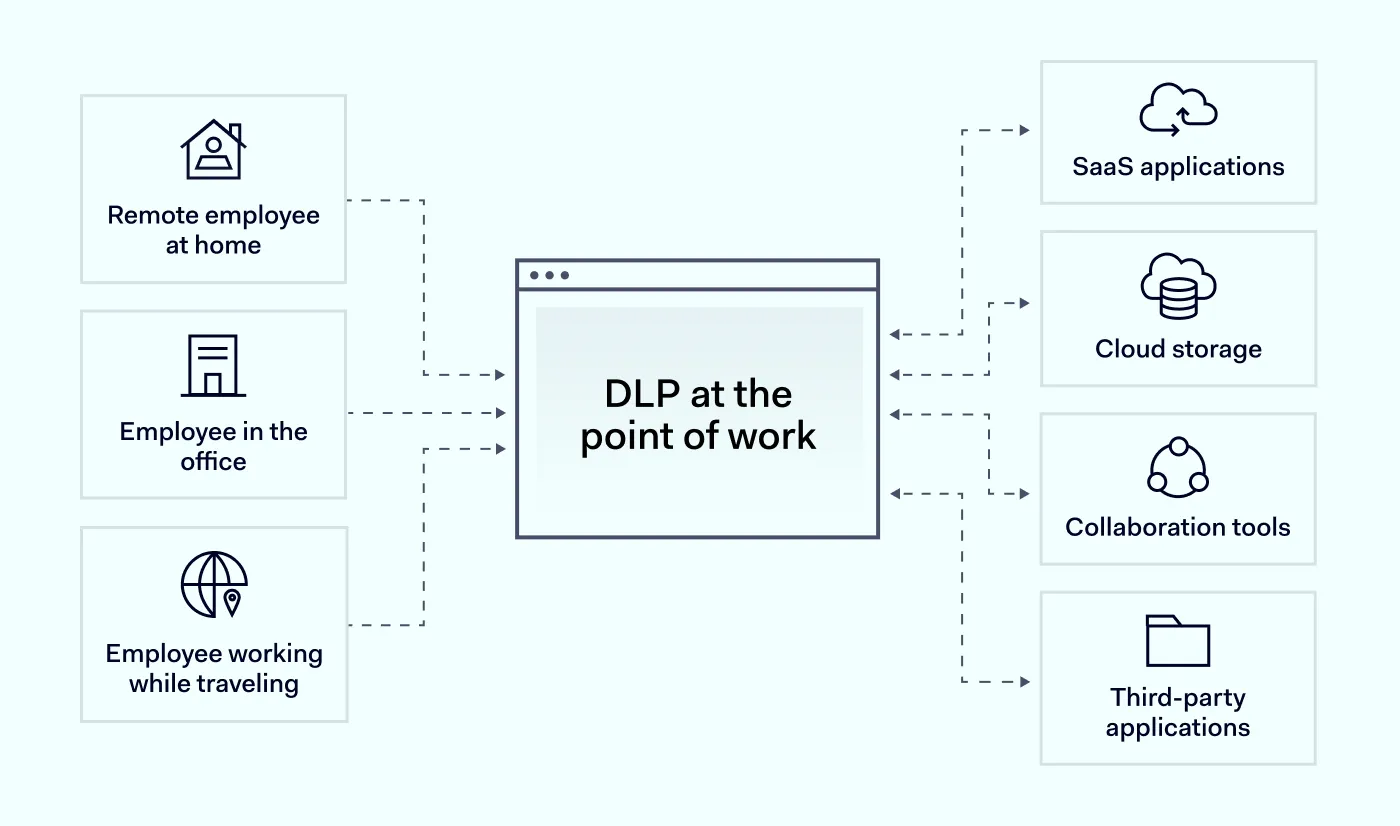
As organizations adopt SaaS applications, cloud storage, and remote work, governance has to extend across distributed environments. Employees routinely access data through browsers, unmanaged networks, and third-party applications.
Today’s data governance strategies need visibility into cloud-based workflows and browser activity. Organizations need consistent data protection no matter where users work or where data sits.
That puts the browser front and center. A browser-focused DLP solution helps organizations monitor user activity, prevent risky actions, and enforce security policies at the point of work.
DLP governance best practices
Frameworks tell you what to build; best practices tell you how to keep it working once it’s live. The principles below come up consistently in mature programs and are worth treating as defaults rather than nice-to-haves.
Align DLP governance with data governance objectives. Security controls should support wider organizational goals for compliance, data quality, and data management.
Classify sensitive data consistently. Standardized classification improves policy enforcement and reduces confusion.
Review policies regularly. Business requirements change, and governance practices need to keep up.
Automate monitoring where possible. Automation improves visibility and helps teams respond faster to potential data breach events.
Train employees continuously. User awareness remains essential for successful data protection.
Measure program effectiveness. Use metrics, audits, and incident reviews to strengthen both DLP governance and data governance initiatives.
Even programs that follow every best practice run into recurring obstacles. Knowing the common ones in advance shortens the time between hitting them and solving them.
Common DLP governance challenges
No program rolls out cleanly. The challenges below show up in most organizations at some point—anticipating them early is the difference between a temporary slowdown and a stalled program.
Lack of data visibility. Organizations often struggle to identify where sensitive data exists and how it moves across systems.
Unclear ownership. Without defined responsibilities, governance efforts become inconsistent fast.
Complex cloud environments. Distributed infrastructure makes monitoring and policy enforcement harder.
Balancing security and productivity. Overly restrictive controls frustrate users and slow business operations.
Policy sprawl. Excessive or poorly maintained rules decrease the program's effectiveness.
Integration challenges. Connecting the DLP solution, cloud platforms, and existing data governance processes is rarely plug-and-play.
Modern threats. New attack methods continuously increase the risk of a data breach, and governance has to adapt to them.
Most of these challenges trace back to the same root cause: a gap between where governance policies live and where users actually work with data. That gap is widest at the browser.
Close the tabs on browser threats. Open one for security
Your first line of defense starts at the Enterprise Browser
Strengthening DLP governance with browser-based controls
Effective governance needs visibility into the place where users interact with sensitive data most: the browser.
As organizations expand cloud adoption and support hybrid workforces, browser-based security controls enforce governance requirements at the point of activity. The result: stronger data protection, fewer paths to a leak, and support for wider data governance efforts.
NordLayer Browser, the enterprise browser built for hybrid teams, gives organizations visibility into risky behavior, protects sensitive data, and complements existing data governance and data loss prevention investments. Combined with a mature DLP governance framework, browser-level controls add a meaningful layer of protection for modern work.
DLP governance succeeds when policies, accountability, ongoing monitoring, and the right tooling work together. Organizations that bring those four together are better positioned to protect critical information, run effective data management, and maintain trust with the people whose data they hold.
Agnė Srėbaliūtė
Senior Cybersecurity Copywriter
After spending a decade writing across media, PR, and advertising, Agne has been specializing in technology and cybersecurity content, focusing on IP address management, networking, zero trust, and internet infrastructure. She helps businesses understand complex technologies through clear, engaging, and sometimes creative content.