What is IT compliance?

If you are reading this, there is a good chance you have recently experienced the unique heart-pounding sensation that comes with opening an email with the subject line: "Audit notification." Or perhaps you are scrambling to understand why terms like GDPR and SOC 2 are suddenly dominating your executive meetings. IT compliance is now the shield against these financial and reputational disasters.
IT compliance definition
IT compliance is the strategic practice of ensuring that an organization's technology systems align with legal regulations, industry standards, and internal governance policies. It involves implementing specific technical controls and administrative procedures to guarantee data protection and privacy. With IT compliance, organizations can prevent legal penalties and show meaningful responsibility to their stakeholders.
The practical application of IT compliance is a complex journey. It is a continuous cycle of improvement. When an organization fully embraces it, they are both satisfying a regulator and protecting their most sensitive assets.
Implementing IT compliance protocols helps organizations reduce risks by identifying vulnerabilities before they can be exploited. It forces a company to look in the mirror and ask hard questions about where data lives and who is in charge. If they meet compliance requirements, businesses transform their IT infrastructure from a chaotic mix of tools into a defensible environment.
Why is IT compliance important?
IT compliance serves as the foundation for operational integrity and legal safety. Without a dedicated focus, companies leave themselves open to threats.
Avoiding financial penalties
The most immediate driver for IT compliance is the threat of financial ruin. Regulatory bodies have become incredibly aggressive. Non-compliance with frameworks like GDPR or HIPAA can result in fines that scale with your global revenue. For many small to mid-sized enterprises, a single violation of IT compliance standards could lead to bankruptcy. If you maintain strict compliance, you are better insured against these government levies.
Building customer trust via IT compliance
Trust is the hardest currency to earn and the easiest to lose. Customers today are hyper-aware of data privacy. They know the risks of handing over their credit card numbers or health information.
When you demonstrate a commitment to data compliance, you are sending a signal to the market that you are a safe harbor. Achieving certification in recognized compliance frameworks proves that you value your customers' safety as much as your own profits.
Enhancing operational efficiency
Surprisingly, IT compliance is a major driver of business efficiency. The process of achieving it requires you to document every workflow and data process. This often reveals redundancies and outdated practices.
IT compliance often forces you to clean house, deleting old data that costs money to store and improving user access. The result is a leaner, faster, and more organized IT environment that supports business growth.
IT compliance vs IT security
While they often share the same budget and staff, IT compliance and IT security are distinct disciplines with different goals. IT compliance confirms that you meet the requirements of a third party (like a government or trade body), ensuring you can prove your governance. IT security is the application of technology to protect digital assets from threats.
The distinct role of IT compliance
IT compliance focuses on the "what" and the "why." It answers the question: "What rules must we follow to legally operate in this sector?" The role of IT compliance is to map technical controls to legal obligations. It ensures that if a regulator walks through the door, the organization has the paperwork to prove they are behaving responsibly.
The technical focus of IT security
Conversely, IT security focuses on the "how." If IT compliance dictates that user data must be protected, IT security decides whether to use AES-256 encryption or tokenization. IT security teams are the ones battling cybercriminals, managing firewalls, and patching vulnerabilities. However, unlimited security doesn't guarantee IT compliance if the measures aren't documented or aligned with specific regulations.
Integrating IT compliance with security
The best organizations merge these two functions. IT compliance provides the roadmap, and IT security builds the car. When IT compliance and security work together, the organization benefits from a "compliant-by-design" architecture. This ensures that compliance regulations are met naturally through daily security operations, rather than being a panicked scramble right before an audit.
Benefits of IT compliance
Many executives look at compliance as a burden-a tax on innovation. However, a mature program offers significant competitive advantages that go well beyond simple compliance risk avoidance.
Improved reputation
Trust is a differentiator. Companies that openly display their adherence to IT compliance standards (like ISO 27001) win more business. Enterprise clients often require their vendors to meet specific compliance requirements before signing a contract. That's why sturdy IT compliance is often the key to high-value B2B relationships.
Lowering legal risks with IT compliance
Having a documented compliance history serves as a legal protection. In the unfortunate event of a data breach, proving that you practiced "due diligence" through IT compliance can significantly reduce liability and settlements in class-action lawsuits. It changes the narrative from "negligence" to "victim of a sophisticated attack despite best efforts."
Data management efficiency
IT compliance requires you to know exactly what data you have. This eliminates the "digital hoarding" that plagues many companies. By classifying data to meet compliance regulations, you can delete useless "ROT" (Redundant, Obsolete, Trivial) data. This reduces storage costs and makes your systems run faster.
Global market access
If you want to scale globally, IT compliance is your passport. You cannot sell digital services in Europe without GDPR. You cannot process payments globally without PCI DSS. IT compliance removes the regulatory barriers to entry for new markets, allowing your business to expand its footprint without fear of foreign litigation.
Common IT compliance standards
You need to understand the various compliance frameworks that apply to your specific industry. Adhering to the correct IT compliance standards is the core of the practice.
General Data Protection Regulation (GDPR)
GDPR remains the heavyweight champion of data privacy. Originating in the EU, it affects any organization processing the data of European residents. IT compliance under GDPR requires strict consent for data collection, the ability to delete user data upon request, and the reporting of data breaches within 72 hours. It is often considered the baseline for global IT compliance.
Service Organization Control 2 (SOC 2)
For SaaS companies, SOC 2 is the gold standard. This compliance framework is an audit procedure that ensures service providers securely manage data to protect the interests of their clients. It focuses on five trust principles: security, availability, processing integrity, confidentiality, and privacy. Passing a SOC 2 audit is often a requirement for closing deals with large enterprise customers.
Health Insurance Portability and Accountability Act (HIPAA)
HIPAA is the defining compliance standard for the US healthcare sector. It dictates how Protected Health Information (PHI) must be handled. IT compliance here involves strict access control, physical security of servers, and encryption of patient data in transit and at rest. Violating HIPAA compliance requirements carries some of the heaviest fines in the industry.
Payment Card Industry Data Security Standard (PCI DSS)
Any business that touches a credit card number must adhere to PCI DSS. This set of standards is designed to reduce credit card fraud. It requires specific network configurations, regular vulnerability scanning, and strict prohibitions on storing CVV codes. Failing PCI DSS audits can lead to a revocation of your ability to process payments, effectively closing your business.
ISO/IEC 27001 IT compliance standards
ISO 27001 is the international behemoth of IT compliance. It provides a framework for an Information Security Management System (ISMS). ISO 27001 provides a broad framework that covers people, processes, and IT systems across an organization. Achieving IT compliance through ISO 27001 is a rigorous process that signals to the world that your organization participates in the highest level of security management.
How to implement IT compliance standards in your organization?
Implementing IT compliance requires a shift in culture and a methodical approach to technology.
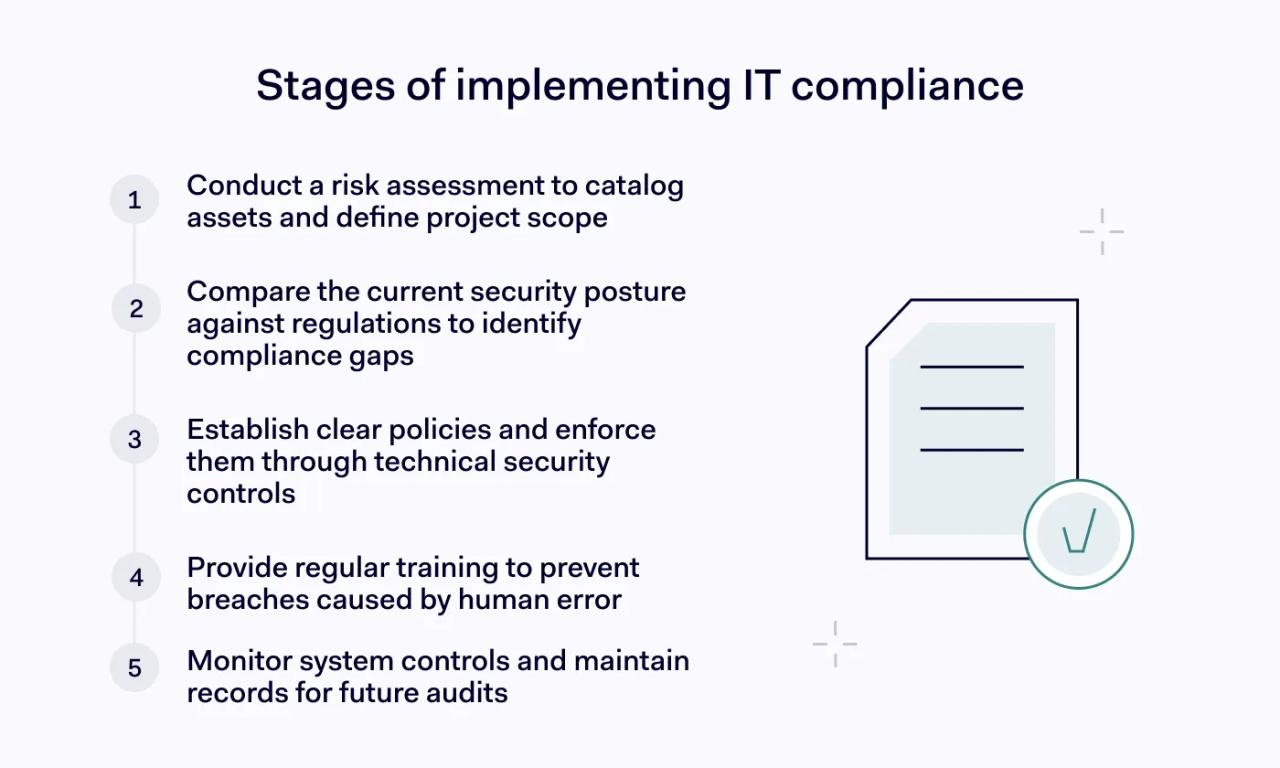
Step 1: Conducting an IT compliance risk assessment
The first step in IT compliance is a comprehensive risk assessment. You must catalog every asset-laptops, servers, cloud instances-and the data they hold. Identify the compliance risk associated with each. What happens if this server goes down? Who has access to this database? This phase defines the scope of your IT compliance project.
Step 2: Performing a gap analysis
Once you understand your environment and know which IT compliance standards you must meet, you need to find the gaps. Compare your current security posture against the regulatory requirements. If PCI DSS requires two-factor authentication and you don't have it, that is a compliance gap. Documenting these gaps creates your roadmap.
Step 3: Establishing IT compliance policies and controls
Documentation is the lifeblood of IT compliance. You need to write clear, enforceable policies (like Acceptable Use or Data Classification policies). But policies are useless without controls. You must implement the technical measures (like strict access control via Identity Management systems) to enforce these rules. Compliance is about proving that your digital reality matches your written policy.
Step 4: Employee training on IT compliance requirements
You can have the best firewalls in the world, but if "Dave from accounting" gives his password to a phishing scammer, you are not compliant. Human error is the leading cause of data breaches. Regular, engaging training is essential. Employees must understand their role in IT compliance and the specific data security risks they face. Building a "human firewall" is just as critical as hardware.
Step 5: Monitoring and compliance audit
IT compliance is not a "set it and forget it" task. You must implement monitoring tools to ensure controls remain effective. Also, you must prepare for the inevitable compliance audit. Whether internal or external, audits are the final test of your IT compliance strategy. Maintain organized logs and evidence so that when the auditor asks for proof of data protection, you can provide it instantly.
Conclusion
IT compliance is often viewed through a lens of anxiety. But in reality, it is the backbone of digital trust. It is the assurance you give to your customers that their "digital lives" are safe in your hands.
If you adhere to compliance standards, you avoid fines and build a resilient organization capable of weathering the storms. Don't wait for a data breach to force your hand. Start your compliance risk assessment, secure your access control, and turn IT compliance from a burden into your biggest business asset. After all, it is much cheaper to follow the rules than to pay the price for breaking them.