Summary: This article explains what dark AI is, how attackers use it, real-world examples, and the security measures organizations need to stay protected.
Artificial intelligence has become a powerful tool for productivity, automation, and business innovation. But as organizations adopt AI, so do cybercriminals. This shift has led to the emergence of dark AI—a threat where artificial intelligence is used maliciously to launch faster, smarter, and more sophisticated attacks.
In this article, we’ll break down what dark AI is, how it works, and why it’s becoming one of the biggest challenges security teams face today.
What is dark AI?
Dark AI is the use of artificial intelligence, machine learning, or automated models by malicious actors to improve and scale cyber-attacks. It includes tools and techniques that generate malicious code, automate social engineering, bypass security controls, or accelerate attacks such as phishing, identity theft, business email compromise, and data breaches.
Unlike traditional hacking—where skills, time, and manual effort limit attackers—dark AI automates much of their work. This allows threat actors to launch broader, more targeted, and more adaptive attacks with less expertise.
How is dark AI different from regular AI?
Dark AI and regular AI use many of the same underlying technologies. The difference lies in why they are created and how they are used. Regular AI is built to support legitimate business needs: automating routine tasks, improving decision-making, and increasing productivity. Its development typically relies on clean, verified datasets and follows strict safety guidelines to ensure predictable, trustworthy behavior.
Dark AI, on the other hand, is developed for harmful or illegal purposes. Instead of improving operations, it enables threat actors to scale social engineering campaigns, automate hacking attempts, or manipulate individuals and systems at speed. These models are often trained on stolen, poisoned, or deliberately manipulated data, and they are engineered to bypass the ethical and security safeguards that protect regular AI systems.
Regular AI
Dark AI
Used ethically to solve business problems
Used maliciously to commit cybercrime
Supports automation, insights, and productivity
Enables large-scale attacks and manipulation
Trained on clean, verified data
Often trained on poisoned, stolen, or manipulated datasets
Designed with safety constraints
Built to remove safety controls
While the technology is similar, dark AI exists outside ethical, legal, and security boundaries, making its impact far more dangerous.
How does dark AI work?
Dark AI tools imitate the same workflow as legitimate AI systems but with a malicious objective. Threat actors typically rely on several components:
Data collection (often stolen or scraped illegally). Dark AI models require large datasets. Attackers gather sensitive data from breaches, social networks, public sources, and underground markets.
Model training (sometimes on compromised infrastructure). Attackers can fine-tune or retrain AI models on malicious objectives, such as generating phishing emails or scanning for vulnerabilities.
Automation and execution. Once trained, dark AI can automate everything from writing malicious code to interacting with victims.
Adaptation and evasion. Advanced dark AI systems can dynamically change their behavior, helping them bypass security controls or adapt to defenders’ countermeasures.
Continuous improvement through feedback loops. Threat actors feed successful attack patterns back into their models, making each attack more effective than the last.
This is what makes AI-driven threats so dangerous: they are fast, scalable, and difficult to predict using traditional defenses.
Dark AI already plays the main role in cybercrime. Examples include:
AI-generated phishing and social engineering
AI can write convincing emails, mimic writing styles, or craft personalized messages based on scraped data. This fuels business email compromise (BEC), spear-phishing, and identity theft campaigns. Security researchers have tracked blackhat LLMs like WormGPT and FraudGPT being sold on underground forums, allowing less-skilled attackers to generate phishing emails, BEC scripts, and ransomware notes.
Automated malware and malicious code creation
Some dark AI tools can generate polymorphic malware—code that changes its structure each time it runs—making traditional detection far more difficult. According to Europol’s Innovation Lab, recent research demonstrates that LLMs can be misused to produce working encryption malware and data theft tools.
Voice and video deepfake attacks
Attackers can clone voices or faces to impersonate executives, approve transactions, or trick employees during urgent requests. In 2024, a Hong Kong finance employee was conned into transferring around $25 million after joining a video call where the CFO and colleagues were convincingly deepfaked.
AI-powered credential stuffing and brute-force attacks
AI analyzes leaked password databases, predicts patterns, and automates login attempts at a massive scale. Security researchers have shown how “computer-using” AI agents can automate credential stuffing end-to-end: filling forms, solving CAPTCHA, and rotating proxies with minimal human input. In parallel, industry reports note that credential theft has surged, with AI-assisted phishing and malware-as-a-service driving a sharp rise in breaches linked to stolen logins.
Data poisoning
Threat actors manipulate or inject malicious inputs into machine learning datasets, causing AI systems to fail, misclassify, or expose proprietary information. IBM and OWASP both highlight data and model poisoning as a key AI risk, where attackers subtly corrupt training data to introduce backdoors or biased behavior that they can later exploit.
Automated reconnaissance
Dark AI can scan internet-facing systems, identify weaknesses, and prioritize high-value targets faster than a human attacker. Public proofs-of-concept already show “agentic” AI chains that automatically discover subdomains, run vulnerability scans, and summarize findings. It demonstrates how the same techniques can be repurposed for offensive recon.
AI-driven botnets and DDoS attacks
AI improves botnet efficiency by choosing targets, attack vectors, and timing to maximize disruption. Recent analysis of AI-assisted DDoS attacks has described autonomous botnets that adapt in real-time to defenses and shape their traffic to mimic that of legitimate users, making mitigation far harder.
Social media manipulation
Automated AI tools generate fake personas, spread misinformation, or impersonate employees to infiltrate networks. Studies of recent elections in Europe and the US have found that generative AI is used to rewrite news stories, mass-produce tailored posts, and amplify disinformation via bot networks and fake news sites.
These examples show how dark AI is expanding the cybercrime toolkit. Attacks that once required expert skills can now be launched with minimal experience—thanks to automated, AI-powered tools.
How to protect against dark AI
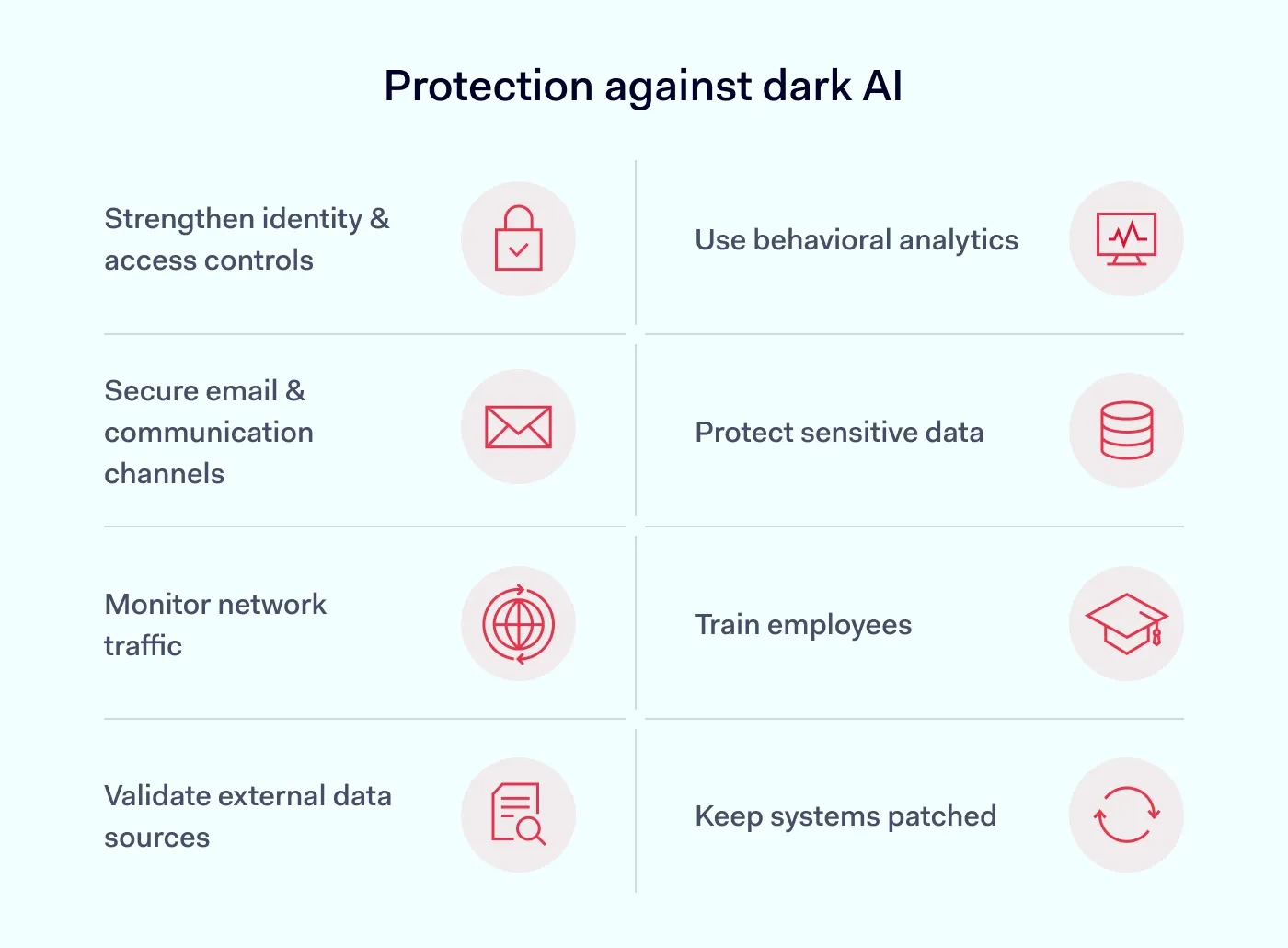
Defending against AI-based threats requires modern, layered security. Here are the most effective strategies:
1. Strengthen identity and access controls
Multi-factor authentication (MFA), strong password policies, and continuous verification make it harder for AI-driven attacks to exploit credentials. These controls limit how far automated threats can spread within a compromised environment.
2. Implement behavioral analytics
AI-powered security tools can detect unusual behavior, such as sudden access requests, unusual login locations, or abnormal file transfers. By learning what “normal” looks like, these systems can flag deviations before damage is done.
3. Harden email and communication channels
Use tools that detect AI-generated phishing, spoofing attempts, and deepfake content. Strengthening these channels reduces the likelihood that manipulated messages reach employees in the first place.
4. Protect sensitive data
Encrypt data in transit and at rest, minimize access privileges, and monitor for unauthorized exfiltration attempts. Effective data governance ensures that even if attackers break through, they struggle to obtain anything valuable.
5. Monitor network traffic and anomalies
AI threats often leave traces—such as unexpected API calls or automated scanning behavior—that network monitoring can reveal. Early detection provides precious time to isolate affected systems.
6. Train employees to recognize AI-driven social engineering
Deepfakes and hyper-personalized phishing can deceive even experienced staff. Regular training builds intuition and confidence, reducing the likelihood of human error.
7. Validate external data used for AI training
This reduces the risk of data poisoning or model manipulation. Secure data pipelines help ensure that your AI systems aren’t unknowingly learning from corrupted or hostile inputs.
8. Keep systems patched and updated
Dark AI tools often exploit known vulnerabilities. Reducing your attack surface slows them down. Consistent patching shuts down easy entry points and forces attackers to work harder for access.
While no single tool stops dark AI attacks completely, combining these measures significantly strengthens defense.
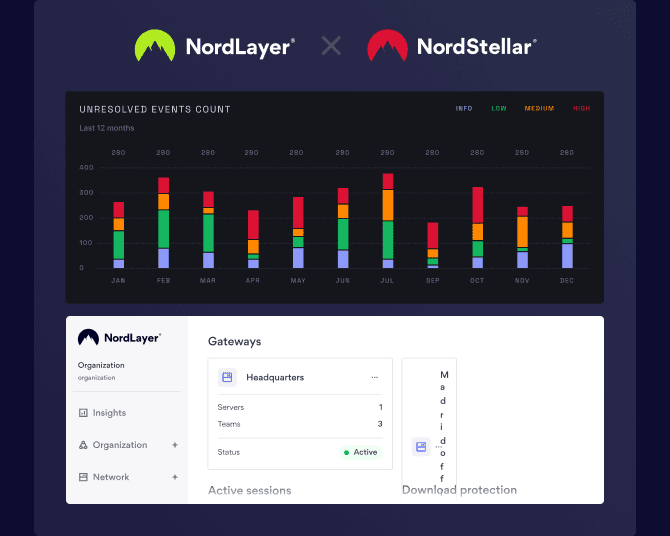
Double your security: Protect inside out with NordLayer & NordStellar
Nord Security brings together a B2B suite that includes NordLayer, NordPass, and NordStellar. The three products combine secure connectivity, identity protection, and threat intelligence so AI-driven attacks have fewer ways to get in, spread, or go unnoticed.
NordLayerfocuses on network security and access control. We provide cybersecurity solutions for secure connectivity, including Zero Trust Network Access (ZTNA) and a Business VPN with features such as Dedicated IP, Site-to-Site VPN, Device Posture Security, and Always On VPN. These help encrypt traffic, limit what users and devices can reach, and make suspicious access patterns easier to spot.
Paired with DNS Filtering to block malicious domains at the DNS layer, NordLayer makes it harder for dark AI-driven attacks to deliver payloads or trick users into visiting harmful sites.
NordPassprotects identities and credentials. As a business credential manager, it stores company logins and other sensitive items in an encrypted vault, and detects weak, old, reused, or exposed credentials. NordPass gives admins controls such as Password Health, Password Policy, and Data Breach Scanner to improve overall password hygiene.
By supporting MFA and providing credential autofill only on exact domain matches, NordPass reduces the effectiveness of AI-powered phishing, credential stuffing, and automated password-guessing attacks.
NordStellar provides external threat intelligence. The threat exposure management platform monitors for leaked data across the deep and dark web—including hidden forms, marketplaces, Telegram channels, and ransomware blogs—while tracking brand impersonation, phishing sites, and malicious domains on the clear web.
Such visibility helps teams detect the threats amplified by dark AI (such as cloned websites, cybersquatting, or data leak exploitation) and respond before minor incidents turn into major breaches.
Together, NordLayer, NordPass, and NordStellar provide organizations with a coordinated way to protect users, networks, and data from dark AI threats across access, identity, and visibility.
Frequently asked questions
What are the dark AI and forbidden AI differences?
Forbidden AI refers to restricted or disallowed use cases defined by providers (e.g., generating malware). Dark AI is the deliberate use of AI for malicious activity by threat actors.
How do attacks using dark AI differ from classic hacking?
Traditional hacking requires manual skills and time. Dark AI attacks are automated, scalable, adaptive, and often harder to detect.
Can dark AI run attacks without human hackers?
Yes. Some tools can autonomously scan networks, generate phishing content, or modify malicious code. However, most attacks still require human direction.
Should small businesses and individuals worry about dark AI?
Absolutely. Dark AI lowers the barrier for cybercrime, meaning even small organizations and individuals are viable targets for phishing, identity theft, and email account compromise.
Agnė Srėbaliūtė
Senior Creative Copywriter
Agne is a writer with over 15 years of experience in PR, SEO, and creative writing. With a love for playing with words and meanings, she crafts content that’s clear and distinctive. Agne balances her passion for language and tech with hiking adventures in nature—a space that recharges her.