NordLayer Cloud Firewall solutions
Control remote access to your organization’s internal resources and cloud tools by specifying who can connect and via which gateways.
- Ensure only authorized users can access your SaaS services and private networks
- Allow remote workers to access your on-premises infrastructure securely
- Deploy quickly without additional hardware

14-day money-back guarantee
OVERVIEW
What is Cloud Firewall
Cloud firewall is another name for Firewall-as-a-Service (FWaaS). Similar to a traditional firewall, a cloud firewall is designed to prevent or lessen unauthorized access to private networks by removing potentially harmful network traffic. Similar to how traditional firewalls create a barrier around an organization's internal network, cloud-based firewalls create one around cloud platforms, infrastructure, and applications (cloud firewalls can enable organizations to securely access on-premise infrastructure while working remotely).
INSIDE LOOK
How NordLayer’s Cloud Firewall works
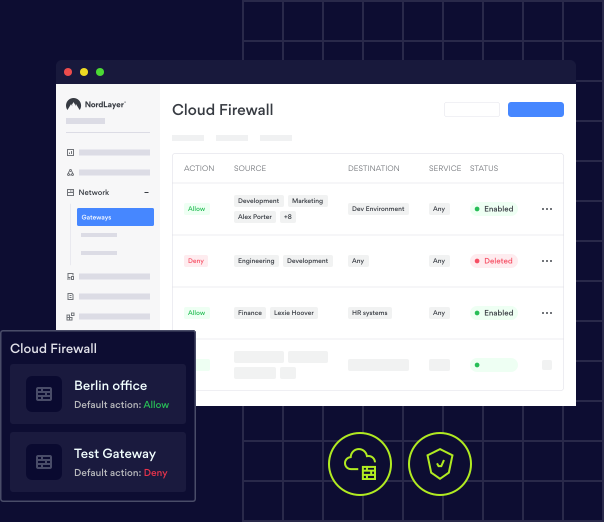
NordLayer’s Cloud Firewall allows organizations to set up custom security rules for their Virtual Private Gateways, helping them protect their hybrid infrastructures and network resources from both internal and external threats. With micro-segmentation and granular network controls, IT administrators can define access rules for entire teams or individual members, reducing the risk of unauthorized access and boosting overall network security.

Get a real-time look at how NordLayer protects businesses
Explore features like Custom DNS, a dedicated IP, VPN Split Tunneling, and more, all in real-time with our interactive Control Panel demo.

NordLayer + CrowdStrike: secure your network and endpoints all at once
With threats coming from all sides, your business can’t afford to leave anything unprotected. NordLayer and CrowdStrike secure both your company network and employee devices, so your teams stay safe and productive.
Monitor and control who can access your company network.
Stop threats like malware and phishing with AI-powered protection.
Keep your business compliant with the latest data security standards.


VALUE
The benefits of NordLayer’s Cloud Firewall

Scalability, Availability, Extensibility
Because a cloud firewall does not contain any hardware, it can easily adapt to the changing needs of the business it’s protecting and scale together.

Simplified operations
A cloud-based firewall service can easily integrate into existing hybrid cloud environments and makes it very simple to create and apply firewall rules. There are only a handful of rules applied to the gateway rather than having to manage the entire company network.

Automatic Updates
Because FWaaS extends the full range of firewall capabilities to the cloud, there is no hardware to look after. Management is centralized over one cloud-based Control Panel.
REAL-LIFE EXAMPLES
Common use cases for cloud-based firewalls
As more businesses migrate their data and applications to the cloud, it makes sense to move firewalls there as well. Cloud-based firewalls are the solution best suited to adapt to this evolving environment and provide optimal security.
Using Cloud Firewall rules, organization owners can define who has access to internal cloud resources. With Firewall as a Service (FWaaS), businesses can allow remote workers to access only what is necessary while blocking everything else.
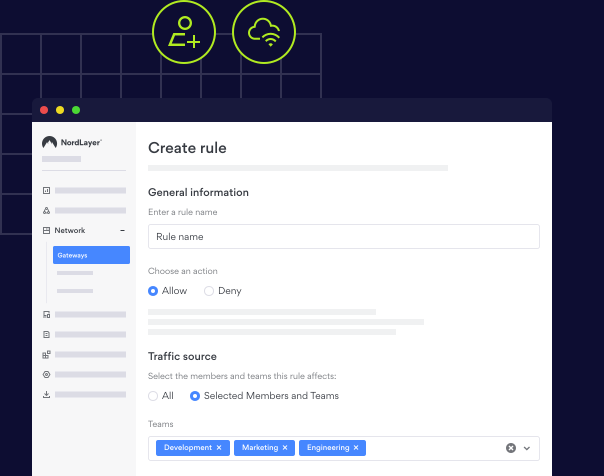
NordLayer allows for granular control. Organization owners can create firewall rules at the Virtual Private Gateway level to grant or deny access to specific internal or external internet resources. These rules can apply to individual members or entire teams and can be configured based on the traffic source (the user), the destination (the resource the user wants to access), and the service (the port or protocol being used).
DNS Filtering by category blocks malicious websites and filters out sites containing harmful or inappropriate content. Managers can choose which types of content should be inaccessible to employees on company-managed networks, and the DNS filters handle the rest. This strengthens the security of company data and protects team members from malicious activity and phishing websites.
By monitoring and controlling traffic across networks, cloud-based firewalls can help prevent unauthorized access, detect suspicious activity, and stop potential data breaches before they can impact your business.
Get our Premium plan to enhance your network security with Cloud Firewall

COMPARED
Cloud Firewalls (FWaaS) vs Traditional Firewalls
Back in 2020, Gartner® projected that by 2025, 30% of new distributed branch office firewall deployments would switch to FWaaS, up from less than 5% in 2020. Based on this, we can expect FWaaS to become more popular than traditional network firewalls in the future. The schemes below will provide a better understanding of the differences between these two solutions.

Cloud Firewalls (FWaaS)
- Very easy to set up, as there are no physical components
- Effortless scalability
- Vendor handles all maintenance
- Dynamic, risk-based security policies follow your users everywhere without a complicated matrix of policy and network configurations

Traditional Firewalls
- May require technical expertise to set up
- Requires additional hardware and deployment in order to scale
- IT department responsible for maintenance
- Inconsistent firewall policies that do not follow users
ENABLING
How to enable Cloud Firewall with NordLayer?
Register
Choose Premium plan with a Server with a dedicated IP
Create gateways
Navigate to Firewall settings and manage firewall rules
New Feature
NordLayer’s Cloud Firewall is a part of unified cloud Security Service Edge
Secure Service Edge (SSE) is a framework that contains multiple features to secure and protect a business network. Network security solutions like FWaaS, CASB, SWG, and ZTNA are combined into a single, cloud-native service via the SSE framework. Secure business data, resources, and all users in your network by adopting the SSE framework.
Be the first to experience the added security of our Firewall as a Service feature
Try our cutting-edge Firewall, risk-free.

14-day money-back guarantee
OTHER RESOURCES
Cloud Firewall resources


ADDITIONAL INFO
Frequently asked questions
No. Firewall-as-a-Service (FWaaS) and cloud firewall describe the same service and can be used interchangeably.
Multiple cloud deployments can be protected at once (as long as NordLayer supports each cloud).
You have almost limitless options when it comes to configuring cloud firewalls and what they protect. You may design a firewall to solely cover one particular virtual server group or even just one server. In addition to virtual servers, the firewall may also be micro-segmented with rules for certain applications or user roles.
Not by default. While the cloud itself does not automatically include a firewall, organizations can protect their cloud resources using a Cloud Firewall (FWaaS).
There are three types of firewalls categorized by delivery method:
- Hardware-based firewalls
- Software-based firewalls
- Cloud-based firewalls (FWaaS)
Cloud firewalls protect both cloud and on-premises resources by monitoring traffic and blocking attacks. They safeguard cloud assets such as SaaS applications, IaaS, and PaaS implementations, as well as on-premises servers and remote work devices.
No, a cloud firewall cannot completely replace a VPN, as they serve different security purposes. They do, however, work excellently together as part of a comprehensive security strategy.